
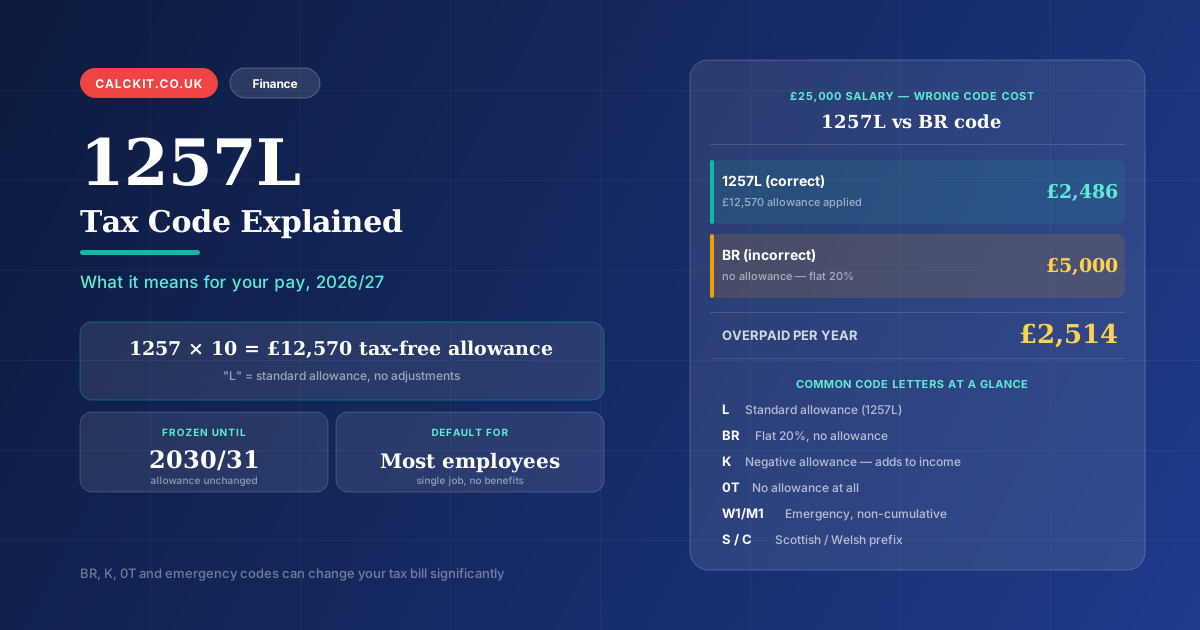
1257L is the tax code on the payslip of most working adults in the UK — but a surprising number of people have never had it explained to them, and fewer still know that a different code (BR, K, 0T, or an emergency W1/M1) can quietly change their take-home pay by hundreds of pounds a year without them noticing.
This guide breaks down exactly what 1257L means, every other common UK tax code letter, why codes change, and how to check whether yours is actually correct.
🏛What does 1257L mean?
Your tax code tells your employer or pension provider how much tax-free income you're entitled to before deductions begin. 1257L breaks down into two parts:
- 1257 — your tax-free Personal Allowance (£12,570) with the final digit removed
- L — confirms you receive the standard Personal Allowance, with no special adjustments
1257L is the default tax code for most UK employees and pensioners with a single job, no taxable benefits, and no other income. The Personal Allowance has been frozen at £12,570 since 2022/23 and will remain there until at least 2030/31 — so 1257L has been, and will continue to be, the standard code for several years running.
Tax-free allowance = Tax code number × 10 1257 × 10 = £12,570
How 1257L affects your actual tax bill
Your tax code is applied automatically through PAYE — your employer's payroll software uses it to work out how much of your pay is tax-free before calculating tax on the rest.
Worked example — £30,000 salary on 1257L:
| Step | Calculation | Amount |
|---|---|---|
| Tax-free allowance | £12,570 | |
| Taxable income | £30,000 − £12,570 | £17,430 |
| Income tax at 20% | £17,430 × 20% | £3,486 |
This is split evenly across the year under a cumulative tax code (the normal basis) — so roughly £290.50 is deducted each month, building up your allowance gradually rather than all at once.
🏛Every common UK tax code letter explained
| Code | Meaning | Effect |
|---|---|---|
| L | Standard Personal Allowance | Standard £12,570 tax-free, as in 1257L |
| M | Marriage Allowance — received | You've received 10% of your partner's Personal Allowance |
| N | Marriage Allowance — transferred | You've transferred 10% of your allowance to your partner |
| T | Other calculations needed | HMRC needs to review specific items in your tax affairs |
| 0T | No allowance applied | All income taxed with no tax-free amount — often used when allowance is fully used elsewhere or details are missing |
| BR | Basic Rate | All income taxed at 20% with no allowance — common for a second job or pension |
| D0 | Higher Rate | All income taxed at 40% with no allowance — used for additional income already in the higher band |
| D1 | Additional Rate | All income taxed at 45% with no allowance — used for additional income already in the top band |
| K | Negative allowance | Deductions exceed your allowance; an amount is added to taxable income rather than subtracted |
| NT | No Tax | No tax is deducted at all — rare, used in specific HMRC-approved circumstances |
| S prefix | Scottish taxpayer | Scottish income tax rates and bands apply (e.g. S1257L) |
| C prefix | Welsh taxpayer | Welsh rates apply, currently aligned with rUK rates (e.g. C1257L) |
Emergency code suffixes
| Suffix | Meaning |
|---|---|
| W1 | Weekly emergency basis — allowance applied per week, not cumulatively |
| M1 | Monthly emergency basis — allowance applied per month, not cumulatively |
| X | Emergency code with an unspecified period basis |
What does a BR code actually cost you?
If BR is applied to a source of income that should genuinely have no allowance (like a second job, where your main job already uses your full £12,570), it's correct — no issue. But if BR is applied to your only job in error, you lose your entire tax-free allowance.
Worked example — £25,000 salary incorrectly on BR instead of 1257L:
| Code | Calculation | Tax owed |
|---|---|---|
| 1257L (correct) | (£25,000 − £12,570) × 20% | £2,486 |
| BR (incorrect) | £25,000 × 20% | £5,000 |
Difference: £2,514 overpaid for the year — over £200 a month. This is exactly the kind of error worth catching early; HMRC will eventually correct it and refund the overpayment, but there's no reason to wait months for your own money.
What does a K code actually cost you?
A K code means your deductions (large benefits-in-kind, or previously underpaid tax being recovered) exceed your Personal Allowance — so instead of subtracting an allowance, the system adds an amount to your taxable income before calculating tax.
Worked example — £35,000 salary, K100 code (adding £1,000 to taxable income):
| Code | Taxable income | Tax owed |
|---|---|---|
| 1257L (standard) | £35,000 − £12,570 = £22,430 | £4,486 |
| K100 | £35,000 + £1,000 = £36,000 | £7,200 |
K codes can significantly increase your tax bill — they're capped so no more than 50% of your gross pay in any period can be taken as tax, to prevent an unaffordable single deduction, but the total owed over the year is still higher than a standard code at the same salary.
Why your tax code might not be 1257L
| Situation | Likely code |
|---|---|
| Single job, no benefits, no other income | 1257L |
| Company car or medical insurance benefit | Reduced L code (e.g. 1157L, if benefit value is £1,000) |
| Second job or pension | BR, D0, or D1 (depending on income level) |
| New job, P45 not yet processed | Emergency code (1257L W1/M1/X) |
| Receiving Marriage Allowance | M suffix code |
| Transferred Marriage Allowance to partner | N suffix code |
| Large underpayment being recovered | K code |
| Scottish taxpayer | S-prefixed code |
| Income above £125,140 | 0T (Personal Allowance fully tapered away) |
Cumulative vs emergency (non-cumulative) tax codes
Under a cumulative code (the standard basis for 1257L), your allowance is spread evenly across the tax year and calculated based on your year-to-date earnings — so if you earned less in an earlier period, you get a bit of "catch-up" allowance later.
Under an emergency (non-cumulative) code — 1257L W1, M1, or X — each pay period is calculated in isolation, with that period's slice of the allowance only, ignoring what happened earlier in the year. This typically happens when you start a new job and your employer doesn't yet have your full tax history (commonly a missing P45 from a previous employer).
Why this matters: an emergency code can mean you're taxed more than you actually owe in the short term, because the system can't "smooth" your allowance across the year the way a cumulative code does. This usually self-corrects automatically — either HMRC issues a corrected cumulative code once they have your full details, or you receive an automatic refund through payroll once the correction is applied.
Multiple jobs and tax codes
If you have more than one job, your Personal Allowance is normally allocated entirely to what HMRC considers your main job (usually whichever pays more, or whichever you tell HMRC is your main job). Your other job(s) typically receive a BR, D0, or D1 code — taxed at a flat rate with no allowance, since the allowance is already "spent" on your main job.
This is correct in most cases, but can occasionally lead to over- or under-payment if your income split between jobs changes significantly during the year. For the full picture on how National Insurance (a separate system from tax codes) handles multiple jobs, see National Insurance Rates UK 2026/27.
📈How to check if your tax code is correct
- Find your current code — on your latest payslip, P60, or P45, or by logging into your HMRC Personal Tax Account at gov.uk/personal-tax-account
- Compare it to your circumstances — using the table above, does your situation match what your code implies?
- Check the tax code notice — HMRC sends a "Tax Code Notice" (form P2) whenever your code changes, explaining the specific reason
- If something doesn't match — contact HMRC directly (0300 200 3300) or via your Personal Tax Account to query and correct it
Common signs your code might be wrong:
- You started a new job and have been on an emergency code for more than 1–2 pay periods
- You no longer have a company car or benefit that was previously reducing your code, but your code hasn't been updated
- You've taken on a second job and your main job's code has unexpectedly changed
- Your code shows BR but it's your only source of income
Frequently Asked Questions
Can I change my own tax code?
Not directly — HMRC sets your tax code based on information from your employer, pension providers, and your own reported circumstances. You can request a review or correction through your Personal Tax Account or by contacting HMRC, but you cannot self-assign a code the way you might adjust other payroll settings.
Will I get a refund if my tax code was wrong?
Usually yes, automatically. Once HMRC corrects your code, any overpaid tax for the current tax year is typically refunded through your next payslip via PAYE. For overpayments from previous tax years, you may need to claim a refund directly from HMRC, which can take longer to process.
Does 1257L apply in Scotland and Wales?
The Personal Allowance amount (£12,570) is the same across the whole UK, but Scotland and Wales can set different income tax rates and bands above that allowance. Scottish taxpayers get an "S" prefix (S1257L) and Welsh taxpayers get a "C" prefix (C1257L) so employers apply the correct regional rates once income exceeds the shared Personal Allowance.
Why does my tax code show a different number from £12,570?
Any number other than 1257 means your allowance has been adjusted from the standard amount — usually reduced because of a taxable benefit (company car, private medical insurance) or increased slightly through a relief like the Marriage Allowance or claimed expenses. The number is always the adjusted allowance divided by 10.
The bottom line
1257L means you're receiving the full £12,570 tax-free Personal Allowance for 2026/27 — the correct, default code for most single-job employees with no taxable benefits. But codes like BR, K, and emergency W1/M1 variants exist for good reasons and can mean a meaningfully different tax bill on the same salary. Checking your code against your actual circumstances takes a few minutes and can catch an overpayment worth hundreds of pounds.
🏛Once you know your tax code is correct, see your exact monthly take-home after tax, NI, pension, and student loan:
💷Last updated June 2026. Tax code rules and the £12,570 Personal Allowance reflect HMRC 2026/27 guidance, frozen until at least 2030/31.