
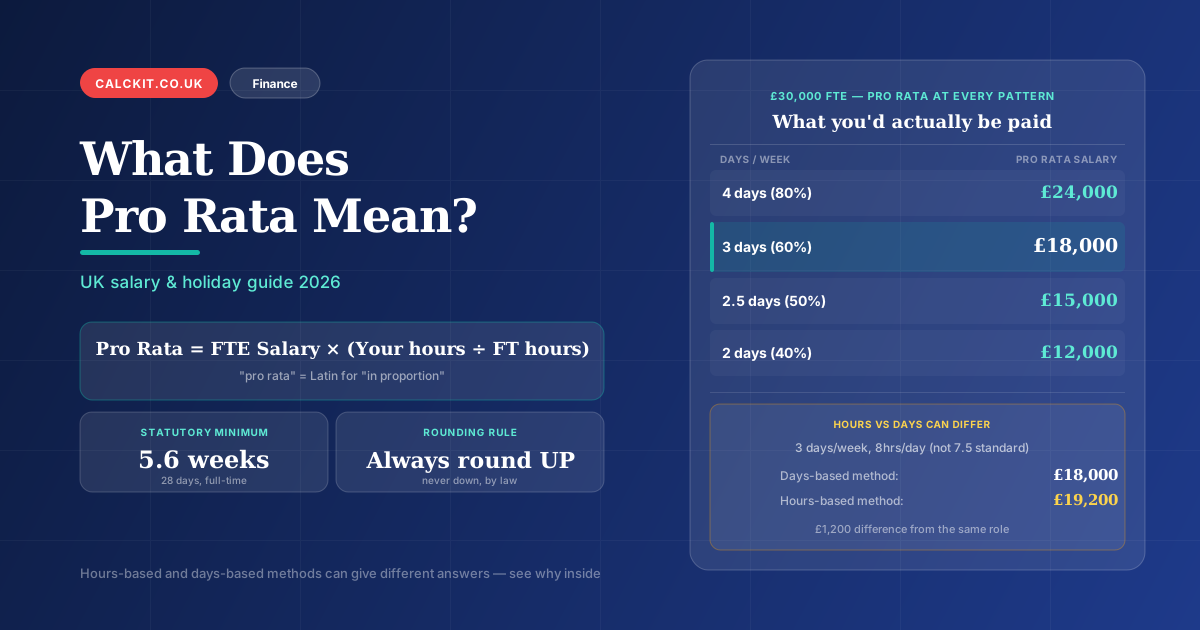
A £30,000 full-time role, paid pro rata for 3 days a week, sounds like a simple £18,000. Most of the time, it is. But depending on whether your employer calculates pro rata using days or hours — and whether your contracted hours per day genuinely match the full-time pattern — you can end up with two different numbers from the same starting salary. Knowing the actual formula means you can check your own pay slip rather than just trusting the number on your contract.
This guide covers exactly what pro rata means, how to calculate it for salary, holiday, sick pay, and pension, and the specific situations where it most commonly goes wrong.
⏱️What does pro rata mean?
Pro rata is a Latin phrase meaning "in proportion." In UK employment, it describes the practice of scaling a full-time salary, holiday entitlement, or other benefit down (or up) to match the actual hours or days someone works, relative to a standard full-time pattern.
If a role is advertised as £30,000 full-time equivalent (FTE), and you work 3 days a week instead of the standard 5, your pro rata salary is 3/5ths of £30,000 — not because of any special rule, but because pro rata simply means matching pay to the proportion of full-time hours actually worked.
Pro rata applies to:
- Salary — adjusted by hours or days worked
- Holiday entitlement — adjusted by days or hours per week
- Sick pay — Statutory Sick Pay is paid per qualifying day, naturally pro-rating itself for part-time patterns
- Pension contributions — calculated on actual pro rata earnings, not the FTE figure
- Bonuses and benefits — many employers pro-rate discretionary bonuses for part-time or mid-year starters
The pro rata salary formula
Pro Rata Salary = FTE Salary × (Your hours or days worked ÷ Full-time hours or days)
Worked example — 3 days a week:
FTE salary: £30,000. Standard full-time week: 5 days. Your contracted days: 3.
£30,000 × (3 ÷ 5) = £18,000
Worked example — reduced hours, same days:
FTE salary: £35,000 for a standard 37.5-hour week. You work 25 hours across 5 days (reduced hours, not reduced days).
£35,000 × (25 ÷ 37.5) = £23,333.33
Hours vs days — when the two methods actually diverge
Most of the time, calculating pro rata by days or by hours gives the same answer, because a "day" is assumed to be a consistent number of hours. But when your daily hours don't match the standard pattern, the two methods produce different results.
Example: a role with a standard 5-day, 37.5-hour week (7.5 hours/day). You work 3 days a week, but 8 hours per day instead of 7.5.
| Method | Calculation | Result |
|---|---|---|
| Days-based | £30,000 × (3 ÷ 5) | £18,000 |
| Hours-based | £30,000 × (24 ÷ 37.5) | £19,200 |
These two methods disagree by £1,200 — because the days-based method ignores that your actual daily hours are longer than standard, while the hours-based method captures it. The hours-based method is more accurate whenever daily hours vary from the standard pattern. If your contract or payslip doesn't match the FTE salary using either method correctly for your actual hours, it's worth asking payroll which method they used and why.
If your working pattern involves non-standard daily hours (e.g. compressed hours, varying shift lengths), always ask your employer to confirm whether your pro rata salary was calculated on a days basis or an hours basis — the two can produce meaningfully different figures.
Pro rata salary quick reference
| FTE Salary | 80% (4 days) | 60% (3 days) | 50% (2.5 days) | 40% (2 days) |
|---|---|---|---|---|
| £20,000 | £16,000 | £12,000 | £10,000 | £8,000 |
| £25,000 | £20,000 | £15,000 | £12,500 | £10,000 |
| £30,000 | £24,000 | £18,000 | £15,000 | £12,000 |
| £35,000 | £28,000 | £21,000 | £17,500 | £14,000 |
| £40,000 | £32,000 | £24,000 | £20,000 | £16,000 |
| £50,000 | £40,000 | £30,000 | £25,000 | £20,000 |
Use the calculator for any salary and working pattern not shown above:
⏱️Pro rata holiday entitlement
The UK statutory minimum holiday entitlement is 5.6 weeks — equivalent to 28 days for someone working a standard 5-day week. Part-time workers are entitled to the same proportional amount.
Pro Rata Holiday (days) = Days worked per week × 5.6
Worked examples:
| Days worked per week | Calculation | Holiday entitlement |
|---|---|---|
| 5 (full-time) | 5 × 5.6 | 28 days |
| 4 | 4 × 5.6 | 22.4 → 22.5 days |
| 3 | 3 × 5.6 | 16.8 → 17 days |
| 2 | 2 × 5.6 | 11.2 → 11.5 days |
Critical rule: always round up, never down. A calculation that produces 22.4 days must be rounded up to at least 22.5 days — UK law does not permit rounding down a fractional entitlement, even by a small amount.
Mid-year starters and leavers
If you start or leave partway through the holiday year, entitlement accrues proportionally based on time worked:
Accrued Holiday = (Full annual entitlement ÷ 12) × Complete months worked
A full-time employee with 28 days annual entitlement who starts on 1 July (halfway through a calendar holiday year) accrues approximately 28 ÷ 12 × 6 = 14 days for the remainder of that year.
Term-time and school staff contracts
Term-time-only contracts are one of the most common — and most frequently miscalculated — pro rata scenarios in the UK, affecting teaching assistants, school catering staff, and similar roles.
The key principle: term-time staff are paid an annualised salary that has already been divided across 12 months, even though they only work during term weeks (typically around 39 weeks a year). Their FTE comparison salary should reflect what a full-year equivalent role would pay, then pro-rated for the proportion of weeks actually worked — not simply divided by the number of months they receive a paycheck.
Worked example: A term-time-only role works 39 weeks a year (term weeks plus any specified holiday pay weeks), compared to a full-time year of 52.14 weeks (accounting for statutory annual leave).
£28,000 FTE × (39 ÷ 52.14) = £20,943
This figure is then typically paid in 12 equal monthly instalments across the year, even though no work happens during the school holidays outside the contracted weeks.
Bank holidays for part-time workers — the common mistake
Bank holidays are not an automatic extra day off on top of pro-rated leave — they are included within the pro-rated statutory entitlement.
The mistake employers commonly make: giving every part-time employee the day off for every UK bank holiday (8 per year in England and Wales), regardless of which days they normally work, in addition to their pro-rated holiday allowance. This over-allocates leave compared to a full-time worker.
The correct approach: if a part-time employee's normal working days happen to include a bank holiday, they take it as part of their pro-rated entitlement (the same way a full-time employee would). If their normal working days never fall on a bank holiday (e.g., they only work Tuesdays and Wednesdays), they are not automatically compensated for bank holidays that fall on days they wouldn't have worked anyway — though many employers choose to offer an equivalent day off as a matter of policy, even though it isn't a statutory requirement.
Pro rata and tax — does it change what you pay?
No. Your personal allowance (£12,570 for 2026/27) and tax bands apply to your actual income, not the full-time equivalent figure. If your pro rata salary is £18,000, you are taxed as if you earn £18,000 — the £30,000 FTE figure is irrelevant to HMRC.
This means part-time and pro rata workers often pay a lower effective tax rate simply because more of their actual income sits within the tax-free personal allowance and basic rate band. For the full picture of how UK income tax bands work, see UK Income Tax Bands 2026.
🏛Pro rata pension and Statutory Sick Pay
Pension contributions are calculated on your actual (pro rata) earnings, not the FTE salary. If your employer contributes 3% of salary, that 3% is calculated on your real £18,000, not the £30,000 FTE figure — contributions naturally scale down with pro rata pay. The pension auto-enrolment earnings threshold (£10,000/year) also applies to actual earnings, meaning some part-time workers fall below the threshold and may need to opt in rather than being automatically enrolled.
Statutory Sick Pay (SSP) is paid per qualifying day at a fixed weekly rate (regardless of your salary), so it naturally pro-rates itself based on how many qualifying days you work per week — a 3-day-a-week worker receives SSP for their 3 qualifying days, not the full 5-day week rate.
Common payroll mistakes — and their real cost
1. Using the wrong full-time hours denominator. If a company's "standard" full-time week is actually 35 hours but payroll uses 37.5 in the calculation, every part-time salary is calculated against the wrong baseline. On a £30,000 FTE role at 3 days a week: using 37.5 hours gives £18,000; using the correct 35 hours gives £18,514 — a £514 underpayment that compounds every year it goes uncorrected.
2. Forgetting to pro-rate bank holidays correctly (covered above) — either over- or under-allocating leave.
3. Dividing term-time salaries by months actually worked, not weeks. As shown above, this produces a different (often lower) figure than the correct weeks-based calculation.
4. Not adjusting holiday entitlement after a change in hours mid-year. If someone reduces from 5 days to 3 days partway through the year, their holiday entitlement for that year should be calculated using a weighted average across both working patterns, not simply applied retroactively at the new lower rate for the whole year.
How to check if your pro rata salary is correct
- Take your actual annual pro rata salary
- Divide it by your contracted hours (or days) per week
- Multiply by the standard full-time hours (or days) for that role
- Compare the result to the advertised FTE salary
Example: You earn £18,000 for 3 days a week. The role's FTE salary is supposed to be £30,000 for a 5-day week.
£18,000 ÷ 3 × 5 = £30,000 ✓ — this confirms the pro rata calculation is correct.
If the result doesn't match the advertised FTE figure, ask your employer or payroll team for a breakdown of how your pro rata salary was calculated — there may be a genuine discrepancy worth raising.
🕐Frequently Asked Questions
Can my employer pay me a lower hourly rate because I'm part-time?
No. Under the Part-Time Workers (Prevention of Less Favourable Treatment) Regulations 2000, part-time workers must receive the same hourly rate of pay as a comparable full-time employee doing the same job, unless the employer can objectively justify a difference for reasons unrelated to part-time status. Pro rata adjusts the total salary for fewer hours — it should never reduce the underlying hourly rate itself.
Does pro rata redundancy pay work the same way?
Statutory redundancy pay is calculated using a formula based on age, length of service, and a capped weekly pay figure — for part-time workers, the weekly pay figure used is their actual (pro rata) weekly earnings, not the FTE equivalent. The calculation already accounts for part-time status through the actual earnings figure, rather than requiring an additional pro rata adjustment step.
What if I work irregular hours — how does pro rata apply?
For genuinely irregular or zero-hours patterns, holiday entitlement is usually calculated as 12.07% of hours worked (5.6 weeks ÷ 46.4 working weeks in a year), accrued as you work rather than allocated upfront. This is a different calculation method from the standard "days worked × 5.6" formula used for workers with a fixed, regular pattern.
Is pro rata only relevant to part-time workers?
No — it also applies to full-time employees who start or leave a job partway through a year (holiday and sometimes bonus calculations), employees on career breaks or sabbaticals, and anyone whose contracted hours change during the year. Pro rata is a calculation method, not a category of employment.
The bottom line
Pro rata simply means proportional — your salary, holiday, and most benefits are scaled to match the proportion of full-time hours or days you actually work. The maths is usually straightforward, but it goes wrong often enough — wrong denominators, miscounted bank holidays, term-time contracts divided the wrong way — that it's worth checking your own figures rather than assuming payroll got it right.
⏱️Last updated June 2026. Figures reflect 2026/27 UK rates and statutory minimums. This guide provides general information, not legal advice — consult ACAS or an employment solicitor for specific disputes.