
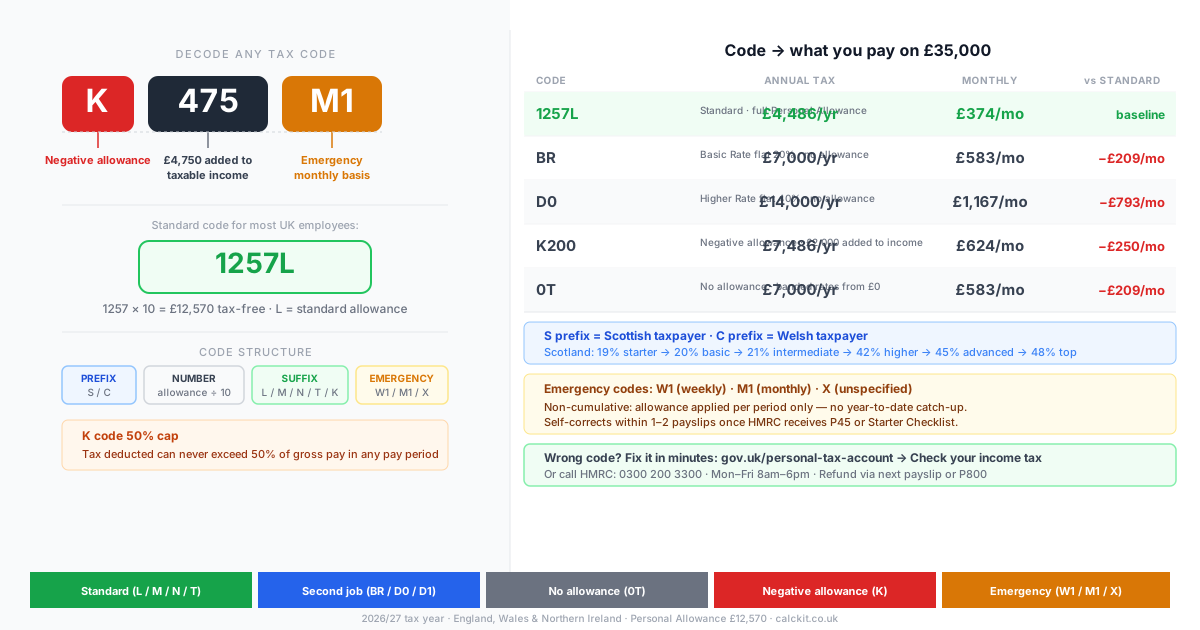
Maya started a new job in April 2026. Her first payslip showed £812 deducted in tax on a £3,200 monthly salary — far more than her colleague on the same pay. Her code read 1257L M1. Within six weeks, once HMRC processed her details, her code switched to 1257L and her monthly deduction dropped to £338. HMRC refunded the difference through her next payslip.
Michael's payslip shows K475. He has a £6,000 company car benefit — more than the £3,750 adjustment his Personal Allowance covers, so HMRC adds the excess to his taxable income rather than subtracting from it. He pays more tax than a colleague on the same salary but with no car.
These are two of the most misunderstood codes on a UK payslip. Here's how to decode any code and what each type actually means for your take-home pay.
How to decode any UK tax code
A UK tax code has up to four components, each carrying specific information:
[Prefix] [Number] [Suffix letter] [Emergency suffix]

Examples:
1257L          → standard code (no prefix, no emergency suffix)
BR             → second job / flat-rate code (number-less)
K475           → negative allowance code
S1257L         → Scottish taxpayer, standard allowance
1257L M1       → standard allowance, emergency monthly basis
S900T          → Scottish taxpayer, allowance adjusted, HMRC review needed
The number (when present): multiply by 10 to get your tax-free amount for the year. 1257 × 10 = £12,570. If the number is higher than 1257, you have an extra relief added to your allowance (e.g. Marriage Allowance received). If lower, something has reduced it (e.g. a taxable benefit).
The suffix letter: describes your situation. Most people have L — the standard Personal Allowance.
The prefix (if any): S = Scottish taxpayer, C = Welsh taxpayer.
The emergency suffix (if any): W1 (weekly), M1 (monthly), or X — means your allowance is applied non-cumulatively, pay period by pay period.
Every UK tax code letter — the complete list
Standard codes
| Code | What it means | Typical situation |
|---|---|---|
| L | Full Personal Allowance (£12,570) | Most employees: single job, no benefits |
| M | Marriage Allowance received (PA increased by £1,260) | Partner transferred their unused allowance to you |
| N | Marriage Allowance transferred (PA reduced by £1,260) | You transferred your allowance to your partner |
| T | HMRC reviewing your tax affairs | Income above £100,000 where PA is tapering, or complex circumstances |
| NT | No tax deducted | Rare — specific HMRC-approved arrangements |
Codes with no Personal Allowance
| Code | Tax rate applied | How income is taxed |
|---|---|---|
| BR | 20% flat | All income taxed at basic rate, no tax-free element |
| D0 | 40% flat | All income taxed at higher rate, no tax-free element |
| D1 | 45% flat | All income taxed at additional rate, no tax-free element |
| 0T | Banded (20% / 40% / 45%) | No allowance, but normal bands apply from £0 |
Negative allowance
| Code | How it works |
|---|---|
| K | Number × 10 is added to taxable income (not subtracted). K475 adds £4,750 to your taxable income before tax is calculated. |
Regional prefix codes
| Prefix | Region | What changes |
|---|---|---|
| S | Scotland | Scottish income tax rates and bands apply |
| C | Wales | Welsh rates apply (currently identical to England/NI) |
The standard code: 1257L
1257L is the code on the payslip of most UK employees. It gives you the full £12,570 Personal Allowance for 2026/27, split evenly across the tax year — £1,047.50 each month, £241.73 each week.
The Personal Allowance has been frozen at £12,570 since 2022/23. It is currently scheduled to stay there until at least April 2031, which is why 1257L has been — and will remain — the standard code for several years.
How 1257L affects your tax on £35,000:
| Calculation | Amount | |
|---|---|---|
| Gross salary | £35,000 | |
| Personal Allowance | £12,570 | |
| Taxable income | £35,000 − £12,570 | £22,430 |
| Income tax at 20% | £22,430 × 20% | £4,486/year |
| Monthly deduction | £4,486 ÷ 12 | £373.83/month |
BR: the second-job code
BR taxes everything at 20% with no Personal Allowance. It's the correct code when you have a second job or additional pension — your main job already uses your full £12,570 allowance, so the second source gets taxed from pound one.
BR on your only job is almost always wrong. If your payslip shows BR and it's your sole employment, contact HMRC immediately. The cost:
Worked example — £28,000 salary, BR instead of 1257L:
| Code | Taxable income | Tax deducted | Monthly overpayment |
|---|---|---|---|
| 1257L (correct) | £28,000 − £12,570 = £15,430 | £3,086/year | £257/month |
| BR (wrong) | £28,000 × 20% | £5,600/year | £467/month |
| Overpayment | £2,514/year | £209/month |
HMRC usually fixes the code once your employer submits your National Insurance number and Starter Checklist. Any overpaid tax within the same tax year comes back via your next payslip after the correction.
D0 and D1: higher and additional rate codes
D0 taxes all income at 40%, D1 at 45% — both with no Personal Allowance. These appear on secondary income sources where the total combined income already exceeds the higher or additional rate threshold.
Example — main job £55,000, second job £18,000:
The main job (1257L) uses your £12,570 allowance and taxes income up to £50,270 at 20% and above at 40%. The second job (D0) adds £18,000 to an already-higher-rate position — HMRC correctly applies 40% from pound one.
On the £18,000 second income: D0 deducts £7,200. That's correct — the alternative would be under-taxing and generating a large year-end underpayment.
0T: no allowance, but banded
0T differs from BR in one important way: instead of a flat 20% on everything, 0T applies the standard tax bands starting from £0 — so income above £37,700 in a 0T source is taxed at 40%, and above £125,140 at 45%.
0T is applied when:
- You start a new job with no P45 and your employer lacks details to use any allowance
- Your Personal Allowance is fully used against another income source and there's no clear band to apply
- Your income exceeds £125,140 (PA fully tapered away)
0T vs BR on a £30,000 income:
Both result in the same 20% rate here (all income below £37,700). The difference matters above £37,700 — BR keeps deducting 20%; 0T switches to 40%.
K codes: the negative allowance
A K code means your deductions — usually untaxed benefits-in-kind like a company car, private medical insurance, or owed tax being recovered — exceed your Personal Allowance. Instead of subtracting a tax-free amount, the system adds a fixed amount to your taxable income.
Worked example — £40,000 salary, K200 code:
K200 means £2,000 (200 × 10) is added to taxable income.
| Calculation | Amount | |
|---|---|---|
| Gross salary | £40,000 | |
| K addition | +£2,000 | |
| Taxable income | £40,000 + £2,000 | £42,000 |
| Tax at 20% on £37,700 | £7,540 | |
| Tax at 40% on £4,300 | £1,720 | |
| Total tax | £9,260/year |
Compare to 1257L on £40,000: taxable £27,430 → tax £5,486. The K200 code costs £3,774 more per year.
The 50% cap rule
A K code cannot deduct more than 50% of your gross pay in any single pay period. If you earn £2,500 in a month, the maximum tax deduction is £1,250 — even if the calculated tax exceeds that. This protects against catastrophic single-period deductions. Any uncollected amount is carried forward.
What triggers a K code
- Company car: P11D value × BIK rate, minus any employee contribution
- Private medical insurance: the employer's premium is treated as taxable income
- Interest-free loans above £10,000: the notional interest HMRC applies is a benefit
- Previous year tax debt being collected: HMRC can collect up to £3,000 through a K code adjustment rather than demanding direct payment
- State pension exceeding current earnings: pensioners who also receive employment income may have a K code if state pension + employment income can't be offset by the standard allowance
T code: when the Personal Allowance is tapering
The T code signals that HMRC needs to review your tax affairs — most commonly because your income is between £100,000 and £125,140, where the Personal Allowance tapers at £1 for every £2 over £100,000.
At £110,000, your effective allowance is £12,570 − ((£110,000 − £100,000) ÷ 2) = £12,570 − £5,000 = £7,570. The code would be 757T.
At £125,140 or above, the allowance is fully withdrawn. The code becomes 0T.
The 60% effective marginal rate: Between £100,000 and £125,140, every additional £1 of income costs 40% income tax plus the loss of 50p of Personal Allowance (taxed at 40%) — an effective marginal rate of 60%. Pension contributions or Gift Aid can push income back below £100,000 and restore the allowance.
Emergency codes: W1, M1, and X
Emergency suffixes change how your allowance is applied, not how much it is.
| Suffix | Basis | What it means |
|---|---|---|
| W1 | Weekly | This week's 1/52 of annual allowance only — no carry-forward from earlier weeks |
| M1 | Monthly | This month's 1/12 of annual allowance only — no carry-forward from earlier months |
| X | Unspecified | Emergency basis, period not known |
Why this matters: Under a normal cumulative code, if you had low earnings in April, the unused allowance from that month is carried forward and reduces your tax in May. Under W1/M1, each period is treated in isolation — overpayment in one month isn't corrected the next.
Worked example — Maya's M1 code:
Maya earns £3,200/month. In April, her M1 code gives her 1/12 of £12,570 = £1,047.50 in allowance that month. Her taxable pay is £3,200 − £1,047.50 = £2,152.50. Tax at 20% = £430.50.
Under a cumulative code, the same monthly calculation applies. So far no difference.
The difference appears in month 2 when HMRC switches her to cumulative 1257L. The cumulative code looks at total pay and total allowance year-to-date — if April was a lower earning month, any unused allowance would flow through. The M1 code discards that opportunity, month by month.
When does an emergency code appear?
- New job without a P45 from your previous employer
- You complete a Starter Checklist but your employer hasn't received a code from HMRC yet
- A pension starts paying before HMRC has issued the correct code
What to do: Once your employer has your NI number and a code from HMRC (usually 1–2 pay periods), the code updates automatically. Any overpaid tax within the year returns via your payslip. If the emergency code persists for more than 2 months, contact HMRC via your Personal Tax Account.
Scottish and Welsh codes
Scottish taxpayer: S prefix
If HMRC holds your address as Scotland, your code gets an S prefix (e.g. S1257L). Scottish income tax rates for 2026/27:
| Band | Income | Rate |
|---|---|---|
| Starter rate | £12,571–£15,397 | 19% |
| Basic rate | £15,398–£27,491 | 20% |
| Intermediate rate | £27,492–£43,662 | 21% |
| Higher rate | £43,663–£75,000 | 42% |
| Advanced rate | £75,001–£125,140 | 45% |
| Top rate | Above £125,140 | 48% |
The code structure is identical — S1257L, SBR, SK codes all work the same way. Only the rates applied to each band differ. National Insurance is unchanged — it is a UK-wide tax.
Who pays more? A Scottish taxpayer earning between £27,492 and £43,662 pays 21% intermediate rate vs 20% English basic rate — a difference of £ per year roughly equal to 1% of income in that band. At £35,000: approximately £75 more per year. At £43,662: approximately £212 more per year.
A higher-rate Scottish taxpayer (above £43,663) pays 42% vs 40% in England — a significant difference on larger incomes.
Welsh taxpayer: C prefix
Welsh codes carry a C prefix (e.g. C1257L). Welsh income tax rates are currently identical to England and Northern Ireland for 2026/27, so the C prefix has no practical effect on your tax bill today — but Welsh Government retains the power to set different rates, and your code ensures the correct system is applied.
Common codes and what they cost
A direct comparison on a £35,000 salary in England for 2026/27:
| Code | Taxable income / treatment | Annual tax | Monthly take-home difference vs 1257L |
|---|---|---|---|
| 1257L | £22,430 | £4,486 | — |
| 1157L (benefit reducing allowance) | £23,430 | £4,686 | −£17/month |
| BR | £35,000 flat 20% | £7,000 | −£210/month |
| 0T | £35,000 banded (all basic rate here) | £7,000 | −£210/month |
| K200 | £37,000 | £7,400 | −£243/month |
| D0 | £35,000 flat 40% | £14,000 | −£793/month |
| 1257L M1 | Same as 1257L monthly, but no year-to-date catch-up | Usually same | 0 (unless income was irregular) |
Why your code changes mid-year
HMRC updates tax codes automatically when it receives new information. Common triggers:
| Trigger | Effect on code |
|---|---|
| New employer benefit (company car, medical insurance) | Code number reduces (e.g. 1257L → 957L) |
| Benefit removed | Code number increases back toward 1257L |
| Marriage Allowance claim | Recipient's code gains M suffix; transferor's code gains N suffix |
| Income above £100,000 | Code adjusts toward T, then 0T |
| Previous year underpayment below £3,000 | HMRC uses a reduced code to recover it via PAYE (e.g. 1057L to collect £2,000 over the year) |
| Starting a new job without a P45 | Emergency W1/M1 applied until P45 or Starter Checklist confirmed |
| Scottish address change | S prefix added |
HMRC sends a Tax Code Notice (form P2) whenever your code changes, explaining the adjustment. Check your Personal Tax Account — HMRC also displays your current code and the reason there.
How to correct a wrong code
- Sign in to your HMRC Personal Tax Account at gov.uk/personal-tax-account
- Under "Check your income tax", select the current tax year
- Review your income sources and any benefits listed — these drive the code calculation
- If something is wrong (e.g. a company car listed that you no longer have), update your details
- HMRC issues a revised code to your employer within a few days
- Your next payslip should reflect the corrected deduction
- If you have overpaid in the current year, the excess is usually refunded through payroll. For past years, a P800 is issued or you can claim via your Personal Tax Account
Alternatively, call HMRC directly on 0300 200 3300 (Monday to Friday, 8am–6pm).
💷Frequently Asked Questions
What does NT mean on a tax code?
NT means No Tax — your employer deducts nothing from that income source. It is rare and requires specific HMRC authorisation. Common uses include certain overseas income, non-resident employees whose income is taxed abroad, and some HMRC-approved schemes. If you see NT unexpectedly, query it — it should not appear without a specific reason.
Can I have two different tax codes at the same time?
Yes. If you have two jobs or a job plus a pension, each income source has its own code. Typically your main job receives 1257L (using your full Personal Allowance), and the second source receives BR, D0, or D1 depending on which tax band your combined income falls in.
My code shows a lower number than 1257 — what does that mean?
A number below 1257 means your Personal Allowance has been reduced from the standard £12,570. The most common reason is a taxable benefit — a company car, private medical insurance, or interest-free loan above £10,000. The reduction is 10% of the benefit's value. A code of 957L, for example, means your effective tax-free allowance is £9,570 (£12,570 minus a £3,000 benefit).
Can a K code mean I pay tax on more than I actually earn?
The K number adds to your taxable income — but the 50% cap ensures you can never pay more than half your actual gross pay in tax in any single pay period. Over the full year, however, the total tax bill can be significantly higher than on a standard L code at the same salary. If the K code addition exceeds your ability to pay through PAYE, HMRC may agree a direct payment arrangement instead.
Does my tax code affect National Insurance?
No. National Insurance is calculated entirely independently of your tax code. NI is based on your gross earnings for the period against the NI thresholds — it is not affected by your Personal Allowance, code adjustments, or emergency suffixes.
Last updated July 2026. Tax code rules and the £12,570 Personal Allowance reflect HMRC 2026/27 guidance. Scottish income tax rates confirmed by Scottish Parliament for 2026/27.