
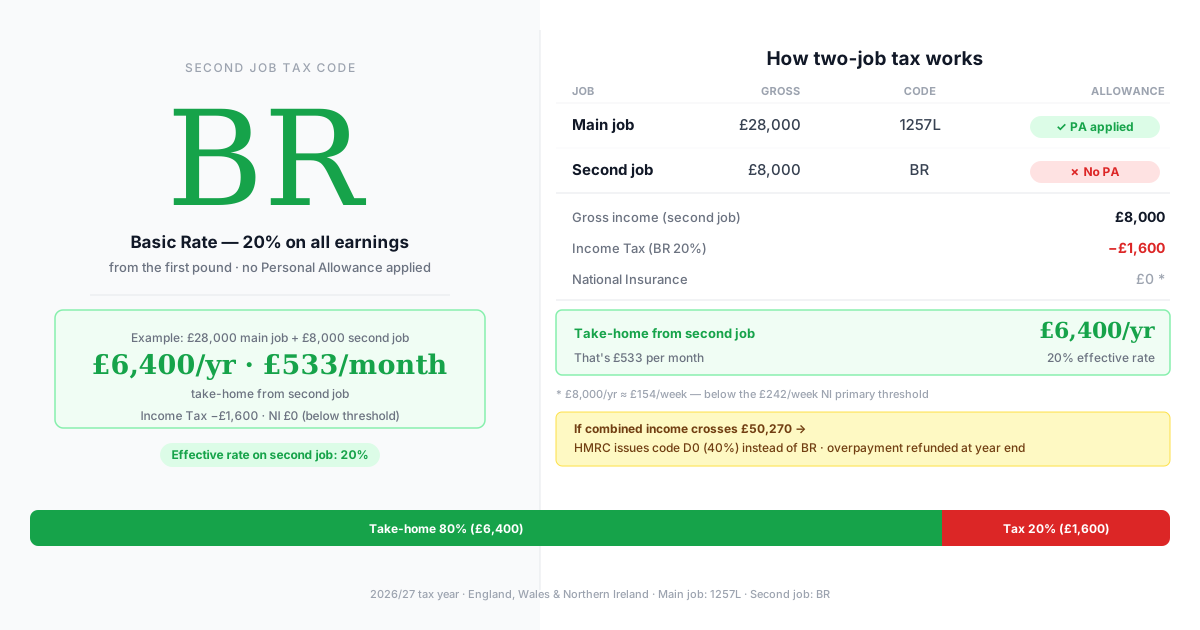
If you're thinking about taking a second job and worried you'll be taxed at a higher rate because of it — you won't be. UK income tax rates are the same regardless of how many jobs you have. What changes is that your tax-free Personal Allowance is already being used by your main job, so your second job gets taxed from the very first pound with no tax-free slice.
This guide explains exactly how that works, which tax code your second job gets, what you'll actually take home at different salary combinations, and what to do if HMRC deducts more than it should.
💼Why your second job is taxed differently
Everyone in the UK gets one Personal Allowance per tax year — £12,570 in 2026/27. This is the amount you can earn before paying any income tax at all. The problem with a second job is that you only have one allowance to go around.
HMRC allocates your full £12,570 to whichever job pays you the most — normally your main job. That job gets the standard 1257L tax code, meaning you pay zero tax on the first £12,570 and then 20% on the income above it (up to £50,270).
Your second job gets whatever is left of your allowance. In most cases, nothing. Your second job is therefore taxed at the applicable rate from pound one, with no tax-free slice at all.
The key point: your second job is not taxed at a higher rate. It is taxed at the same rate — 20%, 40%, or 45% — but on all of the income rather than the income above your allowance. Your total tax on the same combined income is exactly the same as if you had earned it all from a single employer.
Second job tax codes: BR, D0, and D1
HMRC communicates to your employer how much tax to deduct through a tax code. For second jobs, one of three codes is used:
| Code | Tax rate | When HMRC applies it |
|---|---|---|
| BR | 20% on all income | Combined income stays within the basic rate band (up to £50,270) |
| D0 | 40% on all income | Combined income exceeds £50,270 — higher rate taxpayer |
| D1 | 45% on all income | Combined income exceeds £125,140 — additional rate taxpayer |
BR (Basic Rate) is by far the most common. If your second job is part-time or casual work that keeps your total income comfortably below £50,270, you will receive a BR code on job two. Every pound from that job is taxed at a flat 20% with no allowance.
D0 applies when your combined income pushes you into the 40% higher rate band. If your main job pays £45,000 and your second adds another £10,000, combined income of £55,000 crosses £50,270 and HMRC may issue D0 — all of your second job earnings taxed at 40%.
D1 is rare. It applies only when combined income consistently exceeds £125,140, the point at which the 45% additional rate applies to all further income.
For a full explanation of every UK tax code — including K codes, emergency codes, and 0T — see 1257L Tax Code Explained.
Worked example A: second job within the basic rate band
Main job: £28,000 (code 1257L) · Second job: £8,000 (code BR)
Combined income: £36,000 — comfortably within the basic rate band.
Main job:
| Gross pay | £28,000 |
| Personal Allowance | −£12,570 |
| Taxable income | £15,430 |
| Income tax at 20% | −£3,086 |
| NI at 8% on £15,430 | −£1,234 |
| Take-home (main job) | £23,680/yr · £1,973/month |
Second job (BR code):
| Gross pay | £8,000 |
| Personal Allowance | £0 (used by main job) |
| Income tax at 20% (BR) | −£1,600 |
| National Insurance | £0 ✱ |
| Take-home (second job) | £6,400/yr · £533/month |
✱ £8,000 ÷ 52 weeks ≈ £154/week. The NI primary threshold is £242/week in 2026/27. Weekly earnings from this second job stay below that threshold, so no NI is deducted.
Total take-home from both jobs: £30,080/year. This is identical to the take-home on a single £36,000 salary. Having two jobs doesn't change the tax bill — it just moves where the allowance sits.
Worked example B: crossing into the higher rate band
Main job: £40,000 (code 1257L) · Second job: £15,000 (code D0)
Combined income: £55,000. This exceeds the £50,270 basic rate ceiling by £4,730.
Because your main job already takes you to £40,000, only £10,270 of second job income sits within the basic rate band (£50,270 − £40,000). The remaining £4,730 is in the 40% higher rate band.
What HMRC actually owes on this income:
| Portion of second job | Rate | Tax owed |
|---|---|---|
| £10,270 (basic rate portion) | 20% | £2,054 |
| £4,730 (higher rate portion) | 40% | £1,892 |
| Total tax owed on second job | £3,946 |
What D0 deducts: 40% × £15,000 = £6,000
Overpayment: £2,054 — this is refunded to you via a P800 tax calculation at year end, or through Self Assessment if you file one.
HMRC uses D0 when it expects combined income to exceed £50,270, but it can't precisely split the second job income between two bands in real time. So it deducts at the higher rate on everything and refunds the over-collection later. You are never double-taxed — any overpayment comes back.
🏛National Insurance on a second job
National Insurance is calculated separately from income tax and works differently. NI is assessed per-employer, per-pay-period — each job is treated as a standalone calculation, with no knowledge of your other income.
Threshold for 2026/27:
| Pay frequency | NI primary threshold |
|---|---|
| Weekly | £242/week |
| Monthly | £1,048/month |
| Annual equivalent | £12,570/year |
If your second job earns below these thresholds in each pay period, no NI is deducted — regardless of what your main job pays. Many part-time second jobs fall below the weekly threshold, meaning no NI applies at all.
Can you overpay NI across two jobs?
Yes — and it is a genuine risk if both jobs are above the NI threshold. Here is why:
Each employer independently charges 8% NI on earnings up to the Upper Earnings Limit (UEL, £50,270/year). Neither employer knows about the other's payroll. If both jobs are above the NI primary threshold, you are paying 8% on income from each job separately — but if combined income exceeds £50,270, the portion above the UEL should attract only 2%, not 8%.
Example:
- Job 1: £35,000 → NI: (£35,000 − £12,570) × 8% = £1,794
- Job 2: £25,000 → NI: (£25,000 − £12,570) × 8% = £994
- Total NI paid across both: £2,788
Correct NI on combined income of £60,000:
- (£50,270 − £12,570) × 8% = £3,016
- (£60,000 − £50,270) × 2% = £195
- Correct total: £3,211
In this particular case, you actually underpay NI (£2,788 vs £3,211 owed) because neither job individually crosses the UEL. HMRC may collect the shortfall via Self Assessment.
The overpayment scenario occurs when one or both jobs individually exceed £50,270 — each employer then charges 8% up to the UEL as if you had no other job, while the combined position means some of that income should only attract 2%. In that case, you can claim a refund. Contact HMRC directly or file a Self Assessment return to recover it.
For a full breakdown of Class 1 NI rates, thresholds, and employer contributions, see National Insurance Rates UK 2026/27.
Student loan deductions
If you are repaying a student loan, each employer deducts repayments based only on the earnings from that specific job — they have no visibility of your other income. Deductions only trigger if your earnings from that employer exceed the plan threshold in that pay period.
2026/27 plan thresholds:
| Plan | Annual threshold | Monthly equivalent |
|---|---|---|
| Plan 1 | £24,990 | £2,083 |
| Plan 2 | £27,295 | £2,275 |
| Plan 4 (Scotland) | £31,395 | £2,616 |
| Plan 5 | £25,000 | £2,083 |
| Postgraduate Loan | £21,000 | £1,750 |
If your main job pays £30,000 (above the Plan 2 threshold) and your second job pays £10,000 (below it), only your main employer deducts student loan repayments. However, your total income from both jobs counts when HMRC calculates whether you have repaid enough during the year — any shortfall may be collected via Self Assessment.
Pension contributions on a second job
Auto-enrolment applies per employer. If you earn more than £10,000/year from a single employer and are aged between 22 and state pension age, that employer must automatically enrol you into a workplace pension. If both your main job and your second job each pay above £10,000/year, both employers must auto-enrol you independently.
Minimum auto-enrolment contributions for 2026/27:
- Employee: 5% of qualifying earnings (£6,240 to £50,270)
- Employer: 3% of qualifying earnings
Salary sacrifice on a second job: Salary sacrifice pension schemes operate through a specific employer's payroll — you can only access a salary sacrifice scheme offered by that employer. You cannot redirect second-job earnings into your main employer's scheme or combine them.
Making additional contributions via SIPP: If you want to pension contributions from second-job income beyond auto-enrolment minimums, a personal SIPP is the most flexible option. You contribute from net pay and HMRC automatically adds 20% basic rate tax relief. Total contributions across all pensions in 2026/27 are capped at £60,000 or 100% of your total earnings, whichever is lower.
Will I pay more tax with a second job?
No. Your total income tax on the same combined income is identical whether you earn it from one employer or two. On £36,000 total income, you owe the same amount of tax regardless of whether it comes from one job or two.
What does change is the timing of collection:
- Your second job deducts tax from pound one with no allowance, so more of your gross second-job income goes to HMRC through the year
- Your main job's allowance compensates — your 1257L code means you pay no tax on the first £12,570 there
- The two positions offset each other, giving the same net tax position as a single job
The common misconception arises because people see 20% deducted from every pound of second-job income and assume they're paying more. They're not — they're just seeing the tax front-loaded, because the Personal Allowance is already being applied elsewhere.
Where over-deduction genuinely happens is through incorrect codes (emergency codes, D0 on income that straddles the boundary) — but HMRC reconciles these at year end and issues refunds automatically where owed.
How to tell HMRC about a second job
When you start your second job, your new employer will ask you to complete a Starter Checklist. You'll see three options — select C: "I have another job or pension."
This signals to your employer to apply a BR (or relevant) code from day one rather than the default 1257L — which would give you a second Personal Allowance and leave you underpaying tax, with a bill later.
If you accidentally select the wrong option and your employer applies 1257L to your second job, you'll end up owing tax at year end when HMRC reconciles your position. Always select C.
HMRC also updates codes automatically through Real Time Information (RTI) — your employers submit pay data to HMRC every time you are paid, so HMRC can spot that you have two jobs and adjust codes. This process is not always instant; for the first pay period or two, an incorrect code may be applied while HMRC processes the information. Check your codes via your HMRC Personal Tax Account.
How to claim a refund if you were overtaxed
If your second job deducted too much — through a D0 code over-deducting, an emergency code at the start, or any other error — you can claim the money back:
1. P800 tax calculation (automatic) After each tax year ends on 5 April, HMRC automatically issues a P800 to anyone who has overpaid or underpaid. If you are owed a refund, you can claim it online within 45 days — the money is paid directly to your bank account. If you do nothing, HMRC sends a cheque.
2. Self Assessment If you file a Self Assessment tax return (required if your income exceeds £100,000, if you are self-employed, or if you choose to register), any overpayment is automatically included and refunded.
3. In-year claim via Personal Tax Account If you know you've overpaid during the year — for example, you left your second job partway through — you can request a refund without waiting for year end through your Personal Tax Account.
HMRC can refund overpayments going back four tax years. If you've been on the wrong code for multiple years, check your P60s from previous employers and claim promptly.
Self-employed side hustle
If your second income is self-employed work — freelancing, tutoring, selling on platforms, driving for a delivery app — the rules differ from a second PAYE job.
The £1,000 trading allowance: The first £1,000 of self-employed gross income per tax year is covered by the trading allowance. No tax, no reporting, no Self Assessment needed below this threshold. If you sell items online and earn £750 in the tax year, you have no tax obligation.
Above £1,000: Once self-employed income exceeds £1,000, you must register for Self Assessment with HMRC. Tax is charged on your profits (gross income minus allowable expenses) above whatever remains of your Personal Allowance after your employed income is accounted for. If your main job uses your full allowance, your self-employed profits are taxed from pound one at the applicable rate.
National Insurance: Self-employed people pay Class 4 NI on annual profits above £12,570 — 6% on profits from £12,570 to £50,270, and 2% above that. Class 2 NI was abolished in April 2024; you no longer pay a flat weekly amount.
Making Tax Digital from April 2026: HMRC is phasing in MTD for Income Tax Self Assessment (MTD ITSA). From April 2026, self-employed people with income above £50,000 per year must use HMRC-approved software to submit quarterly updates rather than an annual return. The income threshold drops to £30,000 from April 2027 and £20,000 from April 2028.
For the full picture on self-employed tax — allowable expenses, payments on account, and MTD compliance — see Self-Employed Tax UK 2026/27.
📋Check your employment contract first
Before accepting any second job, check the terms of your current employment contract. Many contracts — particularly in professional services, finance, technology, and media — include restrictive covenants or conflict of interest clauses that prohibit:
- Working for a competitor or in the same sector
- Using your current employer's clients, contacts, or commercial relationships
- Carrying out work that conflicts with your duties or creates a divided loyalty
Breaching these clauses can be grounds for disciplinary action or dismissal regardless of whether the second job has been disclosed to HMRC. Tax law does not override employment contract terms.
If your contract is silent on the matter, or the second job is in a completely unrelated field, you are generally free to take it. Checking in writing — or with HR — before starting removes any ambiguity.
Scotland
Scottish taxpayers pay income tax at different rates and bands, but the same tax code framework and NI rules apply as the rest of the UK. In Scotland, the 2026/27 income tax bands above the Personal Allowance are:
| Band | Range | Rate |
|---|---|---|
| Starter rate | £12,571–£15,397 | 19% |
| Basic rate | £15,398–£27,491 | 20% |
| Intermediate rate | £27,492–£43,662 | 21% |
| Higher rate | £43,663–£75,000 | 42% |
| Advanced rate | £75,001–£125,140 | 45% |
| Top rate | Above £125,140 | 48% |
For Scottish second jobs, HMRC issues S-prefixed codes: SBR (Scottish Basic Rate, 20%), SD0 (Scottish higher rate, 42%), or SD1 (Scottish advanced/top rates). If your combined income exceeds £27,491, some of your second job income enters the 21% intermediate band rather than staying at 20% — the boundary is lower than in England and Wales.
Frequently Asked Questions
How much tax do you pay on a second job in the UK?
Tax on a second job uses the same UK income tax rates as any other income — 20%, 40%, or 45%. There is no special second-job rate. The key difference is that your £12,570 Personal Allowance is allocated to your main job, so your second job is taxed from pound one. Most second jobs attract the BR code (20% on all earnings). If combined income exceeds £50,270, HMRC applies D0 (40%) or a split code instead.
What tax code is used for a second job?
The most common is BR (Basic Rate, 20%). If your combined income from both jobs crosses £50,270, HMRC may issue D0 (all at 40%). If combined income exceeds £125,140, D1 applies (all at 45%). The code depends on your total income from all sources — if you're unsure what code you should be on, check your HMRC Personal Tax Account.
Do you pay more tax overall if you have two jobs?
No. Total income tax on the same combined income is identical whether it comes from one employer or two. With two jobs, HMRC collects more tax from your second job (because no allowance is applied there) and less from your main job — the amounts offset. What can happen is temporary over-deduction if codes are misapplied, but HMRC refunds this via P800 at year end.
Do you pay National Insurance on a second job?
Yes, if your earnings from that job exceed the NI primary threshold per pay period (£242/week or £1,048/month in 2026/27). NI is assessed per employer — your second employer does not know what your main employer pays. If both jobs are above the threshold and combined income exceeds £50,270, you may overpay NI and can claim a refund from HMRC.
What happens if my combined income from two jobs crosses £50,270?
The income above £50,270 becomes taxable at 40% instead of 20%. HMRC may issue a D0 code on your second job (40% on all of it), which typically over-deducts because only part of the second job income sits above £50,270. The overpayment is refunded at year end via P800 or Self Assessment. You won't permanently pay more than you owe.
How do I tell HMRC about a second job?
Complete the Starter Checklist with your new employer and select option C ("I have another job or pension"). This tells your employer to apply a BR or appropriate code. HMRC also receives Real Time Information from both employers and updates codes automatically — but checking your codes at gov.uk/personal-tax-account ensures everything is correct from the start.
What is the £1,000 trading allowance for a side hustle?
The trading allowance covers the first £1,000 of self-employed gross income per tax year — no tax, no reporting required below this. If you earn more than £1,000 from self-employment, you must register for Self Assessment and declare the profits. Tax is charged on profits above your remaining Personal Allowance, plus Class 4 NI (6%/2%).
Can I claim a tax refund if I was overtaxed on my second job?
Yes. HMRC issues a P800 tax calculation after the tax year, automatically refunding any overpayment to your bank account. You can also request an in-year refund through your Personal Tax Account if you left the second job mid-year or know you've overpaid. Self Assessment filers receive any refund as part of their return. HMRC can refund overpayments going back four tax years.
The bottom line
Your second job carries the same income tax rates as your first — 20% for most people. What makes it feel higher is that the Personal Allowance is already claimed by your main job, so HMRC taxes every pound from job two with no tax-free buffer. The BR code (20% on all second-job earnings) is the standard outcome for basic rate taxpayers. If combined income crosses £50,270, expect D0 and a year-end reconciliation.
To see your exact take-home from any salary combination:
💷Last updated July 2026. Income tax rates, NI thresholds, and Personal Allowance figures reflect HMRC 2026/27 guidance.