
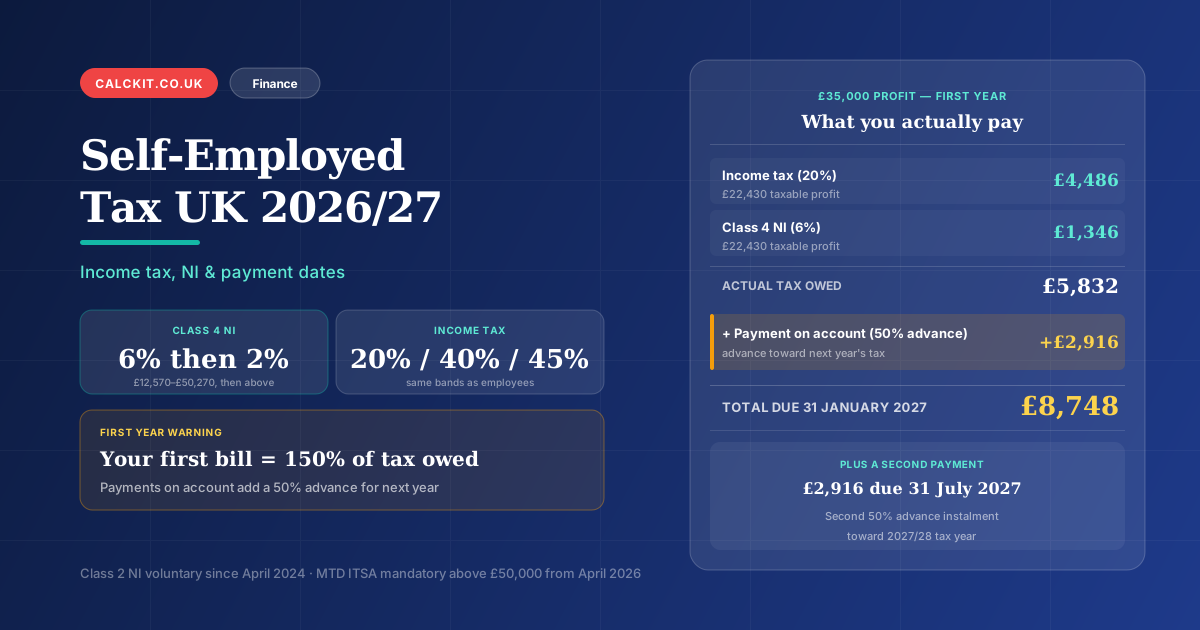
A self-employed person earning £35,000 profit owes roughly £5,832 in income tax and National Insurance for the year — but their first actual payment to HMRC is often closer to £8,750. The difference is payments on account: an advance instalment toward next year's bill that almost nobody expects until it lands.
This guide covers everything self-employed people in the UK need to know for 2026/27 — income tax, Class 4 National Insurance, exactly how payments on account work, what expenses you can deduct, and the Making Tax Digital changes now affecting higher earners.
🏛What tax do self-employed people pay?
Self-employed people (sole traders and partners) pay two main taxes on their profit:
- Income tax — at the same rates as employees: 20% basic rate, 40% higher rate, 45% additional rate
- Class 4 National Insurance — 6% on profits between £12,570 and £50,270, and 2% above
Unlike employees, self-employed people are not subject to employer National Insurance (there is no "employer" in a sole trader business), and Class 2 NI — a flat-rate contribution — became voluntary from April 2024 for most people.
Both income tax and Class 4 NI are calculated on profit (income minus allowable business expenses), not turnover. This is one of the most important distinctions for anyone new to self-employment — what you bill clients is not what you are taxed on.
Income tax rates 2026/27
| Band | Profit | Rate |
|---|---|---|
| Personal allowance | Up to £12,570 | 0% |
| Basic rate | £12,571 – £50,270 | 20% |
| Higher rate | £50,271 – £125,140 | 40% |
| Additional rate | Above £125,140 | 45% |
These are identical to employee income tax bands — self-employment does not give you a different income tax rate. For full details on thresholds and the personal allowance taper, see UK Income Tax Bands 2026.
Class 4 National Insurance 2026/27
| Profit | Class 4 rate |
|---|---|
| Up to £12,570 (Lower Profits Limit) | 0% |
| £12,570 – £50,270 | 6% |
| Above £50,270 | 2% |
Class 4 NI is calculated on the same profit figure as income tax and paid through the same Self Assessment return — there is no separate filing required.
Class 2 National Insurance — voluntary since April 2024
Class 2 NI is a flat weekly contribution that historically all self-employed people paid automatically. Since April 2024, it became voluntary for most people:
- If your profits are above the Small Profits Threshold (£7,105), you are treated as having a qualifying year for State Pension purposes without needing to pay Class 2 at all
- If your profits are below £7,105, you can choose to pay Class 2 voluntarily (a few pounds per week — check the current rate at gov.uk) to protect your State Pension qualifying year
- Paying voluntary Class 2 is significantly cheaper than the alternative — voluntary Class 3 contributions — making it worth doing if your profits are low in a given year and you want to protect your record
For a full explanation of how qualifying years build toward your State Pension, see National Insurance Rates UK 2026/27.
🏛Worked example: full tax bill on £35,000 profit
Income tax = (Profit – £12,570) × applicable rate(s) Class 4 NI = (Profit – £12,570) × 6% (up to £50,270), then 2% above
| Step | Calculation | Amount |
|---|---|---|
| Taxable profit | £35,000 – £12,570 | £22,430 |
| Income tax at 20% | £22,430 × 20% | £4,486.00 |
| Class 4 NI at 6% | £22,430 × 6% | £1,345.80 |
| Total tax and NI owed | £5,831.80 | |
| Take-home from £35,000 profit | £35,000 – £5,831.80 | £29,168.20 |
This is the underlying liability for the tax year. What you actually pay to HMRC on the deadline date can be significantly higher in your first year — covered next.
Self Assessment payment dates 2026/27
| Date | What's due |
|---|---|
| 6 April 2026 | Tax year begins |
| 5 October 2026 | Deadline to register for Self Assessment (if filing for the first time) |
| 31 October 2026 | Paper tax return deadline |
| 30 December 2026 | Deadline to opt into PAYE collection for bills under £3,000 |
| 31 January 2027 | Online tax return deadline, balancing payment due, AND first payment on account for 2026/27 |
| 31 July 2027 | Second payment on account for 2026/27 |
The 31 January deadline is the one that catches people out — it is not just "pay last year's tax." It is the date your balancing payment and first payment on account are both due together.
Payments on account — the mechanism that doubles your first bill
This is the single most misunderstood part of self-employed tax, and almost every guide just lists the date without explaining why the amount is so much higher than expected.
When payments on account apply: If your Self Assessment tax bill is more than £1,000, and less than 80% of your tax was already deducted at source (which is almost always the case for self-employed income), HMRC requires you to make payments on account toward next year's tax bill — in advance, before you've even earned that income.
How it works:
Payment on account (each instalment) = 50% of your previous year's total tax and Class 4 NI bill
Worked example — first year of self-employment:
You owe £5,831.80 in tax and Class 4 NI for 2026/27 (your first year trading). On 31 January 2027, you must pay:
| Component | Amount |
|---|---|
| Balancing payment — your actual 2026/27 tax bill | £5,831.80 |
| First payment on account — 50% advance toward 2027/28 | £2,915.90 |
| Total due 31 January 2027 | £8,747.70 |
Then on 31 July 2027, a second payment on account of £2,915.90 is due — another 50% advance.
The following year (2028), assuming your income stays similar:
| Component | Amount |
|---|---|
| Balancing payment for 2027/28 (£5,831.80 actual, minus £5,831.80 already paid via the two payments on account) | £0 |
| First payment on account for 2028/29 | £2,915.90 |
| Total due 31 January 2028 | £2,915.90 |
Notice the pattern: the first year is painful (150% of your real tax bill), but if your income stays flat, subsequent years settle into paying roughly the "right" amount in advance. The shock is concentrated entirely in year one — and again whenever your income jumps significantly, since payments on account lag a year behind actual earnings.
If you expect your income to fall significantly in the coming year, you can apply to reduce your payments on account through your HMRC online account. Be careful: if you reduce them too much and your income doesn't fall as expected, HMRC charges interest on the shortfall.
How much to set aside from every invoice
Because there is no PAYE deduction for self-employed income, the responsibility for saving toward your tax bill is entirely yours. A practical rule:
| Profit level | Suggested set-aside | Reasoning |
|---|---|---|
| Profit entirely within basic rate (up to £50,270) | 25–30% of profit | Covers ~20% income tax + ~6% Class 4 NI on most of the amount, with margin |
| Profit partly in higher rate (above £50,270) | 35–40% on the portion above £50,270 | 40% income tax + 2% Class 4 NI on that portion |
| First year of trading | Add an extra 15–20% buffer | Accounts for the payment on account shock |
Open a separate savings account — ideally one paying interest — and transfer your set-aside percentage every time you are paid. Treat it as money that is not yours, in the same way PAYE tax is never "yours" as an employee.
👤Allowable expenses — what reduces your tax bill
You only pay tax and Class 4 NI on profit — turnover minus allowable expenses. Common categories:
- Office costs — stationery, software subscriptions, postage, printing
- Travel — business mileage, train fares, parking (not home-to-a-fixed-workplace commuting)
- Home working costs — a proportion of utility bills, internet, and rent/mortgage interest if you work from home regularly (simplified flat-rate options are available based on hours worked from home per month)
- Professional fees — accountancy fees, relevant professional subscriptions, business insurance
- Marketing — website costs, advertising, business cards
- Equipment — computers, tools, machinery (sometimes via capital allowances rather than as a direct expense, depending on the item and value)
- Staff costs — if you employ anyone, their wages and associated costs
The test: an expense must be wholly and exclusively for business purposes. If something has mixed personal and business use (a mobile phone, a car, part of your home), you can only claim the business-use proportion — and you need a reasonable basis for that apportionment if HMRC ever asks.
Keeping organised digital records of every expense — not just at year end — makes both your Self Assessment return and any future Making Tax Digital obligation significantly easier.
Making Tax Digital for Income Tax (MTD ITSA)
From April 2026, Making Tax Digital for Income Tax Self Assessment became mandatory for self-employed people and landlords with qualifying income above £50,000. The threshold drops to £30,000 from April 2027, bringing many more people into scope.
What changes if you're above the threshold:
- You must keep digital records of income and expenses (spreadsheets alone are not sufficient — you need MTD-compatible software, though a bridging tool can connect a spreadsheet to compliant software)
- Instead of one annual Self Assessment return, you submit quarterly updates summarising income and expenses
- A final declaration is still required at year end, similar to the current process, to confirm and finalise your tax position
Quarterly update periods for 2026/27 (first mandatory year):
| Quarter | Period covered | Submission deadline |
|---|---|---|
| Q1 | 6 April – 5 July 2026 | 7 August 2026 |
| Q2 | 6 July – 5 October 2026 | 7 November 2026 |
| Q3 | 6 October – 5 January 2027 | 7 February 2027 |
| Q4 | 6 January – 5 April 2027 | 7 May 2027 |
HMRC has confirmed no penalties apply for late quarterly updates during this initial transition year, though the final declaration deadline (31 January 2028 for the 2026/27 tax year) carries the usual penalty regime.
Below the threshold: if your qualifying income is under £50,000 (or £30,000 from April 2027), you continue filing a standard annual Self Assessment return as before — MTD ITSA does not yet apply to you.
Self-employed vs employed — the real tax comparison
Self-employed people often assume they pay significantly less tax than employees because Class 4 NI (6%) is lower than employee Class 1 NI (8%). The full picture is more nuanced:
| Factor | Employed | Self-employed |
|---|---|---|
| Income tax | Same rates | Same rates |
| NI on earnings up to £50,270 | 8% (employee) | 6% (Class 4) |
| Employer NI | 15% paid by employer (not visible to you) | None — no employer |
| Pension contributions | Often matched by employer | Entirely self-funded |
| Sick pay | Statutory Sick Pay (employer-funded) | None unless self-insured |
| Holiday pay | Statutory minimum 5.6 weeks | None — unpaid time off |
| Maternity/paternity pay | Statutory entitlements | Maternity Allowance only, lower rate |
The 2-percentage-point NI saving is real, but it does not come close to compensating for the lost benefits most employees receive automatically. This is why freelance rate calculations should always build in an allowance for pension, holiday, and sick pay — see How to Set Freelance Rates for the full methodology.
⚖️What happens if you can't pay your tax bill
If you know you will not be able to pay by the deadline, contact HMRC before the due date rather than after. HMRC offers Time to Pay arrangements:
- For debts under £30,000, you can typically set up a payment plan online via your HMRC account, spreading the amount over up to 12 months
- Interest continues to accrue on the outstanding balance, but this is significantly cheaper than the escalating late payment penalties triggered by simply missing the deadline
- For larger debts or more complex situations, you may need to call HMRC directly to negotiate terms
Penalties for late payment (if no arrangement is made):
| Timing | Penalty |
|---|---|
| 30 days late | 5% of unpaid tax |
| 6 months late | Further 5% of unpaid tax outstanding |
| 12 months late | Further 5% of unpaid tax outstanding |
These are in addition to daily interest charged on the outstanding balance from the original due date.
Frequently Asked Questions
Do I need to register as self-employed if I only earn a small amount?
You must register for Self Assessment if your self-employment income exceeds £1,000 in a tax year (the Trading Allowance). Below £1,000, you generally do not need to register or declare the income, though you may choose to if you want to build a Self Assessment history or claim losses.
Can I be both employed and self-employed at the same time?
Yes — many people have a PAYE job alongside self-employed income (sometimes called a "side hustle"). You still need to register for Self Assessment if your self-employment profit exceeds £1,000, and your employed income is taxed normally through PAYE while your self-employed profit is reported and taxed via Self Assessment. Your personal allowance is used against your combined income, generally applied to your employment income first.
Do I pay tax twice if I'm both employed and self-employed?
No — your tax bands and personal allowance apply across your combined income, not separately for each source. However, because your employed income is taxed at source assuming it's your only income, your self-employed profit is effectively taxed starting from wherever your employed income leaves off in the band structure. This often means self-employed profit is taxed at 40% sooner than people expect if their main job already uses up the basic rate band.
Should I become a limited company instead of staying a sole trader?
It depends on your profit level and circumstances. Limited companies can be more tax-efficient at higher profit levels through the salary/dividend split, but come with additional administrative requirements (Companies House filing, separate business bank account, corporation tax). For most sole traders earning under £30,000–£40,000 profit, staying a sole trader is usually simpler with limited tax disadvantage. See Limited Company vs PAYE UK for a detailed comparison.
The bottom line
Self-employed people pay income tax at the same rates as employees, plus Class 4 National Insurance at 6% (up to £50,270) and 2% above. The real complexity is not the rates themselves but the payment mechanism — payments on account mean your first tax bill is often 150% of your actual liability, and Making Tax Digital is now reshaping how higher earners report income from April 2026.
Set aside 25–30% of every payment from day one, register on time, and budget specifically for the payment-on-account shock in your first year — it is the single most common source of self-employed tax stress, and entirely avoidable with the right planning.
🏛Last updated June 2026. Tax rates, thresholds, and MTD deadlines based on HMRC 2026/27 guidance. Rules can change — for personalised advice, consult a qualified UK accountant.