
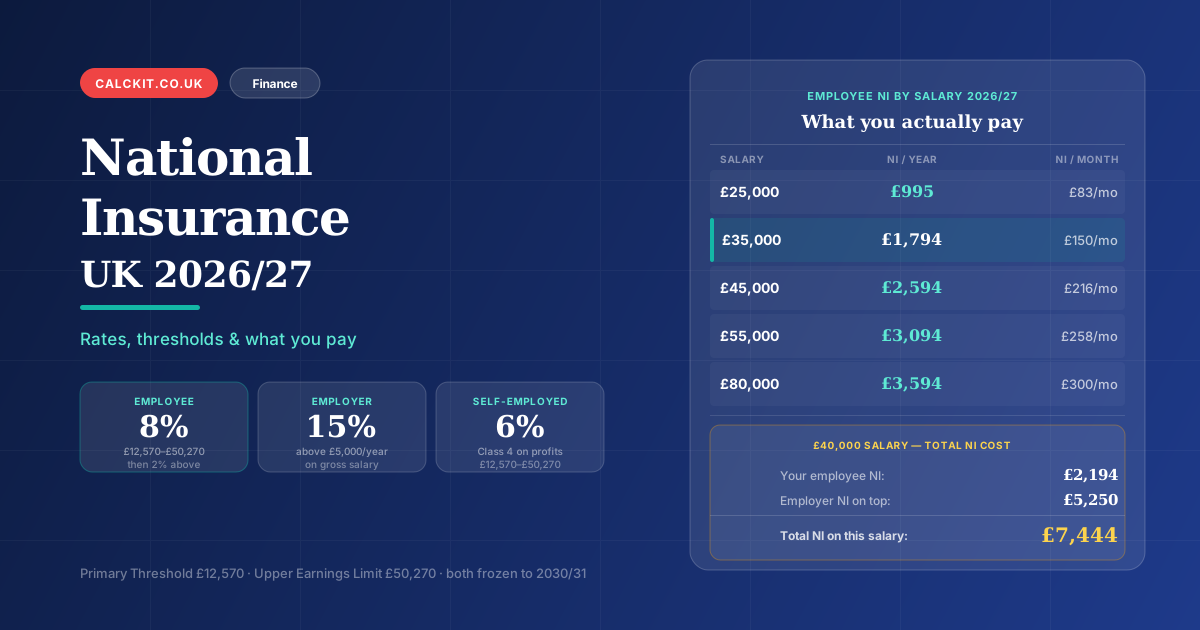
On a £40,000 salary in 2026/27, you pay approximately £2,194 in National Insurance. Your employer pays a further £5,250 on top of your gross salary — money you never see but that significantly increases the total cost of employing you. Combined, nearly £7,500 is paid in NI contributions on a £40,000 salary before a penny of income tax is considered.
National Insurance is often the second largest deduction from a UK pay packet after income tax, yet many people have only a vague idea of how it is calculated, what the thresholds are, or how it connects to their State Pension entitlement. This guide covers all of it.
🏛What is National Insurance?
National Insurance (NI) is a tax on earnings paid by employees, employers, and the self-employed. Contributions fund the NHS, the State Pension, Jobseeker's Allowance, Maternity Allowance, and several other state benefits. Unlike income tax — which goes into a general government pot — NI contributions are nominally linked to your entitlement to these specific benefits, particularly the State Pension.
NI is split into classes:
- Class 1 — paid by employees (and separately by employers) on earnings from employment
- Class 2 — paid by self-employed people (flat-rate weekly contribution)
- Class 3 — voluntary contributions to fill gaps in your NI record
- Class 4 — paid by self-employed people on profits above a threshold
Most employees only deal with Class 1 employee contributions, which appear on your payslip as a deduction alongside income tax.
Employee National Insurance rates 2026/27
| Earnings | NI rate |
|---|---|
| Below £12,570 (Primary Threshold) | 0% |
| £12,570 – £50,270 (Upper Earnings Limit) | 8% |
| Above £50,270 | 2% |
The Primary Threshold (£12,570/year) is aligned with the income tax personal allowance. The Government has frozen both at £12,570 until at least 2030/31. The Upper Earnings Limit (£50,270) is also frozen at the same level as the higher-rate income tax threshold.
Weekly and monthly equivalents:
| Annual | Weekly | Monthly |
|---|---|---|
| Primary Threshold: £12,570 | £242 | £1,048 |
| Upper Earnings Limit: £50,270 | £967 | £4,189 |
How employee NI is calculated — step by step
Employee NI = (Earnings between £12,570 and £50,270) × 8%
- (Earnings above £50,270) × 2%
Example: £35,000 salary
- Earnings above Primary Threshold: £35,000 – £12,570 = £22,430
- NI at 8%: £22,430 × 8% = £1,794.40/year
- Earnings above Upper Earnings Limit: £0 (salary below £50,270)
- Total employee NI: £1,794.40/year (£149.53/month)
Example: £65,000 salary
- Earnings between £12,570 and £50,270: £37,700 × 8% = £3,016
- Earnings above £50,270: £14,730 × 2% = £294.60
- Total employee NI: £3,310.60/year (£275.88/month)
How much NI you pay at common salary levels
This table shows annual employee NI at common UK salary levels — the figures most people actually want to know:
| Gross salary | Employee NI per year | Employee NI per month | Effective NI rate |
|---|---|---|---|
| £15,000 | £195.20 | £16.27 | 1.3% |
| £20,000 | £595.20 | £49.60 | 3.0% |
| £25,000 | £995.20 | £82.93 | 4.0% |
| £30,000 | £1,395.20 | £116.27 | 4.7% |
| £35,000 | £1,794.40 | £149.53 | 5.1% |
| £40,000 | £2,194.40 | £182.87 | 5.5% |
| £45,000 | £2,594.40 | £216.20 | 5.8% |
| £50,000 | £2,994.40 | £249.53 | 6.0% |
| £55,000 | £3,094.40 | £257.87 | 5.6% |
| £60,000 | £3,194.40 | £266.20 | 5.3% |
| £80,000 | £3,594.40 | £299.53 | 4.5% |
| £100,000 | £3,994.40 | £332.87 | 4.0% |
The effective NI rate falls above £50,270 because only 2% applies to earnings above that level.
Use the calculator below to get your precise figure including income tax:
🏛Employer National Insurance 2026/27
Your employer pays a separate, additional NI contribution on top of your gross salary. This is not deducted from your pay — it is an additional cost your employer bears. Many employees are unaware how large this is.
| Earnings | Employer NI rate |
|---|---|
| Up to £5,000 (Secondary Threshold) | 0% |
| Above £5,000 | 15% |
The Secondary Threshold is £5,000/year — significantly lower than the employee Primary Threshold. This means employers start paying NI at a much lower earnings level than employees do.
Employer NI at common salary levels:
| Gross salary | Employer NI per year | Total employer cost (salary + NI) |
|---|---|---|
| £20,000 | £2,250 | £22,250 |
| £30,000 | £3,750 | £33,750 |
| £40,000 | £5,250 | £45,250 |
| £50,000 | £6,750 | £56,750 |
| £60,000 | £8,250 | £68,250 |
Employer NI = (Gross salary – £5,000) × 15%
The gap between what you earn and what you cost your employer is significant. A £40,000 salary costs the employer approximately £45,250 — 13% more than the headline figure.
Employment Allowance
Eligible employers can reduce their employer NI bill by up to £10,500 per year through the Employment Allowance. From April 2026, the previous £100,000 employer NI liability cap was removed, making the allowance available to businesses of all sizes.
Eligible employers include most limited companies, partnerships, and sole traders with at least one employee. Single-director companies with no other employees remain ineligible unless they have at least one other employee on the payroll.
For limited company directors who are the sole employee, the Employment Allowance does not apply. This is one reason many accountants recommend keeping director salary at or near the Secondary Threshold (£5,000) rather than the personal allowance (£12,570) — to avoid employer NI entirely when the allowance is unavailable.
Fiscal drag — what frozen thresholds cost you
The Primary Threshold has been frozen at £12,570 since 2022/23 and will remain there until at least 2030/31. Meanwhile, average UK wages have been rising at 5–6% per year. The effect is that a larger proportion of your earnings falls within the NI band each year — even if your real-terms purchasing power has not changed.
The cost of fiscal drag (employee NI) on a £35,000 2022/23 salary:
If the same person's salary rose with average earnings (5%/year):
| Tax year | Salary | Employee NI | Extra vs 2022/23 |
|---|---|---|---|
| 2022/23 | £35,000 | £1,794 | — |
| 2023/24 | £36,750 | £1,934 | +£140 |
| 2024/25 | £38,588 | £2,081 | +£287 |
| 2025/26 | £40,517 | £2,236 | +£442 |
| 2026/27 | £42,543 | £2,398 | +£604 |
By 2026/27, this person pays over £600/year more in NI than in 2022/23 — not because NI rates changed, but because the frozen threshold captures more of their income each year. The same effect applies to income tax via the frozen personal allowance.
Self-employed National Insurance — Class 2 and Class 4
Self-employed people do not pay Class 1 employee or employer NI. Instead, they pay:
Class 4 NI (profit-based):
| Profit | Class 4 rate |
|---|---|
| Up to £12,570 (Lower Profits Limit) | 0% |
| £12,570 – £50,270 | 6% |
| Above £50,270 | 2% |
Class 4 is paid via self-assessment, alongside income tax. Unlike employee NI at 8%, the Class 4 main rate is 6% — a meaningful saving compared to employed status, which partly explains why some people prefer self-employment or limited company structures.
Class 2 NI (flat-rate):
A flat weekly Class 2 contribution gives you access to benefits including the State Pension and Maternity Allowance. If your profits are above the Small Profits Threshold (£12,570), payment is automatic through self-assessment. If you are below the threshold, you can choose to pay voluntarily to protect your benefit entitlements. Check the current Class 2 weekly rate at gov.uk — it is typically uprated each year in line with CPI.
Class 4 NI worked example (£45,000 profit):
| Step | Calculation | Amount |
|---|---|---|
| Profit above Lower Profits Limit | £45,000 – £12,570 | £32,430 |
| Class 4 at 6% | £32,430 × 6% | £1,945.80 |
| Profit above Upper Profits Limit | £0 (below £50,270) | £0 |
| Total Class 4 NI | £1,945.80/year |
Director NI — the annual earnings period
Company directors are treated differently from regular employees when it comes to NI. Instead of NI being calculated week by week or month by month, directors use an annual earnings period — meaning NI is calculated cumulatively across the whole tax year.
This matters because directors often take little or no salary for part of the year, then pay themselves a larger salary or bonus later. The annual method prevents a director from avoiding NI by timing salary payments across the weekly threshold.
In practice: If you pay yourself a £12,570 salary as a director (the most common approach), you pay zero employee NI for the year — the annual method ensures no NI is triggered once the annual primary threshold is met. This is mathematically identical to a regular employee on the same salary, but the timing of actual deductions on your payslip may differ across the year.
For a full breakdown of salary and dividend strategy for directors, see: How to Pay Yourself as a Limited Company Director.
⚖️Multiple jobs — NI overpayment and how to reclaim it
If you have more than one job, each employer calculates NI independently using the full Primary Threshold (£12,570). This means if you earn £18,000 from Job A and £15,000 from Job B (£33,000 total), both employers apply the threshold separately:
- Job A: NI on £18,000 – £12,570 = £5,430 × 8% = £434.40
- Job B: NI on £15,000 – £12,570 = £2,430 × 8% = £194.40
- Total NI paid: £628.80
If you were in a single job earning £33,000:
- NI on £33,000 – £12,570 = £20,430 × 8% = £1,634.40
In this case, two jobs actually results in less NI — because both employers apply the threshold. However, the situation reverses if both salaries are already above the primary threshold. In that scenario, no over-payment occurs because each job is taxed from the threshold regardless.
The more common overpayment scenario involves the Upper Earnings Limit. If each employer sees your salary below £50,270 but your combined income exceeds it, you may pay 8% on income that should be taxed at 2%. You can reclaim overpaid NI through self-assessment (which you would likely need to file anyway to declare multiple income sources).
NI exemptions — when you stop paying
State Pension age: You stop paying employee Class 1 NI from the first pay day after reaching State Pension age (currently 66). Your employer continues to pay employer NI at 15% regardless of your age. Self-employed people stop paying Class 4 NI from the start of the tax year in which they reach State Pension age.
Under 21 and apprentices under 25: Employers pay 0% NI on these employees' earnings up to the Upper Secondary Threshold (£50,270). This is designed to reduce the cost of hiring younger workers. Employee NI is unaffected — employees under 21 still pay the standard 8%/2% rates.
Veterans: Employers pay 0% NI on veterans' earnings in their first year of civilian employment, up to £50,270.
Married women's reduced rate: A legacy reduced rate (sometimes called the "small stamp") exists for some married women who elected for it before 1977. This is now very rare, but a small number of women still paying at the reduced rate will continue to do so if they have kept the election active.
NI and your State Pension — why qualifying years matter
National Insurance contributions are the mechanism by which you build entitlement to the new State Pension. Each tax year in which you pay or are credited with NI contributions counts as a qualifying year.
| Qualifying years | State Pension entitlement |
|---|---|
| Fewer than 10 | No State Pension |
| 10–34 | Partial State Pension (proportional) |
| 35 or more | Full new State Pension (£241.30/week in 2026/27) |
NI credits: You may receive credits — which count as qualifying years without making payments — if you are receiving Child Benefit for a child under 12, are on certain benefits, or are in certain caring roles. Credits are important for people who take career breaks.
The implication: If you earn above the Lower Earnings Limit (£6,708/year) but below the Primary Threshold (£12,570/year), you are treated as having paid NI — you get the qualifying year without any actual deduction from your pay.
Voluntary Class 3 contributions — filling gaps in your NI record
If you have gaps in your NI record — years spent abroad, in full-time education, caring for someone, or earning below the Lower Earnings Limit — you can pay voluntary Class 3 contributions to fill them.
Each qualifying year filled by Class 3 contributions costs £18.40 per week in 2026/27 — £956.80 for a full year (the rate is uprated annually, so check gov.uk). Filling one gap year adds 1/35th of the full State Pension to your entitlement.
Is it worth paying? In most cases, yes. The cost of filling a one-year gap is £956.80 at the 2026/27 Class 3 rate. One extra qualifying year adds approximately £6.89/week to your State Pension (£241.30 ÷ 35), which is about £358/year. The payback period is under 3 years — and since the State Pension is index-linked, the return compounds over a typical 20+ year retirement.
You can generally fill gaps going back six years. In some circumstances (reaching State Pension age before April 2035), you may be able to fill gaps back to 2006/07 — speak to HMRC or a pension adviser about your specific situation.
How to check your National Insurance record
The fastest way to check your NI record — including how many qualifying years you have and any gaps — is through your HMRC Personal Tax Account at gov.uk.
You can see:
- Your NI number
- Number of qualifying years on record
- Estimated State Pension based on your current record
- Any gaps and whether they can be filled with voluntary contributions
If you have not already set up your Personal Tax Account, you can do so at gov.uk/personal-tax-account. You will need a Government Gateway ID.
If you are approaching State Pension age and have fewer than 35 qualifying years, checking your NI record and filling affordable gaps is one of the highest-return financial moves available — the yield on voluntary Class 3 contributions typically far exceeds savings accounts or low-risk investments.
Frequently Asked Questions
Can I opt out of National Insurance?
No. National Insurance is a legal requirement for employees earning above the Primary Threshold and self-employed people earning above the Lower Profits Limit. There is no opt-out. The only way to legitimately reduce NI is through salary sacrifice arrangements (such as pension contributions or cycle to work), which reduce your gross pay before NI is calculated.
Does salary sacrifice reduce National Insurance?
Yes — this is one of its main benefits. When you make pension contributions via salary sacrifice, your gross pay is reduced before NI is applied. A basic-rate employee sacrificing £2,000/year into a pension saves 8% on that amount (£160 in employee NI) plus their employer saves 15% (£300 in employer NI). Many employers pass the employer NI saving back to the employee as additional pension contributions.
Does National Insurance affect my tax code?
No. Your PAYE tax code (e.g. 1257L) relates to income tax, not National Insurance. NI is calculated separately using its own thresholds and has no code. Changes to your NI contribution do not affect your tax code and vice versa.
Is there a maximum NI you pay per year?
There is no explicit annual cap, but the rate structure effectively limits the percentage you pay. Once your earnings exceed £50,270, you only pay 2% on the excess — so as a proportion of income, NI falls significantly at higher salaries. A person earning £100,000 pays £3,994.40 in NI (roughly 4% of income), compared to someone earning £50,000 who pays £2,994.40 (roughly 6%).
Does dividend income count for National Insurance?
No. Dividends do not attract National Insurance — neither employee nor employer NI. This is one reason limited company directors often take a low salary and draw additional income as dividends, reducing their combined tax and NI burden.
The bottom line
For 2026/27, the employee NI rate of 8% applies to earnings between £12,570 and £50,270, and 2% above. Your employer pays a further 15% on your earnings above £5,000. Self-employed people pay Class 4 at 6% up to £50,270 and 2% above.
With thresholds frozen to 2030/31, fiscal drag will continue to push more earnings into the NI band each year as wages rise. Checking your NI record and understanding how contributions feed into your State Pension entitlement is increasingly important — particularly if you have gaps from career breaks, periods abroad, or low-earning years.
🏛To see your complete take-home after both income tax and NI — with pension and student loan included:
💷Last updated June 2026. National Insurance rates and thresholds based on HMRC 2026/27 guidance. Rates are subject to change in future Budgets.