
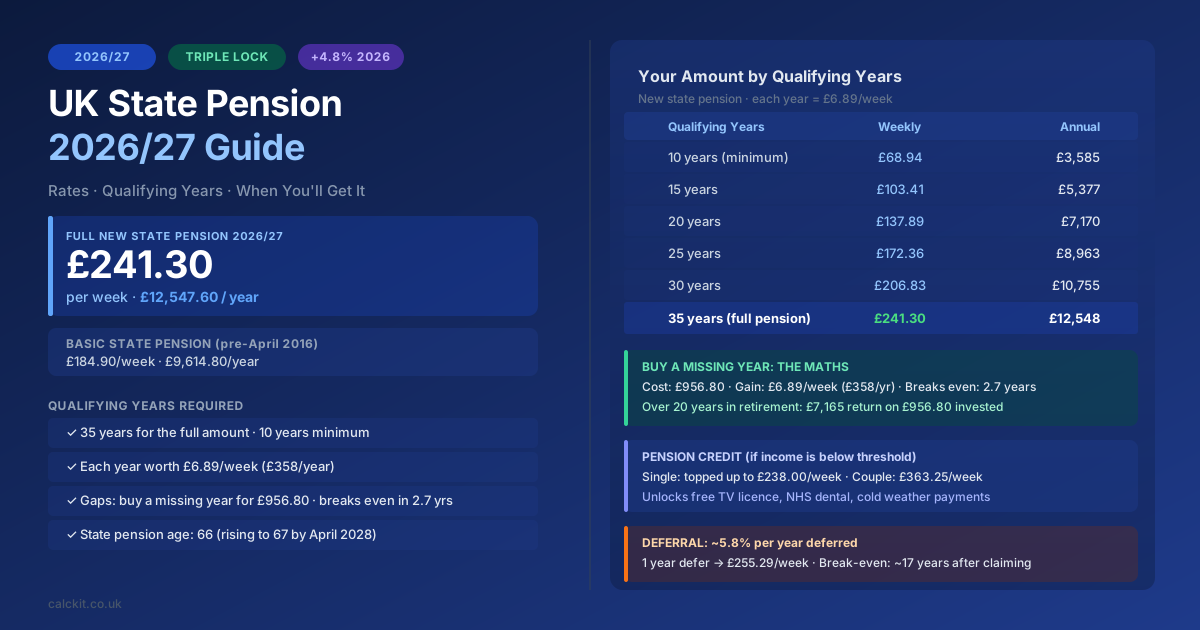
The full new state pension is £241.30 a week from 6 April 2026. That's £12,547.60 a year — almost exactly the personal allowance, which means most people living solely on the state pension pay no income tax. But millions receive less than the full amount, and many don't realise there are straightforward steps to top it up before they reach state pension age.
This guide covers everything: the 2026/27 rates, how qualifying years determine your amount, whether buying missing years is worth it, when you'll actually receive it, and what to do if you're short.
🏛UK state pension rates 2026/27
There are two state pension systems in the UK, depending on when you reached state pension age.
| Pension type | Weekly rate 2026/27 | Annual equivalent |
|---|---|---|
| Full new state pension (reached SPA from 6 April 2016) | £241.30 | £12,547.60 |
| Full basic state pension (reached SPA before 6 April 2016) | £184.90 | £9,614.80 |
The new state pension increased by 4.8% from April 2026, in line with average earnings growth — the highest of the three triple-lock measures for this year. This followed a 4.1% rise in 2025/26.
What is the triple lock?
The triple lock is the government's commitment to increase the state pension each April by the highest of:
- Average earnings growth (measured May–July of the previous year)
- CPI inflation (measured the previous September)
- 2.5%
For 2026/27, average earnings growth at 4.8% was the winning measure. The triple lock has been government policy since 2010 but remains subject to parliamentary vote each year.
How qualifying years determine your amount
The full new state pension requires 35 qualifying years of National Insurance (NI) contributions or credits. You need at least 10 years to receive anything.
Each qualifying year adds £6.89 per week to your state pension (£241.30 ÷ 35).
| Qualifying years | Weekly state pension | Annual state pension |
|---|---|---|
| 10 | £68.94 | £3,585 |
| 15 | £103.41 | £5,377 |
| 20 | £137.89 | £7,170 |
| 25 | £172.36 | £8,963 |
| 30 | £206.83 | £10,755 |
| 35 | £241.30 | £12,548 |
These figures apply to the new state pension. If you have a National Insurance record that predates April 2016, your starting amount was calculated under transitional rules, and you may receive a protected amount that's different from these figures — higher if you built up Additional State Pension before 2016, or lower if you were contracted out.
State pension age: when will you get it?
State pension age has been rising and varies depending on when you were born.
| Date of birth | State pension age |
|---|---|
| Before 6 April 1960 | 66 (already reached) |
| 6 April 1960 – 5 March 1961 | Between 66 and 67 (rising gradually, transitional period April 2026 – April 2028) |
| 6 March 1961 onwards | 67 |
| Projected further rise | 68 (planned 2044–2046, subject to legislation) |
The gradual increase from 66 to 67 means someone born in July 1960 reaches state pension age at 66 years and 7 months — not 66 on their birthday. You can check your exact date on gov.uk.
The previously planned rise to 68 between 2037 and 2039 has been pushed back to 2044–2046 under current government policy. But "current policy" can change — anyone in their 40s today should be aware their state pension age may still shift.
What counts as a qualifying year?
A qualifying year is a tax year in which you have:
Paid NI contributions:
- Employed (Class 1): earnings at or above the Lower Earnings Limit — £6,396 in 2025/26
- Self-employed (Class 2 and Class 4): profits above the Small Profits Threshold — £6,845 in 2025/26
- Voluntary (Class 3): paying voluntary contributions to fill gaps (more on this below)
Or claimed NI credits for:
- Child Benefit while responsible for a child under 12
- Caring for someone for 20+ hours per week (Carer's Credit)
- Claiming certain benefits: Jobseeker's Allowance, Employment and Support Allowance, Carer's Allowance
- Statutory Sick Pay, Maternity Allowance, or Statutory Maternity Pay periods
If you were a stay-at-home parent or carer for most of their working life, NI credits for Child Benefit and Carer's Credit may have quietly built up qualifying years without any contributions. Check your NI record — you might have more than you think.
How to check your NI record and state pension forecast
- Go to gov.uk/check-your-state-pension-forecast (requires a Government Gateway account)
- Or use the HMRC app on your phone
- Or call the Future Pension Centre: 0800 731 0175
Your forecast shows your current projected weekly state pension, how many qualifying years you have, any gaps in your record, and what you would receive if you carried on to state pension age.
Voluntary NI contributions: is buying missing years worth it?
If your NI record has gaps, you can fill them by paying Class 3 voluntary NI contributions.
2026/27 Class 3 rate: £18.40/week = £956.80 per year
What do you get in return?
| What you pay | What you gain | Break-even |
|---|---|---|
| £956.80 (one year) | £6.89/week = £358.28/year | 2.7 years after claiming |
| £956.80 (one year) | Over 20-year retirement: £7,165 total | 648% return |
This is one of the best-value financial decisions available to anyone approaching retirement with NI gaps. The payback period of under three years is hard to beat with any other savings product.
Which years can you buy?
You can normally fill gaps in the previous 6 tax years. For 2026/27, that means buying back to 2020/21.
A special extended deadline that allowed buying years all the way back to 2006/07 closed in April 2025. If you missed it, you can no longer access those older cheap rates. Going forward, only the most recent 6 years are available for voluntary purchase.
Who should prioritise this?
- Anyone with fewer than 35 qualifying years who has gaps they can fill
- Those who took time out to raise children or care for a family member and didn't claim the relevant NI credits at the time
- Self-employed people who had years with profits below the Small Profits Threshold
It is worth checking whether you already have NI credits for any gap years before paying voluntarily — you may not need to buy years you already have.
Contracting out — why your forecast might be below £241.30
Many people who worked before April 2016 have a state pension forecast below £241.30 even though they have 35+ qualifying years. The reason is almost always contracting out.
Between 1978 and 2016, employees could opt out of the Additional State Pension (S2P or SERPS) in exchange for paying lower National Insurance. Their employer's pension scheme — often a defined benefit scheme — agreed to replace that portion of the state pension with a workplace pension instead.
If you were contracted out, HMRC records a Contracted Out Pension Equivalent (COPE) amount. This is the portion of state pension that your workplace pension is meant to replicate. It reduces your state pension starting amount — but the expectation is that your workplace pension more than compensates.
What to do if you were contracted out:
- Check your state pension forecast and look for any mention of a deduction
- Locate old defined benefit pension records to verify the COPE amount is actually being paid
- If you changed jobs frequently and have multiple small defined benefit pensions, make sure each one is traced (the Pension Tracing Service can help: gov.uk/find-pension-contact-details)
Deferring your state pension — does it pay off?
You don't have to claim your state pension the moment you reach state pension age. If you delay, it grows.
Deferral rate: 1% for every 9 weeks deferred ≈ 5.8% per year
| Defer by | Weekly amount | Extra per week | Break-even after claiming |
|---|---|---|---|
| 0 (no deferral) | £241.30 | — | — |
| 1 year | ~£255.29 | +£13.99 | ~17 years |
| 2 years | ~£269.27 | +£27.97 | ~17 years |
| 3 years | ~£283.26 | +£41.96 | ~17 years |
The break-even is roughly the same regardless of how long you defer: around 17 years after the date you start claiming.
When deferral makes sense:
- You are still working and don't need the state pension income
- You are in good health and expect a long retirement
- You have other income to live on and don't want to push yourself into a higher tax band earlier
When deferral rarely pays off:
- You are in poor health or have a family history of shorter lifespan
- You need the income immediately
- You are already earning enough that extra state pension would be fully taxed
Unlike the old basic state pension, the new state pension does not offer a lump sum option for deferral — only a higher weekly amount. If you reached state pension age before April 2016 under the old rules, the lump-sum option may still apply to you.
Is the state pension taxable?
Yes — the state pension counts as income and is subject to income tax. However, at £12,547.60 per year in 2026/27, it sits just £22.40 below the personal allowance of £12,570.
For people with only state pension income: no income tax is due — the state pension fits almost entirely within the personal allowance.
For people with additional income: once the state pension plus other income (private pension, part-time work, savings interest, rental income) exceeds £12,570, income tax applies on the excess at 20% for most people.
How it appears on your tax: state pension is paid gross — no tax is deducted at source. HMRC adjusts your tax code on any other income source you have, such as a private pension, to collect any tax owed.
If your only income is the state pension and it slightly exceeds your personal allowance (possible if you have a protected payment), or if you have untaxed income elsewhere, HMRC may issue a simple tax calculation. Don't ignore it — the amount owed is usually small but there can be penalties for non-payment.
What if the state pension isn't enough? Pension Credit
If your weekly income falls below certain thresholds, you may be entitled to Pension Credit — a means-tested top-up from the government.
Pension Credit thresholds 2026/27:
| Situation | Guarantee Credit threshold |
|---|---|
| Single person | £238.00/week |
| Couple | £363.25/week |
If your state pension and other income is below these amounts, Pension Credit tops you up to the threshold.
Pension Credit also unlocks:
- Free TV licence (if over 75)
- Help with council tax (Council Tax Reduction)
- NHS dental treatment, glasses, and hospital travel costs
- Cold Weather Payment during cold snaps
- Warm Home Discount
Only around half of those eligible for Pension Credit actually claim it. If your weekly income is near these thresholds, use the Pension Credit calculator at gov.uk/pension-credit-calculator or call the Pension Credit helpline: 0800 99 1234.
How the state pension fits into a retirement income plan
The full new state pension at £241.30/week covers day-to-day basics, but falls short of the Retirement Living Standards' "moderate" retirement income target of around £31,300 per year for a single person (or £43,100 for a couple).
The gap between state pension and a comfortable retirement is roughly £18,750/year for a single person — and bridging that gap is what workplace pensions, SIPPs, and ISAs are designed to do.
If you're still in work, salary sacrifice pension contributions are one of the most efficient ways to build that gap: every £1 you sacrifice costs you as little as 72p in take-home pay while putting the full £1 into your pension — and your employer saves their 15% NI on it too, which many employers pass back to you under SMART sacrifice arrangements.
🐷State pension quick-reference: 2026/27
| Figure | 2026/27 |
|---|---|
| Full new state pension | £241.30/week |
| Full basic state pension | £184.90/week |
| Triple lock increase | +4.8% (average earnings) |
| Qualifying years for full new SP | 35 |
| Minimum qualifying years | 10 |
| Each qualifying year worth | £6.89/week |
| Class 3 voluntary NI rate | £956.80/year |
| State pension age (born before Apr 1960) | 66 |
| State pension age (born after Mar 1961) | 67 |
| Deferral rate | ~5.8% per year |
| Pension Credit threshold (single) | £238.00/week |
| Pension Credit threshold (couple) | £363.25/week |