
Most retirement guides give you a target pension pot — £500,000, or ten times your salary — without showing how they got there. The number sounds large, feels abstract, and rarely connects to what retirement actually costs.
This guide works from the other direction. It starts with what a retirement lifestyle actually costs in the UK (according to independent research), subtracts what the State Pension contributes, and shows you the pot size and monthly savings rate needed to cover the gap. Every figure is grounded in the same PLSA standards that HMRC, financial advisers, and the DWP use as reference points.
🐷What does retirement actually cost? The PLSA Retirement Living Standards
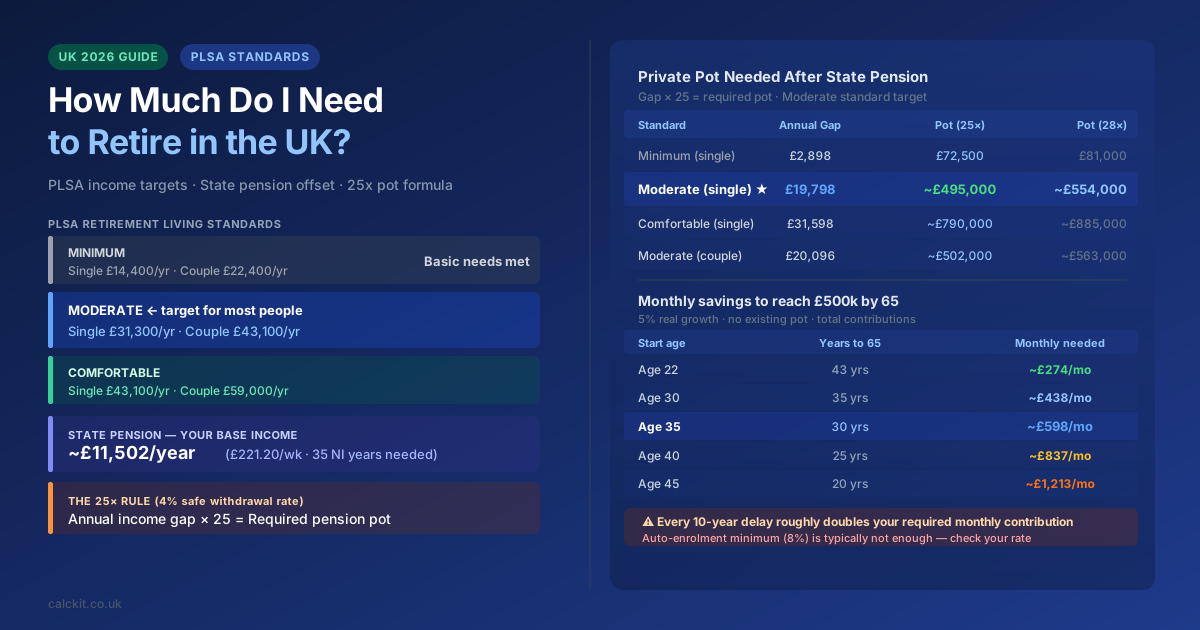
The Pensions and Lifetime Savings Association (PLSA) publishes three annual income benchmarks for retirement in the UK. These are not arbitrary targets — they are calculated from detailed consumer research into what real people spend at each quality of life level, covering housing, food, transport, clothing, leisure, and holidays.
| Standard | Single person | Couple |
|---|---|---|
| Minimum | £14,400/year | £22,400/year |
| Moderate | £31,300/year | £43,100/year |
| Comfortable | £43,100/year | £59,000/year |
What each standard actually looks like:
Minimum — covers all basic needs with some money for leisure. No car (public transport only), limited eating out, one short UK holiday per year. Essentially a functional but constrained retirement.
Moderate — a more realistic standard for most people. Includes a used car, regular meals out, two holidays per year (one abroad), home improvements, and some financial flexibility. This is the target most financial advisers recommend planning for.
Comfortable — a comfortably funded retirement. New car every five years, regular restaurant meals, long-haul flights, home improvements, significant gifting to family. Private healthcare subscriptions.
The most important number: for a single person, the difference between minimum and moderate is roughly £17,000 per year. That gap has to come from private pension savings.
What the New State Pension contributes
The New State Pension provides a foundation that most people overlook when calculating their retirement target. For the 2026/27 tax year, the full New State Pension is £241.30 per week (£12,547.60 per year). This amount is uprated each April by the triple lock (the higher of earnings growth, CPI inflation, or 2.5%).
To receive the full State Pension, you need 35 qualifying National Insurance years. A partial State Pension is paid for anyone with 10–34 qualifying years, at a proportional rate.
You can check your State Pension forecast at gov.uk using your Government Gateway login — this shows your current qualifying years and projected weekly amount.
Key point: the State Pension does not depend on your private pension pot. It is paid regardless of what you have saved privately, and it continues for life. This makes it a guaranteed income base that reduces — sometimes dramatically — the private pot you need.
The State Pension age is currently 66 for both men and women, rising to 67 by 2028. If you plan to retire before 66, your private pension must cover the full income gap during those early retirement years — without any state pension contribution — which increases the required pot size.
The retirement income gap — what your private pension actually needs to cover
Once you know the PLSA target and the state pension contribution, the calculation becomes straightforward:
Retirement income gap = target annual income − State Pension
| Standard | Target income (single) | State Pension | Annual gap | Required pot (25x) |
|---|---|---|---|---|
| Minimum | £14,400 | £12,548 | £1,852 | ~£46,300 |
| Moderate | £31,300 | £12,548 | £18,752 | ~£469,000 |
| Comfortable | £43,100 | £12,548 | £30,552 | ~£764,000 |
For couples, both partners receive the State Pension (assuming both have full qualifying records):
| Standard | Target income (couple) | Two State Pensions | Annual gap | Required pot (25x) |
|---|---|---|---|---|
| Minimum | £22,400 | £23,004 | £0 (covered) | £0 |
| Moderate | £43,100 | £23,004 | £20,096 | ~£502,400 |
| Comfortable | £59,000 | £23,004 | £35,996 | ~£900,000 |
The insight that most guides skip: for a couple both receiving full State Pension, the minimum standard is almost entirely covered. The target to plan for is the moderate standard gap of approximately £500,000 — this is the realistic private pension goal for most households.
The 25x rule — how pot size is calculated
The target pot figures above use the 25x rule, derived from the 4% safe withdrawal rate. The logic:
- A diversified pension portfolio invested in equities and bonds can sustain withdrawals of 4% of its value per year
- At 4%, you would need a pot 25 times your required annual income to maintain withdrawals indefinitely
- £18,752 annual gap × 25 = £468,800 — rounded to ~£469,000 above
The 4% rule is a guide, not a guarantee. Actual withdrawal sustainability depends on investment returns, inflation, sequence of returns risk, and how long retirement lasts. Many advisers now use 3.5% (a 28.6x rule) as a more conservative figure, particularly for early retirees.
Conservative version: using 3.5% withdrawal, the moderate standard gap (£18,752/year) requires a pot of £535,771 — approximately £536,000.
For planning purposes, targeting £500,000–£570,000 for a moderate single retirement is a reasonable range.
💰Monthly contributions needed — by start age
The table below shows the approximate monthly contribution required to reach a £500,000 pension pot by age 65, starting with no existing pot, assuming 5% annual real growth (after inflation). These are total contributions — the sum of employee and employer contributions.
| Start age | Years to 65 | Monthly contribution needed |
|---|---|---|
| 22 | 43 years | ~£274/month |
| 25 | 40 years | ~£322/month |
| 30 | 35 years | ~£438/month |
| 35 | 30 years | ~£598/month |
| 40 | 25 years | ~£837/month |
| 45 | 20 years | ~£1,213/month |
| 50 | 15 years | ~£1,866/month |
Every decade of delay roughly doubles the required monthly contribution.
Starting at 22 with minimum auto-enrolment (8% of £25,000 salary = £167/month total): this is significantly below the £274/month needed for moderate retirement. The auto-enrolment minimum was designed as a floor, not a target.
Salary sacrifice amplifies your contribution: because salary sacrifice pension reduces your taxable income, the net cost to you is lower than the gross contribution. A basic rate taxpayer saving £274/month grossly spends only £198/month in take-home pay terms (saving 20% tax plus 8% NI). See Salary Sacrifice Pension UK for the full calculation.
Worked example: retirement planning at a £35,000 salary
Anna earns £35,000 per year. She wants to retire at 65 with a moderate lifestyle. She is currently 32.
Step 1 — Target income: PLSA moderate = £31,300/year (single)
Step 2 — State Pension: Full New State Pension = £12,548/year
Step 3 — Annual gap: £31,300 − £12,548 = £18,752/year from private pension
Step 4 — Required pot: £18,752 × 25 = £468,800 (≈ £470,000)
Step 5 — Monthly contribution: Starting at 32 (33 years to 65), 5% real growth → approximately £510/month total contributions
Step 6 — Auto-enrolment check: At £35,000, mandatory minimum auto-enrolment = 8% = £2,800/year = £233/month total. This is £277/month short of the target.
Step 7 — Gap to fill: Anna would need to voluntarily increase contributions by £277/month. Through salary sacrifice, this costs approximately £200/month in actual take-home pay, since the 20% income tax and 8% NI relief reduce the effective cost. Her employer may also match voluntary contributions — worth checking.
Step 8 — Pension access: Anna can access her private pension from age 57 (from 2028). If she wants to retire before 65, the pot calculation changes — a retirement at 60 means drawing down for 5 more years with no State Pension yet, requiring a larger pot.
Are you on track? Pension pot benchmarks by age
These benchmarks show approximate pot sizes for someone targeting a moderate single retirement (£500,000 pot by 65). Enter your own numbers into the pension calculator for a projection built around your actual age, pot, and contribution rate.
🏦These are approximate milestones for someone targeting a moderate single retirement (£500,000 pot by 65):
| Age | Pension pot benchmark |
|---|---|
| 30 | £30,000–£50,000 |
| 35 | £60,000–£90,000 |
| 40 | £110,000–£155,000 |
| 45 | £175,000–£235,000 |
| 50 | £260,000–£330,000 |
| 55 | £355,000–£420,000 |
| 60 | £440,000–£490,000 |
These ranges account for variable investment returns and assume total contributions in the range of £350–£550/month from age 22–30 onwards. If your current pension pot is significantly below the lower figure for your age, consider increasing contributions or consulting a financial adviser.
How to find your current pension pot value: log in to each pension provider's online portal. If you have lost track of old workplace pensions, use the government's Pension Tracing Service (gov.uk/find-pension-contact-details).
Private pension access age and State Pension age — two different things
This distinction trips people up:
| Private pension | New State Pension | |
|---|---|---|
| Current access age | 55 (rising to 57 in April 2028) | 66 (rising to 67 by 2028) |
| Future changes | 57 from 2028 | 68 proposed from mid-2040s |
| Depends on | Your pension plan rules | Your National Insurance record |
If you retire at 60, you can draw from your private pension from age 57 (from 2028 onwards) — but you will not receive the State Pension until age 66 or 67. Your private pot has to cover the full income requirement during that gap.
Early retirement gap example: retiring at 60 rather than 67 means seven years without State Pension income. At £12,548/year, that is approximately £87,800 of State Pension income your pot has to generate instead. This adds roughly £85,000–£100,000 to the required pot size for early retirees.
The annual allowance — how much you can contribute
You can contribute up to £60,000 per year (or 100% of your earnings, whichever is lower) to a pension and receive tax relief. This is the standard annual allowance. The Lifetime Allowance was abolished in April 2024.
Carry forward: if you have not used your full annual allowance in any of the previous three tax years, you can carry it forward. This is useful for making larger one-off contributions, such as after a bonus or inheritance.
High earners: if your adjusted income exceeds £260,000, the tapered annual allowance may reduce your limit to as low as £10,000. Consult a financial adviser if you earn above this threshold.
What type of pension you have matters
Defined Contribution (DC): your pot grows based on contributions and investment returns. The final pot size is not guaranteed. This guide's calculations apply to DC pensions — the most common type for people currently in work.
Defined Benefit (DB): your employer guarantees a specific income in retirement, typically based on years of service and final or average salary. If you have a DB pension, your guaranteed income directly reduces the private pot target. DB pensions are rare in the private sector but still common in the public sector (NHS, teachers, civil servants).
SIPP (Self-Invested Personal Pension): a DC pension you manage yourself, with control over investment choices. Useful for the self-employed or for consolidating old workplace pensions. Contributions work the same way for tax relief purposes.
The salary sacrifice advantage
Pension contributions made through salary sacrifice cost less in take-home pay terms than the same contribution through a standard personal pension, because they reduce your income tax and National Insurance bill.
For a basic rate taxpayer:
- Gross pension contribution: £100/month
- Income tax saving (20%): £20
- National Insurance saving (8%): £8
- Net cost to you: £72/month
For a higher rate taxpayer:
- Net cost: £58/month (saving 40% tax + 2% NI)
Over 30 years, this difference compounds significantly. A basic rate taxpayer who contributes £500/month gross through salary sacrifice has an effective cost of only £360/month in take-home pay. See Salary Sacrifice Pension UK for full worked examples by salary level.
🏛Quick checklist — retirement planning actions
- Find all your pensions — use the government's Pension Tracing Service for any lost workplace pensions
- Check your State Pension forecast — log in to gov.uk with your Government Gateway credentials
- Check your NI record — fill gaps in qualifying years before it's too late (you can buy back up to 6 years of missing years)
- Calculate your gap — PLSA target income − State Pension = annual shortfall × 25 = required pot
- Check your current contributions — are they above the auto-enrolment minimum? Are you leaving employer matching unused?
- Model salary sacrifice — if your employer offers it, calculate the NI saving and consider increasing contributions
- Review investment allocation — at 22–50, most DB and SIPP experts recommend higher equity allocation (70–80%+); shift to bonds/cash as you approach retirement
- Consider professional advice — if your situation involves DB benefits, property income, or significant inheritance, an independent financial adviser regulated by the FCA can model the interactions
Last updated July 2026. PLSA Retirement Living Standards figures are as published by the Pensions and Lifetime Savings Association. State Pension figure is 2025/26 confirmed rate. This article is for information only and does not constitute financial advice. For personalised retirement planning, consult an FCA-regulated financial adviser or use the free Pension Wise service (available to over-50s via MoneyHelper).