
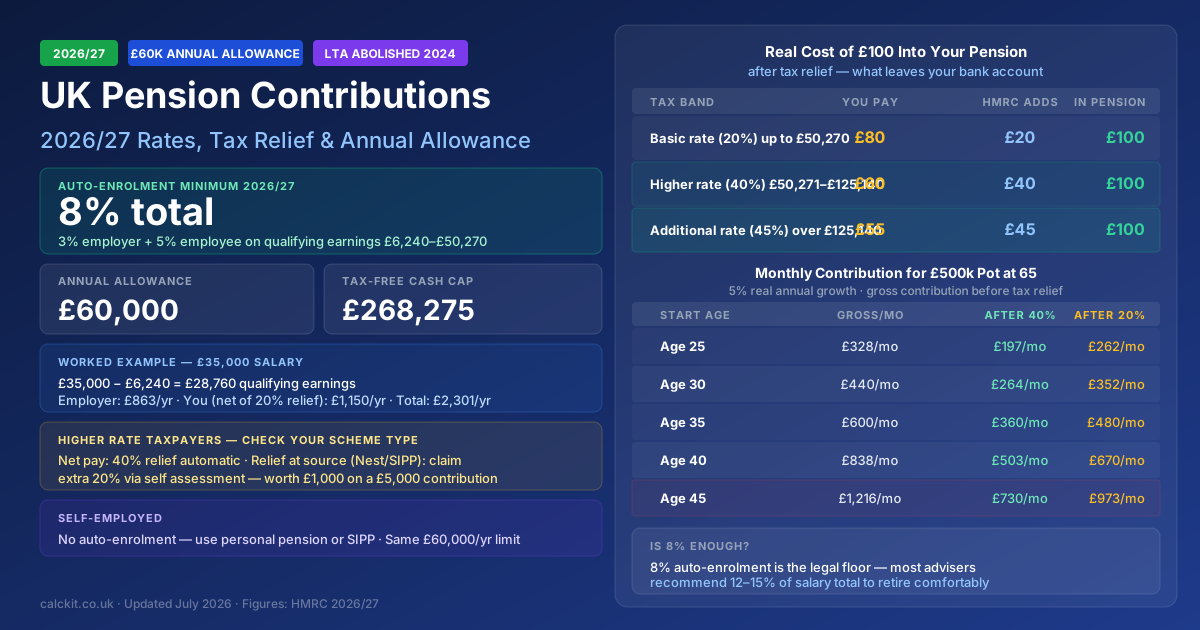
The legal minimum pension contribution in the UK is 8% of qualifying earnings. For someone on a £35,000 salary, that is just under £2,300 a year going into their pension. But at that rate, most people will fall short of a comfortable retirement — and many won't realise until it's too late.
This guide covers exactly how auto-enrolment contributions are calculated, how tax relief works at each tax band, and how much you actually need to be saving to replace your salary in retirement.
🏛Auto-enrolment minimum contributions 2026/27
Auto-enrolment requires a minimum total contribution of 8% of qualifying earnings, split between you and your employer:
| Who pays | Minimum contribution |
|---|---|
| Employer | 3% of qualifying earnings |
| Employee (you) | 5% of qualifying earnings |
| Total | 8% of qualifying earnings |
These minimum rates have been in place since April 2019. Your employer can contribute more than 3% — if they do, you may be able to contribute less while still hitting the 8% total, depending on your scheme rules.
Some employers use a "total earnings" or "pensionable pay" basis instead of qualifying earnings. This can be more generous if pensionable pay equals your full salary, but the auto-enrolment minimum using the qualifying earnings band is the legal floor.
What are qualifying earnings?
Qualifying earnings are not your full salary. They are the slice of your pay between the lower earnings limit (£6,240/year) and the upper earnings limit (£50,270/year).
Qualifying earnings = Your salary − £6,240 (up to a maximum of £44,030)
Auto-enrolment contributions at common salaries:
| Gross salary | Qualifying earnings | Employer (3%) | Your share (5%) | Total | Your net cost (after 20% relief) |
|---|---|---|---|---|---|
| £20,000 | £13,760 | £413/yr | £688/yr | £1,101/yr | £550/yr |
| £25,000 | £18,760 | £563/yr | £938/yr | £1,501/yr | £750/yr |
| £30,000 | £23,760 | £713/yr | £1,188/yr | £1,901/yr | £950/yr |
| £35,000 | £28,760 | £863/yr | £1,438/yr | £2,301/yr | £1,150/yr |
| £45,000 | £38,760 | £1,163/yr | £1,938/yr | £3,101/yr | £1,550/yr |
| £55,000+ | £44,030 (max) | £1,321/yr | £2,202/yr | £3,522/yr | £1,321/yr |
The "your net cost" column assumes basic rate tax relief (20%). If you pay higher rate tax, your actual cost is even lower — see the tax relief section below.
How pension tax relief works
Tax relief is the government's contribution to your pension. Every pound you put in was already taxed when you earned it — so HMRC gives that tax back, which is why contributing to a pension is one of the most tax-efficient things you can do with your salary.
The real cost of a £100 pension contribution:
| Your tax rate | You contribute | HMRC adds | In your pension | Your effective cost |
|---|---|---|---|---|
| Basic rate (20%) | £80 | £20 | £100 | £80 |
| Higher rate (40%) | £60 | £40 | £100 | £60 |
| Additional rate (45%) | £55 | £45 | £100 | £55 |
Higher rate taxpayers: If your pension uses relief at source (see below), you need to take an extra step to claim the additional 20% relief. HMRC only adds basic rate (20%) automatically — you claim the other 20% via self assessment or by contacting HMRC to adjust your tax code. This is worth claiming: on a £5,000 pension contribution, the extra relief is £1,000.
💰Net pay vs relief at source — an important distinction
There are two methods by which workplace pensions collect tax relief, and the difference matters for higher rate taxpayers:
Relief at source: You pay contributions from your post-tax pay. The pension provider then claims 20% basic rate tax relief from HMRC and adds it to your pot. Higher and additional rate taxpayers must claim additional relief themselves via self assessment.
Used by: Nest, The People's Pension, many personal pensions and SIPPs
Net pay arrangement: Contributions are deducted from your salary before income tax is calculated — so you automatically receive tax relief at your full marginal rate without needing to file a self assessment return.
Used by: most large employer schemes and occupational pensions
Why it matters: A higher rate taxpayer in a net pay scheme pays £60 per £100 pension contribution automatically. The same taxpayer in a relief at source scheme pays £80 (and must claim an additional £20 back via self assessment). If you don't claim the extra relief, you're overpaying by 20p for every £1 you contribute.
Check your pension scheme documents or ask your HR department which method your workplace pension uses.
Is 8% enough?
The 8% auto-enrolment minimum was designed to get people saving, not to provide a comfortable retirement. Whether it is enough depends on:
- When you start contributing
- Your target retirement income
- What the state pension provides (currently £241.30/week if you have 35 qualifying NI years)
A widely cited rule of thumb for contributions is half your age as a percentage. Start at 25 and contribute 12.5%; start at 35 and you need 17.5%. This is a rough guide, not a formula, but it conveys the impact of starting late.
Monthly contributions to build a £500,000 pot by age 65 (5% real annual growth):
| Start age | Monthly contribution needed | After 40% tax relief | After 20% tax relief |
|---|---|---|---|
| 25 | £328/mo | £197/mo | £262/mo |
| 30 | £440/mo | £264/mo | £352/mo |
| 35 | £600/mo | £360/mo | £480/mo |
| 40 | £838/mo | £503/mo | £670/mo |
| 45 | £1,216/mo | £730/mo | £973/mo |
These are gross contributions (before tax relief). The "after relief" columns show what you actually need to take out of your bank account if your pension uses relief at source.
A £500,000 pot, added to the state pension (£12,548/year), could generate an income of approximately £32,548/year under the 4% withdrawal rule — around the PLSA Moderate Retirement Living Standard for a single person in 2026.
These figures assume 5% real annual growth (after inflation) and no existing pension savings. If you already have a pension pot, the monthly contribution needed is lower. Use the savings goal calculator below to model your own scenario with a starting balance.
The annual allowance
The pension annual allowance is the maximum you can contribute to your pension each year while still benefiting from tax relief. For 2026/27 it is £60,000 (or 100% of your annual earnings, whichever is lower). This includes:
- Your own contributions
- Your employer's contributions
- Any contributions from third parties
Carry forward: If you did not use your full annual allowance in the previous three tax years, you can carry the unused portion forward. This requires you to have been a member of a pension scheme in each of those years. Carry forward is particularly useful for the self-employed with variable income, or anyone who wants to make a large one-off pension contribution.
Money Purchase Annual Allowance (MPAA): Once you have accessed your pension flexibly (for example, by entering drawdown), your annual allowance for defined contribution pensions is reduced to £10,000. This prevents people from drawing down pension money and then re-contributing it for tax relief. The standard £60,000 allowance still applies to any defined benefit pension you might have.
The pension lifetime allowance — what changed in 2024
The Lifetime Allowance (LTA) was abolished from 6 April 2024. Previously, there was a cap (£1,073,100) on total pension savings that could benefit from tax relief. That cap no longer exists — you can save as much as you want in a pension without a lifetime limit.
However, two new allowances replaced it:
- Lump Sum Allowance (LSA): £268,275 — caps the total amount of tax-free cash (usually 25% of your pot) you can take at retirement. Any tax-free lump sum above this is taxed at your marginal rate.
- Lump Sum and Death Benefit Allowance (LSDBA): £1,073,100 — applies to death benefits. Lump sums above this paid from pensions on death are taxable.
For most people with pension pots under £1 million, the LTA abolition makes little practical difference. For higher earners who were approaching the old £1.073m limit, it removes a significant barrier to saving more.
Pension contributions if you are self-employed
Self-employed workers are not automatically enrolled into a pension — you need to set one up yourself. The good news is you can contribute to a personal pension or SIPP (Self-Invested Personal Pension) on your own terms.
- Contribute up to £60,000/year (or 100% of your net relevant earnings — essentially your profit after expenses — if that is lower)
- Basic rate tax relief (20%) is added automatically
- Higher rate taxpayers claim additional relief via self assessment
- Contributions do not have to be monthly — you can pay lump sums whenever your cash flow allows
If your income is variable, consider saving a fixed percentage of each invoice payment into a pension rather than setting a fixed monthly direct debit. Many self-employed workers contribute at the end of the tax year once their profits are clearer.
For more on self-employed tax and NI, see Self-Employed Tax UK 2026/27.
Use our pension calculator to project how your current contribution rate grows over time and see how much you need to add monthly to hit your retirement target.
🏦Pension contributions quick reference 2026/27
| Figure | 2026/27 |
|---|---|
| Auto-enrolment minimum total | 8% of qualifying earnings |
| Employer minimum | 3% |
| Employee minimum | 5% |
| Qualifying earnings lower limit | £6,240/year |
| Qualifying earnings upper limit | £50,270/year |
| Annual allowance | £60,000 |
| Money Purchase Annual Allowance (if in drawdown) | £10,000 |
| Lump Sum Allowance (tax-free cash at retirement) | £268,275 |
| Basic rate relief on contributions | 20% (HMRC adds £20 per £80 paid) |
| Higher rate effective relief | 40% (claim extra 20% via self assessment) |
| Lifetime Allowance | Abolished April 2024 |