
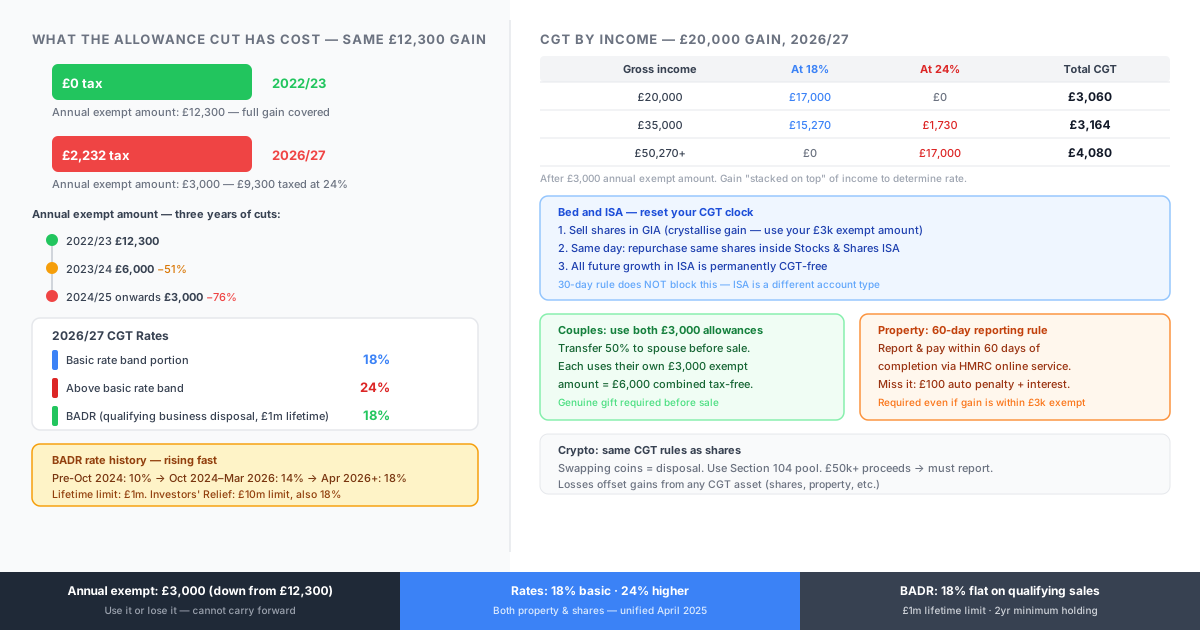
In April 2022, Rachel sold some shares and made a £12,300 gain. Her CGT bill: £0. The annual exempt amount was £12,300 — every penny of the gain was tax-free.
In April 2026, her brother James sells a similar parcel of shares and makes the same £12,300 gain. His CGT bill: £2,232 — because the annual exempt amount is now £3,000, and the remaining £9,300 is taxed at his 24% higher-rate CGT band.
Same gain. Four-year gap. £2,232 more in tax.
The allowance was cut from £12,300 to £6,000 in April 2023, then to £3,000 in April 2024, where it remains frozen. For anyone who remembers paying no CGT on modest investment gains, the current position is a significant change.
This guide covers the full picture: rates, how your income band determines what you pay, the major reliefs, reporting rules, and the legal strategies to reduce your bill.
🏛CGT rates for 2026/27
Capital gains tax is charged at two rates, depending on how much of your basic rate income tax band is unused after accounting for your income.
| Your situation | CGT rate |
|---|---|
| Gain (or portion of gain) falls within your basic rate band | 18% |
| Gain (or portion) exceeds your basic rate band | 24% |
| Business Asset Disposal Relief (BADR) — qualifying business sales | 18% |
| Investors' Relief — qualifying investor disposals | 18% |
| Carried interest (fund managers) | 32% |
These rates apply to all asset classes — shares, buy-to-let property, second homes, cryptocurrency, and other assets. The residential property premium (previously 8% above the standard rate) was removed from 6 April 2025. Your main home is exempt under Private Residence Relief (see below).
The basic rate band for 2026/27 runs from £12,571 to £50,270 — a width of £37,700.
The annual exempt amount
Every individual gets a tax-free CGT allowance each year:
| Tax year | Annual exempt amount |
|---|---|
| 2022/23 | £12,300 |
| 2023/24 | £6,000 |
| 2024/25 | £3,000 |
| 2025/26 | £3,000 |
| 2026/27 | £3,000 |
The allowance is use it or lose it — you cannot carry unused amounts forward to future years. Married couples and civil partners each have their own £3,000 allowance, giving a combined £6,000 on assets held jointly or transferred between spouses before sale (see Couples strategy below).
What the cut has cost in £:
| Gain size | CGT in 2022/23 (£12,300 exempt) | CGT in 2026/27 (£3,000 exempt) | Extra tax |
|---|---|---|---|
| £5,000 | £0 | £0 | £0 |
| £10,000 | £0 | £1,260 (18%) | £1,260 |
| £12,300 | £0 | £2,232 (24%) | £2,232 |
| £20,000 | £1,386 | £4,488 | £3,102 |
| £50,000 | £9,450 | £12,600 | £3,150 |
Higher rate CGT (24%) assumed. Lower-income investors paying 18% would see proportionally lower but still significant increases.
How your income determines your CGT rate
This is the most misunderstood part of CGT. Your rate is not simply based on whether you are a "basic rate" or "higher rate" taxpayer — it depends on how much of your basic rate band is still available after your income is accounted for.
Step by step:
- Calculate your taxable income (salary, self-employment profit, dividends, etc.) minus your personal allowance (£12,570)
- Check how much of the basic rate band (£37,700) remains: £37,700 − taxable income above personal allowance
- The first slice of your capital gain uses up the remaining basic rate band (taxed at 18%)
- Any gain above that is taxed at 24%
Examples — £20,000 capital gain in 2026/27:
| Annual income (gross) | Taxable income above PA | Basic rate band remaining | Gain at 18% | Gain at 24% | Total CGT |
|---|---|---|---|---|---|
| £20,000 | £7,430 | £30,270 | £17,000 | £0 | £3,060 |
| £35,000 | £22,430 | £15,270 | £15,270 | £1,730 | £3,141 |
| £50,270 | £37,700 | £0 | £0 | £17,000 | £4,080 |
| £60,000 | £47,430 | £0 | £0 | £17,000 | £4,080 |
All figures after subtracting the £3,000 annual exempt amount from the £20,000 gain, leaving £17,000 taxable.
The capital gain is always added on top of your income — it does not replace it. A £17,000 taxable gain for someone earning £35,000 straddles the two rates: £15,270 at 18% (£2,749) and £1,730 at 24% (£415) = £3,164 total.
Business Asset Disposal Relief (BADR)
BADR gives qualifying business owners an 18% flat CGT rate on the disposal of their business, rather than the standard 24%. The relief has changed significantly in recent years.
BADR rate history:
| Period | BADR rate |
|---|---|
| Pre-October 2024 | 10% |
| October 2024 – March 2026 | 14% |
| April 2026 onwards | 18% |
The lifetime limit remains £1 million of qualifying gains. Once you have used £1 million under BADR across all disposals in your lifetime, further business gains are taxed at standard rates.
To qualify for BADR you must (for at least 2 years before disposal):
- Have owned the business, or shares in your personal company
- Hold at least 5% of ordinary share capital and 5% of voting rights
- Be an employee or officer of the company (not just a shareholder)
- The company must be a trading company (not mainly investment)
Investors' Relief is a separate relief for external investors in unlisted trading companies, also at 18% from April 2026, with a £10 million lifetime limit. The shareholding must have been held for at least 3 years from 6 April 2016.
Private Residence Relief: your main home
Your main home is fully exempt from CGT under Private Residence Relief (PRR) — provided it was your main and only home for your entire period of ownership.
Partial relief applies if:
- You let the property (the letting period is no longer automatically exempt — only the final 9 months of ownership are always exempt)
- You had a period of absence not covered by an allowed exemption
- Part of the property was used exclusively for business
The final 9 months rule: The last 9 months of ownership are always treated as if you were living in the property, regardless of whether you were. This helps people who have already moved to a new home before selling.
Lettings relief — previously up to £40,000 of exemption for landlords — was removed for most landlords in April 2020. It now only applies if you were living in the property at the same time as the tenant (i.e. a lodger situation).
If you genuinely lived in the property as your main home for the entire ownership period, there is no CGT and nothing to report — provided you did not use it exclusively for business.
CGT on shares
Gains on shares and funds held outside an ISA or pension are subject to CGT. Key rules:
Acquisition cost (the "pool"): When you buy shares over time, HMRC uses the "Section 104 pool" — an average cost across all purchases — rather than specific lot prices. You cannot choose which shares to "sell first."
The 30-day anti-avoidance rule: If you sell shares and repurchase the same shares within 30 calendar days, the repurchase price replaces the original pool cost. This prevents harvesting paper losses by selling and immediately rebuying.
Same-day rule: If you buy and sell the same shares on the same day, those are matched first before the pool rule applies.
Dividends vs gains: Dividends are taxed as income (covered separately under dividend tax). Only the increase in share price from acquisition to disposal creates a capital gain.
ISA exemption: Gains inside a Stocks and Shares ISA are permanently exempt from CGT. Losses inside an ISA cannot be used to offset gains elsewhere.
The Bed and ISA strategy
The most commonly used legal CGT planning technique for investors is Bed and ISA: selling shares held outside an ISA and immediately rebuying them inside a Stocks and Shares ISA. Future growth is then sheltered from CGT entirely.
Step by step — Bed and ISA:
- You hold £25,000 in a global tracker fund in a general investment account (GIA), originally purchased for £15,000. Unrealised gain: £10,000.
- You sell the fund in your GIA. The £10,000 gain minus your £3,000 annual exempt amount = £7,000 taxable. At 18% (basic rate): £1,260 CGT.
- The same day, you use £25,000 (or your remaining ISA allowance, up to £20,000) to buy the same tracker fund inside your Stocks and Shares ISA.
- Going forward, all gains inside the ISA are CGT-free — regardless of how much the fund grows.
The 30-day rule does not apply to Bed and ISA because the repurchase is in a different account type (ISA, not GIA). You crystallise the gain now — at a modest cost — to permanently exempt all future growth.
Optimal timing: If the CGT crystallised falls within your £3,000 annual exempt amount, there is no tax cost at all. Many investors run Bed and ISA each April using their fresh annual allowance to shelter gains up to £3,000 tax-free.
🏛CGT on buy-to-let and second properties
Buy-to-let and second home disposals follow the same 18%/24% rates as other assets since April 2025. The key differences from share disposals:
Allowable deductions: You can deduct from the gain:
- Purchase price plus buying costs (solicitor fees, stamp duty)
- Selling costs (estate agent fees, solicitor fees)
- Improvement costs (extension, conversion — not maintenance or repair)
- Any letting agent fees or mortgage arrangement fees paid on purchase are NOT deductible
60-day reporting rule: For UK residential property with a taxable gain, you must report and pay CGT within 60 days of the completion date — not exchange. This is done via HMRC's online "Report and Pay Capital Gains Tax on UK Property" service. You will need your Government Gateway login.
If you miss the 60-day deadline:
- Automatic £100 penalty
- A further £300 (or 5% of the tax due, if higher) at 6 months
- Interest charged on unpaid tax from day 61
The 60-day service is separate from Self Assessment. Even if you later submit a Self Assessment return covering the same year, you must still have reported the property gain within 60 days.
You must report within 60 days even if:
- The gain is fully covered by the annual exempt amount
- You have losses from the same year that reduce the gain to zero
- The property is being gifted (deemed disposal at market value)
The exception: if PRR fully covers the gain (main home sold with no letting period or business use), you do not need to report.
CGT on cryptocurrency
HMRC treats cryptocurrency as a capital asset. Every disposal is potentially a CGT event:
What counts as a disposal:
- Selling crypto for sterling
- Swapping one cryptocurrency for another (e.g. Bitcoin → Ethereum)
- Using crypto to buy goods or services
- Gifting crypto to anyone other than a spouse or civil partner
What does not count:
- Moving crypto between your own wallets
- Buying crypto with sterling (the acquisition, not a disposal)
Calculating the gain: Use the same Section 104 pool rules as shares. If you have bought Bitcoin in multiple tranches at different prices, you use the average pool cost. Apply the same-day and 30-day rules.
Losses: Crypto losses can be offset against gains from any other CGT asset in the same year (shares, property). If your crypto portfolio has fallen significantly, crystallising those losses (selling at a loss) creates a loss you can carry forward against future gains.
Reporting: If total CGT proceeds (across all disposals including crypto) exceed £50,000 in the tax year, you must report via Self Assessment even if the net gain is below £3,000 or you have no tax to pay.
Couples strategy: using two allowances
Transfers between spouses and civil partners happen at "no gain, no loss" — the recipient takes over the original acquisition cost. This is a legitimate way to use two annual exempt amounts on a single asset.
Example — buy-to-let sold for a £30,000 gain:
Without planning: One spouse sells. Gain £30,000 minus £3,000 exempt = £27,000 taxable at 24% = £6,480 CGT.
With spouse transfer: Transfer 50% of the property to spouse before sale (at no gain, no loss). Each spouse then has a £15,000 gain. Each uses their £3,000 exempt amount. Taxable for each: £12,000. If both are basic rate taxpayers: 18% × £12,000 × 2 = £4,320 CGT — saving £2,160.
If one spouse is a non-taxpayer or basic rate taxpayer, transferring the larger share to them can further reduce the bill by ensuring more of the gain falls in the 18% band rather than 24%.
Requirements: The transfer must be a genuine, outright gift before the sale — not a paper exercise the day of completion. HMRC can challenge artificial arrangements.
Capital losses
Losses from asset disposals are first offset against gains in the same tax year. If total losses exceed total gains, the net loss carries forward indefinitely.
Key rules:
- Losses must be used in the earliest year you have a gain — you cannot choose to save them for a high-income year
- Carried-forward losses reduce your net gain first, then the annual exempt amount applies to whatever remains
- Losses must be formally reported to HMRC within four years of the tax year of the loss
- Losses on assets given to charity, or on most personal use assets, cannot be claimed
- Losses within an ISA or pension cannot be used against external gains
Loss harvesting: Deliberately selling an asset at a loss before year end (5 April) to crystallise a loss that offsets gains elsewhere is entirely legal. You can repurchase the asset after 30 days without the anti-avoidance rule applying. Alternatively, use Bed and ISA — sell and immediately rebuy inside an ISA (the 30-day rule does not block this).
Reporting and paying CGT
Residential property: Report within 60 days of completion via HMRC's online property CGT service. Pay at the same time.
All other assets: Report via Self Assessment. The deadline is 31 January following the tax year. So gains made between 6 April 2026 and 5 April 2027 must be reported by 31 January 2028.
The £50,000 proceeds rule: If your total disposal proceeds (the total amount you received from selling assets — not just the gain) exceed £50,000 in the tax year, you must complete a Self Assessment return even if you owe no CGT. This catches people who sold assets below their acquisition cost.
What you can deduct from the gain:
- Acquisition cost (purchase price)
- Buying costs: solicitor fees, SDLT, surveyor fees
- Improvement costs (not maintenance)
- Selling costs: estate agent fees, solicitor fees
- Enhancement expenditure that increases the asset's value
Frequently asked questions
Do I pay CGT on my main home?
No — your main and only home is fully exempt from CGT under Private Residence Relief, provided you lived there as your principal residence for the entire ownership period. If you let the property, worked abroad, or owned multiple homes and nominated different main residences at different times, partial relief applies. The final 9 months of ownership are always treated as a qualifying period, regardless of whether you were living there.
Do I have to report CGT even if I owe nothing?
For residential property: yes, you must report within 60 days even if your gain is within the £3,000 exempt amount — unless PRR covers the gain entirely. For other assets: you must file Self Assessment if your total proceeds exceed £50,000, even with no tax due. If proceeds are under £50,000 and your total net gain is within the £3,000 exempt amount, you do not need to file.
Can I use my pension contributions to reduce CGT?
Not directly — pension contributions reduce your income tax liability, not CGT. However, they can indirectly reduce CGT if a large pension contribution drops you from higher rate to basic rate status, meaning a larger portion of your capital gain is taxed at 18% rather than 24%.
What assets are exempt from CGT?
Exempt assets include: your main home (under PRR), gains within ISAs and pensions, UK government gilts, most personal possessions (chattels) worth under £6,000, cars (including classic cars), premium bonds, lottery and betting winnings, and EIS/SEIS investments held for at least 3 years.
What is the difference between BADR and Investors' Relief?
Both give an 18% CGT rate from April 2026. BADR applies to business owners disposing of their own trading business or shares in a personal company where they have at least 5% of shares and work in the business. Investors' Relief applies to external investors in unlisted trading companies — they do not need to work in the business, but must have subscribed for newly issued shares and held them for at least 3 years. BADR lifetime limit: £1 million. Investors' Relief lifetime limit: £10 million.
When does the 30-day anti-avoidance rule apply?
The 30-day rule applies when you sell shares or securities and buy the same shares back within 30 calendar days. The repurchase price replaces the pool cost, preventing you from harvesting a paper loss by selling and rebuying. The rule does not apply to: Bed and ISA (repurchase inside an ISA), Bed and SIPP (repurchase inside a pension), or buying a different fund that tracks a different index.