
Beth left her £30,000 job in October 2025. Her employer had been deducting tax all year as though she'd earn £30,000 through to April — but she stopped at the halfway point. When her P800 arrived in July 2026, HMRC owed her £860. She claimed online and had the money in her bank account within 5 working days.
Tom has been contributing £4,000 a year into a Nest pension for four years. His pension scheme claimed 20% basic rate relief on his behalf — but Tom pays 40% tax. He never filed a Self Assessment. He's left £4,000 unclaimed.
These aren't unusual cases. They're two of the most common ways UK workers lose money they're legally owed. Here's every claim route, with the actual amounts at stake.
🏛Are you owed a refund?
The most common reasons for overpaid tax in the UK:
- Wrong tax code — an emergency BR or 0T code applied when you started a new job, or a code that hasn't updated after a pay change
- Left a job mid-year — your employer deducted tax assuming you'd earn the same salary all year; the unused personal allowance for the rest of the year was never credited
- Multiple jobs in one year — PAYE treats each job independently; HMRC reconciles at year end
- Work expenses never claimed — millions of employees are entitled to WFH relief, uniform allowances, and professional fee deductions and never claim
- Marriage allowance not set up — worth up to £1,008 in backdated refunds if unclaimed
- Higher-rate pension contributions via relief at source — your pension provider claimed 20% back from HMRC, but if you pay 40% tax, you're owed another 20% via Self Assessment
Which tax years are still claimable?
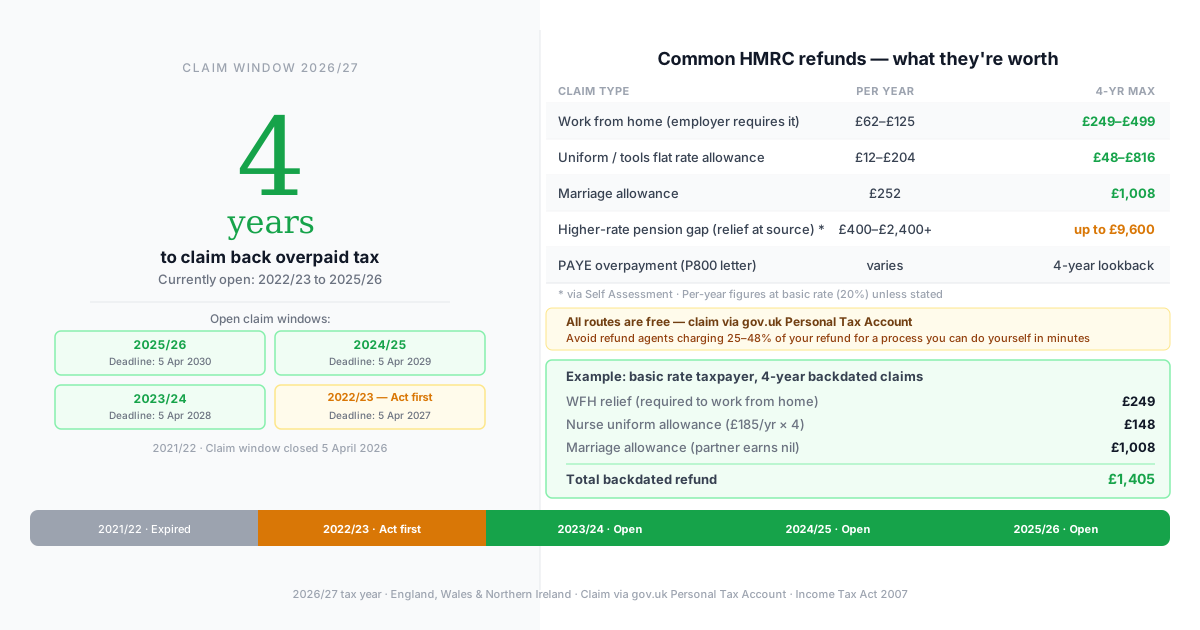
You have four years from the end of a tax year to claim. As of July 2026:
| Tax year | Claim deadline | Notes |
|---|---|---|
| 2025/26 | 5 April 2030 | Current year |
| 2024/25 | 5 April 2029 | |
| 2023/24 | 5 April 2028 | |
| 2022/23 | 5 April 2027 | Act on this one first |
| 2021/22 | Passed 5 April 2026 | No longer claimable |
If you have any of the claims below outstanding for 2021/22, that money is gone. For everything else — start with 2022/23, which has the nearest deadline.
Route 1: PAYE overpayment — the P800 letter
After each tax year, HMRC runs an end-of-year reconciliation of every PAYE income. If you've overpaid, they send a P800 tax calculation letter — usually between June and November.
What to do when it arrives:
- Sign in to your Personal Tax Account at GOV.UK
- Check the numbers match your records (payslips, P60, P45)
- Click "Claim refund" — choose bank transfer (5 working days) or cheque (up to 6 weeks)
- Important: If you don't claim online within 45 days, HMRC sends a cheque automatically — but claiming online is significantly faster
If you haven't received a P800 but think you're owed:
Sign in to your Personal Tax Account. Your income history and tax paid are visible there. If figures show overpayment, you can claim directly without waiting for a letter. HMRC won't chase you — you have to initiate this.
Worked example — Beth, mid-year job change:
Beth earned £30,000 and left her job in October 2025 (6 months into the 2025/26 tax year). Her employer taxed her as though she'd earn a full year's salary, using up only 6 months of her personal allowance through PAYE:
- Tax actually deducted (annualised basis): approximately £2,286
- Tax owed on £15,000 actual earnings: approximately £486
- P800 refund: £860
She claimed online on 4 July 2026. The money was in her account on 11 July.
Route 2: Work expenses — WFH, uniform, mileage, professional fees
Employees who spend their own money on work-related costs can claim tax relief. HMRC has agreed flat rates for common categories — no receipts needed.
Claim via: Online P87 form through your Personal Tax Account (for claims up to £2,500/year). Larger claims require Self Assessment.
Work from home
You can claim if your employer requires you to work from home — voluntary remote work doesn't qualify. The employee flat-rate claim was abolished from 6 April 2026, so this route now only covers earlier tax years (2022/23 to 2025/26) — see our working from home tax relief guide.
- Flat rate: £6 per week (no receipts needed)
- Annual allowance: £312/year
- Annual refund: £62.40 (basic rate, 20%) or £124.80 (higher rate, 40%)
- Backdated 4 years: up to £249.60 (basic) or £499.20 (higher rate)
Uniform and tools flat rates
For laundering a work uniform or replacing tools you bought yourself. Selected trades:
| Occupation | Annual allowance | Basic rate refund | Higher rate refund |
|---|---|---|---|
| Standard flat rate | £60 | £12 | £24 |
| Healthcare (nurses, physios) | £185 | £37 | £74 |
| Construction, police, firefighters | £140 | £28 | £56 |
| Retail, hospitality | £60 | £12 | £24 |
| Airline cabin crew | £1,022 | £204.40 | £408.80 |
A nurse backdating the £185 uniform allowance 4 years recovers £148 at the basic rate — or £296 at the higher rate.
You can find your trade's flat rate on the HMRC approved list.
Mileage
If you use your own car for work journeys (not your daily commute): HMRC's approved mileage rate is 45p/mile for the first 10,000 miles, 25p/mile above that. If your employer reimburses you at a lower rate (or not at all), you can claim the difference. At 45p with 5,000 business miles and no employer reimbursement, that's £2,250 in deductible expenses — worth £450/year at the basic rate.
Professional subscriptions
Annual fees to HMRC-approved professional bodies are fully deductible — RCN, Law Society, CIPD, ICAEW, and many others. Check the HMRC approved bodies list before claiming.
💷Route 3: Emergency tax refund
Starting a new job without a P45 often results in an emergency tax code — BR (20% flat, no personal allowance) or 0T (full bands applied with no allowance). This can cost hundreds per month.
What emergency tax costs in practice:
On a first monthly pay of £2,500 under a BR code (no personal allowance applied):
- Tax deducted under BR: £500
- Correct tax under 1257L (£12,570 annual PA): approximately £138/month at £30,000 salary
- Monthly overpayment: approximately £362
HMRC usually corrects the code once your employer has your National Insurance number and Starter Checklist. Any tax overpaid within the same tax year is recovered via a P800.
If your code is still wrong: contact HMRC through your Personal Tax Account or call 0300 200 3300. Getting the code corrected immediately stops ongoing over-deductions — you won't have to wait until April for the full refund.
Route 4: Stopped work mid-year — P50 form
If you've left employment and don't expect to work again before 5 April 2027 — retirement, redundancy, a career break — you can claim your refund now rather than waiting for the year-end P800.
P50 eligibility:
- Been out of work for at least 4 weeks
- Not claiming taxable state benefits (Jobseeker's Allowance is taxable)
- Don't expect to return to work before 5 April 2027
Submit online at GOV.UK using your P45 from your last employer. HMRC typically processes within 14 days — compared to the June–November wait for an automatic P800.
Without a P50, your overpaid tax sits with HMRC until the reconciliation runs. The money is yours either way, but the P50 route gets it back months earlier.
Route 5: Higher-rate pension relief gap
This is the highest-value missed claim for basic-rate-to-higher-rate taxpayers — and the least well-known.
The problem:
Pension schemes use one of two relief mechanisms:
- Net pay / salary sacrifice: Relief is given before the deduction. Higher-rate taxpayers automatically receive full 40% relief. Nothing further to do.
- Relief at source (Nest, People's Pension, most personal pension SIPPs): You contribute net of 20% basic rate tax. The scheme claims that 20% back from HMRC and adds it to your pot. Higher-rate taxpayers are owed another 20% — but HMRC does not add this automatically.
Worked example — Tom, higher-rate taxpayer:
Tom earns £55,000 and contributes £4,000 net to Nest annually. Nest claims 20% basic relief (£1,000), making Tom's gross pension contribution £5,000. Tom pays 40% tax — he's owed 40% of £5,000 = £2,000 total relief. Having received £1,000 via Nest, he's owed £1,000 more from HMRC via Self Assessment.
Tom hasn't filed a Self Assessment in 4 years. He has a potential backdated claim of £4,000.
How to claim:
Register for Self Assessment at GOV.UK. On your tax return, enter your total pension contributions in the "Pension savings" section. HMRC calculates and pays the extra relief — either as a bank transfer or by reducing your tax bill.
To confirm whether your scheme uses relief at source: check your pension statement — if the pot receives more than you paid net (e.g. you paid £4,000 and the pot shows £5,000), it's relief at source.
Route 6: Marriage allowance
If one partner earns below the personal allowance and the other is a basic rate taxpayer, the lower earner can transfer £1,260 of their unused allowance to their partner.
- Annual saving: £252/year (£1,260 × 20%)
- Maximum backdated claim: £252 × 4 years = £1,008
Who qualifies:
- Married or in a civil partnership
- One partner earns under £12,570
- The other earns between £12,571 and £50,270 (must be basic rate — higher rate taxpayers cannot receive it)
- Both born after 5 April 1935
Claim at gov.uk/marriage-allowance. The non-earning partner makes the transfer — the other partner's tax code is then adjusted (to 13,830L) and they receive a refund or lower future tax deductions.
If you've never claimed this and have been eligible for 4 years: file the backdated claim covering 2022/23 to 2025/26.
Route 7: Savings interest — Form R40
If tax has been collected on savings interest you shouldn't have paid — because your total income is below your personal allowance, or your savings tax bill was overcalculated — you can reclaim via Form R40.
This applies to:
- Non-taxpayers or low earners whose savings income triggered a tax code change by mistake
- People whose income fell significantly after a previous year's tax code adjustment
- Anyone whose bank deducted tax at source in error
Claim via Personal Tax Account or postal Form R40. The 4-year lookback applies.
For a full breakdown of how savings interest is taxed and the Personal Savings Allowance, see Tax on Savings Interest UK 2026/27.
How HMRC pays you
| Method | Timescale | How to select |
|---|---|---|
| Bank transfer | 5 working days | Choose when claiming online via PTA |
| Cheque | Up to 6 weeks | Default if you don't claim P800 online within 45 days |
| Tax code adjustment | Spread over the year | HMRC's default for ongoing work expense claims |
A note on HMRC interest: If HMRC is slow to repay a refund you've formally claimed, they may owe you interest at the repayment supplement rate. This is modest (roughly base rate − 1%) but worth noting on larger refunds left outstanding for months.
Scam warning
Tax refund scams surge every summer when P800 letters go out. Real HMRC will:
- Never send you an email, text, or WhatsApp asking for bank details to process a refund
- Never send a link to click to claim
- Only contact you about refunds by post (P800) or via your Personal Tax Account when you sign in yourself
If you receive an unsolicited message claiming to be HMRC about a refund: report it to phishing@hmrc.gov.uk and delete it. All legitimate HMRC claims are initiated by you, through gov.uk.
Frequently Asked Questions
How long does an HMRC tax refund take?
If you claim online via your Personal Tax Account and select bank transfer, money arrives in 5 working days. Cheques take up to 6 weeks. If you're waiting for a P800 letter, HMRC sends them between June and November after the tax year ends in April. For in-year claims (P50, emergency tax corrections), HMRC typically processes within 14 days.
How far back can I claim a tax refund in the UK?
Four years from the end of the tax year. As of July 2026, you can claim back to 2022/23 (deadline: 5 April 2027). The 2021/22 year expired on 5 April 2026 — that window is permanently closed. Each year's deadline is exactly 4 years after 5 April of that tax year.
What is a P800 and what should I do with it?
A P800 is a tax calculation HMRC sends when they've worked out you've overpaid (or underpaid) through PAYE. If it shows a refund, sign in to your Personal Tax Account and claim online — money arrives in 5 working days via bank transfer. If you don't claim online within 45 days, HMRC sends a cheque automatically. If it shows an underpayment under £3,000, HMRC usually collects it by adjusting next year's tax code.
Can I claim tax back without using a refund agent?
Yes — and in most cases you should. All HMRC refund routes are available for free through your Personal Tax Account at gov.uk. Refund agents charge 25–48% of your refund in fees. For a £252 marriage allowance refund, that's up to £121 in fees for something you can do in 10 minutes online. Use an agent only if your situation is genuinely complex (e.g. overseas income, multiple years of self assessment).
I pay 40% income tax and contribute to a pension. Am I missing anything?
Possibly. If your pension scheme uses relief at source (common with Nest, People's Pension, personal SIPPs), the scheme claims 20% basic rate relief from HMRC on your behalf. As a 40% taxpayer you're owed another 20% — but HMRC doesn't add this automatically. You must claim it via Self Assessment. On a £5,000 annual gross pension contribution, that's £1,000 per year. You can backdate 4 years. Check your pension statement: if your pot receives more than the net amount you contributed, your scheme uses relief at source.
My partner doesn't earn — can we claim marriage allowance?
If your partner earns below £12,570 and you earn between £12,571 and £50,270, yes. They transfer £1,260 of their unused personal allowance to you, reducing your annual tax by £252. You can backdate to 2022/23, recovering up to £1,008 total. Claim at gov.uk/marriage-allowance — your partner applies, the saving comes to you via an adjusted tax code.
I was on emergency tax when I started my job. How do I know if it's been corrected?
Check your payslip tax code: if it shows 1257L (or a similar L-suffix code), the correct code is in place and any overpayment will come back via a P800. If it still shows BR, 0T, or W1/M1, contact HMRC at 0300 200 3300 or via your Personal Tax Account — every month you're on an emergency code is another month of overcollection.
What if HMRC says I owe them money on my P800?
Underpayments under £3,000 are collected by adjusting your tax code the following year — you pay it back gradually through slightly lower take-home pay, not a lump sum. Amounts above £3,000 may require you to pay HMRC directly via their online payment portal. If you disagree with the figure, you can challenge it through your Personal Tax Account — include your payslips, P60, and P45 as evidence.