
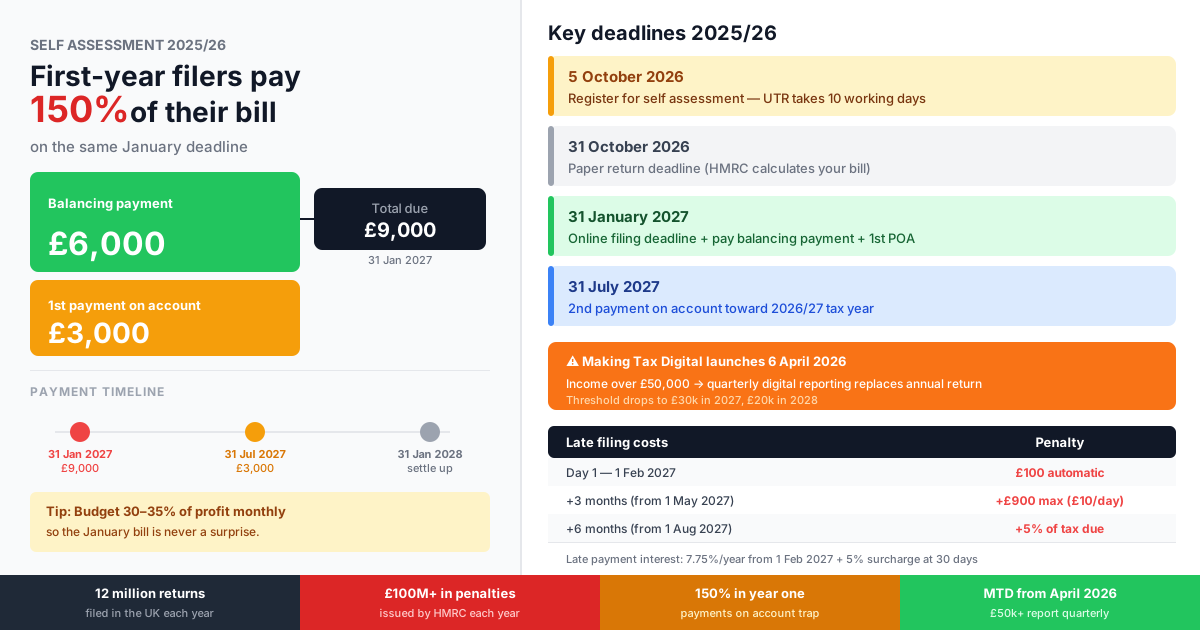
Over 12 million people file a UK self assessment tax return each year. HMRC handed out over £100 million in penalties last year for late filing alone. But the biggest shock most first-timers face is not the tax bill itself — it is discovering they owe 150% of it on the same day.
This guide covers the 2025/26 tax year (6 April 2025 to 5 April 2026), with all key dates, who needs to file, and the sections competitors never explain clearly: the payments on account trap, Making Tax Digital launching in 2026, and what penalties actually cost in real pounds.
🏛Do you need to file?
HMRC does not always write to tell you. If any of the following applied between 6 April 2025 and 5 April 2026, you are responsible for registering and filing.
| Situation | Threshold | Notes |
|---|---|---|
| Self-employed income | Over £1,000 | Gross income before expenses |
| Rental income | Over £1,000 | All UK and overseas property |
| Dividends | Over £500 | The dividend allowance for 2025/26 |
| Capital gains | Over £3,000 | The annual exempt amount |
| High Income Child Benefit Charge | Income over £60,000 | Claws back 1% of Child Benefit per £200 above £60k — fully clawed back at £80,000 |
| Savings interest | Above your Personal Savings Allowance | £1,000 (basic rate), £500 (higher rate), £0 (additional rate) |
| Foreign income | Any amount | Unless taxed at source with no UK liability |
| Tips and commission | Over £2,500 | Untaxed amounts only |
| CIS contractors | Any | If deductions were made under the Construction Industry Scheme |
| Company directors | Any | With untaxed income or dividends above the allowance |
| Income over £100,000 | Any amount above | Personal allowance tapers — PAYE cannot handle this |
| HMRC notice to file | Mandatory | Once HMRC issues a notice you must file, even if none of the above apply |
No longer required to file: From 2024/25, PAYE employees earning over £150,000 are not automatically required to file self assessment purely because of income level — unless another trigger above applies.
Not taxable, so not reportable: State Pension, Child Benefit itself (only the charge is reportable), Personal Independence Payment, Maternity Allowance, and War Widow's Pension do not appear on your return.
Key dates for 2025/26
| Deadline | Date | What it covers |
|---|---|---|
| Register for self assessment | 5 October 2026 | First-time filers only — needed to get your UTR in time |
| Paper return deadline | 31 October 2026 | File by post; HMRC completes your tax calculation |
| Online filing deadline | 31 January 2027 | File via Government Gateway |
| Pay your tax bill | 31 January 2027 | Balancing payment + 1st payment on account |
| 2nd payment on account | 31 July 2027 | Toward your 2026/27 liability |
If you are already registered and filing for 2024/25, your second payment on account for that year was due 31 July 2026.
The first-year trap: why you owe 150%
This catches almost every first-time self assessment filer. When you pay your January bill, you are not just paying for the year just gone — you are also making an advance payment toward the year you are currently in.
How payments on account work:
HMRC requires advance payments if your tax and Class 4 NI bill is £1,000 or more and less than 80% of your tax was collected at source. Each payment on account equals 50% of your previous year's bill.
| What you pay on 31 January | Amount |
|---|---|
| Balancing payment (2025/26 tax and NI owed) | Your full bill |
| First payment on account (toward 2026/27) | 50% of your 2025/26 bill |
| Total due in January | 150% of your 2025/26 bill |
Then on 31 July 2027 you pay the second payment on account — another 50%.
Worked example — first year of self assessment
Your 2025/26 tax and Class 4 NI bill comes to £6,000.
| Payment | Date | Amount |
|---|---|---|
| Balancing payment (2025/26) | 31 Jan 2027 | £6,000 |
| 1st payment on account (2026/27) | 31 Jan 2027 | £3,000 |
| 2nd payment on account (2026/27) | 31 Jul 2027 | £3,000 |
| Total across both dates | £12,000 |
You pay £9,000 in January alone. Budget for this from your first month of self-employment — set aside 30–35% of profit each month so the January bill is not a surprise.
In year two, the January payment is smaller: you pay only the difference between your actual bill and the payments on account already made. If your income stayed the same, your January bill in year two would be £0 balancing payment plus £3,000 first POA for the following year.
Registering for the first time
If 2025/26 is your first year, you must register by 5 October 2026. HMRC then issues a Unique Taxpayer Reference (UTR) — a 10-digit number that takes up to 10 working days to arrive by post. Without it you cannot file.
How to register:
- Go to gov.uk and create a Government Gateway account if you do not already have one.
- Choose your registration type:
- Self-employed: Register as a sole trader (also registers you for Class 2 NI)
- Not self-employed: Register for self assessment for another reason (landlord, director, etc.)
- Wait for your UTR by post.
- Activate your Government Gateway account for self assessment using the code HMRC sends.
Keep your UTR safe — you need it for every return and when contacting HMRC about tax.
👤What to gather before you start
Having the right documents before you open the return saves hours of stopping and searching.
| Document | Needed for |
|---|---|
| P60 | Employment income (from each employer) |
| P11D or P11D(b) | Benefits in kind (company car, private medical, etc.) |
| Bank interest statements | Savings interest from each account |
| Dividend vouchers | Dividends received |
| Rental income and expense records | Property income |
| Sales invoices and receipts | Self-employment income and expenses |
| Mileage log | Business mileage claims |
| Pension contribution statements | Personal pension relief claims |
| P45 if you left a job | To account for tax already paid |
| Capital gains records | Sale price, purchase price, improvement costs |
HMRC requires self-employed people to keep records for 5 years after the filing deadline. Other taxpayers must keep records for 22 months after the end of the tax year.
SA100 and supplementary pages
The main self assessment return is the SA100. Depending on your income sources, you attach supplementary pages.
| Supplementary page | Who needs it |
|---|---|
| SA103S / SA103F | Self-employed (short form if turnover under £85k, full form above) |
| SA105 | UK property income |
| SA106 | Foreign income |
| SA108 | Capital gains |
| SA101 | Additional income (share schemes, life insurance gains) |
| SA102 | Employment income (if you have multiple jobs or benefits in kind HMRC has not resolved) |
| SA109 | Residency (non-residents or dual-residents) |
When filing online, the Government Gateway asks questions and presents only the pages relevant to your situation. You rarely have to select them manually.
Expenses self-employed people miss
HMRC estimates 15–30% of self-employed people do not claim all allowable expenses. Common ones:
Trading allowance: If your allowable expenses total less than £1,000, claim the £1,000 trading allowance instead. It is simpler and sometimes more valuable than itemising small receipts.
Home office: Either use HMRC's simplified flat rate (£10, £18 or £26 a month depending on how many hours you work from home), or claim the actual proportion of household costs (mortgage interest or rent, utilities, council tax) based on the number of rooms used for business and hours worked.
Mileage: 45p per mile for the first 10,000 business miles, then 25p per mile. Keep a log of each business journey — date, destination, purpose, and miles.
Pension contributions: Personal pension payments you make yourself qualify for tax relief. Basic-rate relief is added automatically by your provider. Higher-rate filers must claim the additional 20% through self assessment — this is the most commonly missed relief.
Professional fees: Accountant fees, professional subscriptions, and trade body memberships are all allowable.
Training: Courses that update existing skills are allowable. Courses to learn a new skill or trade are not.
Phone and broadband: The business proportion of your bill if you use a personal phone or home broadband for work.
Making Tax Digital: the big change from April 2026
This is the most significant change to self assessment in years and most guides barely cover it.
From 6 April 2026, sole traders and landlords with qualifying income over £50,000 must use Making Tax Digital for Income Tax Self Assessment (MTD for ITSA). Instead of filing one annual return, they must:
- Keep digital records using HMRC-compatible software
- Submit quarterly updates to HMRC (every 3 months)
- Submit a final declaration by 31 January each year (replacing the current annual return)
MTD income threshold rollout:
| From | Qualifying income threshold |
|---|---|
| 6 April 2026 | Over £50,000 |
| 6 April 2027 | Over £30,000 |
| 6 April 2028 | Over £20,000 |
"Qualifying income" means total gross income from self-employment and UK property combined — not profit.
First-year transitional concession: For the 2026/27 tax year, HMRC will not charge penalties for missing quarterly update deadlines. This is a one-year grace period to allow businesses to adapt. Late payment penalties still apply.
Compatible software includes Xero, QuickBooks, FreeAgent, and several others on HMRC's approved list. Spreadsheets may be used if bridging software connects them to HMRC's systems.
If your income is below the threshold, you continue filing the annual self assessment return as normal until the threshold drops to cover you.
Penalties in real pounds
Late filing penalties
| How late | Penalty |
|---|---|
| 1 day late (from 1 Feb 2027) | £100 automatic — even if you owe no tax |
| 3 months late (from 1 May 2027) | £10 per day for up to 90 days (max £900 additional) |
| 6 months late (from 1 Aug 2027) | 5% of tax due or £300, whichever is greater |
| 12 months late (from 1 Feb 2028) | A further 5% of tax due or £300, whichever is greater |
Example — £5,000 bill, return filed 8 months late:
- Automatic penalty: £100
- Daily penalties (90 days): £900
- 6-month penalty (5% of £5,000): £250
- Total filing penalties: £1,250 — before paying a penny of the actual tax.
Late payment penalties and interest
| Timing | Charge |
|---|---|
| From 1 Feb 2027 | 7.75% per year interest (daily rate: 0.0212%) on the outstanding balance |
| 30 days after due date | 5% surcharge on tax still unpaid |
| 6 months after due date | Further 5% surcharge |
| 12 months after due date | Further 5% surcharge |
Important: The 5% surcharges apply to the balancing payment only. If you miss your July payment on account, HMRC charges interest from 1 August but does not add the 5% surcharge.
Example — £5,000 balancing payment paid 6 months late:
- Interest (6 months at 7.75%): £194
- 30-day surcharge (5%): £250
- 6-month surcharge (5%): £250
- Total extra cost: £694
Can you reduce your payments on account?
If your income this year will be lower than last year, you can reduce your payments on account so you do not overpay.
How to do it:
- Log in to your HMRC self assessment online account
- Go to "Reduce payments on account"
- Enter your estimated tax liability for the year
- HMRC recalculates both January and July payments
The risk: If you reduce payments and then earn more than estimated, HMRC charges interest on the underpaid amount from the original due date. Do not reduce more than you are confident your income justifies.
If you have genuinely overpaid payments on account, HMRC repays the excess — but at a lower rate (3.75%) than it charges on underpayments (7.75%).
Cannot pay? Time to Pay agreement
If you cannot clear your bill by 31 January, contact HMRC before the deadline, not after. HMRC's Time to Pay service lets you spread payments in monthly instalments over an agreed period.
Interest at 7.75% still runs throughout the agreement, but the 5% penalty surcharge is waived if you contact HMRC before the 30-day mark. One phone call before the deadline costs much less than a missed deadline.
You can set up a Time to Pay agreement online if you owe less than £30,000.
Frequently asked questions
What is the self assessment deadline for 2025/26?
The online filing deadline is 31 January 2027. The paper deadline is 31 October 2026. Register by 5 October 2026 if it is your first time.
Who needs to file a self assessment tax return?
Self-employed people with income over £1,000, landlords with rental income over £1,000, anyone with dividends over £500, capital gains over £3,000, or the High Income Child Benefit Charge (income over £60,000). Also anyone who receives an HMRC notice to file — that notice is mandatory regardless of income.
What are payments on account in self assessment?
Advance payments toward next year's tax bill. Each payment equals 50% of your previous year's bill. In your first year you pay the full year's bill plus the first payment on account on 31 January — so 150% of the liability in one go.
What happens if you miss the self assessment deadline?
An automatic £100 penalty from day one, then £10 per day from month three (up to £900), plus 5% surcharges at 6 months and 12 months. Even if you owe no tax, the £100 penalty still applies.
What is Making Tax Digital for Self Assessment?
From 6 April 2026, sole traders and landlords with income over £50,000 must submit quarterly digital updates via compatible software rather than one annual return. The threshold drops to £30,000 in 2027 and £20,000 in 2028.
Can I reduce my payments on account?
Yes — via your HMRC online account if you expect lower income this year. If you reduce too much and underpay, HMRC charges interest on the shortfall from the original due date.
What is the late payment interest rate?
7.75% per year (Bank of England base rate plus 4%), applied daily from the day after the due date. This is in addition to the 5% surcharge at 30 days on the balancing payment.
Do I need to file self assessment if I earn over £100,000?
Yes. Above £100,000 your personal allowance tapers at £1 for every £2 of income above that level. PAYE cannot handle this automatically, so self assessment is required to settle the correct amount.