
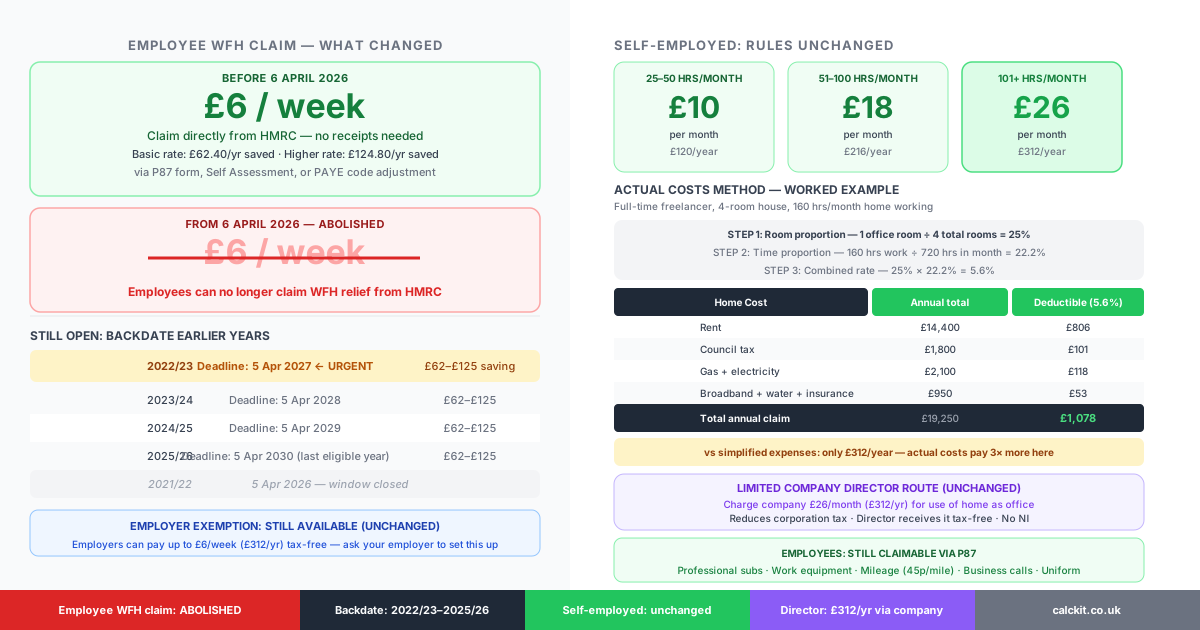
The £6 per week working from home allowance that millions of employees claimed — the easiest tax refund in the UK — has been abolished from 6 April 2026. Employees filing a 2026/27 tax return cannot claim it. There is no transitional relief and no grace period.
Self-employed workers are unaffected. Directors have a separate route. And if you are an employee who never got round to claiming for 2022/23, 2023/24, or 2024/25, you still can — but the first deadline closes in eight months.
🏛What changed on 6 April 2026
From 6 April 2026, employed workers can no longer claim tax relief on homeworking expenses directly from HMRC. The section 316A exemption that covered the flat rate has been repealed.
This means:
- No P87 claim for WFH costs in 2026/27 or later years
- No Self Assessment deduction for employed WFH costs
- No PAYE code adjustment via Personal Tax Account for homeworking expenses
The government's stated reason: incorrect claiming at scale. The COVID-era temporary easement (March 2020 to April 2022) allowed any employee to claim for the full tax year even if they worked from home for just one day. When the easement ended, millions of employees continued claiming under old habits — many without meeting the post-2022 eligibility requirement (that employers contractually require working from home, not merely permit it). HMRC found that over half of claims after April 2022 were ineligible.
What the abolition costs employees in pounds
The flat rate was worth more to higher earners:
| Situation | Rate of relief | Annual saving lost |
|---|---|---|
| Basic rate (20%) employee | 20% × £312 | £62.40/year |
| Higher rate (40%) employee | 40% × £312 | £124.80/year |
| Additional rate (45%) employee | 45% × £312 | £140.40/year |
£62 per year is not life-changing, but over the four years it ran under normal post-COVID rules (2022/23–2025/26), a basic rate employee who consistently claimed would have collected £249.60 in total.
Backdating: what you can still claim and when
If you are an employee who was contractually required to work from home (not just choosing to), you can still claim for earlier years through Self Assessment or a P87 form. The 4-year backdating window is still open for these years:
| Tax year | Backdating deadline | Value (basic rate) | Value (higher rate) |
|---|---|---|---|
| 2021/22 | 5 April 2026 — CLOSED | — | — |
| 2022/23 | 5 April 2027 | £62.40 | £124.80 |
| 2023/24 | 5 April 2028 | £62.40 | £124.80 |
| 2024/25 | 5 April 2029 | £62.40 | £124.80 |
| 2025/26 | 5 April 2030 | £62.40 | £124.80 |
The 2022/23 deadline (5 April 2027) is the most urgent. If you have three or four years to claim and have not yet submitted, that is up to £499.20 for a higher rate taxpayer.
Eligibility for backdated claims (2022/23–2025/26):
- Your employer required you to work from home — it was not optional or a personal preference
- Working at the employer's premises was not possible on those days
- You incurred additional household costs as a direct result
COVID-era claims (2020/21 and 2021/22) applied the easement rules — anyone who worked from home for any reason during those years could claim. Those years are now permanently closed.
How to submit a backdated claim:
- Employed (no Self Assessment): complete a P87 form online via gov.uk or by post
- Self Assessment registered: include on your tax return for the relevant year
The employer exemption: still available
The employer-paid route is entirely separate from the abolished employee claim and is unchanged.
Employers can reimburse employees up to £6 per week (£312 per year) for home working costs, free of income tax and National Insurance. The employer deducts the payment as a business expense. No receipts are required up to this threshold.
Amounts above £6 per week can also be paid tax-free if the employee has actual evidence of higher costs — utility bills, proportional calculations — that justify the payment.
This is discretionary. No law requires employers to offer it. But employees working from home can ask their employer to set up this arrangement.
For employers: the reimbursement is exempt from PAYE, income tax reporting, and National Insurance reporting under ITEPA 2003 sections 316–316A (the employer-paid version of the exemption, which was not repealed). No P11D reporting is needed as long as payments do not exceed the threshold.
What employees CAN still claim in 2026/27
The WFH allowance is gone but other job-related expense claims remain fully intact:
| Expense | Claim route | Notes |
|---|---|---|
| Professional subscriptions | P87 / Self Assessment | Must be on HMRC's approved list |
| Work equipment bought personally | P87 / Self Assessment | Must be exclusively for work |
| Business mileage | P87 / Self Assessment | 45p/mile first 10,000; 25p after |
| Business phone calls | P87 / Self Assessment | Additional cost only, not line rental |
| Uniform / protective clothing | P87 / Self Assessment | Flat rates or actual cost |
These are claimed via a P87 form (employees not on Self Assessment) or through a Self Assessment return.
Self-employed: rules unchanged
Self-employed sole traders and partnerships are completely unaffected. Two methods remain available for 2026/27.
Option 1: Simplified expenses (flat rate)
| Monthly home working hours | Monthly claim | Annual claim |
|---|---|---|
| 25–50 hours | £10/month | £120/year |
| 51–100 hours | £18/month | £216/year |
| 101 or more hours | £26/month | £312/year |
No receipts, no calculation, no apportionment. Simply record the monthly hours worked at home and apply the rate.
You cannot claim simplified expenses and actual costs for the same period. Once you choose simplified, you apply it for the whole year.
Option 2: Actual costs (proportional method)
Works out your genuine deductible cost based on:
- Room proportion: number of rooms used for business ÷ total rooms in the home
- Time proportion: hours the room is used for business ÷ total hours in the period (24 hours × days)
- Combined rate: room proportion × time proportion
- Deductible amount: combined rate × total eligible home costs
Eligible home costs for self-employed actual method:
- Electricity and gas
- Broadband (full cost if used primarily for work; otherwise proportional)
- Water rates
- Council tax
- Rent or mortgage interest (not capital repayment)
- Building insurance
- General repairs and maintenance
Worked example — full-time freelancer, 4-room house:
| Item | Amount |
|---|---|
| Total rooms (excluding bathroom) | 4 |
| Room used exclusively for work | 1 |
| Room proportion | 1 ÷ 4 = 25% |
| Hours working at home per month | 160 hours |
| Total hours in month (30 days) | 720 hours |
| Time proportion | 160 ÷ 720 = 22.2% |
| Combined rate | 25% × 22.2% = 5.6% |
Annual home costs:
| Cost | Annual total | Deductible (5.6%) |
|---|---|---|
| Electricity | £900 | £50.40 |
| Gas / heating | £1,200 | £67.20 |
| Broadband | £400 | £22.40 |
| Council tax | £1,800 | £100.80 |
| Rent | £14,400 | £806.40 |
| Water | £300 | £16.80 |
| Building insurance | £250 | £14.00 |
| Total | £19,250 | £1,078.00 |
A freelancer using the actual method would deduct £1,078 per year versus £312 from simplified expenses — a significant difference when rent is the dominant cost.
Important: if you use a room exclusively for business and never for personal use, you can claim a larger proportion and remove the time adjustment. But HMRC may later argue the room is not truly personal-use-free, which affects private residence relief when you sell the property.
Choosing between simplified and actual costs
Simplified expenses are best when your home costs are low or the room-and-time calculation would produce less than the flat rate. Actual costs are better when you work full-time from home and have a high rent or mortgage.
| Profile | Recommended method |
|---|---|
| Part-time freelancer, renting a room | Simplified (£120–£216/year, zero effort) |
| Full-time home worker, mortgage | Actual costs (typically £800–£1,500/year) |
| Working from a home office 40+ hrs/week | Actual costs — calculate both and compare |
Limited company directors
Directors can charge their company a fee for using their home as a business premises. This is separate from both the abolished employee claim and the self-employed methods.
HMRC typically accepts a payment of around £26 per month (£312 per year) without detailed justification. Higher amounts require a documented calculation (rooms × time × household costs).
The mechanics:
- Director submits an invoice or expense claim to the company
- Company pays the director and deducts the payment as a corporation tax expense
- Director receives the payment tax-free if within a reasonable amount
- No income tax or NI for the director on amounts within HMRC's accepted range
A director paying themselves £312/year from the company saves 19–25% corporation tax on that amount (£59–£78), while the director pays nothing in income tax or NI. Contrast this with the abolished employee flat-rate relief which saved the employee £62–£140 in income tax.
The director route survives the employee abolition because it operates through the company expense system, not the employee tax relief system.
Timeline: how the WFH claim changed
| Period | Who could claim | Rate |
|---|---|---|
| Pre-March 2020 | Employees contractually required to WFH | £4/week (£6/week from April 2020) |
| March 2020–April 2022 | All employees (COVID easement) | £6/week, full year, no proof required |
| April 2022–April 2026 | Employees contractually required to WFH | £6/week (or actual costs if higher) |
| April 2026 onwards | Abolished for employees | — |
| All periods | Self-employed | Simplified or actual costs |
Frequently asked questions
Can I still claim working from home tax relief as an employee in 2026/27?
No. The employee flat-rate working from home allowance was abolished from 6 April 2026. You can no longer claim for the 2026/27 tax year. Self-employed workers are unaffected.
Can I backdate a working from home claim for earlier years?
Yes, if you were contractually required to work from home. The 2022/23 deadline is 5 April 2027. The 2021/22 window closed 5 April 2026 — that year cannot be claimed. Submit via P87 (no Self Assessment) or your tax return.
What is the self-employed working from home simplified expense rate?
£10/month for 25–50 hours, £18/month for 51–100 hours, £26/month for 101+ hours. Unchanged for 2026/27.
Can my employer still pay me £6 per week tax-free for working from home?
Yes. The employer exemption is separate from the abolished employee claim and is unchanged. Employers can reimburse up to £6/week tax-free. They are not required to, but employees can request it.
Why was working from home tax relief abolished for employees?
HMRC found that over half of post-2022 claims were ineligible — employees claiming despite choosing to work from home rather than being contractually required to. The COVID-era easement created widespread habits that persisted after eligibility rules tightened.
What WFH-related expenses can employees still claim in 2026/27?
Professional subscriptions, work equipment bought personally, business mileage, business phone calls, and uniform/tools are still claimable via P87 or Self Assessment. The specific WFH household costs claim (electricity, heating) is abolished.
How do self-employed workers calculate actual home working costs?
Room proportion (rooms used for business ÷ total rooms) × time proportion (hours worked at home ÷ total hours in period) × total annual home costs. This covers electricity, heating, broadband, water, council tax, rent or mortgage interest, insurance, and repairs.
Can limited company directors claim for working from home?
Yes. Directors can charge their company a fee for using their home as an office. HMRC accepts around £26/month (£312/year) without detailed evidence. Higher amounts need a documented rooms-and-time calculation. The company deducts the payment; the director receives it tax-free.