
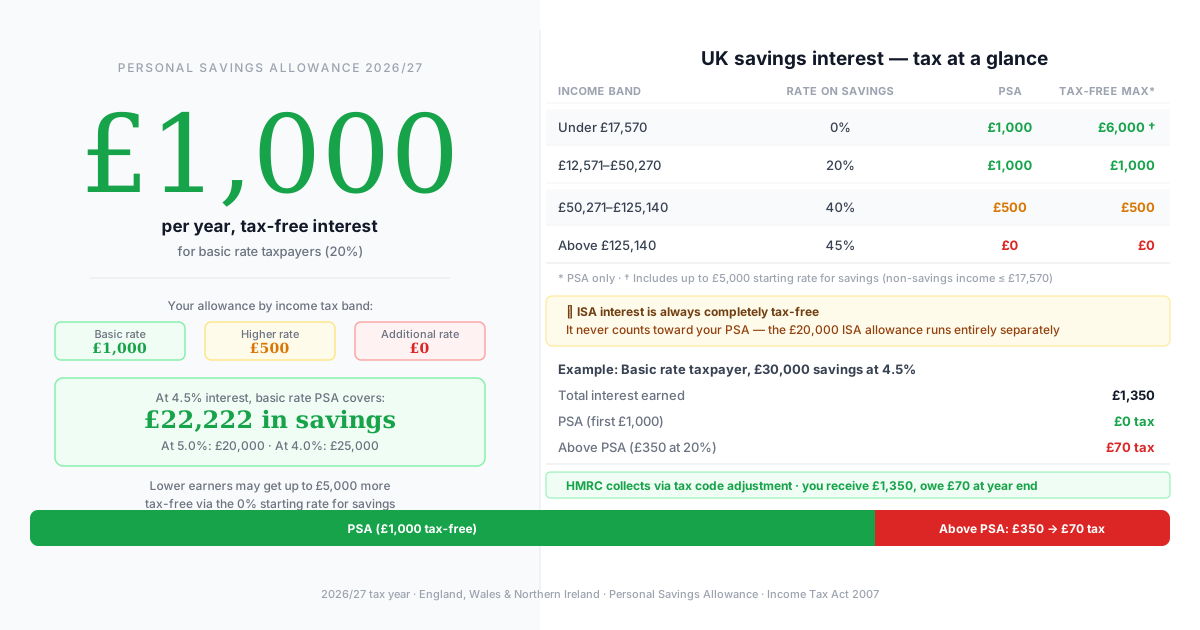
For most of the last decade, the Personal Savings Allowance was a non-issue for the majority of UK savers — interest rates were so low that even a sizeable savings pot barely earned £100 a year. That changed sharply. With high-street savings accounts still offering 4–5% interest in 2026, hundreds of thousands of savers are breaching their PSA for the first time and unexpectedly receiving HMRC tax code adjustments they don't understand.
This guide explains how savings interest is taxed in 2026/27, what your allowances actually cover, at what savings balance you'll start paying tax, and how to decide when an ISA becomes the better option.
🏛The three layers of savings tax protection
The UK taxes savings interest in a system that layers three different reliefs on top of each other. Understanding all three is essential — especially for lower earners who may have far more protection than they realise.
Layer 1 — Personal Allowance (£12,570) Your standard tax-free Personal Allowance applies to all income including savings interest. If your wages, pension, or other income doesn't use up the full £12,570, any remainder offsets your savings interest first.
Layer 2 — Starting rate for savings (up to £5,000) If your non-savings income (wages, rental, pensions) is low enough, you get an additional 0% rate on up to £5,000 of savings interest. This rate phases out as non-savings income rises above the Personal Allowance — more on this below.
Layer 3 — Personal Savings Allowance (£1,000 or £500) Everyone else gets the PSA: £1,000 for basic rate taxpayers, £500 for higher rate taxpayers, and nothing for additional rate taxpayers. This is the allowance most people mean when they talk about "tax-free savings interest."
For most people with full-time employment, layers 1 and 2 don't apply — only the PSA matters. The starting rate is specifically designed for those with low earned income.
Personal Savings Allowance: which band are you in?
Your PSA is determined by your highest income tax band — not just your savings income:
| Income tax band | Annual income | Personal Savings Allowance |
|---|---|---|
| Basic rate | £12,571 – £50,270 | £1,000 |
| Higher rate | £50,271 – £125,140 | £500 |
| Additional rate | Above £125,140 | £0 |
If your income sits entirely within the basic rate band, you get £1,000 of tax-free interest per year. Cross into the higher rate band — even by £1 — and your allowance halves to £500. Once income exceeds £125,140, the PSA disappears entirely.
The PSA applies per person and per tax year. Unused allowance cannot be carried over.
The starting rate for savings (for lower earners)
If your non-savings income — your salary, pension, rental income, or other taxable earnings — is below £17,570, you qualify for a 0% starting rate on some or all of the first £5,000 of your savings interest.
How it works:
- If your non-savings income is at or below £12,570 (the Personal Allowance): you get the full £5,000 starting rate
- For every £1 of non-savings income above £12,570, the starting rate reduces by £1
- Once non-savings income reaches £17,570 (£12,570 + £5,000), the starting rate is fully exhausted
Example: Your pension pays you £14,000 per year.
- Non-savings taxable income: £14,000 − £12,570 PA = £1,430
- Starting rate remaining: £5,000 − £1,430 = £3,570 at 0%
- Plus your PSA: £1,000 at 0%
- Total tax-free savings interest: £3,570 + £1,000 = £4,570
A retired person or part-time worker with employment income of exactly £12,570 gets the full £5,000 starting rate plus £1,000 PSA — £6,000 of savings interest completely tax-free.
The maximum possible: someone with no non-savings income at all could shelter £12,570 (unused Personal Allowance) + £5,000 (starting rate) + £1,000 (PSA) = £18,570 of savings interest tax-free in a single year. At today's rates, that would require a substantial savings pot — but it is relevant for retirees drawing down pension funds.
At what savings balance does your PSA run out?
With interest rates considerably higher than in recent years, the PSA goes further than it used to. Here is the savings balance where your PSA is fully used at different interest rates:
Basic rate taxpayer (£1,000 PSA):
| Savings rate | Balance that fills the PSA | Interest earned | Tax owed above PSA |
|---|---|---|---|
| 3.0% | £33,333 | £1,000 | £0 |
| 3.5% | £28,571 | £1,000 | £0 |
| 4.0% | £25,000 | £1,000 | £0 |
| 4.5% | £22,222 | £1,000 | £0 |
| 5.0% | £20,000 | £1,000 | £0 |
| 5.5% | £18,182 | £1,000 | £0 |
| 6.0% | £16,667 | £1,000 | £0 |
Higher rate taxpayer (£500 PSA):
| Savings rate | Balance that fills the PSA | Interest earned | Tax owed above PSA |
|---|---|---|---|
| 3.0% | £16,667 | £500 | £0 |
| 3.5% | £14,286 | £500 | £0 |
| 4.0% | £12,500 | £500 | £0 |
| 4.5% | £11,111 | £500 | £0 |
| 5.0% | £10,000 | £500 | £0 |
| 5.5% | £9,091 | £500 | £0 |
| 6.0% | £8,333 | £500 | £0 |
Any savings above these balances will generate taxable interest at your income tax rate.
What tax do you pay on interest above the PSA?
Interest above your allowance is taxed at your income tax rate for savings income: 20% (basic rate), 40% (higher rate), or 45% (additional rate).
Worked example A — Basic rate taxpayer:
- Salary: £35,000 (basic rate)
- Savings: £30,000 at 4.5% = £1,350 interest
- PSA: £1,000 (0%)
- Taxable: £350
- Tax owed: £350 × 20% = £70
Worked example B — Higher rate taxpayer:
- Salary: £65,000 (higher rate)
- Savings: £20,000 at 4.5% = £900 interest
- PSA: £500 (0%)
- Taxable: £400
- Tax owed: £400 × 40% = £160
Worked example C — Additional rate taxpayer:
- Income: £130,000 (additional rate)
- Savings: £50,000 at 4.5% = £2,250 interest
- PSA: £0
- All £2,250 taxable
- Tax owed: £2,250 × 45% = £1,012.50
Worked example D — Low earner with starting rate:
- Part-time wages: £12,000 (below Personal Allowance)
- Savings: £40,000 at 4.5% = £1,800 interest
- Remaining Personal Allowance: £12,570 − £12,000 = £570 (covers first £570 of interest at 0%)
- Starting rate: full £5,000 at 0% (non-savings taxable income = £0)
- PSA: £1,000 at 0%
- Total covered: £570 + (£5,000 used, but only £1,230 of interest remains after PA) = all £1,800 within tax-free allowances
- Tax owed: £0
How HMRC collects tax on savings interest
If you are employed or receive a pension via PAYE, HMRC automatically receives savings interest data directly from your bank or building society. You do not need to tell HMRC about interest within your PSA.
For interest above the PSA (employed savers): HMRC adjusts your tax code the following tax year to recover the underpaid tax through your payslip. If you earned £1,500 interest and your PSA is £1,000, HMRC reduces your tax code to collect £100 (the 20% on the excess £500) across your next year's PAYE deductions. This happens automatically — you typically just notice your tax code changing.
For Self Assessment filers: If you already complete a Self Assessment tax return (for self-employment, high income, rental income, etc.), you declare your savings interest there and any tax due is calculated and collected as part of your return.
When you might need to register for Self Assessment: HMRC may require you to register for Self Assessment if your total savings income (gross interest from all sources) exceeds £10,000 in a tax year, or if you have other significant untaxed income alongside savings interest that cannot be efficiently collected through a tax code adjustment.
If you're unsure, you can check your tax position through your HMRC Personal Tax Account at gov.uk/personal-tax-account, where your current tax code and the interest HMRC has recorded will be shown.
ISA interest: always tax-free, always separate
Interest earned inside an ISA (Individual Savings Account) is completely exempt from UK income tax — it does not count toward your PSA, and it is never taxed regardless of how much interest your ISA earns.
The two systems run in parallel:
- ISA: up to £20,000 per tax year may be deposited. All interest, dividends, and growth inside an ISA are permanently tax-free.
- PSA: covers interest on savings held outside an ISA — in ordinary bank accounts, savings accounts, bonds, peer-to-peer lending platforms, and similar.
You can hold both simultaneously. The ISA allowance and the PSA are independent.
When does moving savings into an ISA make sense?
Once your savings pot is large enough that it regularly generates more interest than your PSA covers, a Cash ISA shelters all future interest permanently — not just within this year's PSA limit.
As a rough guide:
- Basic rate taxpayer: consider an ISA when savings exceed ~£22,000–£25,000 at current rates (once interest is reliably £1,000+ per year)
- Higher rate taxpayer: consider an ISA when savings exceed ~£10,000–£12,000 at current rates (PSA is only £500)
- Additional rate taxpayer: there is no PSA — every penny of savings interest outside an ISA is taxable, so ISAs are particularly valuable
The one caveat: easy-access Cash ISAs sometimes offer slightly lower rates than equivalent non-ISA savings accounts. At lower tax rates, the after-tax return on a non-ISA account may still beat the ISA rate. At higher rates — and especially for higher rate or additional rate taxpayers — the ISA rate advantage compounds significantly over time.
Premium Bonds and NS&I products
NS&I Premium Bond prizes are completely tax-free — they are not subject to income tax, they do not count toward your PSA, and they never need to be declared to HMRC. Premium Bonds are lottery-style: your capital is held by HM Treasury, and prizes are paid from a prize fund.
Other NS&I products (such as Income Bonds, Direct Saver, and the Investment Account) pay interest that does count toward your PSA in the usual way.
Fixed-rate bonds: when is your interest taxed?
If you hold a fixed-rate savings bond, the timing of when interest is taxed matters:
- Annual interest bonds: interest is taxed in the tax year it is credited or made available to you
- Rolled-up interest bonds (where interest is paid at maturity): ALL of the interest is taxed in the tax year the bond matures and the interest becomes accessible
If you hold a 2-year bond that rolls up interest to maturity, the full two years' worth of interest is taxed in a single year. This can push you above your PSA in that year even if you would have been fine had the interest been credited annually. When choosing between bond structures, consider which year the interest will be taxed and whether your other income in that year leaves you with any starting rate allowance.
If you have a large lump sum in a fixed-rate bond maturing in a high-income year, it may be worth laddering bonds — spreading maturities across different tax years — to keep interest within the PSA limits each year.
Joint accounts
Interest from a joint savings account is generally split between account holders in proportion to their actual beneficial ownership — most joint accounts are split 50:50.
Each account holder then uses their own PSA against their share of the interest. If you earn £30,000 and your partner earns £60,000:
- You are a basic rate taxpayer: PSA £1,000
- Your partner is a higher rate taxpayer: PSA £500
- On a joint account earning £3,000 interest (split £1,500 each):
- Your share: £1,500 → PSA covers £1,000 → £500 taxable at 20% → £100 tax
- Partner's share: £1,500 → PSA covers £500 → £1,000 taxable at 40% → £400 tax
Joint account interest doesn't pool into a shared allowance — each partner's PSA is applied to their own share independently.
How to check and declare your savings interest
Banks report directly to HMRC. Since 2016, UK banks and building societies automatically submit annual interest data to HMRC. You don't need to send certificates or manually report interest that falls within your PSA.
If you're over the PSA:
- Employed savers: HMRC will adjust your tax code. Watch for a revised tax code notice (P2) — the reduced code reflects the tax being collected on your savings interest.
- Self Assessment filers: enter your savings interest in the "interest and dividends" section of your return. HMRC calculates the tax due automatically.
- Not on PAYE and not SA: contact HMRC directly via your Personal Tax Account or by phone if you believe you owe tax on savings interest and are not receiving automatic adjustments.
If you're unsure how much interest you earned: your bank sends an annual interest statement at the end of the tax year (usually April or May), and the total is also visible in your Personal Tax Account once banks have submitted their data.
Reclaiming overpaid tax on savings interest
If tax was deducted from your savings interest in error — for example, because you were below the PSA threshold, within the starting rate band, or a non-taxpayer — you can claim it back.
For future interest: complete form R85 with your bank or building society. This tells them to pay interest gross (without deducting tax at source) if you are a non-taxpayer. Note: most UK banks already pay savings interest gross since the PSA was introduced in 2016.
For past overpayments:
- Use form R40 (available on gov.uk) to claim a repayment of income tax on savings or investments
- File a Self Assessment return if you already complete one
- HMRC can refund overpayments going back four tax years from the end of the current tax year — so in 2026/27, you can claim as far back as 2022/23
Scotland
Scottish taxpayers are subject to the same PSA rules as the rest of the UK — the Personal Savings Allowance (£1,000/£500/£0) is set by UK law and applies identically. However, because Scotland has different income tax bands (starter rate 19%, basic 20%, intermediate 21%), your tax band — and therefore which PSA tier you fall into — may differ.
HMRC determines which PSA tier you're in based on UK income tax rates, not Scottish rates. So a Scottish taxpayer paying 21% intermediate rate is still classified as a basic rate taxpayer for PSA purposes, receiving the £1,000 allowance. A Scottish higher rate taxpayer (above £43,663) would receive the £500 PSA.
For the starting rate for savings, Scottish taxpayers use the same £5,000 threshold and the same phase-out rule based on non-savings taxable income above £12,570 — identical to the rest of the UK.
Frequently Asked Questions
How much savings interest is tax-free in 2026/27?
For most employed basic rate taxpayers, £1,000 of savings interest per year is tax-free via the Personal Savings Allowance. Higher rate taxpayers receive £500. Additional rate taxpayers receive nothing. Lower earners with non-savings income below £17,570 may get up to an additional £5,000 at 0% through the starting rate for savings. ISA interest is always completely tax-free and is entirely separate from the PSA.
What is the Personal Savings Allowance for 2026/27?
The PSA for 2026/27 is £1,000 for basic rate taxpayers (income £12,571–£50,270), £500 for higher rate taxpayers (income £50,271–£125,140), and £0 for additional rate taxpayers (income above £125,140). It has been at these levels since it was introduced in April 2016 and has not been adjusted for inflation.
How much tax do you pay on savings interest above the allowance?
Interest above your PSA is taxed at your income tax rate: 20% for basic rate, 40% for higher rate, 45% for additional rate. On £500 of taxable interest, a basic rate taxpayer pays £100, a higher rate taxpayer pays £200, and an additional rate taxpayer pays £225.
How does HMRC collect tax on savings interest?
For PAYE taxpayers, HMRC adjusts your tax code the following year based on savings interest data received automatically from your bank. You don't normally need to do anything. Self Assessment filers declare interest on their return. If total savings income exceeds £10,000, you may need to register for Self Assessment.
Do I need to declare savings interest to HMRC?
Not if it is within your PSA — HMRC receives interest data directly from banks. If you exceed the PSA and are employed, HMRC adjusts your code automatically. If you file Self Assessment, declare it on your return. If your savings income exceeds £10,000, you may be required to register for Self Assessment.
Is ISA interest included in the Personal Savings Allowance?
No. ISA interest is completely tax-free by a separate statutory exemption and never counts toward or affects your PSA in any way. The £20,000 annual ISA subscription limit operates entirely independently.
What is the starting rate for savings and who qualifies?
It is a 0% tax rate on up to £5,000 of savings interest, available when your non-savings income (wages, pension, rent) is below £17,570. The £5,000 is reduced by £1 for every £1 of taxable non-savings income above the £12,570 Personal Allowance. On top of this, you also get your £1,000 PSA — giving up to £6,000 of tax-free savings interest for someone with non-savings income of exactly £12,570.
Can I reclaim overpaid tax on savings interest?
Yes — use form R40 on gov.uk or your Self Assessment return. You can reclaim overpayments going back four tax years from the current year (so in 2026/27, back to 2022/23). If your bank deducted tax at source in error, complete form R85 to stop future deductions as well.
The bottom line
For most employed UK savers in 2026/27, the key number is £1,000: the basic rate Personal Savings Allowance that protects the first £1,000 of savings interest from tax each year. At interest rates around 4–5%, that covers savings of roughly £20,000–£25,000. Beyond that, a Cash ISA or direct Self Assessment declaration is the next step.
Check your current savings interest against your PSA, your income band, and your interest rate — the calculation is simpler than most people expect:
🏛For the full picture on how savings income interacts with your PAYE take-home, see Take Home Pay UK 2026/27.
Last updated July 2026. Personal Savings Allowance, starting rate for savings, and ISA allowance figures reflect HMRC and HM Treasury 2026/27 guidance.