
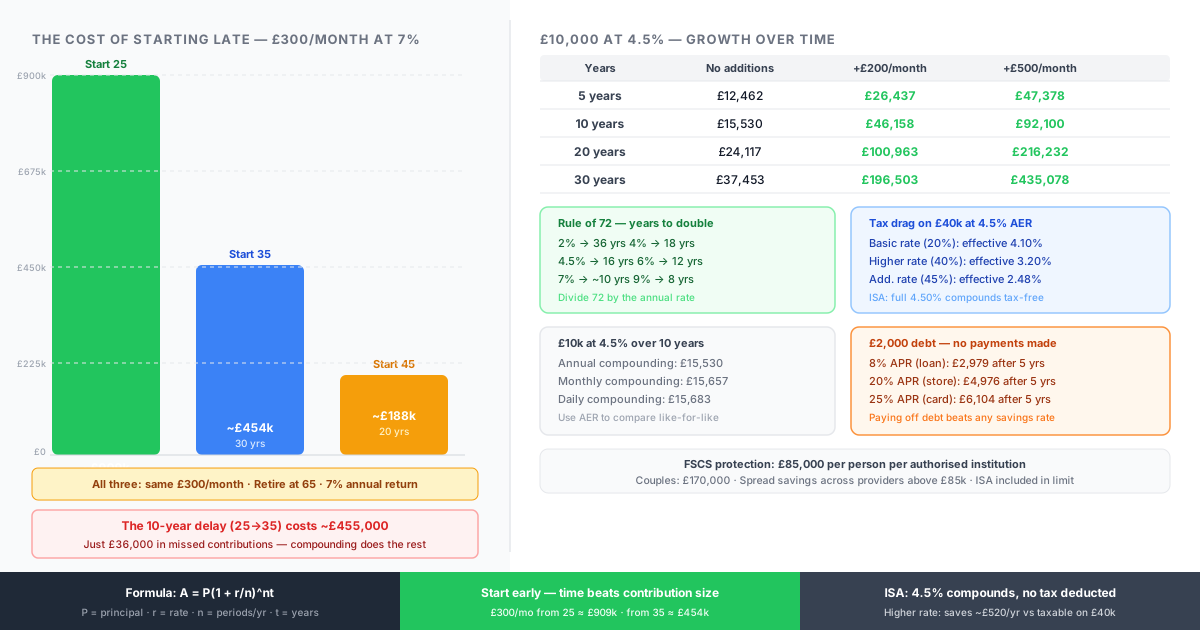
Ali starts saving £300 a month at age 25, into a pension earning 7% annually. Ben waits until 35 to start and saves the same £300 a month at the same rate.
At 65, Ali has approximately £909,000. Ben has approximately £454,000.
The 10-year gap costs Ben around £455,000 — despite the fact that his missing contributions amount to just £36,000 in actual money. The difference is not savings discipline. It is time, and what compound interest does with it.
🐷What compound interest is
With simple interest, you earn interest only on your original deposit. £10,000 at 4.5% earns £450 every year, regardless of whether you have been saving for 1 year or 20.
With compound interest, the interest you earn is added to your balance, and the next period's interest is calculated on that larger amount. In year one you earn £450. In year two you earn interest on £10,450 — so you earn £470. In year three, £492. Each year the base grows, and so does the interest.
Simple vs compound — £10,000 at 4.5% over 20 years:
| Year | Simple interest balance | Compound interest balance | Difference |
|---|---|---|---|
| 1 | £10,450 | £10,450 | £0 |
| 5 | £12,250 | £12,462 | £212 |
| 10 | £14,500 | £15,530 | £1,030 |
| 15 | £16,750 | £19,353 | £2,603 |
| 20 | £19,000 | £24,117 | £5,117 |
The gap starts small and widens. By year 20, compound interest has produced £5,117 more from the same initial deposit with no additional contributions.
The compound interest formula
The standard formula is:
A = P(1 + r/n)^(nt)
Where:
- A = final amount
- P = principal (your starting deposit)
- r = annual interest rate as a decimal (4.5% = 0.045)
- n = number of compounding periods per year (12 for monthly, 365 for daily, 1 for annual)
- t = number of years
Example: £5,000 at 4.5% compounded monthly for 5 years
A = £5,000 × (1 + 0.045/12)^(12×5) A = £5,000 × (1.00375)^60 A = £5,000 × 1.2514 A = £6,257
Interest earned: £1,257 — compared to £1,125 with simple interest over the same period.
How compounding frequency affects growth
The more often interest is calculated and added to your balance, the slightly faster your money grows. In practice the difference between monthly and daily compounding is small, but it matters over long periods.
£10,000 at 4.5% gross over 10 years:
| Compounding frequency | Final balance | Total interest |
|---|---|---|
| Annual | £15,530 | £5,530 |
| Monthly | £15,657 | £5,657 |
| Daily | £15,683 | £5,683 |
The difference between annual and daily compounding over 10 years is £153 on a £10,000 deposit — modest, but it scales with the principal. On £100,000 it becomes £1,530.
AER vs gross rate: UK savings accounts are required to display AER (Annual Equivalent Rate) — a standardised rate that already incorporates compounding frequency. When comparing two accounts, use AER regardless of whether one pays interest monthly and another annually. A 4.38% gross monthly account and a 4.47% AER account are equivalent.
Regular contributions: where compound interest really accelerates
Most people do not start with a lump sum and leave it alone. They save monthly. Adding regular contributions on top of compound growth creates a substantially different outcome.
£10,000 starting deposit at 4.5% AER — with and without monthly additions:
| Monthly addition | 10-year balance | 20-year balance | 30-year balance |
|---|---|---|---|
| £0 (lump sum only) | £15,530 | £24,117 | £37,453 |
| £100/month | £30,844 | £62,540 | £116,978 |
| £200/month | £46,158 | £100,963 | £196,503 |
| £300/month | £61,472 | £139,386 | £276,028 |
| £500/month | £92,100 | £216,232 | £435,078 |
Monthly compounding assumed. No withdrawals.
The effect of regular contributions compounds on itself. At 30 years, adding £200 per month turns £10,000 into £196,503 — versus £37,453 with no additions. The £72,000 of additional contributions you made (£200 × 360 months) grew by a further £87,050 due to compound growth.
🐷The Rule of 72
The Rule of 72 gives you a quick mental estimate of how long it takes to double your money at a given compound interest rate.
Years to double = 72 ÷ annual interest rate
| Interest rate | Years to double |
|---|---|
| 2% | 36 years |
| 3% | 24 years |
| 4% | 18 years |
| 4.5% | 16 years |
| 6% | 12 years |
| 7% | ~10 years |
| 9% | 8 years |
| 12% | 6 years |
At current easy-access savings rates of ~4.5%, your money doubles in roughly 16 years. A long-term equity ISA returning 7% annually doubles in about 10 years. The rule is accurate within 1–2% for rates between 2% and 10%.
Use it to benchmark any savings or investment rate claim: if someone promises your money doubles in 5 years, that implies a 14.4% annual return — worth scrutinising.
The true cost of savings tax
Compound interest grows on your gross interest — but if that interest is taxed, the net compounding rate is lower than the advertised rate.
Personal Savings Allowance 2026/27:
- Basic rate taxpayer: £1,000 per year tax-free
- Higher rate taxpayer: £500 per year tax-free
- Additional rate taxpayer: £0 — all interest taxed at 45%
Annual tax drag on £40,000 at 4.5% AER (£1,800 interest earned):
| Tax rate | PSA | Taxable interest | Tax paid | Net interest | Effective rate |
|---|---|---|---|---|---|
| Basic (20%) | £1,000 | £800 | £160 | £1,640 | 4.10% |
| Higher (40%) | £500 | £1,300 | £520 | £1,280 | 3.20% |
| Additional (45%) | £0 | £1,800 | £810 | £990 | 2.48% |
| ISA (no tax) | — | — | £0 | £1,800 | 4.50% |
A higher-rate taxpayer with £40,000 in a taxable savings account earning 4.5% loses 1.3 percentage points to tax — the effective rate falls to 3.2%. Over 20 years, the compounding difference between 4.5% and 3.2% on £40,000 is approximately £10,600 in lost growth.
This is the ISA's core value: the full 4.5% compounds every year, with no tax deducted. For higher and additional rate taxpayers with savings above the PSA threshold, an ISA is almost always the better wrapper for compound growth.
Inflation: what your savings are actually worth
Compound interest shows you nominal returns — the number in your account. Inflation erodes purchasing power. The real return is what matters for long-term financial planning.
Real return = nominal rate − inflation rate (simplified; Fisherian formula for precision)
Assuming 2.5% average UK inflation:
£10,000 lump sum, 4.5% AER nominal — real (inflation-adjusted) value:
| Years | Nominal balance | Real value (2.5% inflation) | Purchasing power gain |
|---|---|---|---|
| 5 | £12,462 | £10,916 | +£916 |
| 10 | £15,530 | £11,883 | +£1,883 |
| 20 | £24,117 | £14,091 | +£4,091 |
| 30 | £37,453 | £17,329 | +£7,329 |
At 4.5% with 2.5% inflation, your real return is approximately 2%. Your money is growing in purchasing power — but far more slowly than the headline figure suggests.
At 2% nominal (rates available during 2020–2021), inflation of 2.5% produces a negative real return — your money shrinks in real terms even while the account balance rises. Cash savings are not inherently safe over the long term.
The cost of starting late
The most powerful demonstration of compound interest is what a 10-year delay costs.
£300/month invested, 7% annual return (long-term equity returns):
| Start age | End age | Monthly £300 from age... | Total contributions | Approx. final pot |
|---|---|---|---|---|
| 25 | 65 | 40 years | £144,000 | ~£909,000 |
| 35 | 65 | 30 years | £108,000 | ~£454,000 |
| 45 | 65 | 20 years | £72,000 | ~£188,000 |
Starting at 25 versus 35 — the difference is £36,000 in contributions but roughly £455,000 in final value. The early contributions from age 25–34 (just £36,000) grow for 30–40 additional years, producing far more than the contributions themselves.
This is why pension saving in your 20s, even at low amounts, has a disproportionate impact on retirement outcomes. A 25-year-old contributing £100 a month achieves almost as much as a 35-year-old contributing £200 a month — with half the cash outlay over the same endpoint.
🏛Compound interest working against you: debt
Every principle above applies to debt — but it works in the lender's favour. High-interest debt compounds just as powerfully as savings.
£2,000 balance with no payments made:
| APR | After 1 year | After 2 years | After 3 years | After 5 years |
|---|---|---|---|---|
| Personal loan (8%) | £2,166 | £2,346 | £2,540 | £2,979 |
| Car finance (12%) | £2,253 | £2,540 | £2,864 | £3,646 |
| Store card (20%) | £2,400 | £2,880 | £3,456 | £4,976 |
| Credit card (25%) | £2,500 | £3,125 | £3,906 | £6,104 |
A £2,000 credit card balance at 25% APR, left unpaid, grows to over £6,100 in five years. You have paid nothing and owe three times as much.
Minimum payments are not much better. On a £2,000 balance at 25% APR with a minimum payment of 2% of balance (falling as the balance falls), clearing the full debt takes over 30 years and costs approximately £4,200 in interest.
Paying off debt at 25% APR is mathematically equivalent to earning 25% guaranteed after tax on a savings account — no savings product offers anything close. Any spare cash is almost always better directed to high-interest debt before savings.
FSCS protection when savings grow
If your compound growth strategy involves building a large savings pot, keep FSCS limits in mind. The scheme protects up to £85,000 per person per authorised institution. Authorised institution means the banking licence — some banks share a licence (e.g. Halifax and Bank of Scotland are both Lloyds Banking Group), so deposits with both count as one institution.
For larger balances:
- Couples can hold £170,000 per institution (£85k each)
- Spread savings across multiple institutions when approaching £85k
- Temporary high balance protection (£1m, 6 months) applies to property sale proceeds, inheritance, redundancy, etc.
ISA balances are subject to the same £85,000 FSCS limit per institution. Stocks and Shares ISA investments are covered by separate FSCS investment protection (£85,000 for authorised investment firms).
Frequently asked questions
How is compound interest different from simple interest?
Simple interest is calculated only on the original principal — you earn the same amount of interest every year regardless of how long you have been saving. Compound interest is calculated on the principal plus any interest already accumulated. The longer you save, the more dramatically compound interest outperforms simple interest. On £10,000 at 4.5% over 20 years: simple interest gives £19,000; compound interest gives £24,117.
What rate do UK easy-access savings accounts pay in 2026?
Easy-access savings account rates in the UK vary by provider but typically range from 4.0% to 5.2% AER as of mid-2026, following the Bank of England base rate of 4.25%. Fixed-rate bonds at 1–3 years can offer marginally higher rates in exchange for locking your money away. Always compare using AER rather than gross or monthly rates for an accurate like-for-like comparison.
Is compound interest better monthly or annually?
Monthly compounding produces slightly higher returns than annual compounding at the same stated rate, because interest is added to your balance 12 times per year rather than once. However, UK savings accounts quote AER — which standardises all accounts to an annual equivalent regardless of actual compounding frequency. Two accounts with the same AER produce identical results over a full year, regardless of whether one compounds monthly and the other annually.
Can I use compound interest to beat inflation?
Yes, but you need a real return — your interest rate must exceed the inflation rate. At 4.5% interest and 2.5% inflation, your real return is approximately 2%. At current rates (mid-2026), UK savings accounts and cash ISAs can beat inflation. Historically, UK equity markets have returned around 5–7% annually in real terms over long periods, offering stronger inflation-beating returns than cash — but with significantly more short-term volatility.
What is AER and why does it matter?
AER (Annual Equivalent Rate) is the standardised annual interest rate, calculated to account for compounding frequency. UK banks are legally required to display it on savings products so you can compare accounts paying interest at different intervals. If an account pays 4.38% gross monthly, its AER is 4.47% — the amount you would earn over a full year if you left the money untouched. Always use AER for comparisons, not gross rate or monthly rate.
How does compound interest apply to ISAs?
Inside a Cash ISA or Stocks and Shares ISA, compound interest (or compound investment returns) works exactly the same way — but with no tax deducted on the interest or gains. The full 4.5% (or whatever the account pays) compounds each year. Over 20 years, the difference between 4.5% taxed at 40% (effective 3.2%) and 4.5% untaxed in an ISA on a £40,000 balance amounts to roughly £10,600. For higher-rate taxpayers with savings above their PSA, the ISA wrapper is almost always the better choice for long-term compound growth.