
Seven million UK adults have no savings at all. For the average household, one major emergency — a broken boiler, redundancy, or a car failure — is enough to trigger debt. An emergency fund is the financial buffer that absorbs these shocks without sending you to a credit card at 20% APR.
This guide covers how much you actually need (not just "3 to 6 months"), which account to use in 2026, the Universal Credit capital rule that most guides ignore, and why the calculation is different if you are self-employed.
🐷What counts as an emergency
The purpose of an emergency fund is narrow. It exists for sudden, unavoidable expenses that you could not have planned for and cannot delay. It is not a general savings account or a holiday fund.
Legitimate emergencies:
- Job loss or sudden income drop
- Boiler failure (replacement: £2,500–£4,000)
- Car breakdown requiring major repair (£500–£2,000)
- Washing machine or fridge failure (£350–£700)
- Emergency dental treatment (private: £200–£1,500)
- Burst pipe or unexpected home repair
- Medical costs or prescription gap
Not emergencies (use a sinking fund instead):
- Car MOT — predictable, save monthly
- Annual insurance renewal — predictable
- Holidays, Christmas, new furniture
- Home improvements you planned
- Subscription renewals
The mental separation matters. Blurring the boundary means dipping into the emergency fund for expected costs, then having nothing when a genuine crisis hits.
Calculate your number
The correct emergency fund target is a multiple of your essential monthly expenses — not your income, and not a fixed pound figure.
Step 1: Add up monthly essential expenses
| Expense | Your amount |
|---|---|
| Rent or mortgage payment | £ |
| Council tax | £ |
| Electricity and gas | £ |
| Water | £ |
| Groceries | £ |
| Transport (car costs or commute) | £ |
| Home, car and life insurance | £ |
| Phone and broadband | £ |
| Childcare (if applicable) | £ |
| Minimum debt repayments | £ |
| Total monthly essentials | £ |
Do not include subscriptions, eating out, gym, entertainment, or clothing. These are the first things you would cut in a crisis.
Step 2: Choose your multiplier
| Situation | Multiplier |
|---|---|
| Employed, stable income, partner also works | ×3 |
| Employed, single income household | ×4–5 |
| Employed with mortgage (vs renting) | ×4 |
| Self-employed (any situation) | ×6 minimum |
| Variable or commission-based income | ×6 |
| Single earner with dependants | ×6 |
Example targets:
| Monthly essentials | ×3 months | ×6 months |
|---|---|---|
| £1,500 | £4,500 | £9,000 |
| £2,000 | £6,000 | £12,000 |
| £2,500 | £7,500 | £15,000 |
| £3,000 | £9,000 | £18,000 |
| £3,500 | £10,500 | £21,000 |
Review this figure annually. If inflation or a move has increased your essential costs by 10%, your target needs to rise by the same proportion.
The UC capital limit trap
This is the rule most emergency fund guides skip, and it matters if you claim or might ever need to claim Universal Credit.
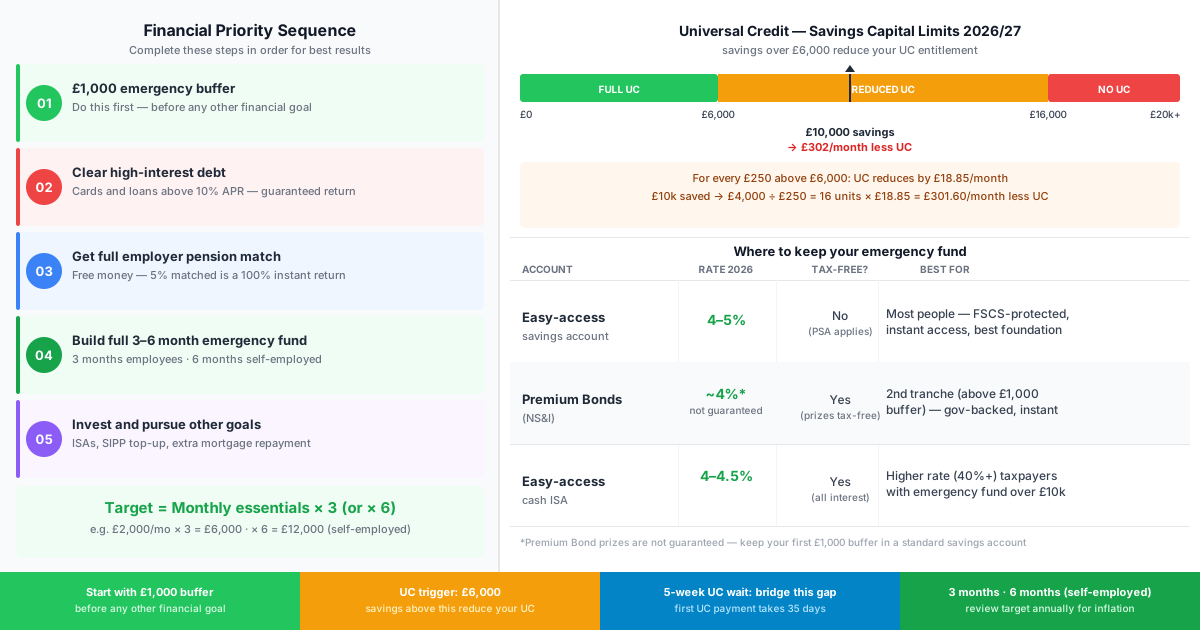
UC applies capital limits to savings:
| Savings level | Effect on UC |
|---|---|
| Under £6,000 | No effect — full UC entitlement |
| £6,001–£16,000 | UC reduced by £4.35/week per £250 above £6,000 |
| Over £16,000 | No UC entitlement at all |
Worked example: You lose your job with £10,000 in savings.
- Capital above £6,000 threshold: £4,000
- Units of £250: 16
- UC reduction: 16 × £4.35 = £69.60/week = £302/month less UC
If you would otherwise receive £400/month in UC, this reduces it to under £100/month.
These limits apply to all liquid savings — current account balances, easy-access savings, ISAs, and Premium Bonds are all included. Property equity, pensions, and the value of a car used for work are excluded.
What this means practically: An emergency fund of £9,000 (a reasonable 3-month target) already puts you £3,000 above the UC trigger. You would receive less UC if you became unemployed. This is not a reason to avoid saving — but it is a reason to know that crossing £6,000 in savings reduces the safety net you could fall back on.
The 5-week UC wait
Even if you are below the capital limits and entitled to full UC, the first payment does not arrive for five weeks after you apply. Advance payments are available as a loan (repaid from future UC), but a genuine emergency fund bridges this gap without taking on debt.
At £2,000/month in essential expenses, the five-week wait costs approximately £2,300 in bills and food. This is your irreducible minimum — the floor below which any emergency fund becomes dangerously thin.
💷Where to keep your emergency fund
The account type matters. Your emergency fund must be:
- Instantly accessible (or within 24–48 hours)
- FSCS-protected
- Earning a return that doesn't erode it through inflation
Easy-access savings account (recommended foundation)
Rates in August 2026: 4.2%–5.0% at the leading providers. Money is accessible the same day, often within hours. FSCS-protected up to £85,000. The right choice for the first £1,000 buffer and a solid option for the full fund.
Keep this at a separate bank from your current account — not just a separate savings tab at the same bank. The friction of a bank transfer takes a couple of minutes and prevents impulse spending.
Premium Bonds (viable for second tranche)
NS&I Premium Bonds are government-backed, instantly accessible, and prizes are tax-free. The prize rate in mid-2026 is approximately 4% annually. However: prizes are not guaranteed. In any given month you might win nothing. This is fine for the second half of your emergency fund (above the first £1,000); it is not the right home for your immediate buffer. Maximum holding is £50,000.
Cash ISA (best for higher rate taxpayers)
All interest is sheltered from tax regardless of amount. The Personal Savings Allowance gives basic rate taxpayers £1,000 of tax-free interest per year — at 4.5% on a £9,000 emergency fund, that is £405, well within the allowance. Higher rate taxpayers only get £500 PSA. If you are a 40% taxpayer and your emergency fund exceeds around £11,000, a cash ISA means you pay no tax on the interest.
Easy-access cash ISAs are available with competitive rates. Important: use an easy-access ISA, not a fixed-rate ISA — you cannot access money in a fixed ISA without penalty.
What to avoid
- Notice accounts — 30, 60, or 90-day notice periods. Emergencies do not give notice.
- Stocks and shares ISAs — Market values fall precisely when recessions (and job losses) hit. Your £9,000 could be £6,000 when you need it.
- Fixed-rate bonds — Early withdrawal penalties eliminate the purpose of liquidity.
- Your current account — Too easy to spend. No separation, no psychological barrier.
Tax on emergency fund interest
Most people saving a standard emergency fund (£5,000–£15,000) will not pay tax on the interest:
| Taxpayer | PSA | Interest on £9,000 at 4.5% | Taxable? |
|---|---|---|---|
| Basic rate (20%) | £1,000 | £405 | No — within PSA |
| Higher rate (40%) | £500 | £405 | No — within PSA |
| Higher rate (40%) on £15,000 | £500 | £675 | Yes — £175 taxable |
| Additional rate (45%) | £0 | £405 | Yes — all taxable |
If you are a higher rate taxpayer with more than roughly £11,000 in savings, or an additional rate taxpayer with any savings, a cash ISA removes the tax liability.
How to build it: the financial priority order
If you are starting from zero, this sequence produces the best outcome:
-
£1,000 starter buffer first — before tackling any long-term goals. This one step prevents small crises from landing on a credit card.
-
Clear high-interest debt — credit cards and high-rate personal loans above 10% APR. The guaranteed return on £2,000 of 20% credit card debt is £400/year — better than any savings account.
-
Employer pension contributions to the match level — if your employer matches 5% and you only contribute 2%, you are leaving free money unclaimed. Get the full match before building further savings.
-
Full emergency fund (3 or 6 months) — now build to your target figure systematically.
-
Remaining goals — higher pension contributions, additional debt, property deposit, or investments.
Automate the saving. Set up a standing order to transfer to your emergency fund account on the same day your salary arrives. Treat it like a bill.
Self-employed: a larger target
If you are self-employed, the standard 3-month figure is not enough. The correct calculation has two parts:
Part 1: 6 months of essential expenses Self-employment income can stop without notice — a client leaves, a contract ends, a slow month becomes three slow months. Six months provides the buffer to restart, retrain, or find employment.
Part 2: Your upcoming HMRC tax bill Self Assessment payments can arrive with months of advance notice, but the cash must be ready. Many sole traders experience their worst financial crisis not from lost income but from a January 31 payment on account they did not save for.
A practical approach:
- Set aside 25–30% of every invoice payment into a separate tax account as you go
- This tax account is not your emergency fund — it is a committed liability
- Your emergency fund is the 6-month buffer on top
A sole trader earning £40,000 net profit with £2,000/month in essential expenses should aim for:
- Emergency fund: £2,000 × 6 = £12,000
- Tax reserve (25% of £40k): £10,000
- Total ring-fenced: £22,000
This sounds like a lot. Build it gradually, starting with the £1,000 buffer and the tax reserve running in parallel.
Common mistakes
Setting a round number target with no calculation. "I want £5,000 in savings" is not an emergency fund — it might be six months of cover or six weeks depending on your costs. Calculate from your actual essential expenses.
Merging it with your current account. The best savings intentions fail when the money is one tap away in the same app. A separate bank creates the right amount of friction.
Forgetting to review it. If your rent increases by £200/month, your emergency fund target increases by £600–£1,200. Review once per year.
Treating it as a general savings pot. Using the emergency fund for a car MOT, a holiday, or furniture removes the protection you spent months building. Use sinking funds (small, purpose-specific savings) for predictable irregular expenses.
Ignoring the UC capital rule. If there is any possibility you might need Universal Credit in the future — and redundancy can happen to anyone — knowing that £6,000 is the threshold shapes how you think about the fund's size and where you hold it.
Frequently asked questions
How much emergency fund do I need in the UK?
For most UK employees with a stable income, 3 months of essential expenses — typically £5,000–£9,000. Self-employed, single earners with dependants, or homeowners should aim for 6 months. Build to £1,000 first, then expand.
Does an emergency fund affect Universal Credit?
Yes. Savings above £6,000 reduce UC by £4.35/week per £250 above the threshold. At £10,000 savings, that is approximately £302/month less UC. Above £16,000, UC entitlement is zero. These limits have been frozen since 2006.
Should I use a cash ISA or easy-access savings for my emergency fund?
Easy-access savings accounts (4–5% in 2026) work for most people — the Personal Savings Allowance covers the interest on typical fund sizes. Higher rate taxpayers with a large fund benefit from a cash ISA. Both are FSCS-protected.
Should I include Premium Bonds in my emergency fund?
Premium Bonds work for the second tranche of your fund (above the first £1,000). They are government-backed, instant access, and prizes are tax-free at roughly 4% annually. But prizes are not guaranteed each month — keep your immediate £1,000 buffer in a guaranteed-rate easy-access account.
Do I pay tax on emergency fund interest?
Not for most emergency fund sizes. Basic rate taxpayers get £1,000 PSA; higher rate taxpayers get £500. At 4.5%, you would need over £22,000 to breach the basic rate allowance, or over £11,000 to breach the higher rate allowance. Use a cash ISA if you exceed your limit.
I am self-employed — how is my emergency fund target different?
Two components: 6 months of essential expenses (not 3), plus a separate tax reserve of 25–30% of net profits. These serve different purposes — the emergency fund covers income gaps; the tax reserve covers HMRC liabilities.
Should I build an emergency fund or pay off debt first?
Build a £1,000 buffer first. Then clear high-interest debt. Then get your employer's full pension match. Then build the full emergency fund. This sequence maximises value at each stage.
How long does it take to build an emergency fund in the UK?
At £200/month: 30 months to £6,000. At £400/month: 15 months. Automate a transfer on payday and let the interest compound. Starting with a lump sum (tax refund, bonus) can cut the timeline significantly.