
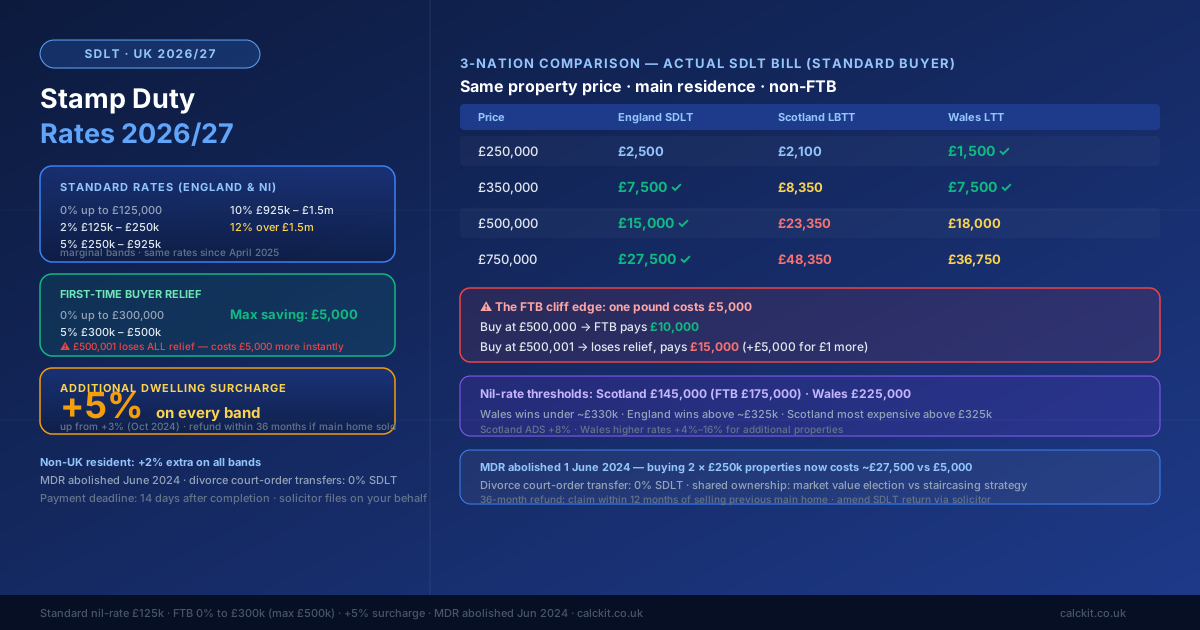
Stamp duty in the UK is not one tax but three — SDLT in England and Northern Ireland, LBTT in Scotland, and LTT in Wales. Each has different bands, thresholds, and surcharges. The rates that took effect in April 2025 (after the temporary 2022–25 thresholds expired) remain in place for 2026/27, with no changes announced.
This guide covers the complete 2026/27 picture: standard rates, first-time buyer relief, second home rules, and six areas the standard guides leave out — including the cliff edge that costs first-time buyers £5,000 for buying at the wrong price.
🏠What Is Stamp Duty?
Stamp Duty Land Tax (SDLT) is the tax paid when you buy a property or land in England and Northern Ireland above a certain price. It is calculated on a marginal basis — like income tax, you pay each rate only on the slice of the price that falls within each band. You do not pay the top rate on the entire purchase price.
Payment is due 14 days after completion. Your solicitor handles submission and payment and will include the amount in your completion statement. Late payment attracts a £100 fine immediately, rising to £200 after six months, plus interest from day 15 at HMRC's late-payment rate.
Standard SDLT Rates 2026/27 (England & Northern Ireland)
| Purchase price | SDLT rate |
|---|---|
| Up to £125,000 | 0% |
| £125,001 – £250,000 | 2% |
| £250,001 – £925,000 | 5% |
| £925,001 – £1,500,000 | 10% |
| Over £1,500,000 | 12% |
Worked examples:
£250,000 purchase (standard buyer):
- 0% on £125,000 = £0
- 2% on £125,000 = £2,500
- Total: £2,500
£400,000 purchase (standard buyer):
- 0% on £125,000 = £0
- 2% on £125,000 = £2,500
- 5% on £150,000 = £7,500
- Total: £10,000
£600,000 purchase (standard buyer):
- 0% on £125,000 = £0
- 2% on £125,000 = £2,500
- 5% on £350,000 = £17,500
- Total: £20,000
First-Time Buyer Relief 2026/27
First-time buyers in England and Northern Ireland benefit from a higher nil-rate threshold, provided the property costs no more than £500,000.
| Purchase price (FTB) | SDLT rate |
|---|---|
| Up to £300,000 | 0% |
| £300,001 – £500,000 | 5% |
| Over £500,000 | Standard rates apply (no relief) |
£350,000 purchase (first-time buyer):
- 0% on £300,000 = £0
- 5% on £50,000 = £2,500
- Total: £2,500 (vs £7,500 standard rate — saving: £5,000)
Maximum possible FTB saving: £5,000 (on a property priced at or near £500,000).
Both buyers in a joint purchase must be first-time buyers to qualify. If either buyer has previously owned property anywhere in the world, the relief is lost.
The First-Time Buyer Cliff Edge: A £5,000 Trap
This is the most important number in this entire guide for buyers near the £500,000 threshold.
At £500,000 (FTB):
- 0% on £300,000 = £0
- 5% on £200,000 = £10,000
- SDLT: £10,000
At £500,001 (FTB — relief lost entirely):
- Standard rates apply to the full price
- 0% on £125,000 = £0
- 2% on £125,000 = £2,500
- 5% on £250,001 = £12,500
- SDLT: £15,000
Buying at £500,001 instead of £500,000 costs a first-time buyer £5,000 more in tax — for a £1 increase in purchase price.
The relief disappears completely rather than tapering. There is no transitional band. This makes the £500,000 threshold a genuine negotiating target: if you are bidding near this level, pushing the seller to keep within £500,000 is worth the conversation.
This is not a rounding error — estate agents are aware of it and often deliberately price properties at £499,950 or £499,995. If you are in a sealed bid scenario at around this level, the maths firmly support keeping your offer at or below £500,000 rather than going above.
Additional Dwelling Surcharge: Second Homes & Buy-to-Let
When you buy a residential property that is not replacing your main residence, a 5% surcharge applies on top of every SDLT band. This includes:
- Second homes and holiday properties
- Buy-to-let residential investments
- Properties bought by companies
The surcharge increased from 3% to 5% in October 2024.
Effective rates with surcharge:
| Purchase price | Standard rate | With +5% surcharge |
|---|---|---|
| Up to £125,000 | 0% | 5% |
| £125,001 – £250,000 | 2% | 7% |
| £250,001 – £925,000 | 5% | 10% |
| £925,001 – £1,500,000 | 10% | 15% |
| Over £1,500,000 | 12% | 17% |
£300,000 second home purchase:
- 5% on £125,000 = £6,250
- 7% on £125,000 = £8,750
- 10% on £50,000 = £5,000
- Total: £20,000 (vs £5,000 standard rate — surcharge adds £15,000)
The 36-Month Surcharge Refund: How It Works
If you buy a new main residence before selling your previous one, you pay the 5% additional dwelling surcharge at completion. You can claim a full refund of this surcharge if you sell the original property within 36 months.
Step-by-step refund process:
- Complete the purchase of your new property (paying the +5% surcharge)
- Sell your previous main residence within 36 months of the new purchase completion date
- Submit an amended SDLT return to HMRC — you cannot use the online SDLT service for this; it must be a paper amendment or through a solicitor
- HMRC has a further 12 months from the date you sold the previous property in which it can assess the claim — submit promptly
- Refund is paid to the person who filed the original return (usually your solicitor, who passes it to you)
What qualifies: The property you sold must have been your main residence. Selling a buy-to-let does not trigger a refund even if you also own that property.
Common mistake: Thinking the refund window is 36 months from sale of the original property. It is 36 months from completion of the new purchase. If you complete your new home on 1 September 2026, you must sell the old property by 1 September 2029 to qualify.
🏡Scotland: Land and Buildings Transaction Tax (LBTT)
Scotland replaced stamp duty with LBTT from April 2015. Rates are set by the Scottish Parliament independently of England.
LBTT residential rates 2026/27:
| Purchase price | LBTT rate |
|---|---|
| Up to £145,000 | 0% |
| £145,001 – £250,000 | 2% |
| £250,001 – £325,000 | 5% |
| £325,001 – £750,000 | 10% |
| Over £750,000 | 12% |
First-time buyer relief (Scotland): The nil-rate threshold increases to £175,000 (vs £145,000 standard). Maximum saving: £600.
Additional Dwelling Supplement (ADS): 8% on top of standard LBTT bands for additional residential properties (increased from 6% in October 2024).
Wales: Land Transaction Tax (LTT)
Wales replaced stamp duty with LTT from April 2018.
LTT main residential rates 2026/27:
| Purchase price | LTT rate |
|---|---|
| Up to £225,000 | 0% |
| £225,001 – £400,000 | 6% |
| £400,001 – £750,000 | 7.5% |
| £750,001 – £1,500,000 | 10% |
| Over £1,500,000 | 12% |
Wales has no first-time buyer relief — all buyers use the main residential rates.
Higher residential rates (additional properties in Wales):
| Purchase price | LTT higher rate |
|---|---|
| Up to £180,000 | 4% |
| £180,001 – £250,000 | 7.5% |
| £250,001 – £400,000 | 9% |
| £400,001 – £750,000 | 11.5% |
| £750,001 – £1,500,000 | 14% |
| Over £1,500,000 | 16% |
3-Nation Comparison: Which Country Is Cheapest?
Actual bills for a standard (non-FTB, main residence) purchase at the same price in each nation:
| Price | England SDLT | Scotland LBTT | Wales LTT | Cheapest |
|---|---|---|---|---|
| £250,000 | £2,500 | £2,100 | £1,500 | Wales |
| £350,000 | £7,500 | £8,350 | £7,500 | England/Wales |
| £500,000 | £15,000 | £23,350 | £18,000 | England |
| £750,000 | £27,500 | £48,350 | £36,750 | England |
Wales is the cheapest at lower price points because of the high nil-rate threshold (£225,000 vs £125,000 in England). England overtakes above ~£325,000, after which Scotland's 10% band from £325,001 makes Scottish purchases significantly more expensive.
At £750,000, a Scottish buyer pays £20,850 more in land transaction tax than an equivalent English buyer — a figure relevant to anyone considering cross-border property investment.
Shared Ownership: Market Value Election vs. Lease Premium
Shared ownership buyers have a choice about how they pay SDLT that most guides ignore:
Option 1 — Pay on the initial share only: You pay SDLT only on the share you are purchasing. Future "staircasing" tranches (buying additional shares) each trigger a new SDLT liability when they take the share above 80%.
Option 2 — Market value election: You elect to pay SDLT on the full market value of the property upfront, as if you owned 100% from day one. Future staircasing tranches attract no further SDLT.
When market value election makes sense:
If you are buying a 25% share in a £300,000 property, your initial share is £75,000 — below any SDLT threshold, so you pay £0 on option 1. If you plan to staircase to 80%+ within a few years, electing early could cost nothing now and save a bill later.
However, if you are unlikely to staircase above 80%, option 1 — paying on each tranche — generally results in lower total SDLT, because each tranche is taxed at current rates on a smaller value.
The decision depends on the likely timeline to staircasing, the property value trajectory, and your confidence in future purchase plans. This is worth explicitly asking your solicitor to model both scenarios before exchange.
Multiple Dwellings Relief: Abolished June 2024
Until 1 June 2024, Multiple Dwellings Relief (MDR) allowed buyers purchasing two or more residential properties in a single transaction to calculate SDLT based on the average price per dwelling rather than the total. This produced a lower effective rate.
MDR was abolished with effect from 1 June 2024. Any contracts exchanged on or after that date — regardless of when the property was originally purchased — cannot use MDR.
The abolition has the biggest impact on:
- Investors buying blocks of flats
- Buyers purchasing a house with an annexe
- Simultaneous purchase of multiple properties from the same seller
Cost example — buying two properties at £250,000 each:
Before MDR abolition: Average price = £250,000 each. SDLT on each: £2,500. Total: £5,000.
After MDR abolition: Total consideration = £500,000 (treated as one transaction plus additional dwelling surcharge on the second property). Standard SDLT on £500,000 = £15,000. Plus 5% surcharge on second property (£250,000): £12,500. Total: £27,500.
The removal of MDR has added significant costs to multi-unit acquisitions and should be factored into any investment appraisal.
Divorce and Separation: No SDLT on Court-Ordered Transfers
When a court issues a property transfer order as part of a divorce settlement — known as a Finance Order under the Matrimonial Causes Act 1973 — the transfer is exempt from SDLT entirely, regardless of the property's value.
This applies to:
- Transfers of the family home from joint names to one spouse
- Transfers where one party pays the other a cash sum as equalisation
- Transfers from one civil partner to another following civil partnership dissolution
Key conditions:
- The transfer must be made in pursuance of a court order, not just a private agreement
- The exemption applies to cohabitants too, if the transfer is under a court order (though cohabitants have fewer automatic rights)
- Getting a solicitor to document the court order before submitting the SDLT return is essential — HMRC will not grant the exemption retrospectively without evidence
This exemption is rarely explained clearly, and some buyers in divorce proceedings have paid SDLT unnecessarily. If you are going through a separation involving property, confirm the court order status with your solicitor before completion.
Non-UK Resident Surcharge
Buyers who are not UK resident at the time of purchase pay an additional 2% surcharge on top of all standard SDLT bands.
UK residency test for SDLT: you must have been present in the UK for at least 183 days in the 12 months before the effective date of the transaction (usually completion).
This surcharge stacks with the additional dwelling surcharge. A non-UK resident buying a second property pays both +5% (additional dwelling) and +2% (non-resident) — a total surcharge of 7%.
Example — non-UK resident buying £400,000 second home:
- Standard SDLT on £400,000: £10,000
- Additional dwelling surcharge (+5%): £20,000
- Non-resident surcharge (+2%): £8,000
- Total SDLT: £38,000
What Stamp Duty Does Not Apply To
Several common transactions are exempt from SDLT:
- Transfers between spouses and civil partners — not just divorce; transfers within a marriage (e.g., adding a spouse to the title) are also generally exempt if made by way of gift
- Properties under £40,000 — below this threshold SDLT does not apply even if there is a chargeable consideration
- No consideration — if a property is genuinely gifted with no payment, mortgage assumption, or consideration, SDLT is £0 (though Land Registry fees still apply)
- Charities — registered charities buying property for charitable purposes benefit from an SDLT relief
- Purchases from a local authority — a narrow relief for certain social housing transactions
SDLT Payment: Practical Notes
Who files: Your conveyancing solicitor submits the SDLT return (Form SDLT1) and pays the tax on your behalf. The amount is included in your completion statement.
Funding: You need the SDLT amount in cleared funds before completion. For a £400,000 purchase at standard rates, that is £10,000 on top of your deposit and legal fees.
Amendment window: SDLT returns can be amended for up to 12 months after the filing deadline (i.e., within 26 months of completion). This is the window for claiming relief you missed at the time, including the 36-month surcharge refund.
Key Figures at a Glance: 2026/27
| Rule | Detail |
|---|---|
| Standard nil-rate threshold | £125,000 (England/NI) |
| FTB nil-rate threshold | £300,000 (England/NI only) |
| FTB price ceiling | £500,000 (lose all relief above) |
| FTB cliff edge cost | £5,000 penalty for buying at £500,001 vs £500,000 |
| Additional dwelling surcharge | +5% (since October 2024) |
| Non-resident surcharge | +2% |
| Payment deadline | 14 days post-completion |
| Surcharge refund window | 36 months from new purchase completion |
| MDR | Abolished 1 June 2024 |
| Divorce transfer exemption | Yes — under court order only |
| Scotland nil-rate | £145,000 (LBTT) / £175,000 FTB |
| Wales nil-rate | £225,000 (LTT) |