
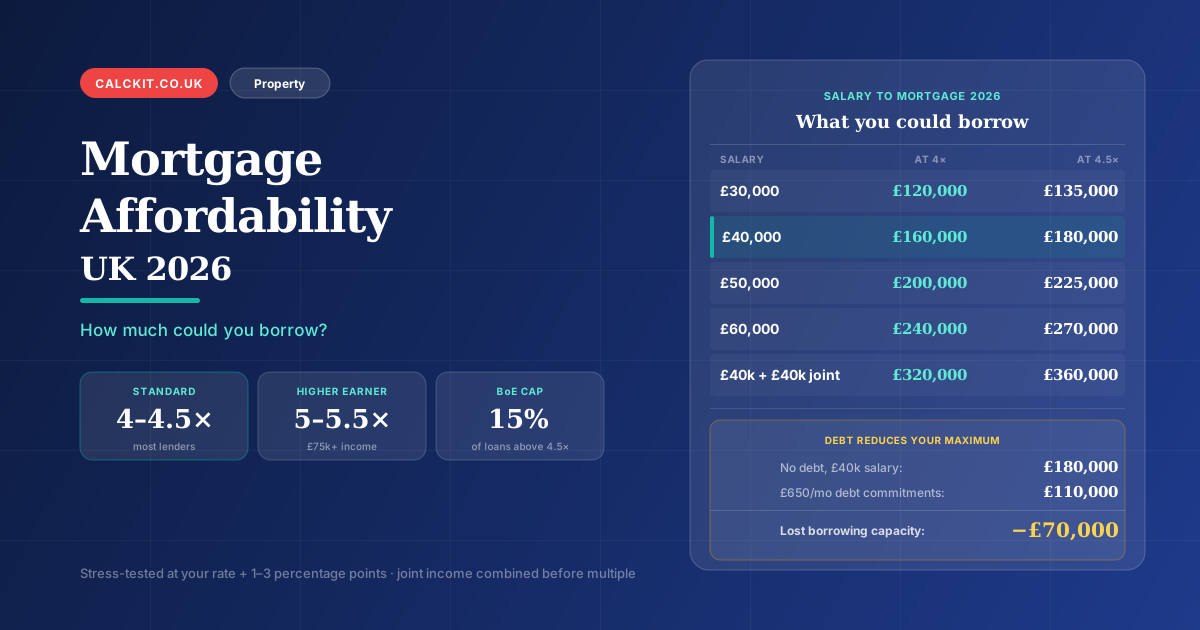
A £40,000 salary typically unlocks a mortgage of £160,000–£180,000. A £60,000 salary unlocks £240,000–£270,000. But the gap between what you think you can borrow and what a lender will actually offer often comes down to details most buyers never see — existing debt, how bonuses are treated, and a stress test that assumes your mortgage rate is several points higher than it actually is.
This guide covers exactly how UK lenders calculate mortgage affordability in 2026: the income multiples, the stress test, how debt and self-employed income are treated, and what you can do to increase your maximum borrowing before you apply.
🏡How much can you borrow? The income multiple
UK lenders use an income multiple — your maximum mortgage as a multiple of your gross annual income — as the starting point for affordability.
| Borrower type | Typical multiple | Maximum range |
|---|---|---|
| Standard applicant | 4–4.5× income | Most high street lenders |
| Higher earner (£75,000+) | 5–5.5× income | Selected lenders, larger deposits |
| Premier/private banking | Up to 6.5× income | Specific bank premier tiers, strict eligibility |
| First-time buyer schemes | Up to 5.5× income | Selected lenders, minimum income thresholds |
Mortgage by salary — standard 4–4.5× multiple:
| Gross salary | At 4× | At 4.5× |
|---|---|---|
| £25,000 | £100,000 | £112,500 |
| £30,000 | £120,000 | £135,000 |
| £35,000 | £140,000 | £157,500 |
| £40,000 | £160,000 | £180,000 |
| £50,000 | £200,000 | £225,000 |
| £60,000 | £240,000 | £270,000 |
| £75,000 | £300,000 | £337,500 |
| £100,000 | £400,000 | £450,000 |
These figures are starting points, not guarantees. Your actual maximum also depends on debt, credit history, and the stress test — covered below.
🏡Why the Bank of England caps how many people get 5×+
The Bank of England's Financial Policy Committee limits loan-to-income (LTI) flow — the proportion of new mortgages a lender can write above 4.5 times income — to 15% of new lending each quarter.
This is a deliberate macroprudential control, introduced after the 2008 financial crisis, designed to prevent another debt-fuelled housing bubble. The practical effect: most lenders reserve their 5×+ multiples for applicants who meet additional criteria —
- Minimum income thresholds (commonly £50,000 single / £75,000 joint)
- Specific professions considered lower-risk (doctors, dentists, solicitors, accountants, teachers at some lenders)
- Larger deposits (often 10%+ rather than the minimum 5%)
- A clean credit history with no missed payments
If you are offered a 5× multiple, it typically reflects that the lender has limited "headroom" within their 15% quota and has chosen you as a good risk within it — not that 5× is a standard offer available to everyone.
The mortgage stress test — why your real rate isn't the only rate that matters
Every UK lender is required to check that you could still afford your mortgage if interest rates rose. Since the Financial Conduct Authority removed the mandatory 3-percentage-point stress test floor in August 2022, lenders now set their own buffer — typically 1 to 3 percentage points above your actual mortgage rate, varying by lender and product.
Stress-tested rate = Your actual mortgage rate + Lender's buffer (typically 1–3 percentage points)
Example: If your mortgage offer is at 4.5%, a lender using a 2-point buffer will check your affordability at 6.5% — even though you would never actually pay that rate on this product. If your income and expenses can comfortably support payments at the stress-tested rate, you pass. If not, your maximum borrowing is reduced until you do.
This is one of the most common reasons buyers are offered less than the headline income multiple suggests — the stress test, not the multiple itself, is often the binding constraint.
How debt reduces what you can borrow
Lenders calculate affordability based on disposable income after existing debt commitments, not just gross salary. Every monthly debt payment is effectively subtracted from your capacity to take on a mortgage payment.
Rough rule of thumb: every £100 of monthly debt repayment can reduce your maximum mortgage by roughly £15,000–£20,000, because lenders model that commitment as ongoing throughout the mortgage term (or at least its remaining term).
Worked example:
| Scenario | Monthly debt | Maximum mortgage (£40,000 salary) |
|---|---|---|
| No existing debt | £0 | £180,000 |
| Car finance | £300/month | £150,000–£155,000 |
| Car finance + credit card | £450/month | £130,000–£140,000 |
| Car finance + credit card + personal loan | £650/month | £105,000–£115,000 |
What counts as debt for affordability purposes:
- Credit card balances (lenders typically assume 3–5% of the balance as a monthly minimum payment, even if you pay it off in full)
- Car finance (PCP, HP, or lease)
- Personal loans
- Student loan repayments (Plan 1, 2, 4, 5, or postgraduate — calculated as an actual monthly deduction)
- Buy now, pay later commitments (increasingly checked by lenders since 2024)
- Other mortgages or rent commitments if not selling/vacating before completion
Clearing a £10,000 credit card balance before applying can increase your maximum mortgage by several thousand pounds — sometimes more than saving the equivalent amount toward your deposit, because lenders weight ongoing debt commitments heavily against affordability.
Joint mortgages — how much more can you borrow together?
Joint applications combine incomes before applying the multiple, which significantly increases borrowing capacity for most couples or co-buyers.
| Applicant 1 income | Applicant 2 income | Combined income | Max mortgage (4.5×) |
|---|---|---|---|
| £30,000 | £0 (sole applicant) | £30,000 | £135,000 |
| £30,000 | £25,000 | £55,000 | £247,500 |
| £30,000 | £35,000 | £65,000 | £292,500 |
| £40,000 | £40,000 | £80,000 | £360,000 |
Most UK lenders allow up to four people on one mortgage application, though typically only the two highest incomes are used in full affordability calculations — additional applicants beyond two often only help by adding to the deposit or providing extra security, depending on the lender's policy.
Important: joint applications also combine debt and credit history. If one applicant has significant existing debt or a poor credit history, this affects the whole application — joint affordability is not simply "the better of the two" scenarios.
Self-employed and limited company director income
Self-employed applicants — sole traders, partnerships, and limited company directors — face additional scrutiny because income can vary year to year.
Sole traders and partnerships: Most lenders average your net profit (not turnover) over the last 2–3 years of accounts or self-assessment tax returns. If your income is rising, some lenders will use the most recent year or an average weighted toward it; if falling, most will use the lower recent figure or an average that reflects the decline.
Limited company directors: Lenders typically assess income as salary plus dividends drawn from the company over the last 2–3 years. Some specialist lenders will instead consider the company's net profit (retained profit plus your salary) — useful for directors who keep profit in the company rather than drawing it all as dividends, which is common for tax efficiency. For more on how directors structure pay, see: How to Pay Yourself as a Limited Company Director.
Typical documentation required:
- 2–3 years of certified accounts (prepared by a qualified accountant)
- 2–3 years of SA302 forms or HMRC tax year overviews
- Business bank statements (usually 3–6 months)
- Confirmation of ongoing trading from an accountant for some lenders
Minimum trading history: Most mainstream lenders require at least 2 full years of accounts. A small number of specialist lenders accept 1 year, usually with a higher rate or stricter terms, and a few accept new businesses with strong contracts or guaranteed future income.
🏠How bonuses, overtime, and commission are treated
Variable income is rarely counted at face value. Lenders typically apply a percentage based on consistency and guarantee:
| Income type | Typical treatment |
|---|---|
| Guaranteed bonus (contractual) | Often 100% counted |
| Regular bonus (2–3 year consistent history) | Usually 50–100% counted |
| One-off or first-year bonus | Often excluded entirely |
| Regular overtime (consistent pattern) | Usually 50–100% counted |
| Commission (sales roles, consistent history) | Usually 50–100% counted |
| Car allowance | Often counted in full if guaranteed |
If your income relies heavily on variable pay, gathering 2–3 years of payslips or P60s showing consistency significantly strengthens your application and increases the percentage a lender will count.
What it costs beyond the mortgage — stamp duty and upfront costs
Affordability calculations focus on the mortgage itself, but buyers also need cash for costs that do not form part of the loan:
- Deposit — minimum 5%, though better rates are available from 10% and significantly better from 25%
- Stamp Duty Land Tax — see Stamp Duty Guide UK for current thresholds and first-time buyer relief
- Mortgage arrangement fees — typically £0–£2,000 depending on the product
- Valuation and survey fees — £150–£1,500 depending on survey level
- Conveyancing/legal fees — typically £800–£1,500
- Removal costs — variable
A common mistake is calculating "can I afford the mortgage?" without separately confirming "do I have enough cash for the deposit plus stamp duty plus fees?" Both must be true simultaneously.
🏠Current schemes for buyers with smaller deposits (2026)
Help to Buy equity loans closed to new applicants in 2023. Current support available to UK buyers includes:
Mortgage Guarantee Scheme: Allows lenders to offer 95% loan-to-value mortgages with government backing, reducing the deposit needed to 5%. Available on properties up to £600,000.
Lifetime ISA (LISA): Save up to £4,000/year and receive a 25% government bonus (up to £1,000/year), usable toward a first home up to £450,000. Must be open for at least 12 months before the bonus can be used toward a purchase.
First Homes scheme: Offers new-build homes at a discount of 30–50% below market value to eligible first-time buyers and key workers in some areas, subject to local authority availability.
Shared Ownership: Buy a percentage share (typically 25–75%) of a property and pay rent on the remainder, with the option to "staircase" to full ownership over time.
How to increase your maximum mortgage before applying
- Clear consumer debt — paying off credit cards, car finance, or personal loans before applying directly increases borrowing capacity, often more efficiently than saving the equivalent toward your deposit
- Avoid new credit applications — each hard credit check in the months before applying can temporarily reduce your credit score
- Build 2–3 years of consistent income evidence — particularly important for bonuses, overtime, and self-employed income
- Consider a joint application — combining incomes (and being aware of combining debt/credit profiles) can substantially increase capacity
- Save a larger deposit — beyond improving your rate, 10%+ deposits sometimes unlock higher income multiples from specific lenders
- Use a mortgage broker — brokers have visibility across lender criteria that vary significantly and can match you to a lender offering a higher multiple for your specific circumstances
Frequently Asked Questions
Is mortgage affordability the same as how much I want to spend?
No. Affordability is the maximum a lender will offer based on income, debt, and the stress test. It is not a recommendation of how much you should borrow. Many financial advisers suggest keeping monthly mortgage payments below 30–35% of net (take-home) income, which is often comfortably below what a lender's maximum income multiple would allow.
Does my credit score affect how much I can borrow, or just whether I'm approved?
Both. A poor credit score can result in outright rejection from many lenders, but even where approved, a weaker credit profile often results in a lower maximum multiple and a higher interest rate — which itself reduces affordability further through the stress test.
Can I use rental income to boost mortgage affordability?
For a standard residential mortgage, only some lenders count rental income from an existing property you already own, and usually only a percentage of it (typically 50–75% of gross rent, after deducting an assumed expense margin). Buy-to-let mortgages use a different affordability calculation entirely, based primarily on the rental income the property being purchased will generate, not your personal salary.
How accurate are online mortgage affordability calculators?
Online calculators, including ours, provide a useful starting estimate based on standard income multiples and typical lending criteria. They cannot replicate a lender's full underwriting process, which includes credit checks, detailed expenditure analysis, and product-specific stress tests. Treat the result as a planning guide — confirm your actual maximum with a mortgage broker or lender before making an offer on a property.
The bottom line
For 2026, most UK buyers can expect a maximum mortgage of 4 to 4.5 times their gross income, with 5×+ available only to higher earners, specific professions, or those with larger deposits — and even then, subject to the Bank of England's 15% cap on high-multiple lending. Existing debt, variable income treatment, and the interest rate stress test often have more impact on your actual maximum than the headline multiple suggests.
Use the calculator to see your estimated maximum borrowing, then speak to a mortgage broker to confirm what specific lenders will actually offer based on your full financial picture.
🏡Last updated June 2026. Mortgage affordability criteria vary by lender and are subject to change. This guide provides general information, not financial advice — speak to a qualified mortgage adviser before making borrowing decisions.