
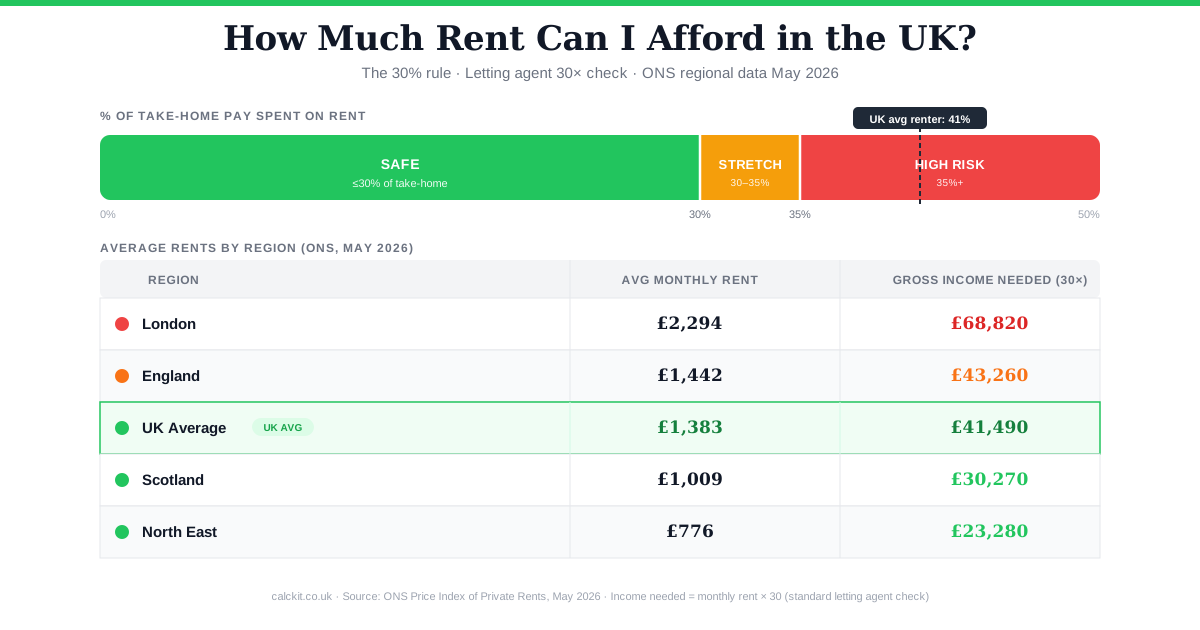
The average UK renter now spends 41% of their take-home pay on rent, according to industry data. The standard advice is 30%. That 11-point gap is not a rounding error — it reflects how stretched the rental market has become, particularly in London and the South East.
Knowing your actual budget before you search saves you the frustration of falling for a flat you cannot realistically afford or failing a letting agent's income check at the last moment. If the numbers are tight, our guide to saving money in the UK covers the quickest ways to free up budget.
There are two separate tests to understand: the personal finance rule (what is sustainable for you) and the letting agent income check (what landlords require).
The Two Tests: Personal Finance vs. Letting Agent Check
Test 1 — The 30% rule (your real budget)
The most widely used personal finance guideline is that rent should not exceed 30% of your monthly take-home pay. Some advisers use gross income, but take-home is what actually arrives in your account — it is the more honest number to plan from.
| Monthly take-home | Safe rent (30%) | Stretch (35%) | High-risk boundary |
|---|---|---|---|
| £1,500 | £450 | £525 | £600+ |
| £2,000 | £600 | £700 | £800+ |
| £2,500 | £750 | £875 | £1,000+ |
| £3,000 | £900 | £1,050 | £1,200+ |
| £4,000 | £1,200 | £1,400 | £1,600+ |
| £5,000 | £1,500 | £1,750 | £2,000+ |
If your rent exceeds 40% of take-home pay, you are in a precarious position. A broken boiler, a month of reduced income, or an unexpected bill can quickly tip you into arrears. The 30% figure exists for exactly this reason.
Test 2 — The 30x check (what letting agents require)
Most UK letting agents and landlords require your annual gross salary to be at least 30 times the monthly rent. This is sometimes stated as the tenant needing to earn 2.5x the annual rent — the arithmetic is the same.
| Monthly rent | Minimum annual gross income required (30x) |
|---|---|
| £700/month | £21,000 |
| £900/month | £27,000 |
| £1,000/month | £30,000 |
| £1,200/month | £36,000 |
| £1,500/month | £45,000 |
| £2,000/month | £60,000 |
| £2,500/month | £75,000 |
Some agents in competitive areas use 35x or even 40x. When in doubt, ask the agent directly before viewing — there is no point falling in love with a flat if you will not pass their check.
🔑Gross vs. Net: Which Income Counts?
This distinction trips many renters up.
Letting agents use gross income (before tax, NI, pension) for the 30x check. A £40,000 salary qualifies you for up to £1,333/month rent by their calculation — even though your take-home pay is only around £2,650/month.
Your personal budget should use net income (take-home). At £2,650/month take-home, the 30% rule gives you a safe rent of £795/month — significantly less than the £1,333 the agent would technically approve.
The point: you can pass a letting agent's check and still be overstretching yourself. Always sanity-check the rent against your actual take-home, not your gross salary.
Average Rents by UK Region (ONS, May 2026)
The ONS Price Index of Private Rents (PIPR) covers both new lets and existing tenancies — the broadest measure of what renters actually pay. As of May 2026:
| Region | Average monthly rent | Annual gross needed (30x) |
|---|---|---|
| London | £2,294 | £68,820 |
| South East | ~£1,650 | ~£49,500 |
| East of England | ~£1,290 | ~£38,700 |
| England (average) | £1,442 | £43,260 |
| UK (average) | £1,383 | £41,490 |
| Scotland | £1,009 | £30,270 |
| Northern Ireland | £876 | £26,280 |
| Wales | £836 | £25,080 |
| North East | £776 | £23,280 |
Annual rents rose 3.3% across the UK in the 12 months to May 2026, with the North East rising fastest at 5.9% and London slowest at 2.0%.
London: Where the Maths Breaks Down
The median London rent of £2,294/month requires a gross income of £68,820 to pass the standard 30x check. The UK median full-time salary is around £37,000.
Most London renters do not pass the theoretical check on a single income. In practice, landlords in London (and increasingly other major cities) accept:
- Joint tenancies — two incomes combined, assessed against the same 30x threshold on the total rent
- Guarantors — a parent or employer providing a guarantee (more on this below)
- Rent in advance — paying 3–6 months upfront instead of meeting the income multiple
- Higher thresholds from employers — some letting agents accept a lower multiplier if the employer provides a letter confirming employment tenure and income
If you are renting in London on a single income below £70,000, a flatshare is typically the most financially stable option.
Self-Employed and Variable Income
If you are self-employed, a freelancer, or on a zero-hours contract, the income check process is more involved.
Most letting agents will ask for:
- SA302 tax year overviews for the last 2–3 years (downloadable from HMRC online account)
- Bank statements for the last 3–12 months
- Accountant reference or signed letter confirming income
The income figure agents use is usually your average net profit over the years provided — not turnover, and not the best year. If your income fluctuates, they often use the lower of the last two years as a conservative measure.
Directors of limited companies: agents typically add your salary and dividends together. Some agents will also accept retained profits in the company as evidence of capacity to pay. Always ask what documentation they need before you apply.
For more on how your income is structured if you are self-employed or a director, see our guides on self-employed tax and paying yourself as a limited company director.
Joint Tenancies
When two or more people rent together, agents add the gross incomes and apply the 30x check to the combined total.
Example: Rent is £1,800/month. The income needed to pass solo is £54,000. Two tenants each earning £28,000 (combined £56,000) would pass — even though neither qualifies individually.
Most agents include all named tenants on the tenancy agreement in the income assessment. If one tenant earns significantly less, it can drag the combined figure down — in which case, the higher earner taking sole tenancy (with the second person as a permitted occupier) may produce a cleaner application, depending on the property.
What to Do If You Don't Pass
Failing the income check does not automatically end your application. Practical routes forward:
1. Add a guarantor. A guarantor agrees to cover rent if you default. Agents typically require guarantors to earn at least 36x the monthly rent annually — a higher bar than the tenant themselves. Guarantors must usually be UK-based homeowners.
2. Pay rent in advance. Many landlords accept 3–6 months' rent upfront instead of (or alongside) a guarantor. This protects them against non-payment and gives you more flexibility on the income check.
3. Negotiate a lower rent. If the property has been listed for a while, the landlord may accept a lower rent that brings you within the qualifying threshold. It costs nothing to ask.
4. Add a co-tenant. If you are trying to rent alone, adding a flatmate to the tenancy can bring the combined income above the threshold.
5. Look at a lower rent band. If the rent at £1,200/month requires £36,000 but you earn £30,000, look at properties at £1,000/month where you qualify on your own income.
6. Universal Credit and housing benefit. Landlords cannot legally refuse an application solely because a tenant claims Universal Credit or other benefits, under the Renters' Rights Act 2025. If a landlord declines you on this basis alone, it may constitute discrimination. Local Housing Allowance (LHA) rates are set by the government and cap how much UC covers toward rent — check the LHA rate for your local authority before assuming UC will cover the full rent.
The Full Cost of Renting
Rent is only part of what you pay. Budget for:
| Cost | Typical UK monthly range |
|---|---|
| Council tax (Band D, England) | ~£181 |
| Gas and electricity | £100–£180 |
| Water | £40–£55 |
| Broadband | £25–£45 |
| Contents insurance | £8–£20 |
| Total on top of rent | £354–£481 |
At a typical £350–£450/month in bills and council tax, the true monthly housing cost is significantly higher than rent alone. A £1,200/month flat may actually cost £1,550–£1,650/month all-in.
Upfront costs to budget for:
- Security deposit: maximum 5 weeks' rent (Tenant Fees Act 2019)
- Holding deposit: maximum 1 week's rent
- First month's rent: typically paid before you move in
On a £1,000/month rent, your upfront costs before moving in could easily reach £2,150–£2,300 (holding deposit + security deposit + first month).
The Bottom Line
Two rules, used together, give you a clear picture:
- Personal finance: Keep rent at or below 30% of your monthly take-home pay.
- Letting agent check: Your annual gross income should be at least 30x the monthly rent.
If both numbers work, the property is within your range. If only the letting agent check passes (because the gross multiple looks fine but the 30% of take-home is tight), treat that as a warning — not a green light.
Use the calculator to run both checks in seconds:
🔑