
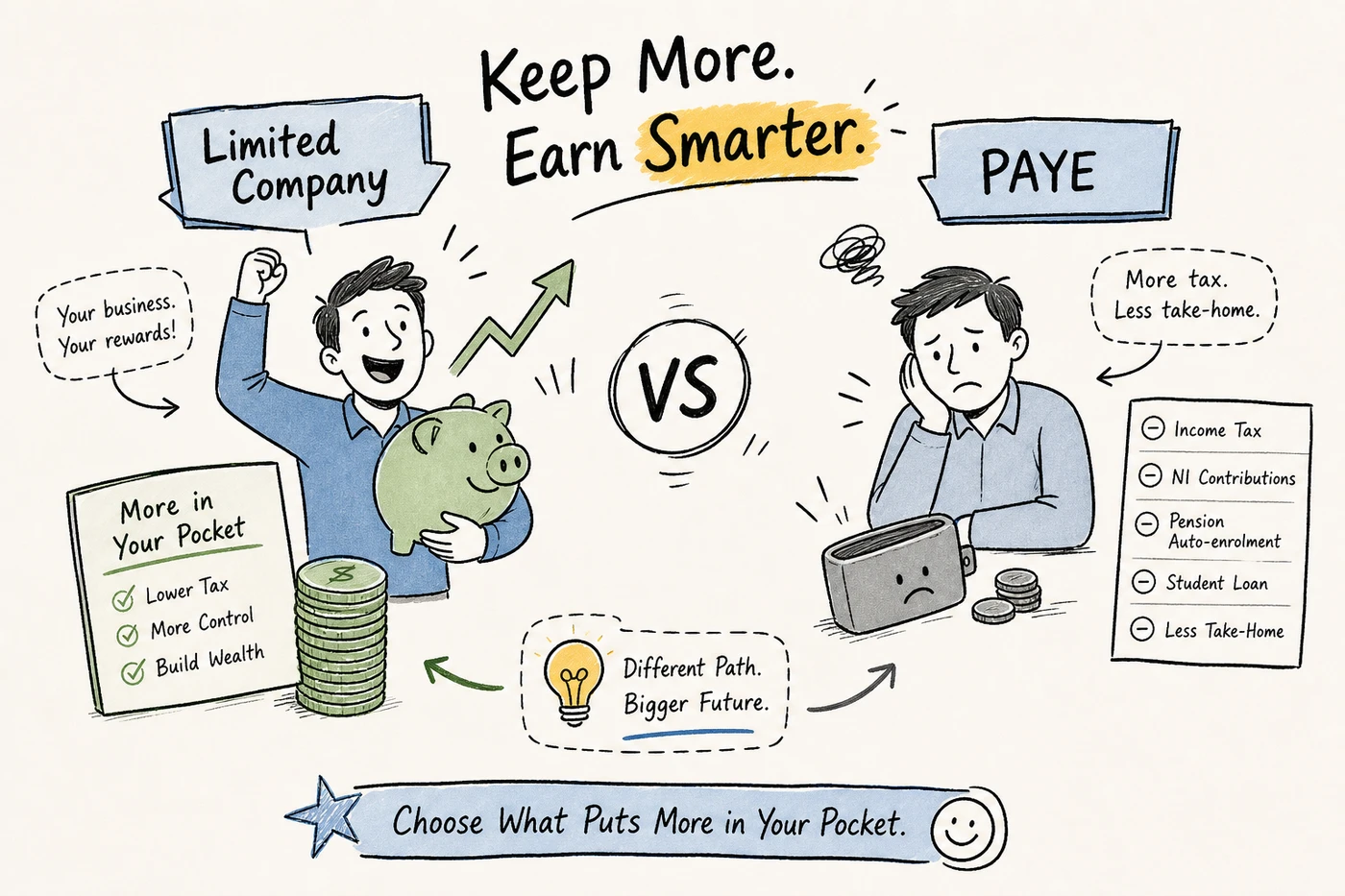
Limited company vs PAYE is the defining financial decision for most UK contractors, and the gap between getting it right and getting it wrong is typically £4,000 to £5,500 in take-home pay every year at mid-range day rates. That money doesn't disappear in one obvious hit — it bleeds out through employer National Insurance deductions, umbrella margins, and income tax on earnings that a limited company director would have sheltered as dividends.
In 2026, UK contractors have three main routes: PAYE through an agency, employment through an umbrella company, or billing via their own limited company (sometimes called a personal service company, or PSC). Each has a different tax profile, a different admin burden, and a different relationship with IR35.
⚖️Three ways UK contractors get paid in 2026
PAYE through an agency
When you work PAYE through an agency, the agency employs you directly. It deducts income tax and employee National Insurance Contributions (NICs) through its payroll and pays employer NICs on top of your rate — currently 15% above the £5,000 secondary threshold. You receive a net salary with nothing else to manage. This is the simplest route available, and take-home is similar to umbrella employment (without the umbrella margin), but well below a limited company outside IR35, because you receive none of the tax-planning tools available to business owners.
Umbrella company employment
An umbrella company becomes your employer across multiple contracts. It absorbs employer NICs off the top of your contract rate before any other calculation, deducts its own weekly or monthly margin (typically £15 to £30), and then processes your remaining pay as PAYE employment income. Umbrella workers are always treated as inside IR35 by default, which closes off dividend strategies entirely.
From 6 April 2026, new regulations also shift secondary PAYE liability up the supply chain to agencies and end-clients if an umbrella fails to pay HMRC correctly. This change is prompting agencies to vet umbrella providers far more carefully than before.
Running your own limited company (PSC)
A personal service company is a private limited company you own and operate. You bill your clients or agency through the company, pay yourself a low salary, and take the remaining profits as dividends — taxed at lower rates than employment income and carrying no National Insurance. This structure produces the highest take-home pay of the three options when it works as intended.
The critical qualification is that a limited company only works as intended when your contract falls outside IR35. Inside IR35, the tax advantage largely disappears while the admin burden remains.
Limited company vs PAYE: what the numbers actually show
Worked example at £400 per day
Take a contractor billing £400 per day across 230 working days. That generates approximately £92,000 in gross annual contract income.
| Structure | Estimated take-home |
|---|---|
| Agency PAYE | ~£57,300 |
| Umbrella company | ~£56,800 |
| Limited company (outside IR35) | ~£61,400 |
The annual gap between umbrella and limited company at this rate is approximately £4,600.
How the gap shifts at different day rates
At £300 per day, the limited company versus umbrella difference is roughly £5,400. At £500 per day it narrows to about £3,900, because more of the director's dividends fall into the 35.75% higher rate band once total income passes £50,270.
At lower day rates — particularly sub-£200 — accountancy fees and running costs can materially reduce the limited company advantage, and the break-even point shifts closer than the headline figures suggest.
Why these figures are approximations
The figures above assume 230 billable days, a £12,570 director salary with the rest taken as dividends, no expenses or pension contributions, a £20/week umbrella margin, and 2026/27 tax rates. Your actual take-home depends on claimable business expenses, VAT flat-rate scheme eligibility, pension contributions into the company, and specific contract terms. Use the calculator below to enter your own day rate, contract days, and IR35 status for a side-by-side comparison built on current HMRC rates.
⚖️How limited company tax actually works
The salary and dividend split strategy
Limited company directors typically set their salary at £12,570 — the full personal allowance — to use that tax-free band while securing a qualifying year for State Pension. Above that, remaining profits are extracted as dividends.
Dividend tax rates (2026/27): Basic rate band: 10.75% Higher rate band: 35.75% Additional rate: 39.35% Dividend allowance: £500 (tax-free)
Dividends carry no National Insurance at all. The first £500 of dividend income each year falls within the dividend allowance and is tax-free.
Setting salary at the full personal allowance does trigger employer NICs of around £1,136 for a sole director (15% on the portion above £5,000), but the corporation tax relief on the salary deduction more than compensates for that cost in most cases.
Corporation tax and what the company pays first
Before distributing any dividends, the company pays corporation tax on its profits. The small profits rate of 19% applies on taxable profits up to £50,000, with marginal relief creating a gradual climb toward the 25% main rate for profits between £50,000 and £250,000.
Flow of money through a limited company: Contract income − Allowable business expenses − Director salary = Taxable profit × Corporation tax (19–25%) = Distributable reserves → Dividends to director
National Insurance for directors
By keeping salary at or near the personal allowance, directors avoid employee NICs at 8% on earnings between £12,570 and £50,270. Contrast this with an umbrella contractor, where employer NICs at 15% come off the gross contract rate before the payslip calculation even begins — effectively reducing the income base from the first pound.
IR35: the variable that changes every calculation
Outside IR35 — where a limited company wins decisively
Outside IR35 means HMRC and your end-client agree you are operating as a genuine business providing a service, not a disguised employee. The three primary tests are:
- Substitution — can you send someone else to do the work?
- Control — does the client direct how you work, or just what outcome you deliver?
- Mutuality of obligation — are both parties obligated to offer and accept ongoing work?
When a contract sits clearly outside IR35, the full salary and dividend strategy is available and HMRC-compliant, delivering the take-home figures shown in the worked examples above.
Inside IR35 — does a limited company still make sense?
Inside IR35, the PSC must treat the contract income as deemed employment income. Income tax and NICs apply as if you were a PAYE employee — which eliminates the dividend tax advantage almost entirely. The accountancy fees, company filing requirements, and compliance obligations remain, making the limited company structure a cost without a corresponding benefit.
If your contract is inside IR35, umbrella or agency PAYE is almost always the more rational choice. The limited company structure only earns its keep through sustained outside IR35 work at a meaningful day rate.
Use the IR35 calculator to model the exact financial difference for your day rate:
📋The April 2026 umbrella regulation change
The new off-payroll rules effective 6 April 2026 introduce joint and several liability for PAYE compliance across the labour supply chain. Agencies and end-clients now carry secondary responsibility for any PAYE that an umbrella company fails to remit to HMRC correctly. This is prompting many agencies to conduct proper due diligence on umbrella partners and, in a notable market shift, some agencies — particularly in financial services — are beginning to prefer PSC contractors for outside IR35 roles to sidestep umbrella chain risk entirely.
Admin costs, employment rights, and what you give up
The real cost of running a limited company
| Cost | Limited company | Umbrella |
|---|---|---|
| Accountancy | £600–£1,500/yr | — |
| Umbrella margin | — | £780–£1,560/yr |
| Companies House | ~£13/yr | — |
| Tax treatment | Business expense (reduces profit before CT) | Deducted from gross pay before any tax |
The key difference is timing: umbrella fees are deducted from gross pay before any tax calculation runs, meaning you lose that money from the widest possible income base. Accountancy fees are a business expense that reduces taxable profit before corporation tax — so the effective after-tax cost is lower than the headline number.
Holiday pay, sick pay and pension — the PAYE and umbrella advantage
Limited company directors have no automatic employment rights. There is no statutory sick pay, no maternity or paternity pay from the company unless specific arrangements are made, and no employer pension contribution unless the director deliberately sets one up.
PAYE and umbrella workers receive:
- 5.6 weeks of holiday pay per year
- Statutory sick pay
- Auto-enrolment pension with minimum 3% employer contribution
For contractors who plan extended leave, have dependants, or value financial security, this difference is worth quantifying alongside any tax saving before deciding on structure.
Which route is right for you?
Answer these four questions honestly before choosing a structure:
- What is your likely IR35 status on your current or upcoming contract?
- What is your day rate and expected annual billable income?
- How long is your typical contract — and do you have gaps between engagements?
- How much financial admin are you genuinely willing to manage each month?
| Situation | Best structure |
|---|---|
| High day rate (£300+) + outside IR35 + longer contracts | Limited company |
| Inside IR35 or contracts under 3 months | Umbrella |
| Public sector roles with limited IR35 flexibility | Agency PAYE or umbrella |
| Mixed inside and outside IR35 contracts | Model both — limited company may still win |
Generic estimates only get you so far. Your specific combination of day rate, contract days, expenses, and IR35 status produces a unique take-home figure that no article can replicate precisely. Use the calculator below to get your personalised comparison in under a minute.
The bottom line
A limited company operating outside IR35 delivers the highest take-home pay available to UK contractors in 2026, typically by £4,000 to £5,500 a year at mid-range day rates on 2026/27 rates. But it is not the right structure for every contractor.
IR35 status is the fulcrum of the entire decision. Everything else — the salary split, the dividend strategy, the corporation tax saving — only applies when the contract sits genuinely outside IR35. Anyone unsure of their status should get a proper IR35 assessment before incorporating, not after. The cost of getting that wrong is not just a tax bill — it is penalties and interest on deemed employment income going back potentially years.
Use the contractor calculator to get your personalised figures, then bring those numbers to a contractor-specialist accountant for professional sign-off before making any structural change.
📋Last updated September 2026. Rates based on 2026/27 HMRC figures.