
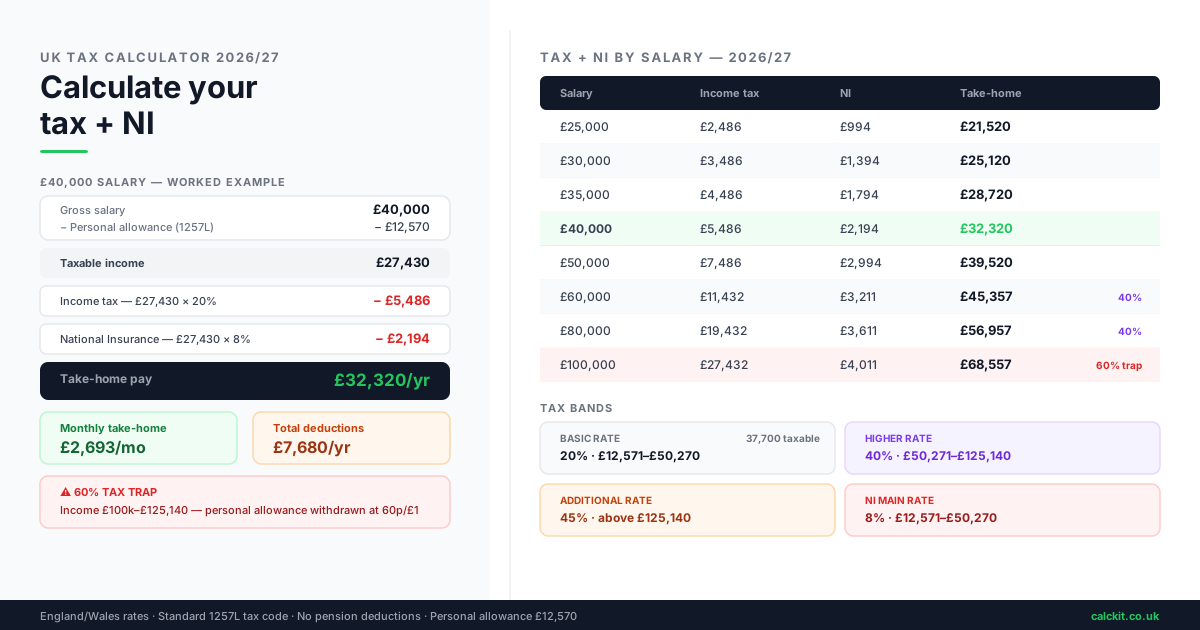
A UK income tax calculator does two things in sequence: it removes your personal allowance, then applies the tax bands to whatever is left. National Insurance runs on its own thresholds, in parallel. This guide shows you exactly how both are calculated, what your take-home pay looks like at common salary levels, and where the tax system produces results that most people find surprising — particularly around £100,000.
🏛UK income tax rates and bands 2026/27
Income tax in England, Wales, and Northern Ireland is charged in bands — each band applies only to the income falling within that range, not to your whole salary.
| Band | Taxable income | Rate |
|---|---|---|
| Personal allowance | £0 – £12,570 | 0% |
| Basic rate | £12,571 – £50,270 | 20% |
| Higher rate | £50,271 – £125,140 | 40% |
| Additional rate | Above £125,140 | 45% |
The personal allowance of £12,570 is frozen — it has not moved since 2021/22 and is currently scheduled to remain at this level until at least 2027/28. As salaries rise with inflation, more people are drawn into higher tax bands without any increase in the headline rates.
Scotland uses different bands and rates — the Scottish basic rate is 20% but applies over a narrower range, with an intermediate rate of 21% and a higher rate of 42%. See the Scottish income tax 2026/27 guide for the full breakdown.
National Insurance rates 2026/27
National Insurance contributions (NICs) for employees are calculated separately from income tax:
| Band | Earnings | NI rate |
|---|---|---|
| Below primary threshold | £0 – £12,570/year | 0% |
| Main rate | £12,571 – £50,270/year | 8% |
| Upper rate | Above £50,270/year | 2% |
How to calculate your tax — step by step
Step 1: Subtract your personal allowance from your gross salary. Step 2: Apply the income tax band rates to the taxable amount. Step 3: Calculate NI separately: 8% on earnings above £12,570, dropping to 2% above £50,270. Step 4: Add income tax and NI to get total deductions. Subtract from gross salary for take-home pay.
Worked example — £40,000 salary, standard 1257L tax code:
| Step | Calculation | Amount |
|---|---|---|
| Gross salary | — | £40,000 |
| Personal allowance | − £12,570 | — |
| Taxable income | £40,000 − £12,570 | £27,430 |
| Income tax (basic rate 20%) | £27,430 × 20% | £5,486 |
| NI (main rate 8%) | £27,430 × 8% | £2,194 |
| Total deductions | £5,486 + £2,194 | £7,680 |
| Take-home pay | £40,000 − £7,680 | £32,320/year |
Monthly take-home: £32,320 ÷ 12 = £2,693/month
Tax and NI at common salary levels (2026/27)
| Salary | Income tax | NI | Total deductions | Take-home |
|---|---|---|---|---|
| £20,000 | £1,486 | £594 | £2,080 | £17,920 |
| £25,000 | £2,486 | £994 | £3,480 | £21,520 |
| £30,000 | £3,486 | £1,394 | £4,880 | £25,120 |
| £35,000 | £4,486 | £1,794 | £6,280 | £28,720 |
| £40,000 | £5,486 | £2,194 | £7,680 | £32,320 |
| £50,000 | £7,486 | £2,994 | £10,480 | £39,520 |
| £60,000 | £11,432 | £3,211 | £14,643 | £45,357 |
| £80,000 | £19,432 | £3,611 | £23,043 | £56,957 |
| £100,000 | £27,432 | £4,011 | £31,443 | £68,557 |
Figures assume the standard 1257L tax code, England/Wales rates, and no pension contributions. Use the take-home pay calculator to include pension, student loan, and other deductions.
💷The 60% tax trap between £100,000 and £125,140
For income between £100,000 and £125,140, the effective marginal tax rate is 60% — not 40% as you might expect for a higher-rate taxpayer.
Why: earning above £100,000 withdraws the personal allowance at £1 for every £2 earned. So each additional £2 of income:
- Gets taxed at 40% (the higher rate): 80p in tax
- Also removes £1 of personal allowance, exposing that £1 to 40% tax: another 40p
- Total cost per extra £2 earned: £1.20 — an effective rate of 60%
The personal allowance is fully withdrawn at £125,140. At that point, the effective rate drops back to 40% for income above £125,140, then to 45% above the additional rate threshold.
What higher earners do about it: many people with income in the £100,000–£125,140 band make additional pension contributions to bring their adjusted net income below £100,000. Each £1 of pension contribution reduces adjusted net income by £1, restoring the personal allowance at a 60% effective saving.
If your income is close to £100,000, your employer may apply an adjusted tax code that already accounts for a reduced personal allowance. Check your payslip carefully and use the income tax calculator to verify the correct figure.
How your tax code affects the calculation
Your tax code tells your employer how much personal allowance to apply before deducting tax. The standard code 1257L gives you the full £12,570 personal allowance.
Common code variations:
| Code | Personal allowance | Typical reason |
|---|---|---|
| 1257L | £12,570 | Standard — most employees |
| 1007L | £10,070 | Reduced — benefit in kind (e.g. medical insurance) |
| BR | £0 | No allowance — usually a second job |
| D0 | £0 (all 40%) | All income taxed at higher rate |
| K475 | −£4,750 added to income | Negative allowance — owe unpaid tax |
| 0T | £0 | Emergency/transitional code |
If your tax code looks wrong, contact HMRC directly. An incorrect code means you are likely overpaying or underpaying — both have consequences at the end of the tax year.
Marriage allowance — a free tax saving worth up to £252
If one partner earns below the personal allowance (£12,570) and the other is a basic rate taxpayer, the lower earner can transfer £1,260 of their personal allowance to their partner. This reduces the higher earner's tax bill by £1,260 × 20% = £252/year.
Eligibility: you must be married or in a civil partnership. The receiving partner must not be a higher or additional rate taxpayer (i.e. income must be below £50,270). Apply free at GOV.UK — it backdates by up to 4 years.
Frequently Asked Questions
Can I reduce my income tax by paying into a pension?
Yes. Pension contributions — particularly salary sacrifice arrangements — reduce your adjusted net income, which directly lowers your income tax and NI liability. For basic rate taxpayers, a £100 pension contribution effectively costs £80 after the 20% tax relief. For higher rate taxpayers, it costs £60. For anyone in the 60% trap (£100k–£125,140), each £100 contributed to a pension saves £60 in tax plus restores personal allowance — an effective 60% relief rate. See the salary sacrifice pension guide for how this works in practice.
What is the difference between marginal rate and effective tax rate?
Your marginal rate is the rate applied to the next £1 of income — 20%, 40%, or 45% depending on your band. Your effective rate is total tax paid divided by total income. At £50,000, income tax is £7,486 on £50,000 — an effective rate of 15%, even though the marginal rate is 20%. The effective rate is always lower than the marginal rate because the lower bands and personal allowance apply first.
Is National Insurance going to increase in 2027?
Employer NI will rise from 13.8% to 15% from April 2026, alongside a reduction in the secondary threshold from £9,100 to £5,000. Employee NI rates remain at 8%/2% for 2026/27. These changes affect employer costs and can affect decisions around salary sacrifice and benefits in kind, but they do not change the employee rates shown in the calculation above.
Last updated November 2026. Rates based on 2026/27 HMRC tables for England, Wales, and Northern Ireland. Scottish income tax uses different rates and bands — see the Scottish income tax guide for separate figures.