
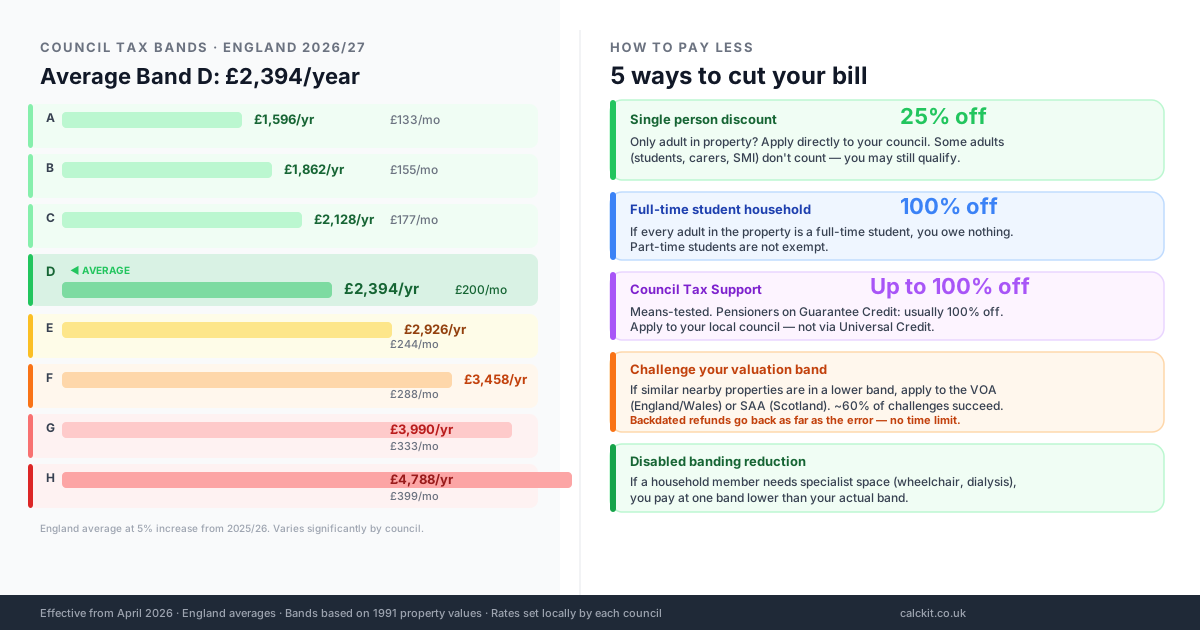
Most households in England saw council tax rise by around 5% in April 2026. Below is everything you need: what your band means in pounds, which discounts and exemptions apply to you, and how to challenge your valuation if you think you are paying too much.
🏛How council tax is calculated
Council tax is set by your local council each year. The bill is based on two things:
- Your property's valuation band — assigned when the property was last valued (1991 for England and Scotland; 2003 for Wales). The band is permanent until you successfully challenge it.
- Your local council's rate — the amount it charges for Band D, which every other band is calculated as a fraction of.
The 8 bands use fixed ratios. If your council's Band D rate is £2,394, the other bands work out as:
| Band | Ratio | Annual bill | Monthly |
|---|---|---|---|
| A | 6/9 | £1,596 | £133 |
| B | 7/9 | £1,862 | £155 |
| C | 8/9 | £2,128 | £177 |
| D | 9/9 | £2,394 | £200 |
| E | 11/9 | £2,926 | £244 |
| F | 13/9 | £3,458 | £288 |
| G | 15/9 | £3,990 | £333 |
| H | 18/9 | £4,788 | £399 |
England average Band D 2026/27. Based on the 2025/26 average of £2,280 plus a 5% increase. Your council's figure may be higher or lower.
The 2026/27 increase
The government set a 5% referendum threshold for England for 2026/27 — the same cap as the previous year. This means:
- Councils can raise bills by up to 3% for general spending without a local referendum
- Councils with adult social care responsibilities can add a further 2% adult social care precept
- Raising bills above 5% requires a local referendum (rarely happens)
Most councils applied the full 5% increase. The average Band D bill in England rose from approximately £2,280 in 2025/26 to approximately £2,394 in 2026/27.
Range across councils: Bills vary significantly. Some London boroughs (Westminster, Wandsworth) remain under £1,000 for Band D because they use commercial property rates to subsidise residents. Some rural and northern councils exceed £2,800. Your figure is on your bill.
Who pays, and who does not
You pay council tax if you are over 18 and live in the property as your main home. Renters pay — it is not automatically the landlord's responsibility for occupied properties.
You do not pay if you are:
- A full-time student (you are disregarded — see below)
- In receipt of a full Council Tax Support award from your council
- Under 18
- Living in certain care homes, hostels, or student halls (which are exempt as properties)
Properties that are fully exempt include student halls of residence, armed forces barracks, and properties where all residents are full-time students.
💷Discounts and reductions
Single person discount: 25% off
If you are the only adult in the property, you receive a 25% single person discount. You apply directly to your council.
Some people do not count as adults for council tax purposes, which means even if they live with you, you may still qualify for the single person discount:
- Full-time students
- Student nurses and midwives on full NHS bursaries
- Apprentices earning less than £195/week
- Youth trainees (aged 16–17)
- Severely mentally impaired (SMI) adults (a formal condition applies)
- Live-in carers (who are not the spouse/partner of the person they care for)
- 18- and 19-year-olds in qualifying education
Full-time student exemption
Full-time students are disregarded. A household where every adult is a full-time student owes nothing. If you share with one non-student adult, they pay — but receive the 25% single person discount because all other adults are disregarded.
Full-time study means at least 21 hours per week for at least 24 weeks of the year. Part-time students are not exempt.
Council Tax Support (Council Tax Reduction)
Council Tax Support (CTS) — also called Council Tax Reduction — is a means-tested discount for people on low incomes. It replaced council tax benefit in 2013 and is now run by each local council under its own scheme.
- Pensioners on Pension Credit Guarantee generally receive 100% support
- Working-age claimants can receive up to 100% support, but many councils cap support at 80–90% of the bill, meaning you always pay something
- Applications go directly to your local council — not via Universal Credit or HMRC
Apply as soon as your circumstances change. Most councils will not backdate support for more than 3 months.
Disabled banding reduction
If a member of your household is disabled and needs a room or space that is essential for their condition (a wheelchair, dialysis equipment, or similar), you can apply for a banding reduction — paying at the rate one band below your actual band. A Band A household can receive a 1/9 discount instead.
Apply to your council with supporting medical evidence.
Empty and second home surcharges
From 1 April 2024, English councils gained a new power to charge up to 100% extra council tax on second homes (homes that are furnished but not your main home). This means paying up to double the standard rate.
For empty properties, the current surcharge structure is:
- Empty for 1 year or more: councils can add up to 100% premium
- Empty for 5 years or more: councils can add up to 200% premium
- Empty for 10 years or more: councils can add up to 300% premium
Not all councils apply these surcharges at maximum, but many do. There are exemptions for properties that are empty due to probate, major renovation, or owners who have moved into care.
If you own an empty or second property, check with the council where it is located.
How to challenge your band
Every property in England and Wales was valued at 1 April 1991 prices. If your home is in a higher band than comparable properties from that era, you may be paying too much.
You challenge through the Valuation Office Agency (VOA) in England or the VOA Cymru in Wales. In Scotland, challenges go to the Scottish Assessors Association (SAA).
Strongest grounds for a challenge:
- Properties of the same size and type on the same street are in a lower band
- A material change has occurred (flooding, nearby development reducing value)
- The property was extended or improved after the 1991 valuation (in theory this should push the band up, but errors occur in both directions)
What happens: The VOA reviews your property and compares it to evidence. If they agree it is wrong, they can lower (or raise) the band. Lowering results in a backdated refund — there is no time limit on how far back this goes. Around 60% of formal challenges in England result in a band reduction.
Warning: If the VOA investigates and finds you are underbanded, your band will go up and your bill will increase.
Use the GOV.UK 'Check and challenge your council tax band' service before submitting — a successful challenge is one of the biggest wins in our UK money-saving guide. Compare against sold prices and known bands on similar nearby properties first.
Scotland and Wales
All three nations use the A–H band structure with the same ratio multipliers. The key differences:
Scotland
- Valuation date: 1991 (same as England)
- Rate-setting: Each Scottish council sets its own Band D rate
- Council Tax Freeze: Scotland operated a freeze on council tax for several years, which ended in 2023/24. Since then, Scottish councils have raised rates
- Council Tax Reduction: Scotland has its own CTR scheme, administered by local councils and the Scottish Government; pensioners on Guarantee Credit receive 100% support
Wales
- Valuation date: 1 April 2003 (properties revalued in 2005 using 2003 values — unlike England and Scotland which still use 1991 values)
- Because Wales uses 2003 values, Welsh bands are based on different price levels — a Welsh Band D property is not the same value as an English Band D property
- Each Welsh council sets its own rate
- Council Tax Reduction: Wales administers its own scheme under the Welsh Government's framework
Northern Ireland There is no council tax in Northern Ireland. The equivalent is Domestic Rates, charged as a percentage of the capital value of the property. It is collected by Land and Property Services (LPS) on behalf of the Northern Ireland government and your district council.
What happens if you cannot pay
If you fall behind, act early. The enforcement sequence is:
- Reminder: issued after the first missed payment
- Second reminder or final notice: if you miss a second instalment or fail to pay after the first reminder
- Loss of instalment rights: your council can demand the full year's bill in one go
- Liability order: applied for at the magistrates' court — a court order confirming the debt
- Enforcement action: deductions from wages, deductions from benefits, bailiff (enforcement agent) referral, or charging order on the property
- Committal: in the most serious cases, a magistrate can commit the debtor to prison
Most councils will agree a payment plan before reaching enforcement stage. Contact your council as soon as you know you cannot pay — do not wait for a reminder.
If you are on a low income, apply for Council Tax Support at the same time. If you have significant council tax debt, Citizens Advice can help negotiate.
Frequently asked questions
How much is council tax in 2026/27?
The average Band D bill in England is approximately £2,394 per year after councils applied up to the 5% maximum increase from April 2026. Bills range from under £1,000 (some London boroughs) to over £2,800 in some rural councils. Check your bill for your council's specific figure.
How do I find out my council tax band?
Check the Valuation Office Agency website (GOV.UK) for England, the Scottish Assessors Association website for Scotland, or VOA Cymru for Wales. Your bill letter also states your band.
What is the single person discount?
If you are the only adult in your property — or the only adult who does not qualify as a disregarded person — you receive 25% off your bill. Apply directly to your council.
Can I challenge my council tax band?
Yes. Submit a proposal to the VOA (England/Wales) or SAA (Scotland). If successful, your band is reduced and you receive a backdated refund with no time limit. Around 60% of formal challenges in England result in a reduction.
Are students exempt from council tax?
Full-time students are disregarded. If all adults in the property are full-time students, the household is entirely exempt. Part-time students are not exempt.
What is Council Tax Support and who qualifies?
A means-tested discount for low-income households, run by each local council. Pensioners on Guarantee Credit generally receive 100% support. Working-age claimants receive varying levels depending on income and the council's scheme. Apply directly to your council — not through Universal Credit.
What happens if I don't pay council tax?
Your council will issue reminders, then demand the full year's bill. If unpaid, they apply to court for a liability order, then can use bailiffs, wage deductions, or benefit deductions. Contact your council early — most will agree a payment plan before reaching enforcement.
Is council tax the same in Scotland and Wales?
The same A–H bands and ratios apply, but amounts are set locally and differ. Wales revalued properties in 2003 (not 1991), so Welsh and English bands are based on different price points. Northern Ireland has Domestic Rates instead of council tax.