
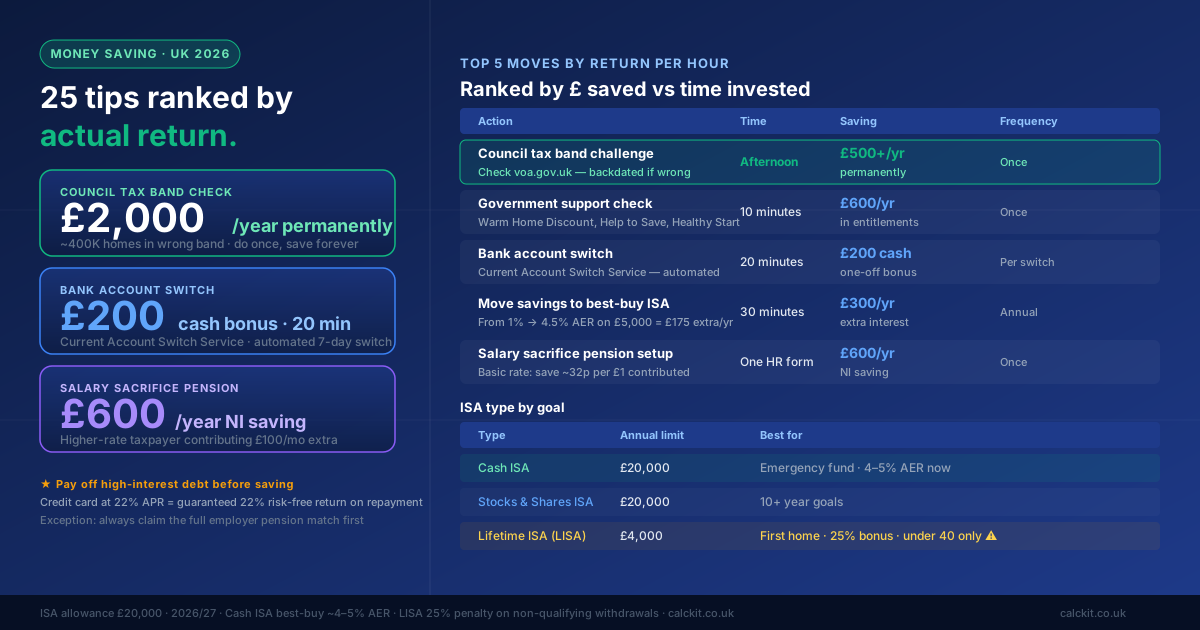
Most money-saving guides tell you to cancel Netflix and skip your morning coffee. Following that advice for a year saves approximately £200. Checking your council tax band once — if you are in the wrong one — can save £400–£2,000 per year permanently.
The highest-return moves are almost never the ones listed first. This guide ranks 25 UK-specific tips by what they actually return vs the effort required.
🐷The debt-vs-savings decision: get this right first
Before anything else, there is one question that changes everything: do you have high-interest debt?
If you owe money on a credit card at 20–25% APR and simultaneously have money sitting in a savings account at 4.5%, you are losing around 16–20 percentage points every year. Paying off the credit card produces a guaranteed, risk-free return equivalent to the interest rate — something no savings account comes close to offering.
The priority order:
- Always contribute enough to your workplace pension to get the full employer match — that is an immediate 50–100% return on your money, nothing else competes
- Keep a minimum emergency buffer (even £500–£1,000) to avoid new debt for unexpected costs
- Pay off high-interest debt (credit cards, store cards, overdrafts above 15% APR) before saving beyond the minimum
- Once high-interest debt is cleared, build savings properly
Use the income tax calculator to check your take-home, then allocate the debt/savings split based on interest rates, not habit.
Tier 1: Do once, save forever
These actions require one session and continue paying back indefinitely.
1. Check your council tax band (worth £200–£2,000/year)
Around 400,000 UK homes are estimated to be in the wrong council tax band — almost always too high. Bands were set in 1991 and many properties were assessed inaccurately.
How to check: Go to voa.gov.uk and look up your property. Then check neighbouring properties of similar size. If yours is banded higher without obvious reason, submit a formal challenge — it is free.
A successful challenge is backdated to when you moved in. On a Band D to Band C correction in an average English local authority, the saving runs to £200–£400 per year. In higher-rate areas or across multiple years of backdated refunds, claims of £1,000–£3,000 are not unusual.
In Scotland, contact the Scottish Assessors Association. In Wales, the Valuation Office Agency.
2. Switch your bank account (£150–£200 in 20 minutes)
The Current Account Switch Service makes switching banks a 7-working-day automated process. Multiple banks currently offer cash bonuses of £150–£200 to new customers who switch and meet basic conditions (usually a minimum number of active direct debits).
What to do: Check the latest switching offers via MoneySavingExpert's best-buy table, apply online, and the switch happens automatically — all direct debits and standing orders transfer over. Some people switch every few months and collect £400–£500 per year this way.
3. Move savings to a competitive account
If your savings are in a standard high-street current account paying 0.5–1% AER, moving them to a competitive easy-access Cash ISA or savings account — currently paying around 4–5% AER at best-buy rates — makes an immediate difference.
Example: £5,000 in savings at 1% earns £50/year. The same amount at 4.5% earns £225/year. That is £175 extra for a single afternoon of account opening.
All interest earned inside a Cash ISA is tax-free. If you are a basic-rate taxpayer with savings outside an ISA, you have a Personal Savings Allowance of £1,000/year before tax applies — but higher-rate taxpayers only get £500.
4. Check if you qualify for government support
The following schemes are significantly underclaimed:
| Scheme | What it pays | Who qualifies |
|---|---|---|
| Warm Home Discount | £150 off electricity bill | Pension Credit claimants (automatic); some low-income households via supplier |
| Cold Weather Payment | £25 per 7-day cold spell | Claimants of certain benefits (Pension Credit, Income Support, ESA, UC with health/disability element) |
| Help to Save | 50p government bonus per £1 saved | Universal Credit or Working Tax Credit claimants |
| Household Support Fund | £100–500 grants | Via local council — for food, utilities, essentials |
| Healthy Start | £4.25/week in vouchers | Pregnant women or parents of under-4s on qualifying benefits |
| Free school meals | ~£500/year per child | Children whose parents receive qualifying benefits |
Check eligibility at gov.uk/benefits-calculators — it takes around 10 minutes.
5. Salary sacrifice your pension contributions
Pension contributions made via salary sacrifice reduce your gross pay before tax and National Insurance are calculated. The saving is immediate and automatic.
| Salary | Extra pension contribution | Effective cost (basic rate) | Effective cost (higher rate) |
|---|---|---|---|
| £30,000 | £100/month | ~£68/month | — |
| £50,000 | £100/month | — | ~£58/month |
On top of your own saving, many employers pass back some of their NI saving as extra employer pension contributions. Use the salary sacrifice calculator to see exactly what a salary sacrifice pension contribution costs you net.
6. Trace lost savings
The UK holds billions of pounds in dormant accounts, lost pension pots, Premium Bond prizes, and matured Child Trust Funds that people have simply forgotten.
Where to look:
- My Lost Account (mylostaccount.org.uk) — searches most UK banks and building societies
- Gretel — broader search including NS&I and other providers
- Pension Tracing Service (gov.uk) — finds old workplace pension pots
- Child Trust Fund — if you were born between 2002 and 2011, you may have a CTF worth £1,000+ that was never accessed
7. Set up a standing order on payday
Saving what is left at the end of the month reliably saves nothing. Automating a transfer on the day you are paid removes the decision. Even £50/month saved consistently from age 25 to 65 grows to over £75,000 at 5% real returns.
🏛Tier 2: Set up once, save monthly
8. Cancel unused subscriptions (save £200–£500/year)
Raisin estimates UK households waste up to £4,600 per year on unnecessary subscriptions — a figure that captures everything from streaming services to gym memberships to apps with forgotten free trials. The average UK household has 6–8 active subscriptions.
How to audit: Go through your bank statements for the last 3 months. List every recurring payment. For each one, ask: did I use this more than twice this month? If not, cancel.
A typical audit surfaces 2–4 subscriptions worth £10–30/month each — saving £150–500 per year.
9. Install a cashback browser extension
Quidco and TopCashback both offer browser extensions that automatically notify you when cashback is available at a retailer you are visiting. Rates vary widely (0.5–10% on most retailers, up to £150 per transaction on insurance and broadband renewals) but require zero extra effort once installed.
10. Use an ISA — and the right type for your goal
The annual ISA allowance is £20,000 per person in 2026/27. All interest, dividends, and gains inside an ISA are permanently tax-free.
| ISA type | Annual limit | Best for | Key condition |
|---|---|---|---|
| Cash ISA | £20,000 | Emergency fund, short-term savings | Must be easy-access for genuine emergencies |
| Stocks & Shares ISA | £20,000 | 10+ year savings goals | Accepts short-term volatility |
| Lifetime ISA (LISA) | £4,000 | First home or retirement | Must be under 40; 25% penalty on other withdrawals |
| Junior ISA | £9,000 | Saving for a child | Locked until child turns 18 |
LISA trap: The 25% withdrawal penalty is applied to the full withdrawal amount — not just the government bonus. If you put in £4,000, receive £1,000 bonus (total £5,000), then withdraw early for a non-qualifying reason, you pay 25% × £5,000 = £1,250, getting back only £3,750. You lose £250 of your own money. Only open a LISA if you are confident you will use it for a first home purchase or retirement.
11. Get a railcard (saves 33–50% on train fares)
Annual railcards cost £30–35 and offer 33% off most standard rail fares, rising to 50% off with certain combinations. A single return trip between two medium-distance cities typically costs more than the card itself — meaning it pays for itself in one journey.
Types: 16–25, 26–30, Senior (60+), Two Together, Family, Network, Disabled. If two of you travel regularly, the Two Together Railcard gives 33% off both tickets.
Tier 3: Spending habits that add up
12. Plan meals and write a shopping list
The average UK household throws away £700 worth of food per year (WRAP estimates). A weekly meal plan eliminates most of this — you buy what you need, nothing rots, and you avoid multiple small top-up shops (where impulse spending is highest).
13. Shop at Aldi or Lidl
Independent price comparisons consistently rank Aldi as the cheapest major UK supermarket, followed by Lidl. For a typical household, switching from a mid-range supermarket to Aldi saves around £1,000–1,500 per year on the same product categories.
If a full switch is not practical, shop at Aldi/Lidl for staples and use your regular supermarket for specific items.
14. Check the world food and baking aisles
Staples like tinned tomatoes, lentils, rice, flour, and spices are often 30–60% cheaper in the world food aisle or baking section than identical or equivalent products stocked in the main grocery aisles. Same product, different location in the store, dramatically different price.
15. Yellow sticker timing by supermarket
| Supermarket | Best time for reductions |
|---|---|
| Aldi | Near closing time |
| M&S | Near closing time |
| Lidl | Morning and early evening |
| Tesco / Sainsbury's / Asda | Varies by store — ask staff |
| Waitrose | Near closing |
16. Avoid grocery delivery apps
Research shows rapid grocery delivery apps (Deliveroo, Getir, Gorillas) charge up to 20% more than shopping in store or via the supermarket's own website. Opting for click-and-collect or a scheduled delivery from a supermarket directly eliminates this premium while maintaining convenience.
17. Apply the 30-day rule for non-essential purchases
Before any non-essential purchase above £30, wait 30 days. Most impulse purchases — particularly online — are simply not made after a month has passed. For larger purchases (£200+), a 48-hour wait alone eliminates a significant proportion of spending.
18. Switch to SIM-only mobile
Switching from a contract phone (where you are still paying off a handset bundled into the monthly fee) to a SIM-only plan typically saves £10–25 per month — £120–300 per year — for the same data allowance. Compare via comparison sites once your current contract ends.
19. Lower your thermostat by 1°C
Lowering your home thermostat from 22°C to 21°C is estimated to save up to £90 per year on heating bills, according to the Energy Saving Trust. Combining this with a smart thermostat that automatically reduces temperature when you are away saves a further £75–150.
20. Negotiate broadband and TV on renewal
Telecoms providers routinely offer significant loyalty discounts when customers threaten to leave. Call your provider when your contract ends and state you have found a cheaper deal elsewhere. A 20–30% discount for 12 months is a common outcome — saving £60–180 per year on broadband alone.
Tier 4: Build the structure
21. Use the 50/30/20 rule — adapted for UK costs
The standard 50/30/20 rule (50% needs, 30% wants, 20% savings) does not account for UK rent levels. A more realistic UK adaptation:
- List your fixed essential costs (rent/mortgage, council tax, utilities, transport, minimum debt payments, food)
- Calculate what percentage of your take-home they represent
- Split what remains roughly 60/40 between discretionary spending and saving
If essentials consume 60–65% of your take-home, target 15% savings rather than 20% — and look for ways to reduce fixed costs (remortgage, change area, negotiate rent) rather than squeezing discretionary spending to nothing.
22. Try a savings challenge
Two approaches that work for people who struggle with open-ended saving:
- 1p challenge: Day 1 = £0.01, Day 2 = £0.02... Day 365 = £3.65. Total saved: £667.95
- 52-week challenge: Week 1 = £1, Week 2 = £2... Week 52 = £52. Total saved: £1,378
Both are automatic if you set up a standing order to a separate account.
23. Build an emergency fund before investing
An emergency fund of 3–6 months of essential outgoings (rent, bills, food, transport) held in an easy-access account prevents you from needing to sell investments or take on debt when unexpected costs hit.
The target for a single person with £1,500/month in essential outgoings: £4,500–£9,000 in accessible cash before putting significant money into stocks or long-term savings products.
24. Trace a lost pension
The average UK worker has 11 jobs over their lifetime. Each one may have started a workplace pension — and old pots are easily forgotten. Use the government Pension Tracing Service to locate any old schemes. The average lost pension pot is worth several thousand pounds.
25. Use the savings goal calculator to make it concrete
Vague saving goals fail. "I want to save more" produces no change. "I want £8,000 for a house deposit in 18 months, which means £444/month starting today" produces a plan.
Use the savings goal calculator to set a specific target, timeline, and monthly amount — then automate it on payday.
The 50/30/20 in practice: a worked example
| Take-home pay | £2,800/month |
|---|---|
| Needs (50%): rent £900, bills £200, food £300, transport £100 | £1,500 |
| Wants (30%): dining out, leisure, subscriptions | £840 |
| Savings (20%): pension top-up + ISA | £560 |
If rent pushes needs to 55%, reduce wants proportionally. The goal is a deliberate split, reviewed monthly — not a rigid formula applied without thought.
The five highest-ROI actions, by return per hour spent:
- Council tax band challenge — one afternoon, potentially £500+ per year permanently
- Government support check — 10 minutes, potentially £150–600/year in entitlements
- Bank switch — 20 minutes, £150–200 cash
- Savings account move — 30 minutes, £100–300/year extra interest
- Salary sacrifice pension — one HR form, £300–600/year in NI savings
Cancel your subscriptions too. But do these five first.
Last updated September 2026. ISA allowances and rates based on 2026/27 figures. Government scheme amounts based on 2025/26 confirmed rates — verify current amounts on GOV.UK.