
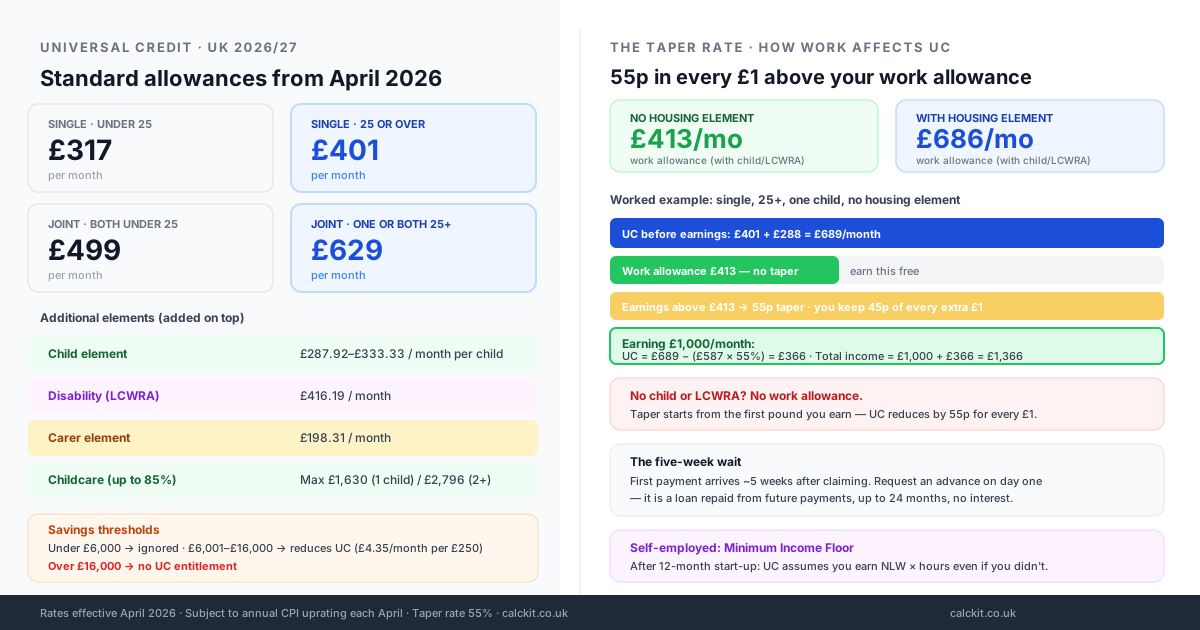
Universal Credit (UC) is the main working-age benefit in the UK. It replaced six legacy benefits and covers people who are in work, out of work, or unable to work. From April 2026, the standard allowance is £401.32 per month for a single claimant aged 25 or over.
💷2026/27 standard allowances
These are the base amounts before any additional elements are added or any earnings deductions are applied.
| Circumstances | Monthly amount |
|---|---|
| Single, under 25 | £317.91 |
| Single, 25 or over | £401.32 |
| Joint claim, both under 25 | £499.01 |
| Joint claim, one or both 25 or over | £629.95 |
UC is paid monthly, directly into your bank account, covering one calendar month (your assessment period). These rates are uprated each April in line with September's Consumer Price Index (CPI).
Additional elements
Your total UC payment is the standard allowance plus any elements you qualify for.
Child element
| Child | Monthly amount |
|---|---|
| First child (born before 6 April 2017) | £333.33 |
| First/only child (born on or after 6 April 2017) | £287.92 |
| Additional children (up to limit) | £287.92 each |
Two-child limit: the child element is not paid for a third or subsequent child born on or after 6 April 2017, unless an exception applies (multiple birth, adoption, non-consensual conception). Children born before April 2017 are not affected.
Disabled child addition: £156.11/month (lower rate) or £487.58/month (higher rate) for a disabled or severely disabled child.
Childcare element
Up to 85% of childcare costs for approved childcare:
- One child: maximum £1,630.15/month
- Two or more children: maximum £2,796.25/month
You must be in paid work (or starting work within one month) to claim the childcare element. You pay your provider upfront and claim back up to 85%.
Limited capability for work elements
If you have a health condition or disability limiting your ability to work:
| Element | Monthly amount |
|---|---|
| Limited capability for work (LCW) | £156.11 |
| Limited capability for work-related activity (LCWRA) | £416.19 |
The LCWRA element applies to the most serious conditions. You cannot receive both — it is one or the other based on your Work Capability Assessment result.
Carer element
£198.31/month if you provide at least 35 hours of care per week to a severely disabled person who receives certain disability benefits. You do not need to claim Carer's Allowance separately to receive this element, but your caring role must meet the qualifying criteria.
Housing cost element
For private renters, based on the Local Housing Allowance (LHA) for your area and household size. For social tenants, covers eligible rent minus any under-occupancy charge. Owner-occupiers do not receive a housing element (separate Support for Mortgage Interest loans exist).
How earnings reduce your UC: the taper rate
UC is designed to make work pay — but earnings above your work allowance reduce your payment by 55p for every £1 earned. You keep the other 45p.
Work allowance (2026/27)
The work allowance is the amount you can earn each month before the 55p taper starts.
| Circumstances | Monthly work allowance |
|---|---|
| Responsible for a child, or have LCWRA — no housing element | £413 |
| Responsible for a child, or have LCWRA — with housing element | £686 |
| No child, no LCWRA (regardless of housing) | £0 — taper starts immediately |
Worked example: Single claimant, 25+, one child, no housing element.
- Standard allowance: £401.32
- Child element: £287.92
- Total UC before earnings: £689.24
- Work allowance: £413/month (no housing element)
- You earn £1,000/month
Earnings above work allowance: £1,000 − £413 = £587 UC reduction: £587 × 55% = £322.85 UC payable: £689.24 − £322.85 = £366.39/month
You keep your £1,000 earnings plus £366.39 UC = £1,366.39 total — versus £689.24 on UC alone.
🏛Savings and capital
| Savings | Effect on UC |
|---|---|
| Under £6,000 | Ignored completely |
| £6,001 – £16,000 | Reduces UC by £4.35/month per £250 above £6,000 |
| Over £16,000 | Not entitled to UC |
The tariff income calculation: round your savings above £6,000 up to the nearest £250, then multiply by £4.35. This assumed income is added to your real income when calculating your award.
Example: £10,000 savings. Excess above £6,000 = £4,000. Rounded up: £4,000 ÷ £250 = 16 units. Tariff income = 16 × £4.35 = £69.60/month deducted from UC.
If you have a partner, their savings and your savings are combined for this calculation.
The five-week wait
UC is paid monthly in arrears. When you first claim, your first payment arrives approximately five weeks after your claim date:
- Week 1: claim processed, assessment period starts
- Weeks 1–4: your first assessment period runs
- Week 5: payment made after assessment period ends
Advance payments: you can request an advance on the day you claim. The advance is a loan — it is repaid from your future UC payments, usually at around £25/month over up to 24 months. There is no interest. If hardship is severe, the repayment period can be extended.
During the five-week wait, local councils may also offer Household Support Fund payments — check with your council.
Self-employed claimants and the Minimum Income Floor
After a 12-month start-up period, the Minimum Income Floor (MIF) applies to self-employed UC claimants. The MIF assumes you earn at least the National Living Wage (£12.71/hour from April 2026) for your expected weekly hours, regardless of what you actually earned.
If your real earnings were lower than the MIF — for example, because you had a quiet month — UC is calculated using the MIF figure, not your actual earnings. This means your UC award is lower than it would be if you had declared the same income as an employee.
MIF does not apply if:
- You are within your 12-month start-up period
- You have a health condition that limits your work capability (LCW or LCWRA)
- Your partner does not work and you have no qualifying children
- A specific temporary exception applies (e.g. serious illness, natural disaster)
Self-employed claimants must report earnings and expenses monthly through their UC journal.
Managed migration from legacy benefits
Universal Credit has been replacing six legacy benefits through managed migration:
| Legacy benefit | Replaced by UC |
|---|---|
| Income-based Jobseeker's Allowance | ✓ |
| Income-related Employment and Support Allowance | ✓ |
| Housing Benefit (working-age) | ✓ |
| Income Support | ✓ |
| Child Tax Credit | ✓ |
| Working Tax Credit | ✓ |
If you receive any of these legacy benefits, you will receive a Migration Notice letter telling you to claim UC within 3 months. If you do not claim within that window, your legacy benefits will stop automatically.
Transitional protection: if your UC award would be lower than your legacy benefit entitlement on migration day, you receive transitional protection — a top-up that fills the gap. This protection erodes over time as your circumstances change and as UC rates rise.
What UC does not cover
UC does not replace:
- New Style Jobseeker's Allowance (contributions-based JSA)
- New Style Employment and Support Allowance (contributions-based ESA)
- Carer's Allowance
- Personal Independence Payment (PIP)
- Child Benefit
- Council Tax Reduction (claimed from your local council separately)
You can receive UC alongside New Style ESA, PIP, Carer's Allowance, and Child Benefit — but these are separate claims.
Frequently asked questions
How much is Universal Credit in 2026?
The standard allowance from April 2026 is £317.91/month (single, under 25) or £401.32/month (single, 25+). Joint claimants receive £499.01 (both under 25) or £629.95 (one or both 25+). Additional elements for children, housing, disability, childcare, and caring can significantly increase your total award.
How does the Universal Credit taper rate work?
For every £1 earned above your work allowance, UC falls by 55p — you keep 45p. Not everyone has a work allowance: only claimants with children or a limited capability for work element qualify. Those without either see the taper apply from the first pound earned.
What is the Universal Credit five-week wait?
UC is paid monthly in arrears, so your first payment arrives around five weeks after you claim. You can request an advance payment on the day you claim — it is repaid from future payments over up to 24 months at no interest.
How do savings affect Universal Credit?
Savings under £6,000 are ignored. Between £6,001 and £16,000, each £250 above £6,000 reduces your UC by £4.35/month. Over £16,000 in savings, you receive no UC.
Does Universal Credit apply to self-employed people?
Yes. After a 12-month start-up period, a Minimum Income Floor applies — UC is calculated as if you earn at least the National Living Wage for your expected hours, even if you earned less. Report earnings monthly through your UC journal.
What legacy benefits does Universal Credit replace?
Income-based JSA, income-related ESA, Housing Benefit, Income Support, Child Tax Credit, and Working Tax Credit. If you receive a Migration Notice letter, claim UC within 3 months. Transitional protection prevents immediate losses on migration.
What is the two-child limit in Universal Credit?
The child element is not paid for a third or subsequent child born on or after 6 April 2017, unless an exception applies. Children born before that date are unaffected.
How is the housing element calculated?
For private renters, it is based on the Local Housing Allowance for your area — the 30th percentile of local rents for your household size. If your rent exceeds the LHA, you pay the difference. Social tenants receive support based on eligible rent minus any under-occupancy charge.