
A supplier invoice arrives with 20% VAT. Your energy bill charges 5%. A bookshop sends you a receipt with no VAT at all. And your accountant mentions that insurance is "exempt." These are not all the same thing — and treating them as though they are costs businesses money.
The UK has four distinct VAT categories. Each carries different rules for registration, pricing, and what happens to the VAT your business pays on its own costs. Here is what each one means and which goods and services fall into each for 2026/27.
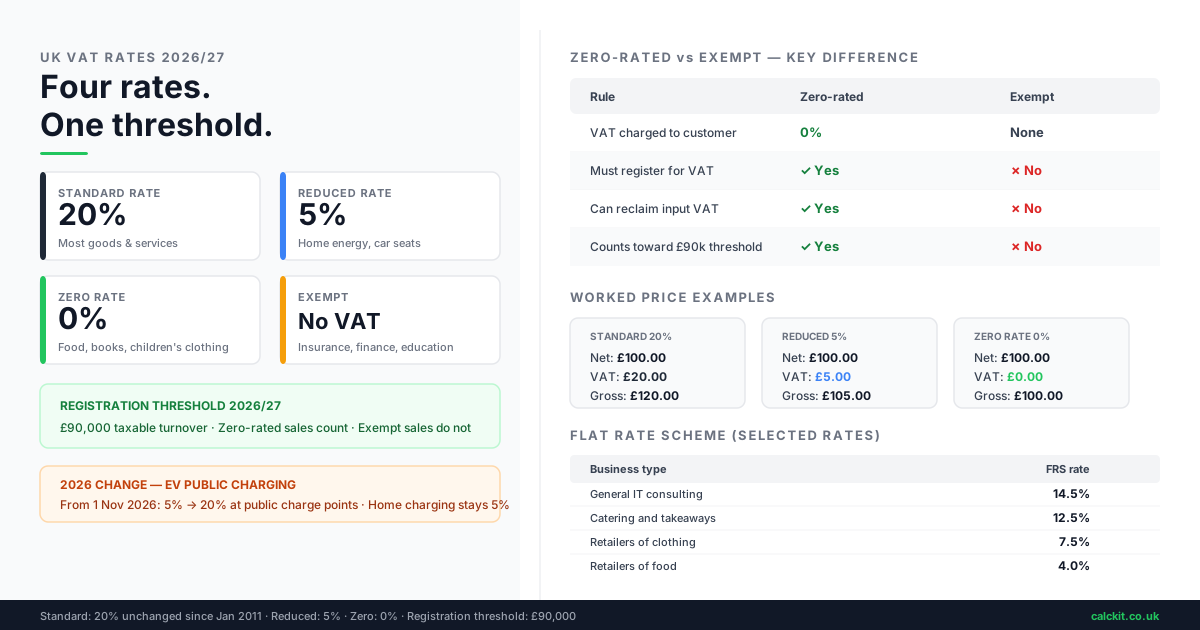
%UK VAT Rates at a Glance — 2026/27
| Category | Rate | Examples |
|---|---|---|
| Standard rate | 20% | Electronics, clothing (adult), alcohol, most services |
| Reduced rate | 5% | Home energy, children's car seats, mobility aids |
| Zero rate | 0% | Most food, books, children's clothing, public transport |
| Exempt | No VAT | Financial services, insurance, education, most property |
The standard rate of 20% has been unchanged since January 2011. The reduced rate of 5% has applied to domestic energy since 2001. No rate changes are planned for 2026/27 — the only significant 2026 change is EV public charging, covered below.
Standard Rate — 20%
The standard rate applies to any goods or services that are not specifically zero-rated, reduced-rated, or exempt. In practice, this covers the majority of commercial sales in the UK.
Standard-rated categories include:
- Most clothing and footwear for adults
- Electronics and electrical goods
- Furniture and household goods
- Alcoholic drinks
- Confectionery, crisps, and savoury snacks
- Hot food sold for immediate consumption (takeaways, cafés)
- Restaurant and hospitality services
- Motor vehicles and petrol
- Professional services (consultancy, marketing, IT)
- Public EV charging points (from 1 November 2026)
Worked example: You buy a laptop for £1,000 net. At 20%, the gross price is £1,200. The £200 is VAT — which a VAT-registered business can reclaim from HMRC on its next return.
Reduced Rate — 5%
The reduced rate applies to a specific list of goods and services set out in Schedule 7A of the VAT Act 1994. The list is narrower than many people expect.
Reduced-rated items include:
- Domestic gas and electricity (home energy supply)
- Heating oil and solid fuels used in homes
- Children's car seats and bases
- Mobility aids for older people (walking frames, stair lifts)
- Nicotine patches, nicotine gum, and other stop-smoking products
- Residential solar panel installations and energy-saving materials
- Women's sanitary products
Worked example: Your gas bill is £200 net. At 5%, the gross is £210. The £10 VAT is non-reclaimable if you are a household (not VAT-registered); a VAT-registered landlord could reclaim it on a commercial energy supply.
Zero Rate — 0%
Zero-rated supplies are VAT-taxable but at a 0% rate. The distinction matters: a zero-rated business is still VAT-registered, still files VAT returns, and can still reclaim input VAT on its own costs — it just charges nothing to customers.
Zero-rated categories include:
- Most food sold for human consumption (see exceptions below)
- Books, newspapers, and magazines
- Children's clothing and footwear
- Prescription medicines and most medical equipment
- Public transport fares (bus, train, ferry)
- Water supply to households
- Exports of goods outside the UK
- New house building (construction services and materials)
- Braille products and equipment for disabled people
Food exceptions that are standard-rated (20%):
| Zero-rated (0%) | Standard-rated (20%) |
|---|---|
| Fresh bread | Confectionery and sweets |
| Raw meat and fish | Crisps and savoury snacks |
| Fresh fruit and vegetables | Ice cream |
| Milk and plain dairy | Alcoholic drinks |
| Cereals and pasta | Hot food for immediate consumption |
The boundary between zero-rated and standard-rated food is one of the most litigated areas in UK VAT law. The "Jaffa Cake case" (McVitie's v HMRC) established that biscuits are standard-rated but Jaffa Cakes are zero-rated (as cakes). When in doubt, check HMRC's Notice 701/14.
Exempt Supplies
Exempt supplies sit outside the VAT system entirely — they are not taxable supplies at all. A business that makes only exempt supplies cannot register for VAT and cannot reclaim input VAT on its costs.
Exempt categories include:
- Financial services (loans, deposits, credit)
- Insurance
- Education and vocational training (by eligible bodies)
- Health and welfare services (by eligible providers)
- Postal services (Royal Mail licensed services)
- Betting, gaming, and lotteries
- Letting of commercial property (unless the landlord opts to tax)
- Burial and cremation services
Zero-Rated vs Exempt: The Critical Difference
This distinction trips up most small business owners. The practical impact is significant.
| Zero-rated | Exempt | |
|---|---|---|
| VAT charged to customers | 0% | None |
| Business must be VAT-registered | Yes (if above threshold) | No |
| Can reclaim input VAT on costs | Yes | No |
| Sales count toward £90,000 threshold | Yes | No |
Example — zero-rated bookshop: A bookshop has £150,000 turnover in zero-rated book sales. It must register for VAT (above £90,000 threshold). It charges 0% on sales but can reclaim the 20% VAT it paid on shop rent, packaging, and delivery costs.
Example — exempt therapist: A registered psychotherapist providing exempt medical services has £150,000 turnover. Because therapy services are exempt, that turnover does not count toward the VAT threshold. They cannot register, cannot reclaim input VAT, and absorb all VAT costs as a business expense.
The £90,000 Registration Threshold — What Counts
The registration threshold for 2026/27 is £90,000 (rolling 12-month taxable turnover). This is unchanged from April 2024.
Key rule most businesses miss: Only taxable supplies count — standard-rated, reduced-rated, and zero-rated sales all count. Exempt sales do not.
| Sale type | Counts toward threshold? |
|---|---|
| Standard-rated (20%) | ✅ Yes |
| Reduced-rated (5%) | ✅ Yes |
| Zero-rated (0%) | ✅ Yes |
| Exempt | ❌ No |
Practical impact: A children's clothing retailer with £95,000 in zero-rated sales must register for VAT — even though they charge no VAT — because zero-rated sales are still taxable supplies. An insurance broker with £200,000 in exempt commission income does not have to register.
The deregistration threshold is £88,000. If your taxable turnover falls below this, you can apply to deregister.
Overseas sellers: Non-UK businesses selling goods to UK customers have a £0 registration threshold — they must register from their very first sale.
£2026 Change: EV Public Charging
The only VAT rate change for 2026 affects electric vehicle charging:
- Before 1 November 2026: Public EV charging points — reduced rate (5%)
- From 1 November 2026: Public EV charging points — standard rate (20%)
- Home EV charging: Remains at the domestic energy reduced rate (5%)
The change was announced in the October 2025 Budget. HMRC's rationale is that public EV charging competes with the fuel market, where fuel duty already applies. The practical effect: a 20kWh charge that cost £8 at a 40p/kWh rapid charger now carries £1.33 VAT at 20% instead of £0.38 at 5%.
Flat Rate Scheme
The Flat Rate Scheme (FRS) lets small businesses pay a flat percentage of gross turnover to HMRC rather than tracking individual input and output VAT. It is available to businesses with taxable turnover of £150,000 or less.
Selected FRS rates for 2026/27:
| Business type | FRS % |
|---|---|
| Retailers of food | 4% |
| Retailers of clothing | 7.5% |
| General IT consulting | 14.5% |
| Accountancy and bookkeeping | 14.5% |
| Management consulting | 14% |
| Catering and takeaways | 12.5% |
| Hairdressing | 13% |
| Pubs | 6.5% |
Under the FRS, you still charge customers at the standard 20% rate, but pay HMRC only the flat percentage on gross (VAT-inclusive) turnover. The difference is yours to keep — which makes it profitable when your actual input VAT is low. The FRS is usually not worth it for businesses with high material or equipment costs.
VAT Rate Summary — 2026/27
| Rate | % | Registration required? | Can reclaim input VAT? |
|---|---|---|---|
| Standard | 20% | Yes (above threshold) | Yes |
| Reduced | 5% | Yes (above threshold) | Yes |
| Zero | 0% | Yes (above threshold) | Yes |
| Exempt | n/a | No | No |
The rates themselves are straightforward. What matters for most businesses is the registration threshold rule (zero-rated counts, exempt doesn't) and the zero-vs-exempt input VAT distinction. Getting those wrong costs money in both directions — either missing out on input VAT reclaims or incorrectly charging VAT on exempt supplies.