
To add 20% VAT to a price, multiply by 1.2. To remove 20% VAT from a price, divide by 1.2. That is it for most transactions. The rest of this guide covers reduced rates, the 1/6 shortcut every accountant uses, and the zero-rated vs exempt distinction that catches out most business owners.
%UK VAT Rates
The UK has three active VAT rates and one exempt category. Each applies to a specific, HMRC-defined list of goods and services.
| Rate | % | What it covers |
|---|---|---|
| Standard | 20% | Most goods and services |
| Reduced | 5% | Home energy, car seats, stop-smoking products, mobility aids |
| Zero | 0% | Most food, books, children's clothing, prescription medicines |
| Exempt | — | Financial services, insurance, healthcare, education, residential lettings |
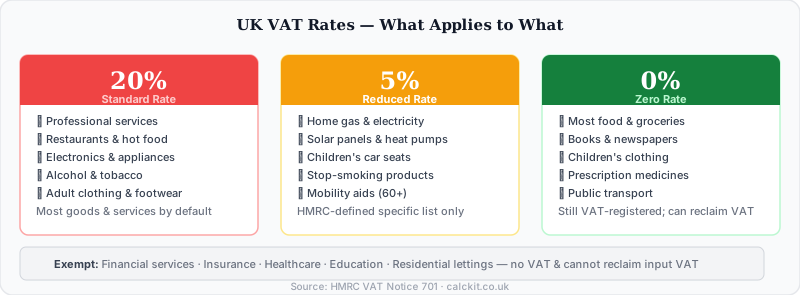
The difference between zero-rated and exempt is not obvious — and it matters financially. It is covered in detail below.
Standard rate (20%)
Standard rate applies to everything unless the law specifically says otherwise. That includes most professional services, restaurants and hot food, alcohol, electronics, adult clothing, most construction work, and advertising.
Reduced rate (5%)
The 5% rate applies to a specific HMRC list:
- Home energy: gas, electricity, and heating oil for domestic properties
- Energy-saving materials: installation of solar panels, heat pumps, insulation, and new boilers
- Children's car seats and booster seats
- Mobility aids for people aged 60 and over
- Stop-smoking products: nicotine patches, gum, and lozenges
- Residential conversions: work to convert buildings into additional dwellings
Zero rate (0%)
Zero-rated items carry 0% VAT — but the business selling them must still be VAT-registered if turnover exceeds the threshold, and they can reclaim input VAT on their costs.
- Most food: fresh produce, bread, milk, meat (but not restaurant meals or hot takeaway food)
- Books, newspapers and magazines: physical and digital publications
- Children's clothing and footwear
- Prescription medicines
- Public transport: buses, trains, aircraft travel, taxis carrying 10+ passengers
Adding VAT to a Price
Gross = Net × 1.2 (standard 20%) Gross = Net × 1.05 (reduced 5%)
Example at 20%: You invoice a client £800 for consultancy work.
- VAT: £800 × 0.2 = £160
- Invoice total: £800 × 1.2 = £960
Example at 5%: You supply and install a boiler for £1,200.
- VAT: £1,200 × 0.05 = £60
- Invoice total: £1,200 × 1.05 = £1,260
Removing VAT from a Price
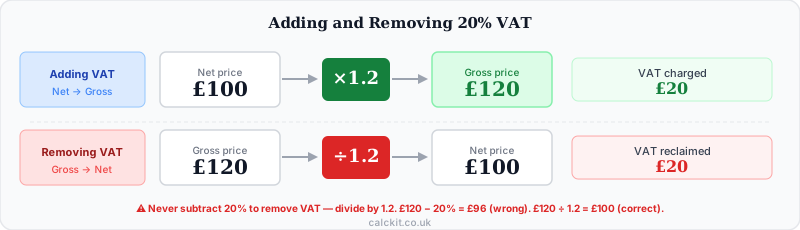
This is where most people make a mistake. You cannot subtract 20% from a gross price — that gives the wrong answer.
Net = Gross ÷ 1.2 (standard 20%) Net = Gross ÷ 1.05 (reduced 5%)
Why subtracting 20% is wrong. Take a £120 invoice. Subtracting 20% gives you £96 — wrong. Dividing by 1.2 gives you £100 net and £20 VAT — correct.
The mistake happens because 20% of the net price (£100) is only 16.67% of the gross price (£120). The base is different.
Example: A supplier invoices you £348 including VAT. What is the net and VAT?
- Net: £348 ÷ 1.2 = £290
- VAT: £348 − £290 = £58
The 1/6 Shortcut
For standard-rated (20%) transactions, there is a quick mental calculation that almost no VAT guide mentions:
The VAT in any standard-rated gross price is exactly one-sixth of the total.
VAT amount = Gross ÷ 6
It works because 20% of net equals 20/120 of gross, which simplifies to 1/6.
- Receipt for £60: VAT = £60 ÷ 6 = £10
- Receipt for £180: VAT = £180 ÷ 6 = £30
- Receipt for £540: VAT = £540 ÷ 6 = £90
Useful when checking expense receipts quickly or estimating input tax claims without a calculator.
Worked Examples by Scenario
| Scenario | Net | Rate | VAT | Gross |
|---|---|---|---|---|
| Freelance invoice | £1,500 | 20% | £300 | £1,800 |
| Restaurant meal | £85 | 20% | £17 | £102 |
| Accountant's fee | £600 | 20% | £120 | £720 |
| Building materials | £4,000 | 20% | £800 | £4,800 |
| Boiler installation | £2,400 | 5% | £120 | £2,520 |
| Home energy bill | £200 | 5% | £10 | £210 |
| Children's shoes | £35 | 0% | £0 | £35 |
| Grocery shop | £120 | 0% | £0 | £120 |
If you're setting prices for products rather than just invoicing for VAT, remember that VAT is added on top of your selling price — it doesn't come out of your profit margin. Getting markup and margin mixed up when you build VAT into a price is a common source of pricing errors; see our guide explaining the difference between markup and margin.
Zero-Rated vs Exempt — The Distinction That Matters
This is the point where most VAT guides fall short. Zero-rated and exempt look the same to customers — neither charges VAT. But for the business, they are completely different.
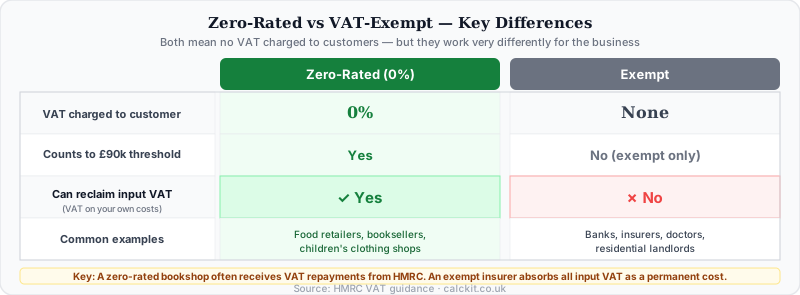
| Zero-rated | Exempt | |
|---|---|---|
| VAT charged to customer | 0% | None |
| Counts toward registration threshold | Yes | No (for wholly exempt turnover) |
| Can reclaim input VAT on costs | Yes | No |
| Must file VAT returns | Yes (if registered) | No (if wholly exempt) |
| Examples | Food retailers, booksellers, children's clothing | Banks, insurers, doctors, residential landlords |
Why it matters in practice.
A bookshop sells zero-rated goods. It charges customers no VAT. But because it sells zero-rated goods — not exempt — it is still VAT-registered and can reclaim all the VAT it pays on its own costs: rent service charges, stationery, website, delivery. It often ends up receiving a VAT repayment from HMRC each quarter.
An insurance broker sells exempt services. It charges no VAT to clients. But it also cannot reclaim any VAT on its costs. Every VAT charge on office rent, software, and marketing is a permanent cost it absorbs. There is no recovery.
If your business makes a mix of taxable (standard or zero-rated) and exempt supplies, partial exemption rules apply. These require a more complex calculation to determine how much input VAT you can recover. Seek professional advice if this applies to you.
VAT Registration Threshold
You must register for VAT if your taxable turnover exceeds £90,000 in any rolling 12-month period.
You can also register voluntarily below the threshold. Voluntary registration makes sense when:
- Most of your customers are VAT-registered businesses (they reclaim the VAT, so your net price to them is unchanged)
- You have significant VAT costs on purchases to reclaim
- You want to appear more established to corporate clients
The £90,000 threshold is based on taxable turnover — standard-rated plus zero-rated supplies. Exempt supplies do not count toward the threshold. A business that only makes exempt supplies does not need to register regardless of turnover.
VAT Flat Rate Scheme
For businesses with turnover under £150,000, the Flat Rate Scheme (FRS) simplifies accounting. Instead of calculating VAT on every sale and purchase, you pay HMRC a fixed percentage of your gross (VAT-inclusive) turnover.
You still charge customers 20% VAT. You just pay HMRC a lower flat rate and keep the difference as profit.
Selected flat rates by sector:
| Sector | Flat rate |
|---|---|
| Accountancy / bookkeeping | 14.5% |
| Computer / IT consultancy | 14.5% |
| Legal services | 14.5% |
| Advertising / marketing | 11% |
| Hairdressing / beauty | 13% |
| Catering | 12.5% |
| General building / construction | 9.5% |
| Retailing (most goods) | 7.5% |
| Farming / agriculture | 6.5% |
| Limited cost businesses* | 16.5% |
*If your goods cost less than 2% of your VAT-inclusive turnover (or under £1,000/year), HMRC classifies you as a limited cost business.
New registrations receive a 1% discount on their flat rate in the first year of VAT registration.
Example: An IT consultant invoices £10,000 + VAT in a quarter. They collect £12,000 from clients. They pay HMRC 14.5% × £12,000 = £1,740. They keep the £260 difference.
The FRS is less attractive if you have significant VAT on purchases to reclaim. Always run the numbers for your specific situation before joining.
The Most Common Mistakes
Subtracting 20% instead of dividing by 1.2. The single most common error. £120 minus 20% = £96 (wrong). £120 ÷ 1.2 = £100 (correct).
Treating zero-rated and exempt as the same. Zero-rated businesses can reclaim input VAT. Exempt businesses cannot. The financial difference is significant.
Using the wrong rate for reduced-rate goods. Home energy is charged at 5%, not 20%. An incorrectly-rated invoice creates compliance risk for both the supplier and the buyer.
Missing the rolling threshold. The £90,000 limit applies to any rolling 12-month period — not just the tax year. A strong few months can push you over it without realising.
Not keeping VAT records for 6 years. HMRC can inspect records going back 6 years. Sales invoices, purchase receipts, and VAT returns all need to be retained.
%Frequently Asked Questions
How do I calculate 20% VAT on a price?
Multiply the net price by 1.2. Example: £500 × 1.2 = £600 gross (which includes £100 VAT). For the VAT amount only: net × 0.2.
How do I remove VAT from a price?
Divide the gross price by 1.2. Example: £360 ÷ 1.2 = £300 net, with £60 VAT. Do not subtract 20% — that gives the wrong answer because the percentage base changes.
What is the quick way to find the VAT amount in a gross price?
For standard-rated (20%) items, divide the gross price by 6. £240 ÷ 6 = £40 VAT. This works because 20% VAT is always exactly one-sixth of the VAT-inclusive price.
What is the current VAT rate in the UK?
The standard rate is 20%. The reduced rate is 5% (home energy, children's car seats, stop-smoking products). Zero rate (0%) applies to most food, books, and children's clothing. These rates have been unchanged since January 2011.
Do I have to charge VAT as a freelancer?
Only if your taxable turnover exceeds £90,000 in a rolling 12-month period, or if you voluntarily register below that threshold. If you are not VAT-registered, you do not charge VAT and cannot reclaim it on your purchases.
What is the difference between zero-rated and exempt VAT?
Both result in no VAT charged to customers. The key difference is input tax: zero-rated businesses are VAT-registered and can reclaim VAT on their own costs. Exempt businesses cannot. Examples: a bookshop sells zero-rated goods and can reclaim input VAT. An insurance company sells exempt services and cannot.
How do I calculate VAT at 5%?
Multiply the net price by 1.05. Example: £200 × 1.05 = £210 gross. To remove 5% VAT from a gross price, divide by 1.05: £210 ÷ 1.05 = £200 net.
Last updated May 2026. VAT rates and registration thresholds based on HMRC guidance current at date of publication. For partial exemption, reverse charge, or import VAT queries, consult a VAT-registered accountant.