
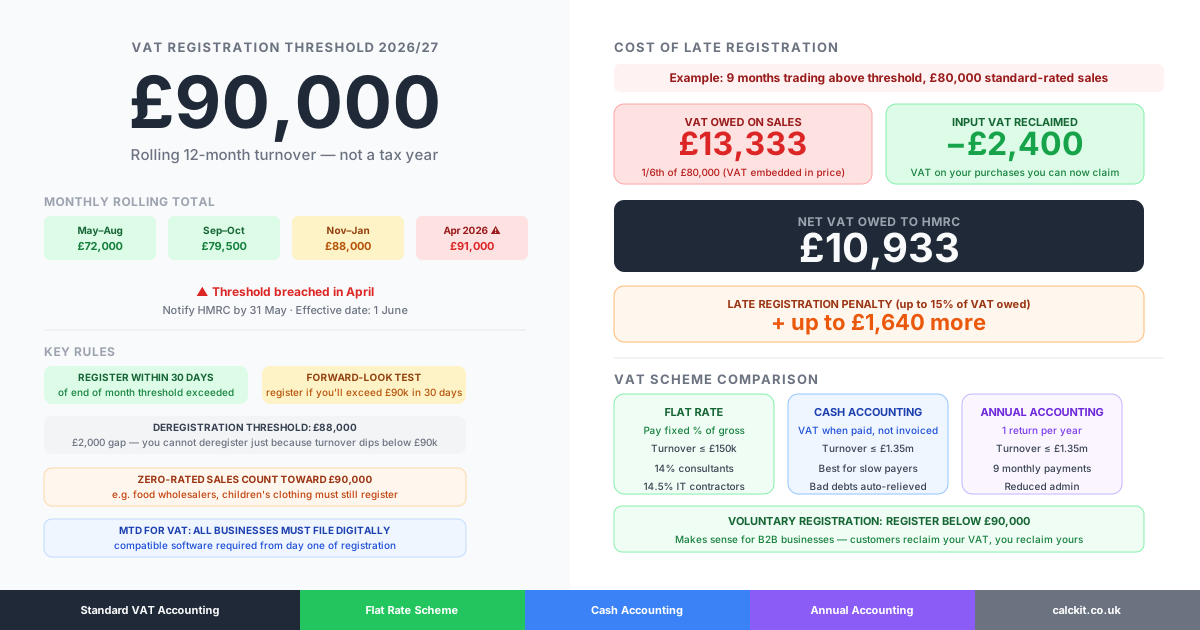
HMRC can issue a VAT bill for every sale you made from your mandatory registration date — even if you never charged your customers a penny of VAT. Miss the registration deadline and you absorb that VAT from your own margin. For a business that crosses £90,000 with 20% VAT on all sales, that is £15,000 of tax owed on income already banked and spent.
This guide covers the 2026/27 threshold, how the rolling 12-month test actually works, what late registration costs in real pounds, and which VAT scheme saves most money for your type of business.
%The £90,000 threshold explained
The VAT registration threshold for 2026/27 is £90,000 of VAT-taxable turnover, measured on a rolling 12-month basis. It has been frozen at this level since April 2024 (raised from £85,000) and is not expected to change before April 2028.
What counts toward the threshold:
- Standard-rated sales (20%)
- Reduced-rate sales (5%)
- Zero-rated sales (0%) — zero-rated goods are VAT-taxable even though no VAT is charged
What does not count:
- VAT-exempt supplies: insurance, financial services, education, residential property lettings, health services
- Out-of-scope supplies: statutory charges, outside-the-scope-of-VAT transactions
- Sales of capital assets used in the business (a van you sell is not trading turnover)
This distinction catches businesses off guard. A wholesaler selling zero-rated food still counts those sales toward the £90,000 threshold and must register — they just charge VAT at 0%.
The rolling 12-month trap
The threshold is not a tax year limit or a calendar year limit. HMRC looks at any rolling 12-month window ending on the last day of each month. You must check your position at the end of every month.
Worked example:
| Month | Monthly revenue | Rolling 12-month total |
|---|---|---|
| Aug 2025 | £6,000 | £72,000 |
| Sep 2025 | £7,500 | £75,500 |
| Oct 2025 | £8,000 | £79,500 |
| Nov 2025 | £8,500 | £83,500 |
| Dec 2025 | £9,000 | £87,500 |
| Jan 2026 | £4,000 | £88,000 |
| Feb 2026 | £3,500 | £88,000 |
| Mar 2026 | £2,500 | £88,000 |
| Apr 2026 | £4,500 | £91,000 ← breached |
The threshold is crossed in April 2026. You must notify HMRC by 31 May 2026 (within 30 days of the end of April). Your effective VAT registration date is 1 June 2026 — the first day of the second month after the breach.
Note that a busy December does not automatically mean you have crossed the threshold. You need to check the full 12 months behind every month-end — not just whether one month's revenue was high.
The 30-day forward-look rule
There is a second, separate trigger that catches many businesses. If at any point you have reasonable grounds to believe your VAT-taxable turnover will exceed £90,000 in the next 30 days alone, you must register immediately — before those 30 days begin.
Example: You sign a £95,000 contract on 3 July starting on 10 July. You knew on 3 July that you would exceed £90,000 in the next 30 days. Your registration date is 3 July, not 10 July. If you wait until the contract is complete to register, you are already late.
This rule applies regardless of what your trailing 12-month turnover looks like. A business that has traded at £30,000/year can be caught by the forward-look test if they win one large contract.
Your effective date and what it means
| How threshold was exceeded | Effective registration date |
|---|---|
| Rolling 12-month test (historic test) | 1st day of the 2nd month after the month of breach |
| Forward-look test (future test) | The date you had grounds to believe you would exceed the threshold |
From your effective date, you must charge VAT on all sales. If HMRC identifies you have been trading above the threshold without being registered, your liability starts from that effective date — even years earlier.
🏛The real cost of registering late
This is what most guides underplay. If you missed registration and are caught by HMRC, you owe VAT on every sale from your mandatory registration date. If you did not charge customers VAT at the time, you must pay it yourself.
Worked example — 9 months of unregistered trading:
| Item | Amount |
|---|---|
| Sales (all standard-rated) over 9 months | £80,000 |
| VAT due to HMRC (20% × £80,000 ÷ 1.20) | £13,333 |
| Input VAT you can now reclaim on purchases | (£2,400) |
| Net VAT owed to HMRC | £10,933 |
| Late registration penalty (up to 15% of VAT owed) | up to £1,640 |
| Total extra cost | up to £12,573 |
The £13,333 is calculated as 1/6th of VAT-inclusive turnover (the VAT is treated as already embedded in the price you charged). You cannot go back and invoice customers for it.
Late registration penalty rates
Penalties are based on potential lost revenue and your degree of culpability:
| Culpability | Penalty range | Example at £10,000 VAT owed |
|---|---|---|
| Non-deliberate, unprompted disclosure | 0–30% | £0–£3,000 |
| Non-deliberate, prompted disclosure | 10–30% | £1,000–£3,000 |
| Deliberate but not concealed | 20–70% | £2,000–£7,000 |
| Deliberate and concealed | 30–100% | £3,000–£10,000 |
| Minimum penalty | £50 | — |
Telling HMRC yourself (unprompted) before they contact you significantly reduces penalties. If you have missed registration, voluntary disclosure is always better than being caught.
How to register
Registration is done online via your Government Gateway account at gov.uk. You will need:
- Your business name and address
- National Insurance number (sole traders) or Company Registration Number (limited companies)
- Details of VAT-taxable turnover
- Your bank account details
- The date you exceeded (or expect to exceed) the threshold
- Your principal business activity
HMRC processes most applications within 40 working days. You receive a VAT registration certificate with your VAT number. You must charge VAT from your effective date even if your certificate has not yet arrived — use "VAT registration pending" on invoices and account for the VAT separately.
Registration exceptions and exemptions:
- You can apply for exemption from registration if your taxable turnover exceeds £90,000 but is mostly zero-rated and you regularly reclaim more VAT than you pay. HMRC grants this if registering would create a net repayment position most of the time.
- Group VAT registration: connected companies can register as a group, with one VAT return covering all members.
Voluntary registration: when the maths work
Any business can register voluntarily regardless of turnover.
Voluntary registration pays when:
Your customers are VAT-registered businesses. They can reclaim any VAT you charge them, so your prices do not increase in real terms. Meanwhile, you reclaim all VAT you pay on purchases, equipment, and expenses.
Voluntary registration costs when:
Your customers are end consumers (B2C). They cannot reclaim VAT, so registering effectively raises your prices by 20% unless you absorb it — reducing your margin by 16.7% (one sixth of the VAT-inclusive price).
The break-even calculation:
If your VAT on purchases (input tax) in a year would be £3,000, voluntary registration saves you £3,000 per year. If registering means raising prices and you lose business as a result, weigh the lost revenue against the VAT recovered.
A sole trader buying £15,000 of equipment at 20% VAT (£2,500 VAT) and spending £8,000 on VAT-rated services (£1,333 VAT) could reclaim £3,833 per year. If their customers are VAT-registered businesses, this is pure gain.
VAT schemes: which suits your business
Once registered, you choose a VAT accounting scheme. The default is standard VAT accounting — but three alternatives suit different business types.
Flat Rate Scheme (FRS)
You pay HMRC a fixed percentage of your gross (VAT-inclusive) turnover. You still charge customers VAT at 20% but keep the difference between what you charge and what you pay HMRC.
Eligibility: VAT-exclusive turnover up to £150,000 to join; you can stay in up to £230,000.
FRS rates by sector (selected):
| Sector | Flat rate % |
|---|---|
| Accountancy or bookkeeping | 14.5% |
| Architect, civil and structural engineer | 14.5% |
| Computer and IT consultancy or data processing | 14.5% |
| Consultant or adviser | 14% |
| Financial services | 13.5% |
| Hairdressing and beauty | 13% |
| Hotel or accommodation | 10.5% |
| Labour-only building or construction services | 14.5% |
| Legal services | 14.5% |
| Management consultancy | 14% |
| Publishing | 11% |
| Retailing of food, confectionery, tobacco | 4% |
| Retailing (other) | 7.5% |
| Restaurants, cafes, and takeaways | 12.5% |
| Travel agents | 10.5% |
| Wholesale — food and drink | 7.5% |
FRS worked example — IT consultant billing £120,000 (VAT-inclusive):
| Standard VAT | Flat Rate (14.5%) | |
|---|---|---|
| VAT charged to clients | £20,000 | £20,000 |
| VAT paid to HMRC | £20,000 minus input VAT | 14.5% × £120,000 = £17,400 |
| Approximate saving vs standard | — | £2,600 (assuming low input VAT) |
FRS saves money when your input VAT is low — typically service businesses with few purchases. It costs money when you have high input VAT (you cannot reclaim it separately under FRS, it is embedded in the flat rate).
Limited cost trader: If your VAT-inclusive cost of goods is less than 2% of VAT-inclusive turnover, HMRC classes you as a limited cost trader and you must use 16.5% regardless of sector. This catches most pure service businesses and makes FRS less attractive for them.
Cash Accounting Scheme
You account for VAT when money is received or paid — not when invoices are issued. This protects cash flow if you have slow-paying customers.
Eligibility: VAT-exclusive turnover up to £1.35 million.
Best for: businesses with 30–90 day payment terms, or B2B businesses where some invoices go unpaid (bad debts are automatically relieved).
Not suited to: businesses that receive payment before delivering goods or services (retailers, subscription businesses) — they gain no cash flow benefit.
Annual Accounting Scheme
Submit one VAT return per year instead of four quarterly returns. During the year you make nine monthly interim payments (or three quarterly payments) based on your previous year's VAT bill. You then submit the annual return and settle any balance.
Eligibility: VAT-exclusive turnover up to £1.35 million.
Best for: businesses with very predictable turnover who want to reduce admin. Can be combined with either Cash Accounting or the Flat Rate Scheme.
Not suited to: businesses with large VAT repayments (they have to wait until the annual return to reclaim — cash flow disadvantage).
Which scheme to choose
| Business type | Best scheme |
|---|---|
| Service business, low purchases, turnover under £150k | Flat Rate (check limited cost trader rule) |
| Product business with high input VAT | Standard |
| Slow-paying B2B customers | Cash Accounting |
| Low admin priority, steady income | Annual Accounting |
| High refund position (zero-rated sales) | Standard (to reclaim quarterly) |
The £88,000 deregistration trap
You can apply to deregister if you expect VAT-taxable turnover to fall below £88,000 in the next 12 months. This is not the same as falling below the registration threshold of £90,000.
The £2,000 gap is deliberate. If you could deregister the moment your turnover dropped below £90,000 and re-register when it rose above again, it would create constant churn. HMRC requires you to expect turnover below £88,000 before they allow deregistration.
When you deregister you must account for VAT on the current value of any business assets on which you claimed input tax — this includes stock, equipment, and goodwill.
Making Tax Digital for VAT
All VAT-registered businesses must keep digital records and submit VAT returns using HMRC-compatible software. There is no turnover floor — this applies from day one of registration.
Compatible software includes Xero, QuickBooks, FreeAgent, Sage, and several others on HMRC's approved list. Spreadsheets may be used if bridging software connects them to HMRC's systems.
HMRC no longer accepts manual VAT returns or XML uploads except in narrow exemption cases (certain disabilities, religious objections, insolvency situations).
Frequently asked questions
What is the VAT registration threshold for 2026/27?
£90,000 of VAT-taxable turnover on a rolling 12-month basis. The threshold has been frozen since April 2024 and applies to both 2025/26 and 2026/27.
How long do you have to register for VAT once you exceed the threshold?
You must notify HMRC within 30 days of the end of the month in which you crossed £90,000. Your effective registration date is the first day of the second month after the breach.
What happens if you register for VAT late?
HMRC backdates your VAT liability to your mandatory registration date. You owe VAT on all sales from that date even if you did not charge customers. Penalties of up to 15% of the unpaid VAT apply, depending on how late you are and whether you disclosed voluntarily.
Can you register for VAT voluntarily below the £90,000 threshold?
Yes. Voluntary registration makes sense if your customers are VAT-registered businesses or if you have significant input VAT to reclaim. It rarely makes sense for B2C businesses.
What is the VAT deregistration threshold?
£88,000 — £2,000 below the registration threshold. You must expect turnover to fall below £88,000 in the next 12 months before HMRC allows deregistration.
What is the Flat Rate VAT Scheme?
FRS lets you pay HMRC a fixed percentage of gross (VAT-inclusive) turnover. The rate depends on your sector — 14% for consultants, 14.5% for IT contractors. You still charge 20% VAT but keep the difference. Available to businesses with VAT-exclusive turnover up to £150,000.
What is Making Tax Digital for VAT?
All VAT-registered businesses must keep digital records and file VAT returns via HMRC-compatible software. There is no turnover minimum — it applies to every VAT registration.
What counts toward the VAT threshold?
Standard-rated and zero-rated sales both count. VAT-exempt sales (insurance, financial services, residential lettings) and out-of-scope supplies do not count.