
A sole trader pays income tax on everything they earn above the personal allowance. A limited company pays corporation tax only on profit — and if that profit is below £50,000, the rate is just 19%.
That difference is why hundreds of thousands of UK contractors, freelancers, and small business owners trade through a limited company. Here is exactly how corporation tax works in 2026/27 and what your company will owe.
The Three-Tier Rate Structure
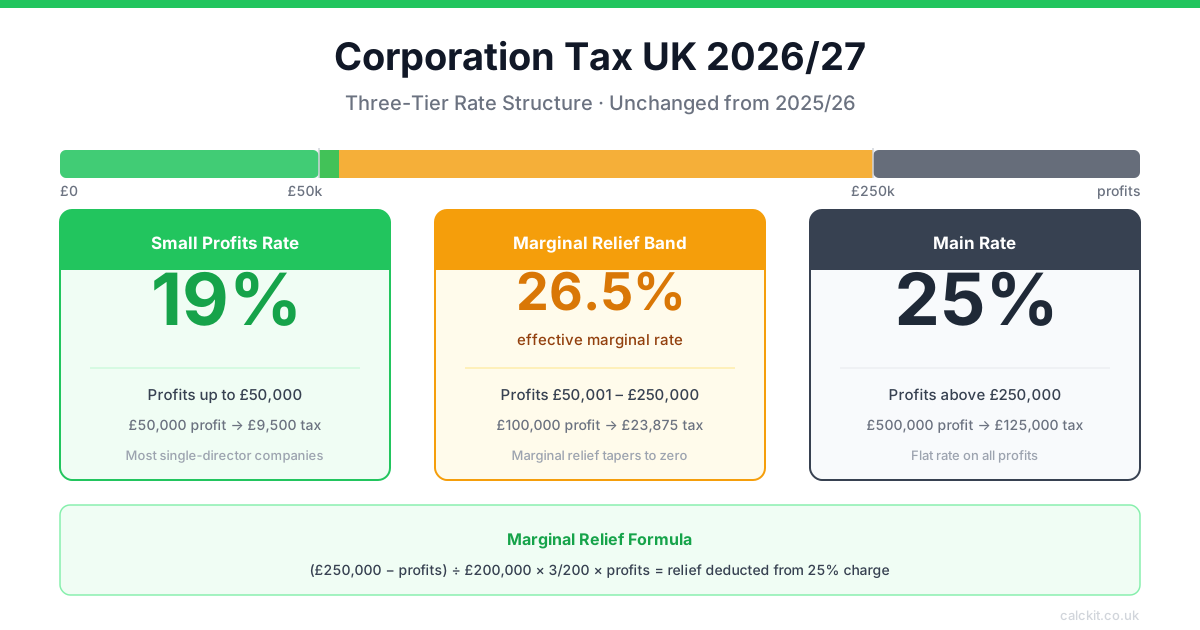
Corporation tax has not always had three tiers. Until April 2023, all companies paid a flat 19%. The two-rate structure was reintroduced from April 2023 and remains unchanged for 2026/27:
| Taxable profit | Rate | What you actually pay |
|---|---|---|
| Up to £50,000 | 19% (small profits rate) | £9,500 on £50,000 profit |
| £50,001 – £250,000 | 26.5% effective marginal rate | Rises from £9,500 to £62,500 |
| Above £250,000 | 25% (main rate) | 25% on the whole profit |
The "26.5% effective marginal rate" deserves explanation. It is not a statutory rate — it is the result of marginal relief applied to the main rate. You pay 25% on everything, then claim a deduction. The deduction tapers to zero as profits approach £250,000, creating an effective marginal rate of 26.5% on each pound earned between £50,000 and £250,000.
2026/27 rates are unchanged from 2025/26. The government confirmed in the October 2024 Budget that corporation tax rates will remain frozen until at least 2030. No changes were announced in March 2026.
How Marginal Relief Works
If your company makes £100,000 profit, you do not simply pay £25,000 (25%). You claim marginal relief to bring the bill down.
The HMRC formula:
Marginal Relief = (£250,000 − taxable profits) ÷ (£250,000 − £50,000) × 3/200 × taxable profits
For £100,000 profit:
= (£250,000 − £100,000) ÷ £200,000 × 3/200 × £100,000
= 0.75 × 0.015 × £100,000
= £1,125
So the calculation is:
- Corporation tax at 25%: £25,000
- Less marginal relief: −£1,125
- Tax payable: £23,875
- Effective rate: 23.875%
HMRC's online Corporation Tax calculator and most accounting software (Xero, QuickBooks, FreeAgent) apply this automatically. You do not calculate it by hand — but understanding it helps you see what happens as profit grows.
Worked Examples at Key Profit Levels
| Taxable profit | Tax due | Effective rate |
|---|---|---|
| £30,000 | £5,700 | 19.0% |
| £50,000 | £9,500 | 19.0% |
| £75,000 | £17,437 | 23.25% |
| £100,000 | £23,875 | 23.88% |
| £150,000 | £36,750 | 24.5% |
| £200,000 | £49,625 | 24.81% |
| £250,000 | £62,500 | 25.0% |
| £500,000 | £125,000 | 25.0% |
The effective rate rises steeply in the £50,000–£250,000 band — this is the marginal relief taper doing its job. Once profits exceed £250,000, every pound is taxed at exactly 25% and the effective rate is flat.
Associated Companies: When Your Thresholds Shrink
This is the rule that trips people up most often.
If you control more than one company — or if a connected person controls one alongside you — those companies are "associated." Each associated company causes both thresholds to be divided by the total number of companies in the group.
Example: two associated companies
- Lower threshold: £50,000 ÷ 2 = £25,000
- Upper threshold: £250,000 ÷ 2 = £125,000
A company in this position that makes £40,000 profit would not pay 19% — its lower threshold is now £25,000, so it falls into the marginal relief band and pays more.
What counts as associated?
- A company you own more than 50% of (directly or indirectly)
- A company where a connected person (spouse, civil partner, business partner, trustee acting together with you) owns more than 50%
- Holding companies and subsidiaries in a group
Dormant companies and companies incorporated overseas generally do not count, but the rules have nuances — if you run multiple companies, an accountant should confirm your associated company position before you assume you qualify for 19%.
What Counts as Taxable Profit?
Corporation tax is charged on taxable profit, not turnover. Broadly:
Taxable profit = Trading income − allowable expenses − capital allowances − reliefs
Allowable expenses are costs wholly and exclusively for business purposes: wages and salaries (including your director's salary), rent, software subscriptions, insurance, professional fees, and so on.
Capital allowances let you deduct the cost of equipment, machinery, and certain other assets against profit, rather than spreading the cost over the asset's life. The Annual Investment Allowance (AIA) is £1,000,000 — most small companies can write off all capital purchases in full in the year of purchase.
Employer pension contributions are fully deductible. Paying £10,000 into your pension directly as an employer contribution reduces your taxable profit by £10,000, saving £1,900–£2,500 in corporation tax depending on your rate.
R&D tax credits provide an additional deduction for qualifying research and development costs. The rates changed from April 2024: most SMEs now use the merged R&D scheme at a 20% expenditure credit rate, replacing the old 230% enhanced deduction.
Dividends are not deductible. You pay corporation tax on profit first, then distribute what is left as dividends. There is no deduction for dividends paid to shareholders — including yourself as a director-shareholder. See our 💰
Payment Deadlines
Miss the payment deadline and HMRC charges interest at 7.25% per annum (as of July 2026) from the day after the due date. It compounds daily.
Small and medium companies (profits below £1.5 million):
Pay corporation tax 9 months and 1 day after the end of your accounting period.
| Accounting period ends | Corporation tax due |
|---|---|
| 31 March 2026 | 1 January 2027 |
| 30 April 2026 | 1 February 2027 |
| 31 December 2026 | 1 October 2027 |
Large companies (profits above £1.5 million in the current or previous year):
Pay in four quarterly instalments — the first falls 6 months and 13 days into the accounting period itself, before you know your final profit.
| Payment | Due |
|---|---|
| Instalment 1 | 6 months + 13 days into the period |
| Instalment 2 | 9 months + 13 days into the period |
| Instalment 3 | 12 months + 13 days into the period |
| Instalment 4 | 3 months + 14 days after the period ends |
CT600: Filing the Return
Payment and filing are separate obligations with different deadlines.
- Pay corporation tax: 9 months + 1 day after period end
- File the CT600: 12 months after period end
Filing late triggers a £100 penalty automatically, rising to £200 if you miss by more than 3 months. Continued lateness triggers tax-geared penalties: 10% of unpaid tax if you are 6 months late, another 10% at 12 months.
You file the CT600 online through HMRC's Corporation Tax online service, or through compatible accountancy software. Companies cannot file paper CT600s unless HMRC has granted an exemption.
Corporation Tax and Your Salary and Dividends
Your director's salary is a deductible business expense — it reduces taxable profit before corporation tax is applied. A £12,570 director's salary saves £2,388 in corporation tax at the 19% rate (or £3,143 at 25%).
Dividends, as noted above, are paid from post-tax profit and are not deductible. But the combined picture — corporation tax on profits, then dividend tax on what you take out — is usually still more efficient than PAYE for profits above a certain threshold.
A simplified example at £80,000 company profit:
| Limited company | Sole trader | |
|---|---|---|
| Pre-tax income | £80,000 | £80,000 |
| Corporation tax (23.25% effective) | −£18,600 | — |
| Income tax + NI (sole trader) | — | −£22,140 |
| Net available | £61,400 | £57,860 |
| Dividend tax on £48,830 (after £12,570 salary) | −£3,674 | — |
| Take-home | ~£57,726 | ~£57,860 |
The difference at this level is small — the benefit of running a limited company grows as income rises above £50,000 and as you use pension contributions to reduce the corporation tax bill. See our ⚖️
The example above excludes accountancy fees (typically £800–£2,000/year for a single-director company), which reduce the net benefit of operating as a limited company. Factor these in when comparing structures.
Making Tax Digital for Corporation Tax
HMRC has delayed MTD for Corporation Tax multiple times. As of July 2026, the mandatory start date is still under consultation — it is not yet confirmed when companies will be required to file CT600s digitally through MTD-compatible software rather than through HMRC's current online service. Existing digital filing via the Corporation Tax online service continues to satisfy the current requirement.
Key Dates Summary
| Obligation | Deadline |
|---|---|
| Pay corporation tax | 9 months + 1 day after period end |
| File CT600 | 12 months after period end |
| Pay quarterly instalments (large companies) | From 6 months + 13 days into period |
| File accounts at Companies House | 9 months after period end (private companies) |
CT600 and Companies House accounts are separate filings. HMRC does not accept accounts filed at Companies House as a substitute for the CT600. You must file both.
What Else to Know for 2026/27
No rate changes are planned. The 19%/25% structure is confirmed until at least 2030 under current government policy.
Loss relief remains available: trading losses can be set against profits from the same or previous accounting period, or carried forward indefinitely against future profits from the same trade.
Group relief allows companies in a group (75%+ common ownership) to offset one company's losses against another's profits in the same accounting period, reducing the group's total tax bill.
Creative industry reliefs (film, TV, animation, video games, theatres, orchestras, museums) provide enhanced deductions for qualifying expenditure — outside the scope of this guide but worth investigating if relevant to your business.
The Bottom Line
For most single-director companies turning a profit below £50,000, corporation tax is straightforward: 19% of taxable profit, paid once a year, nine months after your accounting period ends.
If profits are approaching £50,000, it is worth modelling employer pension contributions — each pound paid into a pension as an employer contribution saves 19p in corporation tax and reduces your total bill before marginal relief even comes into play.
If you have two or more related companies, check your associated company position now — the thresholds halve, and what looked like a 19% situation may already be in marginal relief territory.
Use our 💰