
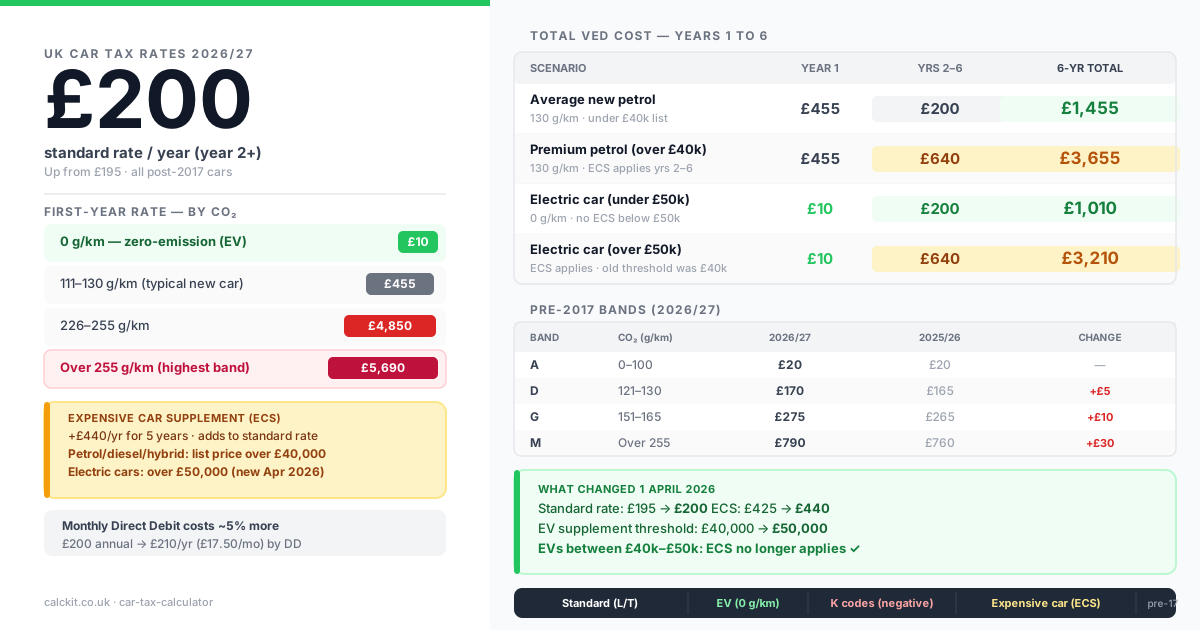
UK car tax (Vehicle Excise Duty) rates rose again on 1 April 2026 as part of the Government's rolling RPI-linked increases. The standard rate is now £200/year — but depending on when your car was registered, its CO2 output, its list price, and whether it is a diesel, the amount you pay can be very different. Every rate is here in full.
🚗Quick Lookup — Which Rate Applies to You?
| Registration date | What you pay (year 2+) |
|---|---|
| On or after 1 April 2017 | £200/year standard rate |
| On or after 1 April 2017, list price over £40k | £640/year (£200 + £440 ECS) for years 2–6 |
| 1 March 2001 – 31 March 2017 | Band A–M (see pre-2017 table below) |
| Before 1 March 2001 | £230 (≤1,549cc) or £375 (over 1,549cc) |
| Electric vehicle, any date | £200/year from year 2 (£10 in year 1) |
| Historic vehicle (over 40 years old) | £0 |
Standard Rate and First-Year Rate (Post-April 2017 Cars)
Cars registered on or after 1 April 2017 pay the CO2-linked first-year rate when first licensed, then a flat standard rate from year two onwards.
Standard rate (year 2+): £200/year
Previous year: £195/year (2025/26)
First-Year VED Rates by CO2 — 2026/27
| CO₂ emissions (g/km) | Petrol/diesel/hybrid | Non-RDE2 diesel | 2025/26 rate |
|---|---|---|---|
| 0 (zero-emission) | £10 | £10 | £10 |
| 1–50 | £115 | £135 | £110 |
| 51–75 | £135 | £280 | £130 |
| 76–90 | £280 | £365 | £270 |
| 91–100 | £365 | £405 | £350 |
| 101–110 | £405 | £455 | £390 |
| 111–130 | £455 | £560 | £440 |
| 131–150 | £560 | £1,410 | £540 |
| 151–170 | £1,410 | £2,270 | £1,360 |
| 171–190 | £2,270 | £3,420 | £2,190 |
| 191–225 | £3,420 | £4,850 | £3,300 |
| 226–255 | £4,850 | £5,690 | £4,680 |
| Over 255 | £5,690 | £5,690 | £5,490 |
What is a non-RDE2 diesel? A diesel car that does not meet the Real Driving Emissions 2 standard for NOx emissions. Most diesel cars registered before September 2018 do not meet this standard. Check your V5C logbook under "euro emissions" or ask your dealer — if it says Euro 6d or Euro 6d-temp, it is RDE2 compliant. A non-RDE2 diesel pays the first-year rate for the next CO2 band up.
The first-year rate only applies once. It is charged when the car is first licensed by the original owner — if you buy a nearly-new used car, the first-year rate was already paid and you pay the standard £200 rate from your first renewal.
Expensive Car Supplement (ECS) 2026/27
| Petrol, diesel, hybrid | Electric vehicle | |
|---|---|---|
| List price threshold | Over £40,000 | Over £50,000 |
| Annual supplement | £440 | £440 |
| Duration | Years 2–6 (5 years) | Years 2–6 (5 years) |
| Total annual VED (with ECS) | £640 | £640 |
The EV threshold rose from £40,000 to £50,000 on 1 April 2026 — a significant change for buyers of popular EVs including some Tesla Model 3, Volkswagen ID.4 and Polestar 2 variants that fall between the two thresholds. If your EV's original list price was under £50,000, you do not pay the supplement.
The supplement applies based on the original list price — if you buy the car second-hand, the supplement still applies if the original list price exceeded the threshold. The five-year clock starts from the date of first registration, not your purchase date.
Total VED Cost: Years 1–6
This is what matters when buying a new car. The table shows total VED across the first six years of ownership for three common scenarios.
| Scenario | Year 1 | Years 2–6 (each) | Total (6 years) |
|---|---|---|---|
| Average new petrol (130 g/km, under £40k) | £455 | £200 | £1,455 |
| Premium petrol (130 g/km, over £40k) | £455 | £640 | £3,655 |
| Electric car under £50k | £10 | £200 | £1,010 |
| Electric car over £50k | £10 | £640 | £3,210 |
| High-emission petrol (255+ g/km) | £5,690 | £200 (or £640) | £6,690 (or £8,890) |
An EV priced under £50,000 saves £445 versus an equivalent petrol car in year one alone, and £1,000 over six years — purely on VED.
Pre-2017 Car Tax Bands (Registered 1 March 2001–31 March 2017)
| Band | CO₂ (g/km) | 2026/27 | 2025/26 | Change |
|---|---|---|---|---|
| A | 0–100 | £20 | £20 | — |
| B | 101–110 | £20 | £20 | — |
| C | 111–120 | £35 | £35 | — |
| D | 121–130 | £170 | £165 | +£5 |
| E | 131–140 | £200 | £195 | +£5 |
| F | 141–150 | £225 | £215 | +£10 |
| G | 151–165 | £275 | £265 | +£10 |
| H | 166–175 | £325 | £315 | +£10 |
| I | 176–185 | £360 | £345 | +£15 |
| J | 186–200 | £410 | £395 | +£15 |
| K | 201–225 | £445 | £430 | +£15 |
| L | 226–255 | £760 | £735 | +£25 |
| M | Over 255 | £790 | £760 | +£30 |
Bands A, B and C are unchanged — cars emitting up to 120 g/km still pay very little. The biggest percentage rise is in Band D (130 g/km): up 3% to £170.
Pre-March 2001 cars are taxed by engine size, not CO2: £230 for engines up to 1,549cc and £375 for engines over 1,549cc. These rates have not changed from 2025/26.
Annual vs Monthly Payment — What the Surcharge Costs
You can pay VED annually, every 6 months, or monthly by Direct Debit. The 6-monthly and monthly options carry a surcharge.
| Payment method | Standard rate (£200) | With ECS (£640) |
|---|---|---|
| Annual (cheapest) | £200.00 | £640.00 |
| 6-monthly | £110.00 × 2 = £220 | £352.00 × 2 = £704 |
| Monthly Direct Debit | £17.50 × 12 = £210 | £56.00 × 12 = £672 |
| Surcharge (monthly) | +£10/year (5%) | +£32/year (5%) |
Monthly payments are convenient but cost roughly 5% more over a year — £10 extra on the standard rate, £32 extra on the £640 ECS rate. Over the five years the supplement applies, that is £160 wasted on surcharges.
🚗2026 VED Changes at a Glance
| What changed | Old rate (2025/26) | New rate (2026/27) |
|---|---|---|
| Standard rate | £195 | £200 |
| Expensive Car Supplement | £425 | £440 |
| EV supplement threshold | £40,000 | £50,000 |
| Top first-year band (255+ g/km) | £5,490 | £5,690 |
The EV threshold change is the most significant for buyers. Electric cars priced between £40,001 and £50,000 — including several popular models — no longer attract the supplement from 1 April 2026 onwards. If you registered such an EV before 1 April 2026, the old £40,000 threshold applied and you may still be in the five-year supplement period.
Three Things Most Guides Miss
1. The ECS clock runs from first registration, not your purchase date.
If you buy a 3-year-old used car that was originally listed at £42,000, you are inheriting 2 years of ECS payments remaining — not starting a fresh 5-year period. Always check the original list price in the V5C and the registration date before buying a nearly-new car in this price bracket.
2. VED does not transfer when you sell.
Since October 2014, the tax is cancelled the moment a sale is registered with DVLA. The seller gets a refund for any full months remaining. The buyer must tax the car before driving it. There is no value in buying a car that is "taxed until March" — you are taxing it again from day one regardless.
3. SORN requires active declaration, not just non-use.
If your car is off the road, you must actively declare a Statutory Off Road Notification (SORN). The vehicle must be kept on private land. Failing to either tax or SORN a car can result in a £80 penalty (reduced from £100 if paid within 33 days) and potentially a £2,500 fine if prosecuted.
What Is eVED? (From April 2028)
The Government has announced a pay-per-mile system for electric and plug-in hybrid vehicles from April 2028, proposed at 3p/mile for EVs and 1.5p/mile for plug-in hybrids. At 3p/mile:
- Drive 6,667 miles/year → £200 (same as the flat rate)
- Drive more than 6,667 miles → pay more than the flat rate
- Drive less than 6,667 miles → pay less
The average UK motorist drives about 7,400 miles per year, which would result in a bill of around £222 — slightly above the current £200 flat rate. High-mileage EV drivers would see the biggest increase; low-mileage drivers would see a reduction. The system is not yet legislated and details may change before 2028.
Last updated November 2026. Rates based on HMRC and DVLA published VED schedules for 2026/27. Historic vehicle status applies to vehicles manufactured more than 40 years before 1 January of the current year. This article is for information only; always verify your rate on the GOV.UK Vehicle Tax Rate Tables before making a purchase decision.