
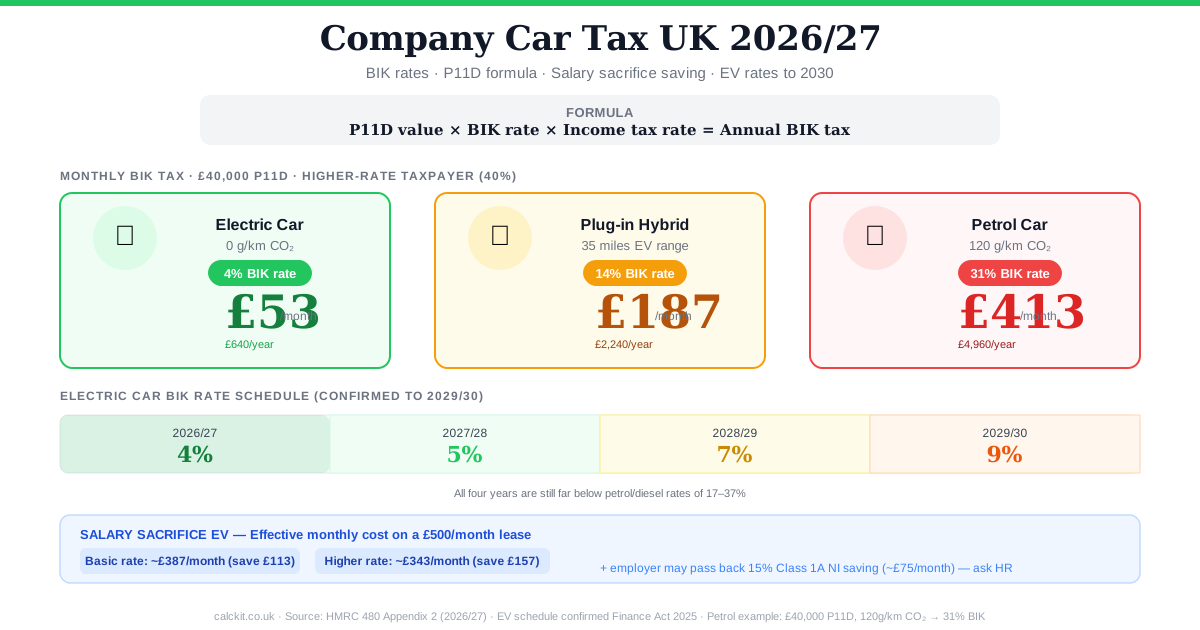
A £40,000 electric car costs a higher-rate taxpayer £53/month in company car tax in 2026/27. The same driver in a petrol car emitting 120g/km CO2 — a typical family saloon — pays £310/month. Same P11D value, same income tax rate, six times the bill.
That gap is the single most important number in company car tax right now, and it explains why EV salary sacrifice has become one of the most discussed employee benefits in the UK.
Here is exactly how the calculation works, what every emission band costs, and when a company car — or salary sacrifice scheme — actually saves you money. (Company car tax is separate from Vehicle Excise Duty — for road tax on a car you own, see our car tax guide.)
The BIK Formula
Company car tax is formally called Benefit in Kind (BIK) tax. The annual amount you owe is:
P11D value × BIK percentage × your income tax rate = annual BIK tax
Three inputs. All three are under your control to varying degrees.
P11D value is the car's list price including optional extras and VAT, but excluding the first-year registration fee and road tax. Your employer or the leasing company states it on your quote. If you make a capital contribution of up to £5,000 from your own post-tax salary, that amount reduces the P11D value used in the calculation.
BIK percentage depends on the car's CO2 emissions (and, for plug-in hybrids, the electric range). The lower the emissions, the lower the rate — see the table below.
Your income tax rate is 20% (basic rate), 40% (higher rate), or 45% (additional rate). The BIK calculation multiplies the taxable benefit by whichever rate you pay.
BIK Rates 2026/27: The Full Picture
Electric vehicles (0g/km CO2)
| Tax year | EV BIK rate |
|---|---|
| 2026/27 | 4% |
| 2027/28 | 5% |
| 2028/29 | 7% |
| 2029/30 | 9% |
These rates are set in HMRC legislation through to 2029/30. Anyone planning a 3-year EV lease starting in 2026 will see rates of 4%, 5%, and 7% across their term — still significantly lower than any petrol or diesel car.
Plug-in hybrids (1–50g/km CO2) — by electric range
| Electric range (miles) | BIK rate 2026/27 |
|---|---|
| ≥130 | 7% |
| 70–129 | 10% |
| 40–69 | 12% |
| 30–39 | 14% |
| <30 | 16% |
Most PHEVs currently sold in the UK offer 30–50 miles of electric range, putting them in the 14–16% band — still well below petrol equivalents but not as low as full EVs.
Petrol and diesel cars (51g/km and above)
| CO2 emissions (g/km) | BIK rate 2026/27 |
|---|---|
| 51–54 | 17% |
| 55–59 | 18% |
| 60–64 | 19% |
| 65–69 | 20% |
| 70–74 | 21% |
| 75–79 | 22% |
| 80–84 | 23% |
| 85–89 | 24% |
| 90–94 | 25% |
| 95–99 | 26% |
| 100–104 | 27% |
| 105–109 | 28% |
| 110–114 | 29% |
| 115–119 | 30% |
| 120–124 | 31% |
| 125–134 | 32–33% |
| 135–144 | 34–35% |
| 145–149 | 36% |
| 150+ | 37% (cap) |
The 37% cap applies to all cars emitting 150g/km or above. Diesel surcharge: add 4 percentage points for diesel cars that do not meet the RDE2 (Euro 6d) standard, subject to the 37% overall cap. Most diesel cars registered after January 2021 meet RDE2 and avoid the surcharge.
Worked Examples
Example 1 — Electric car (£40,000 P11D, 4% BIK)
| Basic rate (20%) | Higher rate (40%) | |
|---|---|---|
| Annual BIK tax | £320 | £640 |
| Monthly BIK tax | £27 | £53 |
| Employer Class 1A NI (15%) | £240/yr | £240/yr |
Example 2 — Petrol car (£30,000 P11D, 120g/km CO2 → 31% BIK)
| Basic rate (20%) | Higher rate (40%) | |
|---|---|---|
| BIK value | £9,300 | £9,300 |
| Annual BIK tax | £1,860 | £3,720 |
| Monthly BIK tax | £155 | £310 |
| Employer Class 1A NI (15%) | £1,395/yr | £1,395/yr |
Example 3 — PHEV (£35,000 P11D, 35 miles electric range → 14% BIK)
| Basic rate (20%) | Higher rate (40%) | |
|---|---|---|
| BIK value | £4,900 | £4,900 |
| Annual BIK tax | £980 | £1,960 |
| Monthly BIK tax | £82 | £163 |
Salary Sacrifice: Where the Real Saving Comes In
A standard company car and a salary sacrifice car are taxed differently. In a salary sacrifice scheme you give up gross salary in exchange for a lease funded by your employer. This does two things simultaneously:
- Reduces your taxable salary — you pay less income tax and NI on the sacrificed amount
- Creates a BIK charge — on the car's P11D value at the relevant rate
For an electric car at 4% BIK, the BIK tax is small, and the sacrifice savings are large. For a petrol car at 30%+ BIK, the reverse is often true.
Worked example — EV salary sacrifice
| Basic rate taxpayer | Higher rate taxpayer | |
|---|---|---|
| Monthly lease cost sacrificed | £500 | £500 |
| Income tax saved on sacrifice | £100 | £200 |
| Employee NI saved on sacrifice | £40 | £10 |
| Annual BIK tax (4% × £40k P11D) | £320 → £27/mo | £640 → £53/mo |
| Effective monthly cost | ~£387 | ~£343 |
| vs. personal lease at £500/mo | Saving £113 | Saving £157 |
The higher-rate taxpayer saves more because the income tax relief is worth 40p in the pound rather than 20p.
Many employers pass their Class 1A NI saving back to employees — 15% of the sacrificed amount, which on a £500/month lease is £75/month. If your employer does this, your effective cost drops further. Always ask HR whether the employer NI saving is shared before signing.
The OpRA rule — what salary sacrifice cars are actually subject to
Salary sacrifice arrangements for cars are subject to HMRC's Optional Remuneration Arrangement (OpRA) rules. Under OpRA, the taxable benefit is the higher of the standard BIK value and the salary foregone.
In practice, this means: if you sacrifice £500/month (£6,000/year) but the standard BIK value of the car is only £1,600 (40,000 × 4%), HMRC uses the higher figure — £6,000 — as the taxable benefit.
For EVs, this changes the maths: you are taxed on £6,000/year rather than £1,600/year. However, the salary sacrifice itself also reduces your taxable income by £6,000 — so the net taxable position is broadly neutral, and the saving comes from the NI relief on the sacrifice.
OpRA does not eliminate the benefit of EV salary sacrifice — it changes the mechanism. The NI saving (both employee and employer) is still real. But the BIK tax is calculated on the amount sacrificed, not on the P11D × 4% figure. Use the calculator to see your specific net position.
How BIK Tax Is Collected
Company car BIK tax is not collected as a lump sum. HMRC adjusts your PAYE tax code to reduce your tax-free allowance by the annual BIK value. This spreads the tax across your remaining pay periods for the year.
For example, if your annual BIK value is £1,600 (EV at 4% on a £40,000 car), HMRC reduces your Personal Allowance by £1,600. At 20% tax, this collects the £320 annual BIK tax across your monthly payslips — roughly £27/month in less take-home pay.
If you get a company car mid-year, HMRC adjusts your code for the remaining months. If you hand it back, the code is adjusted back.
Employer Reporting — P11D Deadlines
Your employer is responsible for reporting company car benefits to HMRC:
| Deadline | Action |
|---|---|
| 6 July 2027 | P11D forms submitted to HMRC for all employees with benefits in 2026/27 |
| 6 July 2027 | Copy of P11D given to each employee |
| 22 July 2027 | Class 1A NI contributions paid to HMRC (23 July if paying electronically) |
If you receive a company car mid-year, your employer files a P46(Car) form within 28 days of the change. This triggers the PAYE code adjustment.
Is a Company Car Worth It? A Quick Framework
| Situation | Company car likely worth it? |
|---|---|
| Employer offers EV on salary sacrifice | Usually yes — significant NI saving |
| Standard company car, petrol/diesel | Depends on your mileage and fuel benefit |
| High-mileage driver (15,000+ miles/yr) | Worth modelling — private fuel cost matters |
| Higher-rate taxpayer, EV | Strong yes — 40% tax relief on sacrifice |
| Basic-rate taxpayer, petrol, low mileage | Often not worth it vs. a car allowance |
A car allowance (cash added to your salary) avoids BIK entirely but is taxed as salary. On a £4,000/year allowance, a basic-rate taxpayer keeps £2,560 after tax — less than the cost of many personal leases. Run the numbers both ways before deciding.
For a full breakdown of your specific car, use the salary sacrifice calculator to model the effective monthly cost against a private lease.
🚗