
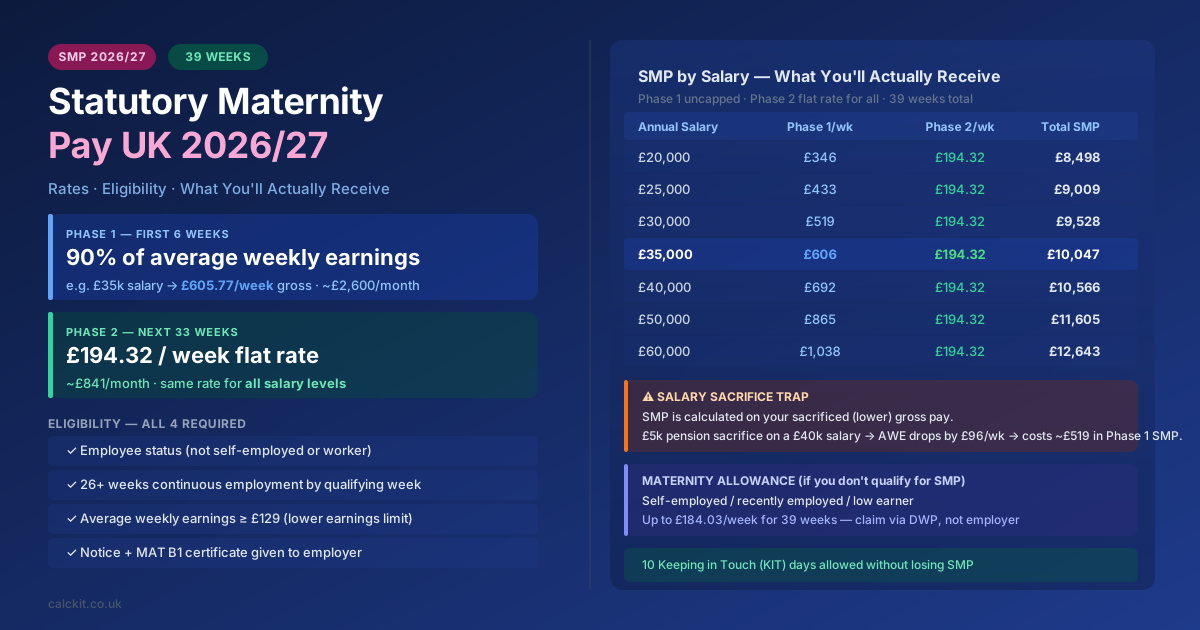
Statutory maternity pay (SMP) in 2026/27 pays 90% of your average weekly earnings for the first 6 weeks, then £194.32 per week for the following 33 weeks (or 90% of average weekly earnings if lower). Total SMP runs for up to 39 weeks. To qualify, you must be an employee, have worked for the same employer for at least 26 continuous weeks by the 15th week before your due date, and earn at least £129 a week on average. SMP is paid through your employer's payroll and is subject to income tax and National Insurance.
Most articles about statutory maternity pay (SMP) tell you the headline rate and stop there. The bit they skip — the bit that actually matters — is how your specific salary translates into real weekly and monthly amounts, and how the rules around average weekly earnings can quietly reduce what you receive before you've even gone on leave.
This guide covers both: the exact rates, the eligibility rules, and a full salary-by-salary breakdown of what SMP actually pays in 2026/27.
🏛SMP rates 2026/27
Statutory maternity pay runs for a maximum of 39 weeks and is paid in two phases:
| Phase | Duration | Rate |
|---|---|---|
| Phase 1 | First 6 weeks | 90% of your average weekly earnings (AWE) |
| Phase 2 | Next 33 weeks | £194.32 per week, or 90% of AWE — whichever is lower |
For most employees, Phase 2 is paid at the flat rate of £194.32, because their average weekly earnings work out above £215.91 a week (i.e. above £11,227/year). If you earn below that, 90% of your AWE will be below £194.32 and becomes the applicable rate throughout Phase 2 as well.
SMP is paid by your employer through the payroll, in the same way and on the same schedule as your normal wages. Tax and National Insurance are deducted in the usual way.
SMP eligibility — the 4 tests
To qualify for SMP you must pass all four of the following:
1. Employment continuity You must have worked for the same employer continuously for at least 26 weeks up to and including the qualifying week — the 15th week before your expected week of childbirth (EWC).
2. Earnings threshold You must earn at least £129 a week on average (the lower earnings limit for 2026/27). This is calculated over the 8 weeks ending with the last payday before the qualifying week.
3. Employee status You must be an employee — not classified as a worker, zero-hours casual, or self-employed contractor. Agency workers and zero-hours employees can qualify if they meet the other tests.
4. Notice and evidence You must tell your employer you are pregnant at least 15 weeks before your due date, confirm when you want your maternity leave to start, and provide a MAT B1 certificate (issued by your midwife or GP after week 20).
Even if your employer goes into administration after the qualifying week, you can still claim SMP — HMRC reimburses it directly in that situation. Leaving your job after the qualifying week also does not disqualify you from SMP.
How average weekly earnings (AWE) is calculated
AWE is the number that determines your Phase 1 rate (90% of AWE) and the Phase 2 cap. It is calculated from your gross earnings in the 8 weeks ending with the last payday on or before the Saturday of the qualifying week.
What counts as earnings:
- Basic salary
- Overtime pay
- Bonuses and commission
- Statutory sick pay paid during the reference period
- Salary sacrifice does not count (see below)
What does not count:
- Expenses and business allowances
- Benefits in kind
Worked example: Your qualifying week is the week ending Saturday 18 October 2026. Your last payday on or before that Saturday is 31 August 2026 (monthly pay). The 8-week reference period runs from 1 July to 31 August 2026. Your gross earnings in those two months are added up and divided by 8 to get your weekly average.
If you received a large bonus or overtime in that 8-week window, your AWE — and your SMP Phase 1 payments — will be higher than your normal monthly take-home implies.
How much will you actually get? Salary table
The table below shows total SMP and approximate monthly take-home during each phase, at common UK salary levels. Figures assume the flat rate applies in Phase 2 (earnings above ~£11,200/year). Take-home estimates are approximate — actual NI and tax deductions depend on your full-year income position.
| Annual salary | AWE | Phase 1 weekly (90% AWE) | Phase 2 weekly | Total SMP (39 wks) |
|---|---|---|---|---|
| £20,000 | £384.62 | £346.15 | £194.32 | £8,498.22 |
| £25,000 | £480.77 | £432.69 | £194.32 | £9,008.70 |
| £30,000 | £576.92 | £519.23 | £194.32 | £9,527.94 |
| £35,000 | £673.08 | £605.77 | £194.32 | £10,047.18 |
| £40,000 | £769.23 | £692.31 | £194.32 | £10,566.41 |
| £50,000 | £961.54 | £865.38 | £194.32 | £11,604.88 |
| £60,000 | £1,153.85 | £1,038.46 | £194.32 | £12,643.33 |
Key insight: The higher your salary, the better Phase 1 is — but Phase 2 is capped at £194.32 for everyone regardless of earnings. A £60,000 earner gets roughly 50% more in the first 6 weeks than a £25,000 earner, but both receive the same flat rate for the following 33 weeks.
Month-by-month: when does your income drop?
The shift from Phase 1 to Phase 2 — and from Phase 2 to zero income — are the two inflection points to plan around.
For a £35,000/year employee (AWE £673.08):
| Period | Weekly rate | Monthly approx (×4.33) |
|---|---|---|
| Weeks 1–6 (Phase 1) | £605.77 | ~£2,623 gross |
| Weeks 7–39 (Phase 2) | £194.32 | ~£841 gross |
| Week 40+ (unpaid leave) | £0 | £0 |
The jump from ~£2,623 to ~£841 at week 7 is the moment most people feel the financial pressure. Planning your finances around that specific date — rather than a vague "maternity leave income" — makes budgeting much more manageable.
🏛Is SMP taxed?
Yes — SMP is taxable income and subject to National Insurance contributions, paid in the same way as regular wages.
In practice, most employees pay less tax during maternity leave than they would in normal employment:
- During Phase 1 (weeks 1–6): your income is 90% of normal pay, so tax is slightly lower than usual
- During Phase 2 (weeks 7–39): at £194.32/week, your annualised income from SMP alone is roughly £10,095/year — below the personal allowance (£12,570). If SMP is your only income in that tax year, or combined with only a few weeks of normal salary, you may pay little or no income tax during Phase 2
If your maternity leave straddles two tax years (e.g. starting in January), your tax position resets on 6 April — which can mean a tax refund on any overpaid tax from the previous year is due.
The salary sacrifice trap
This is the catch most SMP guides skip entirely.
If you have a salary sacrifice pension arrangement, your contractual gross salary on paper is lower than your actual earnings — because pension contributions are routed before tax rather than from net pay. SMP average weekly earnings are calculated on your sacrificed salary, not your pre-sacrifice figure.
Example: You earn £40,000 but sacrifice £5,000/year into your pension via salary sacrifice. Your contractual gross is £35,000. Your AWE is calculated on £35,000/52 = £673.08/week, not £769.23/week. Your Phase 1 SMP is £605.77/week, not £692.31/week — a difference of £86.54 per week, or £519.23 over 6 weeks.
If you are planning a large salary sacrifice increase close to your qualifying week, be aware that it will reduce your SMP Phase 1 payments.
The same issue applies to the enhanced employer maternity pay calculation at many companies — employers who calculate occupational maternity pay as a percentage of salary may also base it on your sacrificed (lower) contractual salary unless their policy specifically states otherwise. Always check with HR before making significant sacrifice changes in the year before your qualifying week.
If you don't qualify for SMP — Maternity Allowance
If you don't meet the SMP eligibility criteria — because you're self-employed, haven't worked for your employer long enough, or earn below the lower earnings limit — you may be entitled to Maternity Allowance (MA) instead.
| SMP | Maternity Allowance | |
|---|---|---|
| Who pays | Your employer | DWP (claim via GOV.UK) |
| Rate | 90% AWE (6 wks) + £194.32 (33 wks) | Up to £184.03/week or 90% AWE |
| Duration | 39 weeks | Up to 39 weeks |
| Eligible if | Employee, 26+ weeks service, earn ≥ LEL | Self-employed, recently employed, low earner |
| Test period | 8 weeks before qualifying week | 66 weeks before due date (best 13 weeks) |
Maternity Allowance for self-employed workers is based on the best 13 weeks of earnings from the 66 weeks before your due date — so recent fluctuations matter less than the cumulative picture.
If you earn below the lower earnings limit but still have some earnings, MA pays the lower of £184.03 or 90% of your average weekly earnings from those 13 weeks.
Keeping in touch (KIT) days
You can work up to 10 KIT days during your maternity leave without losing your SMP entitlement for that week. Any work at all on a given day — even one hour of answering emails — counts as a full KIT day.
KIT days are paid by your employer at your normal rate (or an agreed rate), in addition to your SMP. They cannot be used during the compulsory two-week period immediately after birth.
KIT days are useful for attending important project handovers, training events, or keeping your skills current — and many employers offer them to support a smoother return to work.
Enhanced maternity pay — what to ask for
Statutory maternity pay is a legal minimum. Many employers — particularly in the public sector and larger private companies — offer enhanced or occupational maternity pay on top.
Common enhanced pay structures:
- Full pay for the first 8–12 weeks, then SMP for the remainder
- 50% salary for 13 weeks, then SMP
- SMP topped up to full salary for the first 3–6 months
Before you go on leave, confirm in writing:
- Exactly what your enhanced maternity pay package is
- Whether it is calculated on your pre- or post-sacrifice contractual salary
- Whether there is a "return to work" clause (where you repay some enhanced pay if you don't return for a minimum period)
If your employer's enhanced maternity policy is not documented, ask HR for it in writing before the qualifying week — verbal promises are hard to enforce.
Paternity pay — quick reference
Statutory paternity pay (SPP) follows similar rules:
- Duration: 1 or 2 consecutive weeks, taken within 56 days of birth
- Rate: £194.32/week or 90% of AWE, whichever is lower (same flat rate as SMP Phase 2)
- Eligibility: 26 weeks continuous employment by the 15th week before EWC, earning ≥ LEL
- Shared parental leave: parents can share up to 50 weeks of leave and 37 weeks of statutory shared parental pay (at the same rates as SMP Phase 2) if the mother returns to work early
SMP checklist — what to do before your qualifying week
- Check your qualifying week — count back 15 weeks from your expected week of childbirth
- Check your 26 weeks — confirm you will have continuous employment with your employer from at least 26 weeks before the qualifying week
- Notify your employer — in writing, at least 15 weeks before your due date
- Get your MAT B1 — your midwife or GP can issue this after week 20
- Check your average weekly earnings — ask payroll what your AWE will be based on the reference period
- Review any salary sacrifice — understand the impact on Phase 1 before making changes
- Request your employer's maternity policy — confirm enhanced pay entitlement in writing
- Plan your KIT days — agree them with your manager before you leave
Last updated July 2026. Rates based on 2026/27 statutory figures confirmed by GOV.UK. For personal advice on maternity rights and entitlements, contact ACAS or Citizens Advice.