
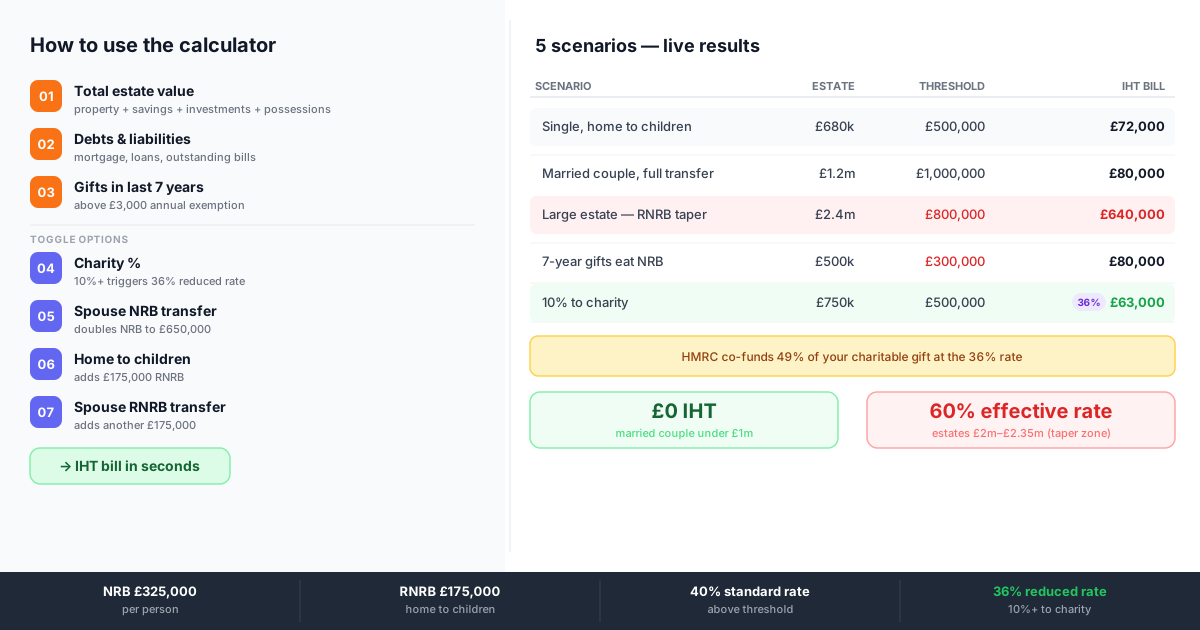
David is the executor of his mother's estate. She owned a house worth £550,000, had £150,000 in savings, and left a £20,000 mortgage outstanding. She left the house to her two children. David enters £700,000 gross value, £20,000 mortgage, ticks the RNRB box, and gets an answer in under 10 seconds: £72,000 inheritance tax due. Before he had the calculator, he had spent two hours trying to work through HMRC's guidance documents. The number was right — it matched what the solicitor later confirmed.
That is what this guide covers: exactly how to use the CalcKit IHT calculator, what each input means, and five different worked scenarios so you can see how the bill changes across common estate types.
🏛️What each input field means
The calculator has four number inputs and three toggles. Here is what to enter in each one.
Total estate value — everything the deceased owned at death: the property value (use market value, not the mortgage-free amount), bank accounts, ISAs, investments, vehicles, jewellery, and personal possessions. If in doubt, include everything and deduct debts separately. For property, use an estate agent's probate valuation — market value, not Zoopla estimates.
Debts and liabilities — the outstanding mortgage balance, any personal loans, credit card balances, unpaid bills (utilities, council tax), and professional fees already incurred. Do not include the funeral costs here; these are typically deducted separately by the executor. Only debts the estate is legally obligated to pay are deductible.
Gifts in the last 7 years — total gifts made above the £3,000 annual exemption in the 7 years before death. Small gifts (under £250 per person) and gifts from surplus income are also excluded. Wedding gifts up to £5,000 (parent), £2,500 (grandparent), or £1,000 (other) are exempt. If you are unsure, enter the total large transfers made and note that annual exemptions of £3,000 per year can be applied before this figure.
Charity donation (% of net estate) — if the will leaves money to a qualifying UK charity, enter the percentage of the net estate going to charity. If this figure reaches 10% or more, the calculator automatically applies the 36% reduced IHT rate rather than 40%. Enter 0 if no charitable bequest applies.
Transfer unused NRB from deceased spouse — tick this if the person who died was married or in a civil partnership, and their partner had already died without using their full nil-rate band. In most cases where the first spouse left everything to the surviving spouse, their full £325,000 NRB and £175,000 RNRB will have been unused — giving the surviving spouse double allowances.
Main home passes to direct descendants — tick this if the estate includes a main residence and it passes to children, grandchildren, or step-children. This adds the £175,000 residence nil-rate band. If the home is left to anyone else (siblings, friends, a charity), the RNRB does not apply.
Transfer spouse's unused RNRB — only visible after ticking both boxes above. If the first spouse also left their home to direct descendants but the RNRB was unused (because their estate was below the threshold), that £175,000 RNRB transfers too, giving a combined £350,000 RNRB.
Five worked examples
Example 1: Single person, home to children — £72,000 IHT
Patricia, 78, widowed, owns her home outright (£550,000) and has £150,000 in savings. She has a £20,000 outstanding mortgage on a small buy-to-let she never sold. The house passes to her two children.
| Input | Value |
|---|---|
| Gross estate | £700,000 |
| Debts | £20,000 |
| Gifts | £0 |
| Charity | 0% |
| Spouse NRB transfer | No |
| RNRB (home to children) | Yes |
Net estate: £680,000. NRB: £325,000. RNRB: £175,000. Total threshold: £500,000. Taxable estate: £180,000. IHT bill: £72,000 at 40%.
Patricia's estate is above the threshold specifically because of the buy-to-let — the main residence itself is comfortably within the RNRB, but the extra property pushes the total above £500,000. If she had sold the buy-to-let before she died, the cash would have been in savings — and still taxable at the same level. The fix would have been lifetime gifting, not asset restructuring.
Example 2: Married couple, full transfers — £80,000 IHT
George and Mary were married for 52 years. George died in 2018 leaving his entire estate to Mary, so his full NRB (£325,000) and RNRB (£175,000) transferred to her unused. Mary dies in 2026 with an estate worth £1,200,000 — a house worth £900,000 and £300,000 in savings. The house passes to their son.
| Input | Value |
|---|---|
| Gross estate | £1,200,000 |
| Debts | £0 |
| Gifts | £0 |
| Charity | 0% |
| Spouse NRB transfer | Yes |
| RNRB (home to children) | Yes |
| Spouse RNRB transfer | Yes |
Net estate: £1,200,000. NRB: £650,000 (own + transferred). RNRB: £350,000 (own + transferred). Total threshold: £1,000,000. Taxable estate: £200,000. IHT bill: £80,000 at 40%.
Without the spouse transfers, Mary's estate would face a £280,000 IHT bill (£700,000 taxable × 40%). The transferred allowances save £200,000 in tax. This is why estate planning around spousal allowances is worth understanding — the rules are automatic once properly recorded on the IHT forms, but executors need to claim the transferred NRB explicitly when filing.
Example 3: The £2 million RNRB taper — £640,000 IHT
Robert and Sandra have a combined estate of £2,500,000 when Sandra, the survivor, dies in 2026. The estate is their main home (valued at £1,500,000), an investment portfolio (£700,000), and savings (£300,000). Both NRBs and both RNRBs are available. The home goes to their daughter.
| Input | Value |
|---|---|
| Gross estate | £2,500,000 |
| Debts | £100,000 |
| Gifts | £0 |
| Charity | 0% |
| Spouse NRB transfer | Yes |
| RNRB (home to children) | Yes |
| Spouse RNRB transfer | Yes |
Net estate: £2,400,000. This triggers the RNRB taper.
NRB: £650,000 (unaffected by taper). RNRB before taper: £350,000. Estate over £2,000,000: £400,000. Taper reduction: £200,000 (£1 per £2 over). Effective RNRB: £150,000. Total threshold: £800,000. Taxable estate: £1,600,000. IHT bill: £640,000 at 40%.
At a £2,000,000 net estate, the full £350,000 RNRB would have applied — total threshold £1,000,000, IHT on £1,000,000 = £400,000. The extra £400,000 in estate value above £2m has increased the IHT bill by £240,000 — because the estate not only pays tax on the additional £400,000 (£160,000 in IHT), it also loses £200,000 of RNRB (worth a further £80,000 in IHT). Effective marginal rate on the £400,000 from £2m to £2.4m: 60%.
This is why estates hovering near £2,000,000 benefit most from professional estate planning. Reducing the net estate below £2,000,000 through lifetime gifts or charitable bequests can save far more than the face-value of the reduction.
🏛Example 4: Gifts in the last 7 years — £80,000 IHT where there would have been none
James is 74 and unmarried, owns a £500,000 property left to his son. He made two significant gifts in recent years: £150,000 to his daughter four years ago and £50,000 to a family friend two years ago. No annual exemption applied.
| Input | Value |
|---|---|
| Gross estate | £500,000 |
| Debts | £0 |
| Gifts in last 7 years | £200,000 |
| Charity | 0% |
| Spouse NRB transfer | No |
| RNRB (home to children) | Yes |
Net estate: £500,000. NRB: £325,000. RNRB: £175,000. Total nil-rate pool: £500,000. Gifts reduce the nil-rate pool: £500,000 − £200,000 = £300,000 effective threshold. Taxable estate: £200,000. IHT bill: £80,000 at 40%.
Without the gifts, the threshold would be £500,000 — exactly matching the estate — and IHT would be zero. The £200,000 in gifts created an £80,000 IHT liability from an estate that would otherwise owe nothing.
Note: the daughter's £150,000 gift was made four years ago, meaning taper relief applies to the gift itself if it exceeds the NRB. In practice, because the gifts reduce the NRB first, taper relief on the gift rarely applies unless total gifts exceed £325,000. For James, the taper does not reduce the £80,000 IHT on his estate — it would only apply to the gift recipient if the gifts pushed over £325,000.
Example 5: The charity 36% rate — HMRC co-funds your legacy
Helen's estate is worth £750,000. She owns her home (£600,000) and has savings of £150,000. She never married. The home goes to her daughter. She has always wanted to leave something to a hospice charity.
Without any charitable bequest:
Net estate: £750,000. NRB: £325,000. RNRB: £175,000. Threshold: £500,000. Taxable estate: £250,000. IHT at 40%: £100,000. To daughter: £650,000. To charity: £0.
With 10% of net estate to the hospice (£75,000):
The 10% threshold is met, so the rate drops to 36%. Taxable estate after deducting the charity gift: £250,000 − £75,000 = £175,000. IHT at 36%: £63,000. To daughter: £750,000 − £75,000 − £63,000 = £612,000. To charity: £75,000.
The £75,000 charitable legacy costs Helen's daughter only £38,000 less (£650,000 vs £612,000). The other £37,000 of the hospice donation is funded by the reduced IHT bill — HMRC effectively co-pays 49% of the charitable gift.
This is the counterintuitive arithmetic behind the 36% rate: if you were planning to leave anything to charity anyway, getting to the 10% threshold is nearly cost-free for heirs. At 10% of net estate, almost half the donation comes from tax savings rather than the inheritance.
Where the 36% rate makes heirs better off: it does not directly. Heirs always receive less when a charitable bequest is made — the 36% rate reduces that loss, but does not eliminate it. The 36% rate is designed to make charitable giving less costly for estates, not to boost heir inheritances.
The cohabiting couple trap
Married couples and registered civil partners get the spousal exemption and nil-rate band transfer. Unmarried cohabiting partners get neither.
If you are cohabiting and leave everything to your partner, they pay 40% on anything above £325,000 (or £500,000 if the home goes to their children from another relationship). A £600,000 estate left to a cohabiting partner with no RNRB eligibility generates £110,000 in IHT — tax that a married couple in the same position would pay zero.
The calculator reflects this correctly: do not tick the spouse NRB transfer box for cohabiting partners. The fix — marriage or civil partnership — is outside the scope of a calculator but worth noting for estate planning.
April 2027: pension pots join the estate
The current calculator covers 2026/27 only. From 6 April 2027, unspent defined contribution (DC) pension pots will be added to the estate for IHT purposes.
Currently, pension funds fall entirely outside the estate. A £500,000 pension pot can pass to a beneficiary with no IHT attached — even on estates worth several million pounds. This exemption has been used deliberately in IHT planning for decades. From April 2027, that pension pot joins the £750,000 estate in the example above, pushing the total to £1,250,000 and the IHT bill from £100,000 to £300,000.
Estates where pension pots are large relative to other assets face the biggest change. If a pension forms a significant part of your plans, the 2026/27 figures from this calculator will significantly understate the April 2027 position.
What the calculator cannot handle
The calculator gives a close approximation for the majority of estates, but several scenarios need professional advice:
- Business property relief (BPR) and agricultural property relief (APR): qualifying business assets and farmland can attract 100% or 50% relief — the April 2026 Budget capped 100% BPR at £1,000,000, with 50% above that
- Non-UK domiciled individuals: different IHT rules apply to non-doms, including a 17-year residency test introduced from 2025
- Trusts: assets held in trusts are not simply added to the estate — the tax treatment depends on the trust type and when assets entered it
- Gifts with reservation of benefit: giving away a property but continuing to live in it counts as still owning it for IHT purposes
- Discretionary trusts and RNRB: leaving a home to a discretionary trust (rather than directly to children) disqualifies the RNRB
For straightforward estates — a house, savings, and straightforward beneficiaries — the calculator gives reliable results. For anything involving trusts, business assets, or complex gift histories, use it as a starting point and take specialist advice.
Last updated August 2026. IHT figures based on 2026/27 HMRC rates: NRB £325,000, RNRB £175,000, standard rate 40%, reduced rate 36% (10%+ to charity). Both bands frozen until at least April 2030. April 2027 DC pension change confirmed in the Autumn Budget 2025. For guidance only — not financial or legal advice.