
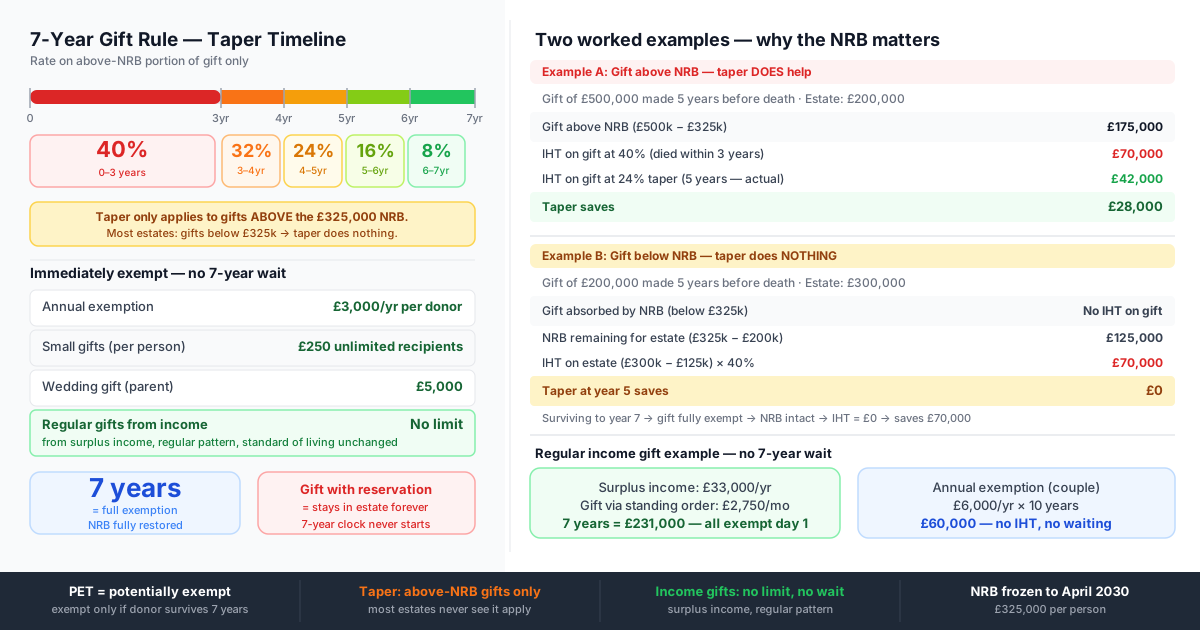
Every guide covering the 7-year gift rule includes a taper relief table. Almost none of them include the caveat that makes most of that table irrelevant to most readers: taper relief only reduces IHT on gifts above the £325,000 nil-rate band. If total gifts in the 7 years before death are below £325,000 — which is true for the majority of estates — taper relief does nothing. The gifts still reduce the NRB available to the estate, and the estate still gets taxed at 40%.
This article explains what the rule actually does, what it does not do, and the exemptions that work better than the 7-year countdown for most people.
🏛️What is a potentially exempt transfer?
A potentially exempt transfer (PET) is a gift made to an individual (or certain types of trust) that is:
- Exempt if the donor survives 7 years from the date of the gift
- Taxable (to some extent) if the donor dies within 7 years
PETs are "potentially" exempt because their status is uncertain at the time of the gift — it only resolves when either 7 years have passed or the donor dies. Every PET starts its 7-year clock from the exact date of the gift, not the tax year.
What counts as a gift: transferring ownership of cash, property, shares, or other assets for less than market value. "Selling" your house to your child for £1 is a gift of the market value minus £1 — not a sale that escapes IHT.
What does not start the clock: promising to give something in your will, holding assets in joint names where you retain access, or giving something while continuing to benefit from it (see the reservation trap below).
All the immediately-exempt gift categories
Before worrying about the 7-year rule, use the categories that are exempt immediately — no countdown required.
Annual exemption: £3,000 per donor
Every individual can give away £3,000 per tax year completely free of IHT, with no 7-year condition. One year's unused exemption can carry forward to the following year only — so the maximum in a single year is £6,000 (current year plus one prior year carried forward). Married couples have separate exemptions: £3,000 each means £6,000 per year combined (or £12,000 in the first year if neither used their prior-year allowance).
| Single donor | Per year | Maximum (1 year carry) |
|---|---|---|
| Individual | £3,000 | £6,000 |
| Married couple (combined) | £6,000 | £12,000 |
The annual exemption applies before other exemptions. It is used up chronologically — a £5,000 gift uses £3,000 annual exemption (fully exempt) and creates a £2,000 PET for the 7-year clock.
Small gifts: £250 per person, unlimited recipients
You can give up to £250 to any number of people in a single tax year, with no IHT consequences. The only restriction: you cannot use the small gift allowance on the same person in the same year as the annual exemption. If you gave someone £3,000 using the annual exemption, you cannot add a further £250 small gift to them in the same year.
Wedding gifts
Gifts made in consideration of marriage or civil partnership are exempt up to:
| Relationship to recipient | Maximum exempt gift |
|---|---|
| Parent | £5,000 |
| Grandparent or remoter ancestor | £2,500 |
| Party to the marriage (to each other) | £2,500 |
| Anyone else | £1,000 |
The gift must be made before or on the wedding day and conditional on the marriage taking place. If the wedding is called off and the gift has already been transferred, it loses its exemption.
Both parents can each give £5,000 — a £10,000 combined wedding gift is fully exempt. Four grandparents giving £2,500 each adds another £10,000. Other guests giving £1,000 each add to this — a single wedding can facilitate £20,000 or more in completely IHT-exempt transfers.
Regular gifts from income — no annual limit
This is the most powerful and most underused IHT exemption. Regular gifts made from surplus income — income you do not need for your own living expenses — are immediately outside your estate. There is no limit on the amount.
The three conditions HMRC requires:
- The gifts must be regular and habitual — a standing order or documented pattern, not occasional lump sums
- They must come from income, not from selling capital (shares, property)
- They must not reduce your standard of living — you must have genuine surplus after your normal expenditure
Worked example: James is 72, receives a pension of £65,000 per year, and spends £32,000 on his normal living expenses. His surplus is £33,000 per year. He sets up a standing order of £2,750 per month (£33,000 per year) to his daughter.
Because this meets all three conditions, these payments are immediately outside his estate from the first transfer. Over 7 years: £231,000 moved out of his estate, every penny exempt from day one — no 7-year wait required.
For HMRC purposes, James should keep a record of his income (pension statements), his normal expenditure, and the gifting pattern. Form IHT403 is used by executors to claim this exemption — having documentation prepared in advance makes the executor's job significantly easier.
The power of combining: James can stack exemptions. His standing order of £2,750/month is covered by the income exemption. He can also give his annual £3,000 exemption to his son separately, and make wedding gifts when his grandchildren marry. The income exemption does not interfere with other exemptions.
How the 7-year rule actually works
When a PET fails (the donor dies within 7 years), HMRC applies a three-step process:
Step 1 — Add all PETs to the nil-rate band calculation. Gifts made in the 7 years before death are listed chronologically, oldest first. Each gift reduces the available NRB from the oldest end.
Step 2 — Test whether any gift exceeds the remaining NRB. If total gifts are below the £325,000 NRB, no IHT is charged on any individual gift. The NRB remaining after gifts is applied to the death estate.
Step 3 — Apply taper to the above-NRB portion. Only if a gift (or cumulative gifts) exceeds the NRB does taper become relevant — and it reduces only the tax rate on the amount above the NRB.
The taper relief table — and the asterisk most guides omit
| Years between gift and death | IHT rate on above-NRB portion |
|---|---|
| 0–3 years | 40% |
| 3–4 years | 32% |
| 4–5 years | 24% |
| 5–6 years | 16% |
| 6–7 years | 8% |
| 7+ years | 0% |
The asterisk: taper relief applies only to gifts that exceed the nil-rate band. For the majority of people — whose total gifts in the last 7 years are below £325,000 — taper does not change the IHT calculation at all.
Worked example: taper helps (gifts above NRB)
Sarah gives her son £500,000 in April 2019. She dies in May 2024 — 5 years and 1 month later. Her death estate is £200,000.
Step 1: Gift is £500,000. NRB is £325,000. Gift exceeds NRB by £175,000.
Step 2: Taper applies to the £175,000 excess. At 5 years 1 month (4–5 year band): 24% rate.
IHT on gift: £175,000 × 24% = £42,000 (paid by the son or recovered from the estate)
Step 3: Remaining NRB after the gift: £0 (the full £325,000 was used against the gift).
IHT on estate: £200,000 × 40% = £80,000
Total IHT: £122,000
Compare to dying within 3 years of the gift: IHT on gift would be £175,000 × 40% = £70,000 (plus £80,000 estate) = £150,000 total. Taper saves £28,000 in this scenario.
Worked example: taper does not help (gifts below NRB)
Margaret gives her daughter £200,000 in April 2019. She dies in May 2024 — same timing as Sarah above. Her estate is £300,000.
Step 1: Total gifts = £200,000. NRB = £325,000. £200,000 is absorbed by the NRB — no excess. No IHT on the gift at any taper rate. Taper is irrelevant.
Step 2: NRB remaining for the estate: £325,000 − £200,000 = £125,000.
IHT on estate: (£300,000 − £125,000) × 40% = £175,000 × 40% = £70,000
Compare to Margaret surviving 7 years: the gift becomes fully exempt and does not reduce her NRB. Her full £325,000 NRB applies to the £300,000 estate — IHT = £0.
The 7-year rule mattered enormously here — surviving 7 years saves £70,000. But taper relief between years 3 and 7 saves Margaret nothing. Her gift is below the NRB at every point.
The gift with reservation of benefit — the trap that wipes out the benefit
The most common mistake: giving your home to your children while continuing to live in it. HMRC calls this a "gift with reservation of benefit" and treats it as if the gift never happened.
The rule: if you give an asset away but retain the right to use it — for free or at below-market rent — it stays in your estate for IHT purposes. The 7-year clock never starts.
Example: Arthur, 78, transfers his £800,000 house to his two children to get it out of his estate. He continues to live there rent-free. When Arthur dies 6 years later, the house is still in his estate — the gift failed entirely. His IHT position is identical to if he had never made the transfer. His children also have a capital gains tax problem on the future sale (they inherited the house at Arthur's death value for CGT purposes, but may have a complex history to unpick).
The fix: To make a genuine gift of your home, you must pay market rent to the new owners from the date of the gift. The rent converts the arrangement into a proper gift, starts the 7-year clock, and removes the property from your estate. The rent income becomes taxable on the recipients, and you lose your home's capital gains tax main residence relief — making this genuinely complex territory for professional advice.
A simpler alternative: move out permanently, make the gift, and rent elsewhere. This starts the clean 7-year clock.
Gift sequencing — which gifts to prioritise
If you have limited time to run the 7-year clock (age, health), sequencing matters. The key principles:
Make large gifts first. Larger gifts are more likely to exceed the NRB and generate real IHT exposure if you die early. Getting the clock running on the largest transfer first gives those gifts the most time to mature toward full exemption.
Use the annual exemption every year. £3,000 per year (or £6,000 for couples) removes funds from the estate immediately. Over 10 years, a couple removes £60,000 with no 7-year condition and no IHT exposure whatsoever.
Use income gifts without restriction. If surplus income exists, the regular income exemption removes money from the estate from the first payment — no sequencing needed.
Make PETs to individuals, not trusts. Gifts into most trusts are chargeable lifetime transfers (CLTs), not PETs — they may incur immediate IHT at 20% if above the NRB, and they complicate the NRB calculation in a different way. CLTs also create a "14-year shadow": failed CLTs made 7–14 years before death can still use up NRB against later PETs. The sequencing of CLTs and PETs is complex territory for specialist advice.
🏛What happens at each year mark
The 7-year clock starts on the exact date of the gift — not the start of the tax year. Key milestones:
Before year 3: Gift fails completely. Full 40% rate applies to any above-NRB excess. No taper benefit.
Year 3: Taper begins. If total gifts exceed NRB, the rate on the excess drops from 40% to 32%. For most gifts below NRB, no change.
Year 4: Rate drops to 24% on above-NRB portion.
Year 5: Rate drops to 16% on above-NRB portion.
Year 6: Rate drops to 8% on above-NRB portion — close to irrelevant even for large gifts.
Year 7: Full exemption. Gift completely outside the estate and does not reduce the NRB. This is the dramatic benefit: the donor's full £325,000 NRB is now intact for the estate.
The year-7 cliff: surviving to exactly 7 years produces a much larger saving than year 6 taper. In Margaret's example above, taper at year 5 saved nothing — but surviving to year 7 saved £70,000 on the estate IHT. The motivation to survive 7 years is the NRB recovery, not the taper.
April 2027: pensions join the estate
From 6 April 2027, unspent defined contribution pension pots will be included in the estate for IHT purposes. Currently, pension funds are the most efficient asset to pass on — they sit entirely outside the estate and face no IHT regardless of estate size.
The April 2027 change removes this exemption. A £300,000 pension pot that currently passes IHT-free would, from April 2027, be added to the estate and potentially taxed at 40%. For estates that were structured around pension-based IHT planning, the 7-year gift rule becomes more important as an alternative — gifts out of other estate assets while the pension remains (until April 2027) in a more favourable position.
If you are currently making use of regular income gifts from pension drawdown, this strategy remains available — but the pension itself will be in scope from April 2027, changing the maths significantly for larger pension pots.
Last updated August 2026. Figures based on 2026/27 IHT rules: NRB £325,000, RNRB £175,000 (frozen to April 2030). Taper relief rates: 0–3 years 40%, 3–4 years 32%, 4–5 years 24%, 5–6 years 16%, 6–7 years 8%, 7+ years 0%. April 2027 DC pension change confirmed in Autumn Budget 2025. For guidance only — not financial, tax, or legal advice.