
IR35 is UK tax legislation that determines whether someone working through their own limited company should be taxed as an employee for that contract, even though they are not legally employed. If IR35 applies — known as being "inside IR35" — the income is taxed roughly like a salary, with income tax and National Insurance deducted before it reaches you. If it does not apply, you are "outside IR35" and can pay yourself through a mix of salary and dividends, which is significantly more tax-efficient.
The name comes from the press release number — Inland Revenue press release number 35 — that announced the rules in 1999. They came into effect in April 2000, originally to stop people leaving permanent jobs on a Friday and returning on Monday as a "contractor" doing the same job for the same client, paying far less tax through a limited company.
📋Inside IR35 vs outside IR35 — what it actually costs you
This is the part that matters most, because the difference between the two statuses is not a technicality — it is thousands of pounds a year.
Outside IR35 means HMRC accepts you are running a genuine business. You bill your client through your limited company, pay yourself a small salary (usually around the personal allowance), and take the rest as dividends — which carry no National Insurance and are taxed at lower rates than salary.
Inside IR35 means the contract is treated as disguised employment. The "fee-payer" (your agency or client) must calculate a deemed salary from your contract income, deduct employer National Insurance, employee National Insurance, and income tax, and pay you what is left — almost exactly as if you were on their payroll, but without holiday pay, sick pay, or pension contributions.
Worked example: £400/day, 220 days a year
| Outside IR35 (Ltd company) | Inside IR35 (deemed employment) | |
|---|---|---|
| Gross contract income | £88,000 | £88,000 |
| Employer NI | £1,136 | £10,826 |
| Salary / deemed salary | £12,570 | £77,174 |
| Corporation tax | £15,938 | — |
| Income tax | — | £18,302 |
| Employee NI | — | £3,554 |
| Dividend tax | £11,384 | — |
| Take-home pay | £59,543 | £55,318 |
Working the same contract outside IR35 puts roughly £4,200 more in your pocket every year. The exact gap depends on your day rate, expenses and pension contributions.
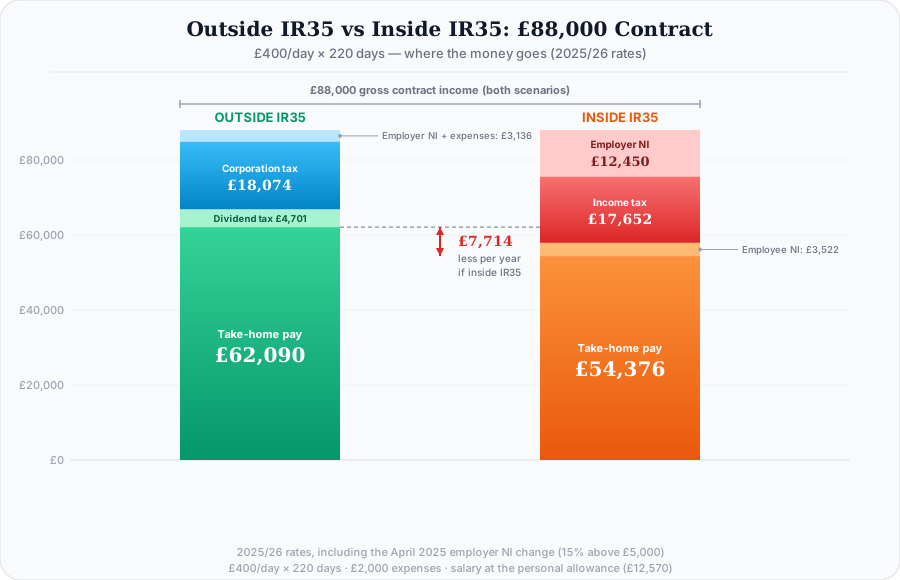
These figures use 2026/27 rates (including the 10.75% and 35.75% dividend rates) and a £400/day, 220-day contract with no expenses or pension contributions. Your own numbers depend on your day rate, expenses, and contract length — use the calculator below for a figure based on your actual situation.
The three tests that decide your status
IR35 status is not decided by what your contract is called — it is decided by the real working relationship, based on long-standing employment case law. Three tests carry the most weight:
1. Substitution
Could you send a suitably skilled substitute to do the work in your place, without the client's approval being a mere formality? A genuine, unfettered right of substitution is one of the strongest indicators of self-employment. If the client would only ever accept you, this points toward employment.
2. Control
Does the client control how, when, and where you do the work — or do they only specify what they need delivered? Contractors who are told to follow the same hours, processes, and reporting lines as employees look like employees for IR35 purposes, regardless of the contract wording.
3. Mutuality of obligation (MOO)
Is the client obliged to keep offering you work, and are you obliged to accept it? In a genuine business-to-business relationship, neither side is committed beyond the current statement of work. An ongoing expectation of future work — even if unwritten — is treated as a sign of employment.
No single test is decisive. HMRC and tribunals look at the whole picture, including financial risk, equipment ownership, whether you work for multiple clients, and whether you are "part and parcel" of the client's organisation (e.g. on their org chart, using their email signature, attending staff-only events).
Who decides your IR35 status?
This is where most of the confusion comes from, because the answer changed in April 2021.
Before April 2021 (and still true for genuinely small private-sector clients), the contractor's own limited company decided its own IR35 status for each contract.
From April 2021, for medium and large private-sector clients (and all public-sector bodies since 2017), the client is legally responsible for determining the status of every contract and must issue a Status Determination Statement (SDS) explaining the decision and the reasons behind it. If the client gets it wrong, the liability for unpaid tax can fall on the client or the agency in the supply chain — not just the contractor. This is why many medium and large businesses have become far more cautious, and some blanket-assess all contractors as "inside IR35" to avoid risk, even when individual contracts would genuinely sit outside.
The small company exemption
If your end client is a genuinely small business, the April 2021 reform does not apply, and your own limited company still determines IR35 status — as it did before 2021.
A client counts as "small" under the Companies Act 2006 if it meets at least two of these three criteria:
| Criteria | Threshold |
|---|---|
| Annual turnover | £10.2 million or less |
| Balance sheet total | £5.1 million or less |
| Average employees | 50 or fewer |
The exemption is based on the size of your client, not your own company. Many contractors working for small businesses or startups self-assess their IR35 status using the same three tests above.
CEST — HMRC's status checking tool
HMRC provides a free online tool called CEST (Check Employment Status for Tax). It asks a series of questions about the working relationship and gives a result of "inside IR35," "outside IR35," or "unable to determine."
CEST is widely used because HMRC has committed to standing by its results, provided the answers given are accurate. However, it has been criticised by tax professionals and successfully challenged in tribunal cases, mainly because it does not directly ask about mutuality of obligation — one of the three core tests. Many accountants recommend treating a CEST result as a starting point, not the final word, particularly for borderline cases.
Why the April 2025 NI change matters for IR35
This is the part most IR35 guides skip — and it has a direct effect on the size of the inside/outside gap.
From April 2025, employer National Insurance increased from 13.8% to 15%, and the threshold at which it starts to apply dropped from £9,100 to £5,000 per year.
Employer NI from April 2025: Rate: 15% (up from 13.8%) Threshold: £5,000/year (down from £9,100/year)
For an inside IR35 contract, the fee-payer deducts employer NI from your gross contract income before working out your deemed salary — so this increase comes straight out of your take-home pay. On the £88,000 example above, employer NI inside IR35 rose from roughly £10,888 under the old rates to £12,450 under the 2025 rates, an extra £1,562 a year lost before income tax and employee NI are even applied.
For an outside IR35 limited company, employer NI only applies to the small salary you pay yourself (typically £12,570), so the increase costs around £190 a year — a far smaller hit. The net effect of the April 2025 changes is that the financial penalty for being inside IR35 has grown, making an accurate status assessment more valuable than ever.
What to do next
If you're outside IR35: the salary-and-dividends structure through a limited company remains the most tax-efficient route for genuine contractors. See our guide on Limited Company vs PAYE for the full breakdown of how the numbers work.
If you're inside IR35: running a limited company no longer carries a tax advantage, and you take on the accountancy costs and admin without the benefit. Compare agency PAYE, umbrella employment, and limited company routes side by side:
⚖️If you're unsure: get a proper IR35 assessment from a contractor-specialist accountant before signing or renewing a contract — particularly if your client hasn't issued a Status Determination Statement, or if the SDS doesn't match how the contract actually operates day to day.
💰Frequently asked questions
What does IR35 mean?
IR35 is the UK tax legislation that determines whether a contractor operating through their own limited company should be taxed as an employee for a specific contract. It is named after the 1999 press release that announced the rules, which took effect in April 2000.
Who does IR35 apply to?
IR35 applies to anyone providing services through an "intermediary" — typically a personal service company (PSC) — where, if that intermediary did not exist, the worker would be considered an employee of the client. It mainly affects contractors, freelancers operating through limited companies, and consultants.
What happens if a contract is inside IR35?
If a contract is inside IR35, the fee-payer (agency or client) deducts employer National Insurance, employee National Insurance, and income tax from the contract income before paying the contractor — similar to a PAYE salary, but without employment rights such as holiday pay, sick pay, or pension contributions.
Can I still use a limited company if I'm inside IR35?
Yes, but it offers little or no tax advantage for that contract, since the income is taxed as deemed employment regardless. You still face accountancy fees, Companies House filings, and corporation tax administration without the salary-and-dividend benefit — which is why many contractors switch to umbrella or agency PAYE for inside-IR35 work.
Does IR35 apply to small companies?
If your end client qualifies as "small" under the Companies Act 2006 (meeting at least two of: turnover under £10.2 million, balance sheet under £5.1 million, fewer than 50 employees), the April 2021 reforms do not apply to that engagement, and your own limited company is responsible for determining its IR35 status using the original tests.
What is the difference between IR35 and the off-payroll working rules?
IR35 is the original 2000 legislation. The "off-payroll working rules" refer to the 2017 (public sector) and April 2021 (private sector) reforms that shifted responsibility for determining IR35 status from the contractor's company to the medium/large client. In practice, both terms describe the same underlying status tests — the reform changed who decides, not what is being decided.
Last updated September 2026. Rates based on 2026/27 HMRC figures, including the April 2026 dividend tax increase.