
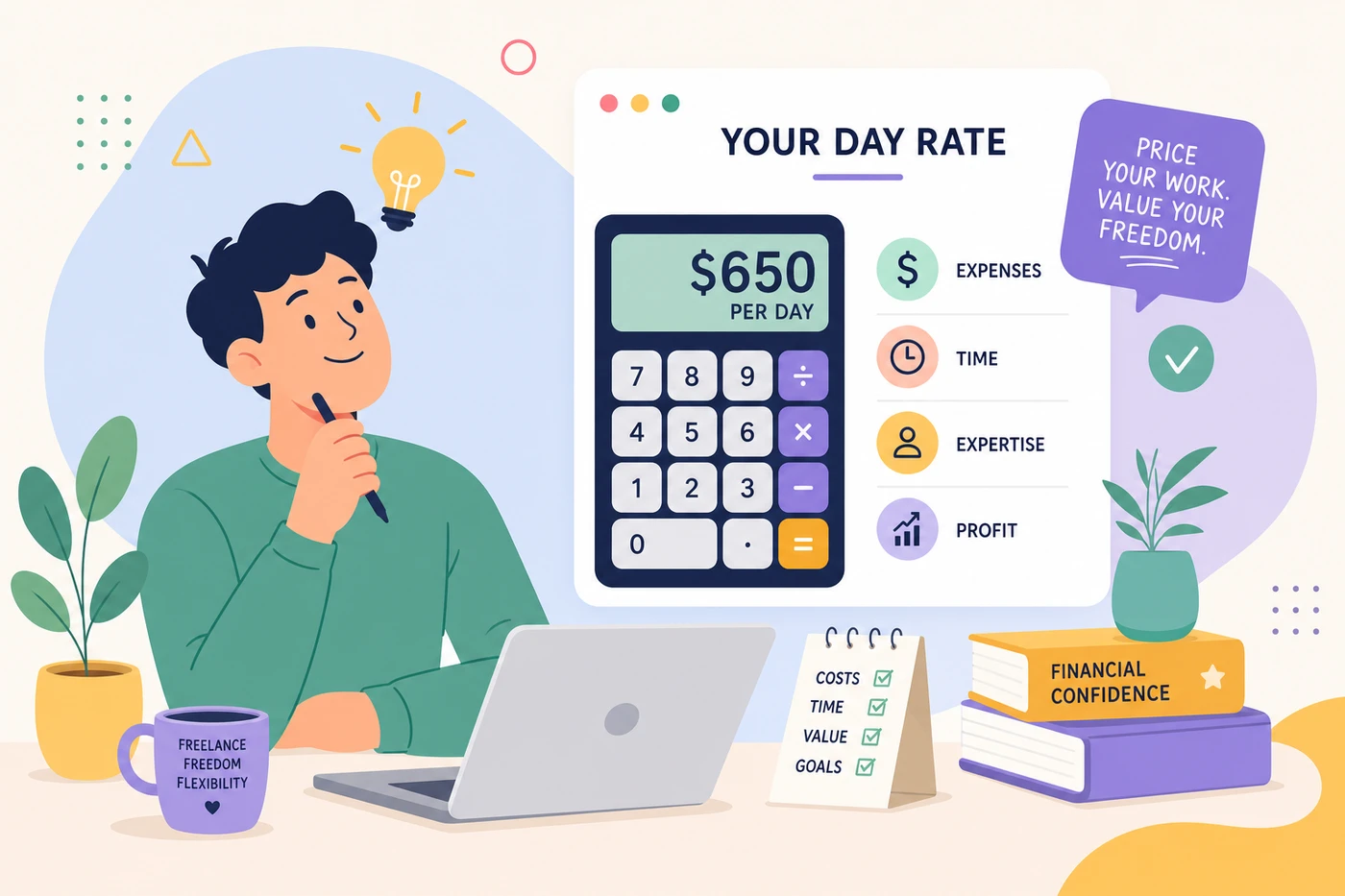
Undercharging by just £50 a day across 200 billable days costs £10,000 a year in lost income. That figure compounds across every contract you take. This guide gives you two things: the formula to calculate a defensible floor rate from your own numbers, and the 2026 market benchmarks to check whether that number holds up against what clients are actually paying.
What a freelancer day rate is
A freelancer day rate is a fixed fee charged for one full working day — typically eight billable hours. It is a distinct pricing model from hourly billing or fixed-project fees, and it exists because clients need predictable costs for short engagements, on-site days, or retainer arrangements.
From the client's perspective, day rates remove the need for timesheet reviews and make it simple to slot freelancers into sprints, workshops, or product launches. For you as the freelancer, landing a confirmed day's work is far more efficient than stitching together three or four one-hour bookings.
Many contractors shift from hourly to daily billing as they gain experience, because it frames payment around value delivered rather than time spent. When you set a daily fee, you are also choosing a professional positioning that signals you operate at a strategic level.
The formula: how your day rate is built
The core calculation is straightforward:
(Target income + Annual business expenses) ÷ Realistic billable days = Floor day rate
Using round numbers: £40,000 target income plus £2,000 in business expenses, divided by 200 billable days, gives a baseline of £210 per day. That is the floor — not the ceiling — but it is grounded in real figures rather than intuition.
👤Choosing your income target
Your starting point is not what you currently earn — it is what you need to earn to cover your life costs and build a sustainable business. Think in terms of desired take-home pay, then work backwards to the gross revenue figure that delivers that after tax. HMRC's self-assessment process and National Insurance obligations both sit between your revenue and your bank account.
Estimating billable days honestly
Most freelancers overestimate how many days they will actually invoice. A realistic figure starts with 250 working days, then subtracts:
- At least 20 days of holiday
- 8 public bank holidays
- Sick days and contingency
- Time spent on proposals, admin, and business development
The industry standard for planning purposes lands between 200 and 220 billable days. Using an inflated number is one of the most common reasons freelancers underprice — and then wonder why the numbers do not add up by December.
The tax buffer you must add
The most common pricing mistake is setting a daily fee based purely on income, without accounting for the costs of being self-employed. As a freelancer, you do not receive employer pension contributions, sick pay, or subsidised professional insurance. You cover all of it yourself — and the only sustainable way to do that is to build a 25–35% buffer into your rate.
What the buffer covers
- Income tax and National Insurance
- Pension contributions
- Professional indemnity and public liability insurance (typically £100–£300/year for most UK freelancers)
- Software subscriptions and equipment
- Non-billable hours: admin, proposals, business development
A £40,000 income target with a 30% buffer means you need to generate around £52,000 in revenue before you are on solid ground.
UK tax and NI: what to set aside
Self-employed freelancers in the UK pay Class 4 National Insurance on profits above the personal allowance of £12,570 — currently 6% on profits up to £50,270 and 2% above that. Income tax sits on top: 20% in the basic rate band and 40% above £50,270.
For a freelancer earning within the basic rate band, setting aside 20–25% of gross revenue as a provisional tax reserve is a sensible starting position. At higher day rates, that percentage rises.
🏛2026 UK freelance rates by role
The formula gives you a floor based on your costs. The benchmarks below show whether the market will support that number. Data is sourced from YunoJuno's 2025 Freelancer Rates Report, IT Jobs Watch contractor listings, and aggregated market data from Q1 2026. These are national averages — London adds 20 to 30% on top.
Tech and development
IT contracting is the strongest end of the UK freelance market. The average across all IT roles sits at £576 per day, with a national median of £500 per day for developers — a 26% jump from the £457 average recorded in early 2024, driven largely by demand for AI, cloud, and DevOps specialists.
| Seniority | Day rate |
|---|---|
| Junior developer | £400 – £500 |
| Mid-level developer | £500 – £600 |
| Senior / cloud / ML specialist | £650 – £900+ |
Design and UX
Design roles average around £501 per day nationally, with remote design work sitting close to that at £499.
| Seniority | Day rate |
|---|---|
| Junior UI / UX designer | £300 – £450 |
| Mid-level practitioner | £450 – £550 |
| Senior product designer | £550 – £700 |
Specialisms push rates toward the upper end. A designer working in Figma-to-code handoff or brand strategy commands rates closer to £650 to £700 than the national average.
Marketing, content and writing
Digital marketers and SEO specialists follow a clear seniority curve.
| Seniority | Day rate |
|---|---|
| Junior digital marketer / SEO | £350 – £450 |
| Mid-level specialist | £450 – £550 |
| Senior specialist (with revenue outcomes) | £550 – £650 |
Writers are a separate market. Day rates for content professionals run from £300 to £550 depending on specialism. Per-word rates range from £0.05 to £0.10 for beginners up to £0.50 per word for established specialist copywriters. Content writing without a clear niche or editorial track record sits firmly at the lower end.
Project management and finance
| Seniority | Day rate |
|---|---|
| Junior to mid-level PM | £500 – £600 |
| Senior delivery lead / programme manager | £600 – £800+ |
Finance freelancers with Big 4 backgrounds or regulatory expertise (FCA compliance, Basel frameworks) tend to negotiate above published benchmarks where specialist supply is limited.
Full summary by role
| Role | Junior | Mid | Senior |
|---|---|---|---|
| Developer | £400–£500 | £500–£600 | £650–£900+ |
| Designer (UI/UX) | £300–£450 | £450–£550 | £550–£700 |
| Digital marketer / SEO | £350–£450 | £450–£550 | £550–£650 |
| Project manager | £500–£550 | £550–£600 | £600–£800+ |
| Finance specialist | £350–£450 | £450–£600 | £600–£800+ |
Add 20 to 30% for London-based or London-rate contracts.
Three factors that shift your rate
Two freelancers in the same discipline with similar experience can have meaningfully different defensible rates.
The London premium
London adds 20 to 30% to national rates. A developer billing £500 per day nationally becomes a £600 to £650 per day contractor in the capital. Birmingham, Manchester and Bristol add a more modest 5 to 10% above the baseline.
The notable shift in 2026 is that remote working is actively eroding this gap. London-based clients are increasingly hiring remote contractors at near-national rates — giving regional freelancers genuine access to high-value projects without paying London living costs.
Seniority in practice
Seniority is not purely years on the job. It reflects the complexity of problems you can solve and the evidence you can show a client. A mid-level developer who can demonstrate measurable delivery outcomes or successful project ownership can price confidently in the senior band.
Identify the specific niche where your experience is deepest, price from that point, and stop presenting yourself as a generalist when you are not. Specialism reduces the client's risk, shortens the learning curve, and tightens the delivery timeline — all of which justify a higher rate.
IR35 status and contract structure
For UK contractors operating through a limited company, IR35 status is not an administrative detail — it is a financial one. An inside-IR35 contract means the client or their agency deducts PAYE tax and National Insurance before payment, removing the tax efficiency of the limited company structure.
To match the same net take-home as an outside-IR35 contract, inside IR35 contractors typically need to quote 15 to 25% more in gross day rate. At £550/day outside IR35, the equivalent inside rate is around £650 to £680. Contractor organisations including IPSE have reported that this creates an annual shortfall of £12,000–£20,000 at the same gross rate.
Never accept an inside-IR35 contract at your standard outside-IR35 rate without running the numbers first.
📋How to present and defend your rate
The formula and benchmarks mean nothing if you undercut your own number the moment a client raises an eyebrow. The way you state your rate matters as much as the rate itself.
Phrases that anchor and hold your rate
When a client asks what you charge, be direct:
"My day rate for this type of work is £X, which covers up to eight hours of focused delivery."
No qualifier. No apology. No offer to discuss. The flat statement signals confidence and gives the client nothing to push against.
If they ask for a reduction, the right response is to offer a narrower scope or fewer days rather than cutting the rate:
"I could do that for £X if we reduce the scope to Y."
This protects your day rate while giving the client a route to a lower total cost.
Urgent work: the premium you are entitled to charge
Urgent requests — last-minute bookings, compliance deadlines, high-stakes product launches — compress your schedule and displace other potential bookings. They warrant an urgency uplift of 20–30% on top of your standard rate, both to reflect the genuine disruption and to train clients to give proper notice.
Half-day rates, minimums, and cancellation terms
Protecting your income also means protecting it from below. A one-hour call should not be billed at a quarter-day rate. Set a minimum booking of one half-day (four hours), and charge a half-day for any engagement under that threshold.
For cancellations, a widely used benchmark is:
- 50% of the day rate for cancellations within 7 business days
- 100% of the day rate for cancellations within 24 hours
Get all of this in writing before any work starts. A brief statement of terms is not awkward — it is professional. Clients who push back on written terms before work begins are telling you something useful about how they will behave once work is underway.
When to review your rate
Most freelancers set a rate once and leave it untouched for years, even as costs, demand, and their own skills move on. A few signals suggest it is time for a review:
- You are booked solid with a waiting list. If you are consistently turning down work, that is pricing information — demand exceeds supply at your current rate.
- It has been over 12 months since your last increase. Even a modest annual increase of 5–10% keeps pace with inflation and rising business costs (software, insurance, accountancy fees).
- You have added a skill or specialism since you last set your rate. Picking up a certification, a new framework, or a track record of measurable outcomes is grounds for moving up a seniority band in the tables above.
- Your tax position or IR35 status has changed. Moving between outside-IR35 and inside-IR35 contracts — or registering for VAT — changes your floor rate even if the market rate has not moved.
For existing clients, the easiest moment to raise your rate is at contract renewal, with reasonable notice (4–6 weeks is typical). Frame it around market movement — "rates for [role] have moved to £X this year" — rather than personal financial pressure. For new clients, simply quote your current rate; there is no need to justify it unless asked.
Limited company vs PAYE: how it affects your take-home
The day rates above are gross figures — what you invoice before tax. How much of that you actually keep depends heavily on whether you operate through a limited company, as a sole trader, or via an umbrella company on PAYE.
A limited company structure is generally more tax-efficient for outside-IR35 contracts, since profits can be drawn as a mix of salary and dividends. But it comes with additional accounting and compliance overhead. See our comparison of limited company vs PAYE for how each structure affects your net income at different day rates.
Calculate your rate before your next proposal
A freelancer day rate is not something you borrow from a forum. It is a calculation: desired income plus business expenses divided by realistic billable days, adjusted upward for taxes and overhead, and validated against market benchmarks for your role and experience level.
Run your numbers through our free calculator — it takes your income target and annual expenses and returns a rate grounded in realistic UK assumptions. No sign-up, no paywall.
👤Knowing your number with clarity is the difference between presenting a rate and defending one.
Updated July 2026. Rate benchmarks sourced from YunoJuno 2025 Freelancer Rates Report and IT Jobs Watch Q1 2026 data. Tax figures reflect the 2026/27 tax year. For personalised tax advice, consult a qualified UK accountant.