
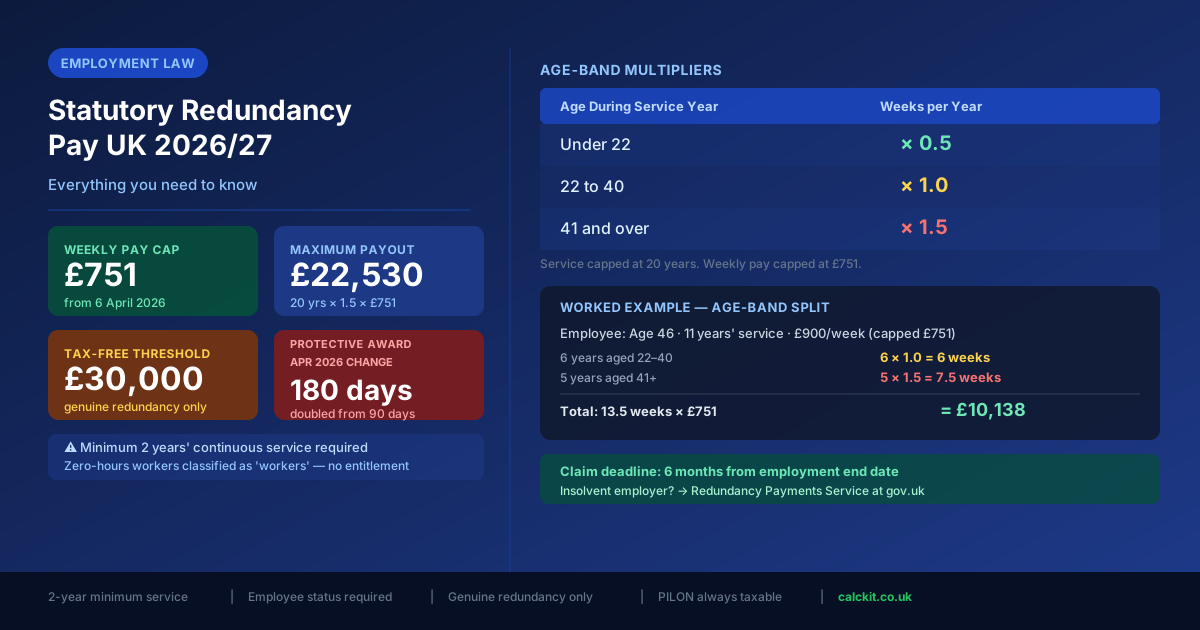
James had worked for the same distribution company for eleven years. When the warehouse closed in March 2026, he expected a payout of around £8,000. He received £4,200. His employer had used the old £719 weekly cap rather than the £751 rate that came into force from 6 April 2026 — and had also miscalculated the age-band split for the three years James worked before his 41st birthday.
Maria had been on a zero-hours contract for four years at a retail chain that entered administration. She assumed she qualified for redundancy pay on the same terms as full-time staff. She did not — her contract classified her as a worker, not an employee.
Both cases are common. Statutory redundancy pay rules are widely misunderstood, underpaid, and claimed too late. This guide covers the 2026/27 ruleset in full, including the April 2026 changes that most employees have not heard about.
🏛Who qualifies for statutory redundancy pay?
Four conditions must all be met:
| Condition | Detail |
|---|---|
| Employment status | You must be an employee — not self-employed, not a worker |
| 2 years' continuous service | With the same employer, without breaks that reset continuity |
| Genuine redundancy | Your role has ceased, reduced, or the workplace has closed — not dismissal for misconduct or performance |
| Not excluded | Certain groups are excluded: armed forces, police, some Crown employees, domestic servants in the employer's immediate family |
Fixed-term and part-time employees qualify on the same terms as full-time staff, provided they have the 2-year threshold.
TUPE transfers: If your employer was taken over via a TUPE (Transfer of Undertakings) process, your pre-transfer service counts toward the 2-year threshold. Your new employer inherits your employment history.
Zero-hours and agency workers — the entitlement gap
Zero-hours workers and agency workers generally do not qualify for statutory redundancy pay. The key distinction is employment status:
- Employee → full statutory redundancy rights
- Worker → no statutory redundancy rights (but other rights, like national minimum wage and holiday pay)
- Self-employed → no employment rights at all
Most zero-hours contracts and agency arrangements classify people as workers rather than employees. If you are unsure of your status, check your contract — specifically whether it contains a "personal service" obligation and whether the employer has obligations to offer you work. If you believe you have been misclassified, an employment solicitor or ACAS can advise.
Statutory redundancy pay rates 2026/27
The weekly pay cap increased on 6 April 2026:
| Tax year | Weekly pay cap | Maximum payout |
|---|---|---|
| 2024/25 | £643 | £19,290 |
| 2025/26 | £719 | £21,570 |
| 2026/27 | £751 | £22,530 |
The maximum is reached with 20 years' service (the cap), all worked aged 41 or over (30 weeks), at £751/week: 30 × £751 = £22,530.
Your weekly pay for this calculation is based on your average earnings in the 12 weeks before your redundancy notice — not your headline salary if you work variable hours or receive irregular commissions.
How statutory redundancy pay is calculated — the age-band formula
The formula uses three variables:
Redundancy pay = (years of service × age multiplier) × weekly pay (capped at £751)
Age multipliers:
| Age during each year of service | Weeks per year |
|---|---|
| Under 22 | 0.5 weeks |
| 22 to 40 | 1 week |
| 41 and over | 1.5 weeks |
Service is counted in complete years only — part-years do not count. Only the last 20 years of service count toward the calculation.
Single-band worked example
Sarah is 38, has 9 years' service, and earns £600/week.
- All 9 years worked in the 22–40 band: 9 × 1 week = 9 weeks
- 9 × £600 = £5,400
Age-band split worked example (the calculation most guides get wrong)
This is where most employers and employees make mistakes. If your service spans your 41st birthday, you must split it.
James is now 46 and has 11 years' service, earning £900/week (capped at £751).
He turned 41 five years ago, so:
- 6 years worked aged 22–40 (from age 35 to 41): 6 × 1 week = 6 weeks
- 5 years worked aged 41+ (from age 41 to 46): 5 × 1.5 weeks = 7.5 weeks
- Total: 13.5 weeks × £751 = £10,138.50
If James's employer applied a flat 1 week per year (ignoring the 41+ uplift) they would pay £8,261 — a shortfall of £1,877.50.
Use HMRC's own redundancy pay calculator at gov.uk to check your employer's calculation. Input your date of birth, leaving date, years of service, and weekly pay — it applies the age-band split automatically.
What counts as weekly pay?
Your weekly pay for redundancy purposes is your average gross earnings in the 12 weeks before your redundancy notice, not necessarily your contracted salary. This matters when:
- You work variable hours — use average across 12 weeks
- You receive regular overtime — included if contractual or regular in practice
- You receive shift allowances or bonuses — included if contractual
- You were on furlough — calculated at normal (pre-furlough) rate, not 80% furlough rate
Items not included: expenses, one-off payments, discretionary bonuses.
💷The £30,000 tax-free threshold — what counts and what doesn't
The first £30,000 of a genuine redundancy payment is free from income tax and employee National Insurance.
| Payment type | Tax treatment |
|---|---|
| Statutory redundancy pay (within £30k) | Tax-free |
| Enhanced redundancy pay (within £30k total) | Tax-free |
| Enhanced redundancy above £30k | Income tax + employer NIC at 13.8% |
| Payment in lieu of notice (PILON) | Always taxable — does not use the £30k allowance |
| Holiday pay owed | Always taxable |
| Wages owed | Always taxable |
The PILON trap: Many employees assume all payments made on redundancy day count toward the tax-free £30,000. PILON does not. If your employer pays three months' notice as a lump sum, that amount is fully taxable as earnings and does not reduce your £30,000 allowance.
Enhanced redundancy above £30,000: If your employer offers enhanced pay (above statutory minimum) and the total genuine redundancy element exceeds £30,000, only the excess is taxed. The employer also pays Class 1A NIC at 13.8% on amounts over £30,000.
The April 2026 change most employers don't know about: protective award doubled
From 6 April 2026, the maximum protective award for collective consultation failures doubled from 90 to 180 days' pay.
What is a protective award? If an employer makes 20 or more employees redundant within a 90-day period, they must consult collectively with employee representatives (or trade unions) for a minimum period before any redundancies take effect:
- 20–99 redundancies: 30 days minimum consultation
- 100+ redundancies: 45 days minimum consultation
If an employer skips or shortens this consultation without good reason, an employment tribunal can award each affected employee up to 180 days' gross pay as a protective award — on top of statutory redundancy pay.
Worked example:
- 50 employees made redundant, no collective consultation carried out
- Average weekly pay: £700
- Protective award: up to 180 days = approximately 25.7 weeks × £700 = £17,996 per person
- Total potential liability for employer: £899,800
This change significantly increases the risk of large employment tribunal awards for employers who skip consultation. Employees who are part of a collective redundancy where consultation was inadequate should take legal advice promptly.
The 4-week trial period for alternative roles
If your employer offers you a different role during a redundancy process, you are entitled to a 4-week trial period to test whether the role is suitable. The clock starts when you begin the new job.
During the 4-week trial:
- If you decide the role is not suitable for a genuine reason, you can still claim statutory redundancy pay as if you had been dismissed on the original date
- If your employer ends the trial because you are performing poorly in the new role, you may lose your entitlement to redundancy pay
- The 4-week period can be extended by written agreement if training for the new role requires longer
What counts as "suitable alternative employment"? There is no legal definition, but tribunals consider whether the job is broadly similar in terms of pay, seniority, hours, location, and skills. An employer offering a role at a significantly lower salary or a 50-mile change of commute is unlikely to be considered suitable.
If you unreasonably refuse a genuine offer of suitable alternative employment, you lose your right to statutory redundancy pay — even if a genuine redundancy situation exists.
If your employer is insolvent: the Redundancy Payments Service
If your employer enters administration, liquidation, or is otherwise unable to pay, the government's Redundancy Payments Service (RPS) will pay your statutory entitlements directly.
The RPS covers:
- Statutory redundancy pay (up to £751/week cap)
- Up to 8 weeks of unpaid wages (capped at £751/week)
- Up to 6 weeks of accrued but unpaid holiday pay
- Statutory minimum notice pay
How to claim:
- Your insolvency practitioner (administrator or liquidator) will give you a reference number
- Go to gov.uk → search "Claim for wages, redundancy and other money you're owed" → use the online Redundancy Payments Service portal
- Submit within 6 months of your employment end date
- Payments typically arrive within 3–6 weeks of the claim being processed
The RPS does not pay enhanced redundancy packages above the statutory cap — those are general creditor debts in the insolvency, which you may be able to claim for but are unlikely to recover in full.
🐷Continuity of service — what can break it
Your 2-year service clock can be reset by certain events. Breaks that do not break continuity:
- Maternity, paternity, adoption, or shared parental leave
- Sickness absence
- Authorised (agreed) career breaks
- TUPE transfers
- Temporary lay-offs of less than 4 consecutive weeks (or less than 6 non-consecutive weeks in a 13-week period)
Breaks that may break continuity:
- Resignation and re-hire (unless agreed otherwise in writing)
- Dismissal for misconduct and re-employment (each case assessed individually)
- Gaps between fixed-term contracts where there is no bridging arrangement
If you have had breaks in service, your employer can only count the continuous service segment when calculating redundancy pay.
Your rights during the redundancy process
Beyond the pay calculation, employees have these additional rights during a redundancy:
Redundancy notice periods (minimum statutory):
| Length of service | Minimum notice |
|---|---|
| 1 month to 2 years | 1 week |
| 2 to 12 years | 1 week per year of service |
| 12+ years | 12 weeks (cap) |
Paid time off to job search: You are entitled to reasonable paid time off (up to 40% of one week's pay) to look for new work or arrange training once you have been given notice. This applies once you have 2 years' service.
Pregnant employees and those on parental leave have additional protections: they must be offered any suitable alternative vacancy before other at-risk employees, regardless of whether a fair selection process has otherwise been applied.
What to do if your employer won't pay
- Request in writing — formally ask your employer to pay the statutory redundancy owed, citing the correct rate (£751/week cap from April 2026)
- Contact ACAS — free early conciliation at 0300 123 1100 or acas.org.uk; this is compulsory before an employment tribunal and often resolves disputes without a hearing
- Employment tribunal — you must claim within 6 months of your employment end date (not 3 months — the general unfair dismissal deadline does not apply here)
- Insolvent employer — use the Redundancy Payments Service as above
Key rates summary 2026/27
| Figure | Amount |
|---|---|
| Weekly pay cap | £751 |
| Maximum statutory redundancy pay | £22,530 |
| Service cap | 20 years |
| Tax-free threshold | £30,000 |
| Claim deadline | 6 months from leaving date |
| Protective award maximum (collective) | 180 days' pay |
| Collective consultation — 20–99 redundancies | 30 days minimum |
| Collective consultation — 100+ redundancies | 45 days minimum |
Last updated September 2026. Redundancy pay rates from HMRC 2026/27 (effective 6 April 2026). Protective award changes confirmed in the Employment Rights Act 2025. For personal employment law advice, consult ACAS or a qualified employment solicitor.