
Tom and Priya had a baby in January 2026. Tom's employer offered six months of enhanced shared parental pay. Priya was earning three times Tom's salary. The obvious move was for Tom to take the bulk of the leave while Priya returned to work sooner. They knew shared parental leave existed. What they didn't know was that they'd missed the 8-week notice deadline before Priya's maternity leave ended — and had forfeited the enhanced pay entirely.
Shared parental leave has one of the lowest take-up rates of any statutory entitlement: roughly 4–5% of eligible couples use it. Part of the reason is genuine preference. Most of the rest is confusion about the rules, missed deadlines, or uncertainty about whether the money works. This guide covers the 2026/27 ruleset from the ground up — including the April 2026 paternity flexibility change most couples haven't heard about.
💷How shared parental leave works
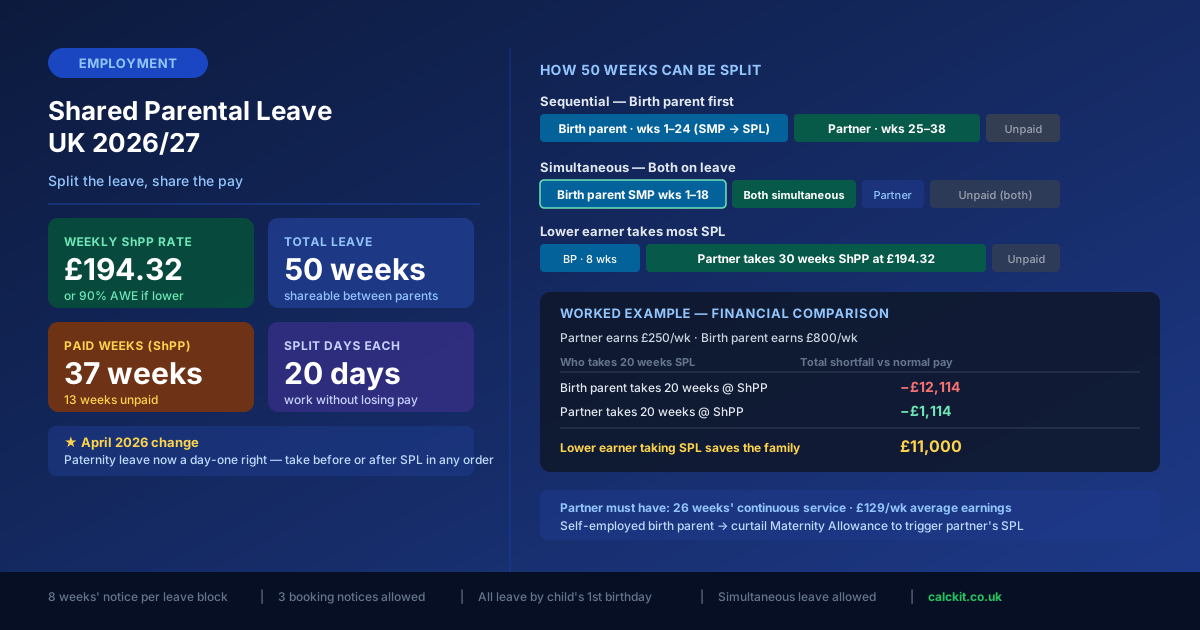
Shared parental leave (SPL) lets eligible parents split the mother's or primary adopter's statutory leave entitlement between them in almost any pattern they choose — sequential, simultaneous, or in alternating blocks.
The mechanics:
| Element | Detail |
|---|---|
| Total shareable leave | Up to 50 weeks (52 weeks maternity leave minus 2-week compulsory period) |
| Total shareable pay | Up to 37 weeks at ShPP (39 weeks maternity pay minus 2-week compulsory) |
| Unpaid weeks | 13 weeks (weeks 38–50 of shareable leave) |
| Deadline | All SPL must be taken before the child's first birthday (or first anniversary of placement for adoption) |
| Leave pattern | Continuous blocks or discontinuous (broken) blocks with work periods in between |
| Simultaneous leave | Both parents can take SPL at the same time |
The birth parent's compulsory 2-week period immediately after birth cannot be transferred. Everything else can be divided.
How the pool is created: The birth parent curtails their maternity leave by submitting a written curtailment notice to their employer. The weeks of maternity leave not taken become the shared parental leave pool. If Priya took 12 weeks of maternity leave, 38 weeks of SPL and 27 weeks of ShPP would be available to share.
Who qualifies for shared parental leave
Both parents must independently meet separate tests.
The birth parent (or primary adopter) test
The birth parent qualifies to trigger SPL if they are entitled to one of the following at the time of the child's birth:
- Statutory maternity pay (SMP)
- Maternity allowance (MA)
- Statutory adoption pay (SAP)
If the birth parent qualifies for SMP or SAP, they must be an employee. If they qualify for MA (which includes self-employed mothers), they can still trigger SPL for an employed partner — see the self-employed scenario below.
The partner test
| Requirement | Detail |
|---|---|
| Continuous employment | 26 weeks with the same employer by the 15th week before the baby's due date |
| Earnings | Average earnings of at least £129/week (the 2026/27 lower earnings limit) in the 8 weeks before each leave block |
| Still employed | Must remain employed by the same employer when SPL starts |
| Employment history | Must have been employed or self-employed for at least 26 of the 66 weeks before the due date |
The partner does not need 26 consecutive weeks of employment in the 66-week window — any 26 weeks, continuous or otherwise, count.
The shared test (both parents must meet this)
Both parents must confirm, in writing to their respective employers, that:
- The other parent meets their respective eligibility test
- Both agree to share the leave responsibly (the child must live with the leave-taking parent during SPL)
Shared Parental Pay rates 2026/27
| Rate | Amount |
|---|---|
| ShPP 2026/27 | £194.32/week or 90% of average weekly earnings, whichever is lower |
| ShPP 2025/26 | £184.03/week |
| ShPP 2024/25 | £172.48/week |
Unlike the first six weeks of statutory maternity pay (which are paid at 90% of earnings with no cap), ShPP is a flat rate from week one. There is no higher-paid opening period.
Earnings cap in practice: A parent earning £150/week average would receive 90% = £135/week rather than the £194.32 flat rate. A parent earning £216/week or more receives the full £194.32.
Both parents can receive ShPP simultaneously. If both take SPL at the same time for four weeks, each receives four weeks of ShPP — subject to the 37-week total pool not being exhausted.
The April 2026 paternity flexibility change
From 6 April 2026, statutory paternity leave became a day-one right and can now be taken in any order relative to shared parental leave.
Previously, statutory paternity leave (one or two weeks) had to be taken within 56 days of birth and had to be completed before any period of SPL. From April 2026:
- Fathers and partners can take their one or two weeks of paternity leave before their first SPL block, after it, or split it around an SPL period
- The 56-day window is removed — paternity leave can be taken at any point in the first year
- Paternity pay (SPP) still requires 26 weeks' continuous employment with the same employer by the 15th week before the due date
Practical example: A partner takes two weeks of SPL in February to cover the birth, returns to work for four months while the birth parent is on maternity leave, then takes their one week of statutory paternity leave in July followed by a further 10 weeks of SPL. This sequence was not possible before April 2026.
Note: enhanced paternity pay policies offered by employers may have their own conditions and may not have been updated to reflect the new flexibility — check your employer's HR policy before planning around it.
How to set up shared parental leave: the notice process
SPL requires three written notices, each with an 8-week minimum lead time.
Stage 1 — Curtailment notice: The birth parent submits a notice to their employer stating when they will end their maternity leave. This notice is binding once submitted (with limited exceptions for relationship breakdown).
Stage 2 — Entitlement declarations: Each parent submits a declaration of entitlement to their own employer. These must include the other parent's name, employer, and confirmation they meet the eligibility conditions. Employers are not required to verify the other parent's details independently — the declaration is taken at face value.
Stage 3 — Leave booking notices: Each parent submits a notice to their employer stating the dates of each SPL block. Each parent can submit up to three separate leave booking notices across the whole period.
| Leave type | Employer response |
|---|---|
| Continuous leave (one unbroken block) | Cannot be refused — employer must agree |
| Discontinuous leave (broken blocks with work in between) | Employer can decline; must hold a 2-week discussion period to explore alternatives |
If an employer declines a discontinuous leave request, the parent can choose to take the requested weeks as continuous leave instead or withdraw the request entirely.
🐷Common SPL patterns
The 50-week pool can be divided in almost any pattern. Four arrangements work well for different circumstances:
Sequential (most common): The birth parent takes the first block of leave; the partner takes over when the birth parent returns to work. No simultaneous leave means ShPP stretches further in weeks.
| Example | Birth parent | Partner |
|---|---|---|
| Sequential 6+6 | Weeks 1–24 (SMP/SPL) | Weeks 25–50 (SPL, weeks 37+ unpaid) |
| Sequential 9+3 | Weeks 1–36 (SMP/SPL) | Weeks 37–50 (SPL, all unpaid — ShPP pool already used) |
Simultaneous (maximise bonding, higher total cost): Both parents on leave at the same time — two people both receiving ShPP in the same weeks. Burns the 37-week ShPP pool twice as fast but gives both parents uninterrupted time together.
Alternating blocks: Birth parent takes six weeks, partner takes six weeks, birth parent takes six weeks. Requires multiple booking notices and detailed planning but allows both parents to maintain workplace presence while each taking substantial leave.
Birth parent short, partner long: Where the partner earns less than the birth parent, it may make financial sense for the birth parent to return to their higher salary sooner and the partner to take the bulk of the SPL period on ShPP. The ShPP ceiling at £194.32 means a birth parent earning £800/week loses £605.68/week on ShPP; a partner earning £250/week loses only £55.68/week on ShPP.
Financial worked example:
| Parent | Weekly earnings | ShPP received | Weekly shortfall |
|---|---|---|---|
| Birth parent (higher earner) | £800 | £194.32 | £605.68 |
| Partner (lower earner) | £250 | £194.32 | £55.68 |
For this couple, every week the birth parent takes on ShPP costs £605.68 in foregone income; every week the partner takes costs £55.68. If 20 weeks of SPL are to be split, giving the partner 18 weeks and the birth parent 2 weeks costs approximately £1,224 in total shortfall. The reverse (birth parent 18 weeks, partner 2 weeks) costs approximately £10,910.
SPLIT days — 20 working days each
SPLIT days (Shared Parental Leave In Touch) allow each parent on SPL to work up to 20 days during their leave without:
- Losing any ShPP for that week
- Losing leave entitlement
- Triggering the end of their SPL period
Both parents working their full 20 SPLIT days gives the couple a combined 40 working days of paid work contact during the leave period. This is significantly more flexibility than the 10 KIT (keeping in touch) days available under standard maternity leave.
SPLIT days require mutual agreement from the employer. They cannot be forced on an employee and cannot be offered as a substitute for a proper pay structure. Common uses:
- Phased return planning
- One-off project deadlines
- Mandatory training
- Client handovers
Rights during SPL
All standard employment rights continue during shared parental leave:
Annual leave: Accrues at the full statutory rate (5.6 weeks per year) throughout SPL. If leave year end falls during SPL, the employer must allow carry-over of the accrued annual leave.
Pension: Employer pension contributions continue if the scheme rules require it during leave. Employee contributions are typically calculated only on actual pay received (i.e., ShPP) — this means pension contributions fall substantially during SPL. Both parents should check their pension scheme rules before planning extended SPL.
Contractual benefits: All non-pay contractual benefits continue — health insurance, company car, gym membership, cycle-to-work schemes. Only pay can be reduced to statutory minimum (unless the employer's enhanced policy says otherwise).
Redundancy protection: An employee on SPL who is at risk of redundancy has enhanced protection. If the period of SPL is 6 or more consecutive weeks, the employee must be offered any suitable alternative vacancy before the employer can offer it to other at-risk employees. This is a day-one right — it applies regardless of length of service.
Right to return:
- After 26 weeks or fewer of combined maternity/adoption/SPL: right to return to the same role
- After more than 26 weeks: right to return to the same role or, if that is not reasonably practicable, a suitable equivalent role on no less favourable terms
Self-employed scenarios
Self-employed birth parent: A self-employed mother cannot access SPL or receive ShPP — these are employee-only entitlements. However, if she qualifies for Maternity Allowance (which does cover self-employed mothers), she can curtail her MA early to create an SPL entitlement for an employed partner.
How it works in practice: The self-employed birth parent must have been entitled to MA at the time of the baby's birth. She submits a MA curtailment notice to DWP (not to an employer). Her employed partner then claims SPL from their employer in the usual way.
Employed birth parent with self-employed partner: The partner's earnings test includes self-employment. The partner must show they were self-employed or employed for at least 26 of the 66 weeks before the due date. However, a self-employed partner cannot receive ShPP — only employed partners can receive it. The self-employed partner can take the leave (unpaid) but does not receive the statutory payment.
Both parents self-employed: Neither can access SPL or ShPP through employment. The birth parent may qualify for Maternity Allowance; there is no equivalent shared element for self-employed couples.
What to do if your employer declines or underpays
-
Check the policy: Some employers have enhanced SPL policies that pay above the statutory minimum. These are published in your employment contract or staff handbook. An employer cannot pay less than the statutory minimum.
-
Occupational schemes with deduction clauses: Some employers offer enhanced ShPP equal to full pay for a number of weeks, but include a clause requiring repayment if the employee does not return for a specified period. Check these conditions before planning extended SPL.
-
If your employer wrongly refuses leave: SPL is a statutory right for eligible employees. Refusing it (or subjecting you to a detriment for requesting it) is unlawful. Contact ACAS (0300 123 1100) for free early conciliation, then bring an employment tribunal claim within 3 months of the act or omission.
-
Insolvent employer: If your employer becomes insolvent during SPL, ShPP is paid directly by HMRC. Apply via your employer's insolvency practitioner or directly to HMRC using form SPP1.
Key rates and figures 2026/27
| Figure | Amount |
|---|---|
| ShPP weekly rate | £194.32 |
| Lower earnings limit (qualifying threshold) | £129/week average |
| Maximum shareable leave | 50 weeks |
| Maximum paid weeks | 37 weeks |
| Unpaid weeks | 13 weeks |
| SPLIT days per parent | 20 |
| Notice required per leave block | 8 weeks |
| Maximum leave booking notices | 3 per parent |
| Simultaneous leave allowed | Yes |
| Redundancy protection threshold | 6+ consecutive weeks SPL |
Last updated September 2026. ShPP rates from HMRC 2026/27 (effective 6 April 2026). April 2026 paternity flexibility confirmed under the Employment Relations (Flexible Working) Act 2023 and Employment Rights Act 2025 secondary legislation. For personal employment advice, contact ACAS or a qualified employment solicitor.