
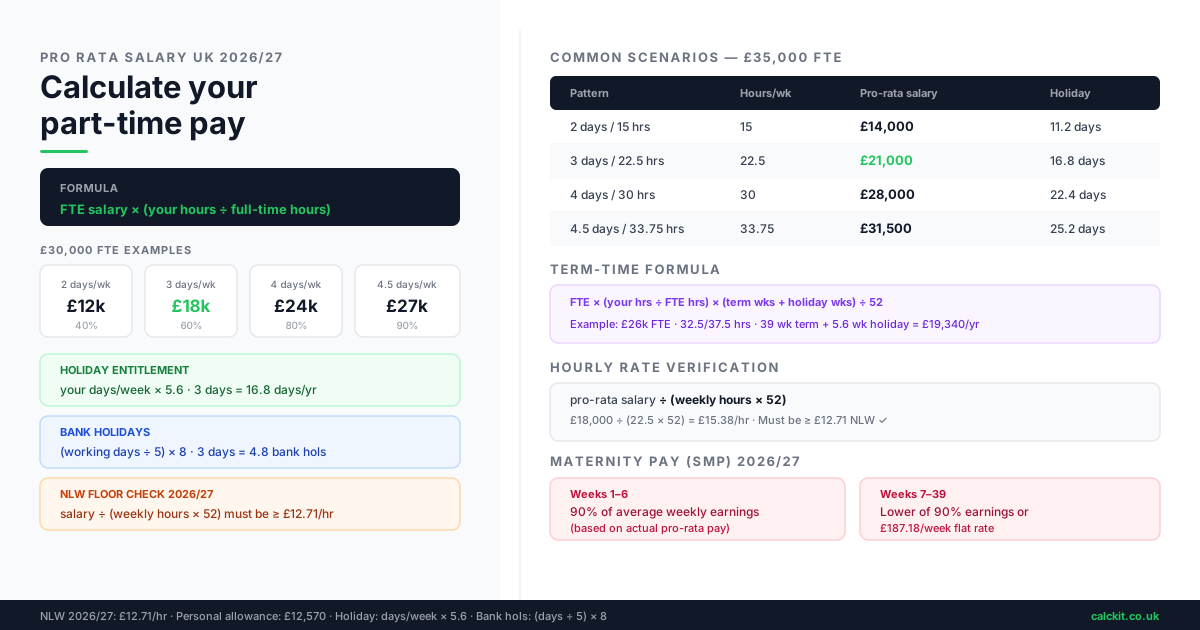
Your offer letter says "£30,000 FTE, pro rata." Your payslip shows £18,000. Is that right?
It depends on how your employer defines full-time hours — and that is not set by law. This guide gives you the exact formula to verify your pro-rata salary, check it clears the National Living Wage, calculate your holiday entitlement and bank holiday days, and understand how term-time and maternity pay work on a part-time contract.
⏱️The Standard Pro Rata Formula
Pro-rata salary = FTE salary × (your contracted hours ÷ full-time hours)
Full-time hours are set by your employer's contract — not by law. Common values are 35, 37.5, or 40 hours per week. Always check your contract before calculating. If the offer letter says "FTE based on 37.5 hours" and you are working 30 hours, your multiplier is 30 ÷ 37.5 = 0.8.
Common part-time examples
| Your days/week | Hours (of 37.5) | Multiplier | £25,000 FTE | £35,000 FTE | £50,000 FTE |
|---|---|---|---|---|---|
| 2 days | 15 hrs | 40% | £10,000 | £14,000 | £20,000 |
| 3 days | 22.5 hrs | 60% | £15,000 | £21,000 | £30,000 |
| 4 days | 30 hrs | 80% | £20,000 | £28,000 | £40,000 |
| 4.5 days | 33.75 hrs | 90% | £22,500 | £31,500 | £45,000 |
If your employer uses a 40-hour week as full-time, the multiplier for 3 days (24 hrs) becomes 24 ÷ 40 = 60% — the same result. For 30 hours: 30 ÷ 40 = 75% (not 80% as above). Always use the hours in your contract, not an assumed 37.5.
Verifying Your Hourly Rate
Once you have your pro-rata salary, calculate your effective hourly rate:
Hourly rate = pro-rata salary ÷ (weekly hours × 52)
Example: £18,000 pro-rata ÷ (22.5 hrs × 52 weeks) = £18,000 ÷ 1,170 = £15.38/hr
This should match what a salary-to-hourly conversion gives you — and it must clear the National Living Wage floor.
National Living Wage Floor Check
Your effective hourly rate must meet the National Living Wage (NLW) regardless of how your salary is expressed.
| Age group | NLW 2026/27 |
|---|---|
| 21 and over | £12.71/hr |
| 18–20 | £10.18/hr |
| Under 18 / apprentice | £7.55/hr |
Check: Divide your pro-rata annual salary by (weekly hours × 52). If the result is below £12.71 and you are 21 or over, your employer is in breach of minimum wage law.
Example: £12,500 pro-rata for 20 hrs/week = £12,500 ÷ (20 × 52) = £12,500 ÷ 1,040 = £12.02/hr — below NLW for a 21+ worker. This is underpayment.
🕐Pro Rata Holiday Entitlement
Your statutory holiday entitlement scales with your working pattern:
Holiday days = your working days per week × 5.6
| Days per week | Statutory holiday |
|---|---|
| 2 days | 11.2 days |
| 3 days | 16.8 days |
| 4 days | 22.4 days |
| 5 days (full-time) | 28 days |
The 5.6-week entitlement is the statutory minimum. Many employers offer contractual entitlement above this — check your contract.
Variable hours workers accrue holiday at 12.07% of hours worked. If you worked 100 hours in a month, you accrued 12.07 hours of holiday entitlement.
Bank Holiday Pro-Rating — The Calculation Most Miss
Part-time workers do not get the same number of bank holidays as full-time workers. Bank holidays are part of your overall holiday entitlement and must be pro-rated:
Bank holiday entitlement = (working days per week ÷ 5) × 8
| Days per week | Bank holiday entitlement |
|---|---|
| 2 days | 3.2 days |
| 3 days | 4.8 days |
| 4 days | 6.4 days |
| 5 days | 8.0 days |
The complication: bank holidays fall on specific days (mostly Mondays). If you do not work Mondays, you are not automatically entitled to those days off. However, your employer cannot disadvantage you compared to a full-time worker — if you miss bank holidays due to your working pattern, your employer must credit the equivalent days to your holiday balance.
Example: You work Tuesday to Thursday (3 days). There are 8 bank holidays this year, 6 of which fall on Mondays. You are not affected by those 6. Your remaining 2 bank holiday entitlement (from the 4.8 pro-rata total) would be agreed with your employer as substitute days.
Term-Time and Part-Year Workers
Term-time contracts require an additional step — your salary reflects not just reduced hours but also reduced weeks per year:
Pro-rata salary = FTE salary × (your hours ÷ FTE hours) × (working weeks + holiday weeks) ÷ 52
Working weeks = weeks you are contracted to work (e.g. 39 for a school year). Holiday weeks = your holiday entitlement in weeks (usually 5.6 or more).
Example: School teaching assistant, £26,000 FTE, 32.5 hrs vs 37.5 hrs FTE, 39-week school year, 5.6 weeks holiday:
- Hours multiplier: 32.5 ÷ 37.5 = 0.867
- Weeks fraction: (39 + 5.6) ÷ 52 = 44.6 ÷ 52 = 0.858
- Pro-rata salary: £26,000 × 0.867 × 0.858 = £19,340
Many term-time workers are paid this annualised figure spread equally over 12 months — so the monthly payslip looks lower than a simple term-time pay calculation would suggest.
Personal Allowance Interaction
For 2026/27, the personal allowance is £12,570. If your pro-rata salary is at or below this amount, you pay zero income tax.
| Pro-rata salary | Tax payable | Note |
|---|---|---|
| £12,570 or below | £0 | Fully within personal allowance |
| £15,000 | £486/yr | Tax on £2,430 at 20% |
| £18,000 | £1,086/yr | Tax on £5,430 at 20% |
| £20,000 | £1,486/yr | Tax on £7,430 at 20% |
If you have multiple part-time jobs, your personal allowance is split between them via your tax code. HMRC applies the full £12,570 allowance to your primary employment (usually your largest income) and uses a BR code (20% on all earnings, no allowance) for secondary jobs.
Maternity and Paternity Pay on Pro-Rata Contracts
Statutory Maternity Pay (SMP) is calculated from your actual earnings — not your FTE salary. HMRC uses your average weekly earnings in the 8 weeks before the 15th week before your due date.
- Weeks 1–6: 90% of your average weekly earnings
- Weeks 7–39: Lower of 90% of average earnings or £187.18/week (2026/27 rate)
- Weeks 40–52: Unpaid (unless your employer offers enhanced pay)
Example: Pro-rata salary £18,000 = £346.15/week average earnings. Weeks 1–6: £311.54/week. Weeks 7–39: £187.18/week (the flat rate is lower than 90% of £346.15 = £311.54).
Statutory Paternity Pay (SPP): 1 or 2 weeks at the lower of 90% of average weekly earnings or £187.18/week.
Mid-Year Starters and Leavers
If you join or leave part-way through a month, your pay is calculated by the day:
Monthly pay × (days worked in month ÷ days in month)
Example: You start on 10 November (22 working days, 10 elapsed). Calendar days in November = 30. Monthly salary: £1,500. First month pay: £1,500 × (21 ÷ 30) = £1,050.
Check your first and last payslips carefully — this is one of the most common payroll errors.