
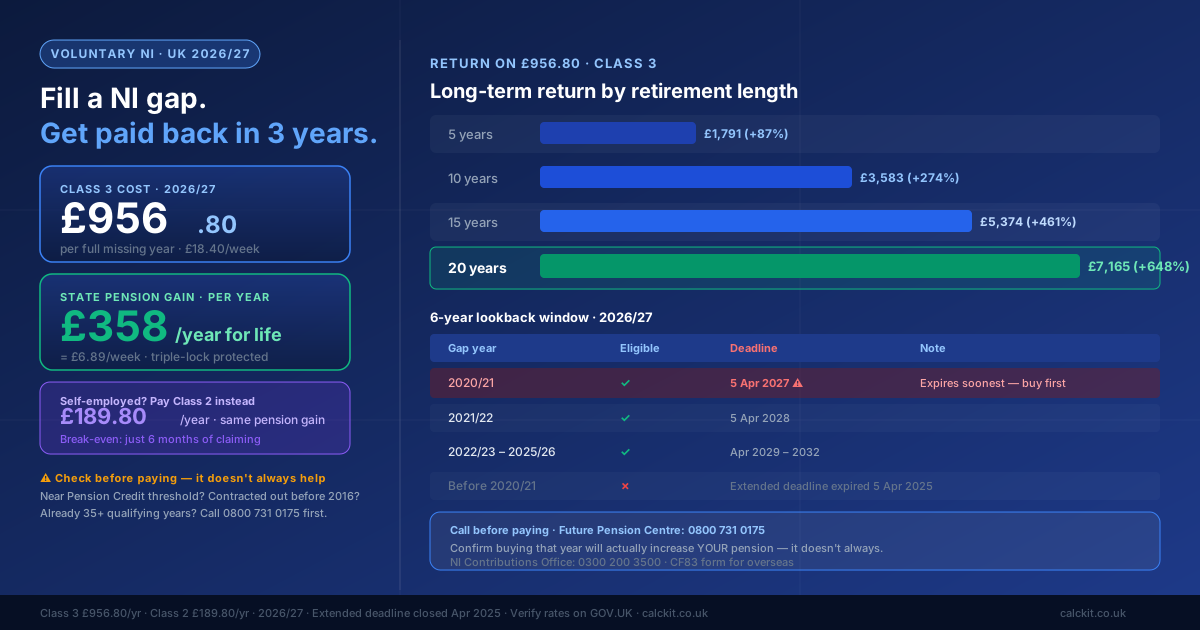
A Class 3 voluntary NI year costs £956.80 in 2026/27. Each one adds £6.89 per week to your state pension — £358 per year, for life. The break-even is under three years of claiming.
That makes it one of the best guaranteed returns available to anyone approaching retirement — for most people. For some, buying extra years achieves very little, or genuinely makes them worse off.
This guide covers the full calculation, the three situations where voluntary NI contributions backfire, and the exact process to check and pay.
🏛Step one: check your NI record before anything else
Before paying a penny, log in to HMRC's Personal Tax Account at tax.service.gov.uk and select "Check your National Insurance record".
You will see your full year-by-year history:
- Full — this year already counts as a qualifying year
- Not full — a gap you may be able to fill, with a specific top-up cost shown
- Years with NI credits listed separately
The same screen shows your state pension forecast — how much you will receive at state pension age based on your current record, and how much you could receive if you contribute until state pension age.
Why this matters first: Your forecast may already show the full £241.30/week without filling any gaps. In that case, voluntary contributions will not increase your pension at all — you would be paying for nothing.
Then, before paying for any gap year, call the Future Pension Centre on 0800 731 0175 and ask them to confirm that paying for a specific year will increase your pension. It does not always.
Class 2 vs Class 3: which applies to you?
| Type | Who qualifies | Rate 2026/27 | Annual cost |
|---|---|---|---|
| Class 3 | Most people — employed, unemployed, or not working | £18.40/week | £956.80 |
| Class 2 | Self-employed with earnings below the Small Profits Threshold in the gap year; some overseas workers | £3.65/week | £189.80 |
Both produce the same state pension outcome — £358.28 extra per year per qualifying year added.
Class 2 is dramatically cheaper for the same return. If you were self-employed in any gap year — even part-time, even with low earnings — check with HMRC whether you qualify to pay Class 2 for that year before paying Class 3.
The ROI on buying a missing year
| Class 3 | Class 2 | |
|---|---|---|
| Cost per gap year | £956.80 | £189.80 |
| Annual pension gain | £358.28 | £358.28 |
| Break-even | 2.7 years | 6.4 months |
| Return over 10 years | +274% | +1,788% |
| Return over 20 years | +648% | +3,674% |
The pension gain is inflation-protected through the triple lock, meaning its real value holds over decades.
Real example: Paying £956.80 to fill one gap year, then claiming for 20 years of retirement, returns £7,165 in additional state pension — a net gain of £6,208 after recovering the initial cost.
The three situations where it can backfire
1. The Pension Credit trap — the most common mistake
Pension Credit tops up your weekly income if it falls below a guaranteed minimum: £218.15 for a single person in 2026/27, or £332.95 for couples.
The trap: if your retirement income is near or below these thresholds, buying voluntary NI years may increase your state pension but reduce your Pension Credit entitlement by almost the same amount — leaving you little or no better off after spending £956.80.
Example: Suppose your state pension without any top-ups would be £200/week, and Pension Credit tops this to £218.15. If you buy two gap years and your state pension rises to £214/week, your Pension Credit falls to approximately £4.15/week — a net gain of only £4.15/week instead of the expected £13.78/week (the gain from two years).
What to do: Contact the Pension Service on 0800 731 0175 before paying. Ask them directly: "If my state pension increases by £X per week, how much would my Pension Credit change?" Only buy gap years if the Pension Credit reduction is smaller than the pension gain, or if you expect other income to take you clear of the Pension Credit threshold in retirement.
2. Contracted-out warning
If you were a member of a final salary (defined benefit) pension scheme or certain contracted-out occupational schemes before April 2016, you were building up a Contracted Out Pension Equivalent (COPE) in place of the Additional State Pension.
The impact: your starting amount for the new state pension may be lower than someone with the same number of qualifying years who was never contracted out. In some cases you need more than 35 qualifying years to reach the full £241.30/week, and buying extra Class 3 years may close that gap — but in other cases, it simply will not help.
What to do: Your state pension forecast on HMRC will show your COPE amount and how it affects your calculation. If your forecast is already at £241.30/week, additional years will not increase it regardless of your contracted-out history. If it is below the full amount, call the Future Pension Centre to understand whether gap years would close that specific shortfall.
3. You already have 35+ qualifying years
The full new state pension is fixed at £241.30/week for 35 qualifying years. More than 35 years does not earn more pension — the rate simply caps at the full amount.
Check your qualifying year count on HMRC before spending anything. If you are already at or above 35, voluntary contributions will not improve your position.
🏦Check for free NI credits before paying
Many people have qualifying years they are not aware of. These credits are free and already count:
| Credit type | Who qualifies | How to claim if missing |
|---|---|---|
| Child Benefit credit | Parent/guardian of child under 12 who claimed Child Benefit | Already applied if you claimed — check your record |
| Carer's Credit | Carer providing 20+ hours/week of care to someone receiving a qualifying benefit | Apply via HMRC Carer's Credit form |
| Specified Adult Childcare credit | Grandparent or family member caring for child under 12 to allow parent to work | Apply via HMRC form CA9176 |
| New Style ESA credits | Received contributory Employment and Support Allowance | Should be applied automatically — check your record |
Important — Universal Credit NI credits bug: If you claimed Universal Credit between 2016 and 2023, there is a known data transfer problem between DWP and HMRC that has left some claimants without the NI credits they should have received. If your record shows gap years that coincide with periods on Universal Credit, contact the NI Contributions Office on 0300 200 3500 to investigate before paying Class 3 for those years.
Partial year top-ups — often much cheaper than a full year
Not every gap year requires the full £956.80. A year marked "not full" in your HMRC record may only be incomplete by a few weeks — for example, because you changed jobs mid-year, left employment in January, or had a short period of self-employment below the threshold.
In these cases, the top-up cost for that specific year may be as little as £20–100, not the full annual rate.
Your Personal Tax Account will usually show the specific cost to complete a partial year. If it is not clear, call the NI Contributions Office on 0300 200 3500 and ask for the exact amount due for each gap year before assuming the full cost applies.
Which years to prioritise
The 6-year lookback window (2026/27)
| Gap year | Standard window | Deadline |
|---|---|---|
| 2020/21 | ✓ Yes | 5 April 2027 — expires soonest |
| 2021/22 | ✓ Yes | 5 April 2028 |
| 2022/23 | ✓ Yes | 5 April 2029 |
| 2023/24 | ✓ Yes | 5 April 2030 |
| 2024/25 | ✓ Yes | 5 April 2031 |
| 2025/26 | ✓ Yes | 5 April 2032 |
| Before 2020/21 | ✗ No | Extended deadline expired 5 April 2025 |
The extended deadline is gone. A transitional window that allowed buying back years as far as 2006/07 at a reduced rate closed permanently on 5 April 2025. Anyone who missed it cannot buy those older years under any current scheme.
Priority order within the 6-year window:
- Buy 2020/21 first — this is the oldest eligible year and expires soonest (April 5, 2027)
- Check each year individually for partial top-up costs before assuming the full £956.80
- Check for free credits covering any gap year before paying
- If you have multiple gaps and limited budget, fill years that take you from below 10 to above 10 qualifying years first (below 10 = zero pension), then years toward 35
New overseas rules from April 2026
From 6 April 2026, the rules for voluntary NI contributions from abroad changed significantly. You now need to have lived in the UK for 10 consecutive years (or paid 10 years of NI contributions) to be eligible for overseas voluntary contributions.
Previously, broadly any UK national living abroad could pay. Under the new rules, overseas workers and expats who do not meet the 10-year requirement are no longer eligible.
If you live abroad and believe you meet the new criteria, apply using form CF83 from GOV.UK (not the standard online process). Contact the HMRC NI helpline on 0300 200 3500 to confirm your eligibility under the new rules before filling in the form.
How to pay
Online — fastest for most people
- Go to tax.service.gov.uk and log in to your Personal Tax Account
- Go to "Check your National Insurance record"
- Select the gap year you want to fill — the specific cost for that year will be shown
- Pay by bank transfer or debit card
- Record updates: Within 5 working days if paid via the state pension forecast service; up to 8 weeks via other payment methods
By phone
Call the NI Contributions Office: 0300 200 3500 (Monday–Friday, 8am–6pm)
They can confirm exactly which years are payable, the cost for each (including partial years), and process payment by direct debit or bank transfer.
If you live abroad
Use form CF83 from GOV.UK. Standard 6-year window applies. Processing takes longer than the online route — allow several months.
When voluntary NI contributions are worth it
They almost certainly make sense if:
- You have fewer than 35 qualifying years and are not close to the full pension already
- Your retirement income will be comfortably above the Pension Credit threshold (£218.15/week single in 2026/27)
- You were not contracted out of the Additional State Pension before 2016 (or if you were, confirm the Future Pension Centre says buying years will still increase your pension)
- You can afford the lump sum or have time to save it before the gap year's deadline
Use the savings goal calculator to work out how quickly you can accumulate £956.80 if you need to spread the cost over several months ahead of an April deadline.
Last updated September 2026. State pension and Pension Credit figures based on 2026/27 rates. Class 3 and Class 2 rates confirmed from HMRC and MoneySavingExpert 2026/27 data.