
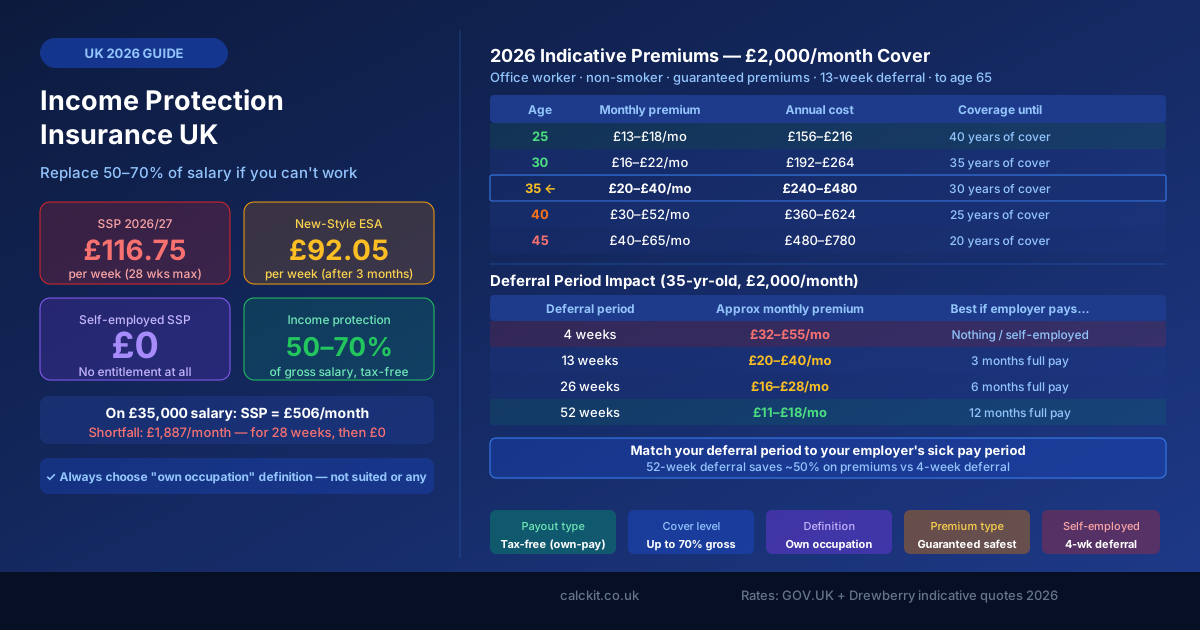
Statutory Sick Pay pays £116.75 a week for a maximum of 28 weeks. On a £35,000 salary, that replaces 17% of what you take home. After 28 weeks, it stops entirely. At that point, your options are savings, state benefits averaging £92 a week, your employer's goodwill — or an income protection policy that pays roughly what you were earning until you recover.
Most people find out they needed one when it is too late to buy it.
💷What is income protection insurance?
Income protection insurance is a policy that pays you a regular monthly income if you are unable to work due to illness or injury. It pays a percentage of your gross salary — typically 50–70% — as a tax-free monthly benefit, and continues paying until one of three things happens:
- You recover and return to work
- The benefit period ends (either a fixed term such as 2 years, or your chosen retirement age)
- The policy expires
Unlike a lump-sum product, income protection is designed to function like a salary replacement. A claim for a serious back injury, severe depression, or cancer could pay out for years — or for the rest of your working life if you never fully recover.
The SSP gap: what state support actually pays
The UK's state safety net for illness is thinner than most people expect.
| Support | Amount | Duration | Who qualifies |
|---|---|---|---|
| Statutory Sick Pay | £116.75/week | Max 28 weeks | Employees earning ≥ £125/week |
| New-Style ESA | £92.05/week | Ongoing (means-tested) | If NI contributions met |
| Personal Independence Payment | £28.70–£184.30/week | Ongoing | Severe disability (harder to qualify) |
| Self-employed SSP | £0 | — | None — self-employed get nothing |
Worked example — £35,000 salary:
| Monthly figure | |
|---|---|
| Normal take-home (approx) | £2,393 |
| SSP only (weeks 1–28) | £506 |
| New-Style ESA only (week 29+) | £399 |
| Shortfall on SSP | £1,887/month |
An income protection policy on a £35,000 salary covering 60% of gross income would pay roughly £1,750/month tax-free — closing the gap almost completely.
For employees, the situation depends heavily on whether your employer offers enhanced sick pay. Many employers pay full salary for 3, 6, or 12 months before dropping to SSP. If yours does, you have a buffer — and the timing of that buffer is the key input into choosing your policy's deferred period (more on that below). See Statutory Sick Pay 2026/27 for the full rules.
Own occupation vs suited occupation vs any occupation
This is the most important distinction in income protection — and the one most policies bury in the small print.
Own occupation (best) Pays out if you cannot perform the specific duties of your own job. A surgeon who loses fine motor control qualifies even if they could theoretically work a desk job. A teacher with severe anxiety qualifies even if they could work in a low-stress role. The policy measures you against YOUR work, not hypothetical alternatives.
Suited occupation Pays out if you cannot do your own job AND cannot do any job reasonably suited to your skills, qualifications, and experience. "Reasonably suited" is assessed by the insurer, not you. A former solicitor who cannot practice law might be deemed capable of paralegal work. This definition denies more claims and the reasoning can be subjective.
Any occupation (worst) Pays out only if you are unable to do any paid work at all. This definition rarely pays for anything short of total, permanent disability. Avoid it for mainstream income protection.
Most quality policies (Aviva, LV=, British Friendly, Zurich) offer own occupation definitions. Some cheaper policies default to suited or any occupation definitions. Always confirm which definition applies before purchasing — it is not always obvious from the policy summary.
How much does income protection cost? 2026 premiums
The following premiums are indicative figures for a non-smoker in a sedentary (office) occupation, seeking £2,000/month benefit, with guaranteed premiums and a policy running to age 65. Deferral period: 13 weeks.
| Age | Monthly premium range | Annual cost |
|---|---|---|
| 25 | £13–£18 | £156–£216 |
| 30 | £16–£22 | £192–£264 |
| 35 | £20–£40 | £240–£480 |
| 40 | £30–£52 | £360–£624 |
| 45 | £40–£65 | £480–£780 |
| 50 | £65–£110 | £780–£1,320 |
Sources: Drewberry Insurance, Pocketwise indicative rates (Sept 2026). Actual quotes will vary by insurer, health history, and occupation class.
Impact of key variables on a 35-year-old (£2,000/month, office worker):
| Variable | Change | Premium effect |
|---|---|---|
| Smoker vs non-smoker | — | +25–50% |
| 4-week deferral vs 13-week | — | +40–60% more expensive |
| 13-week vs 52-week deferral | — | ~50% cheaper |
| Short-term (2 years) vs long-term (to 65) | — | ~50–60% cheaper |
| Guaranteed vs reviewable premiums | — | Guaranteed ~15–25% more upfront |
| Manual occupation vs office | — | Manual = 25–100% more expensive |
The deferred period: match it to your employer's sick pay
The deferred period is the gap between becoming unable to work and receiving your first policy payment. The longer you wait, the cheaper the premiums — but you must be able to survive financially during that wait.
The optimal strategy: set your deferred period equal to how long your employer pays sick pay.
- If your employer pays full salary for 3 months: choose a 13-week (3-month) deferral
- If your employer pays full salary for 6 months: choose a 26-week deferral
- If your employer pays nothing (most self-employed, some zero-hours workers): choose a 4-week deferral
This means the policy activates precisely when your employer income stops, with no gap and no unnecessary overlap. Choosing a 4-week deferral when your employer pays 6 months of sick pay means paying significantly higher premiums for cover you will never use in the first 6 months.
🐷How much cover do you actually need?
The standard guidance is 50–70% of gross salary. Here is how to work out your own figure:
Step 1 — Find your monthly take-home pay. Use the take-home pay calculator above. This is the actual amount you need to replace.
Step 2 — Subtract state benefits you would receive. If you have sufficient NI contributions, you may receive New-Style ESA (£92.05/week). Most working-age adults also receive nothing else meaningful during illness unless they have a registered disability.
Step 3 — Check insurer limits. Most policies cap cover at 65–70% of gross salary. You cannot over-insure your income (HMRC rules prevent you profiting from a policy).
Step 4 — Compare against essential outgoings. Add up mortgage/rent, utility bills, food, and essential loan repayments. If the insurer cap (65% of gross) covers these, you may not need to maximise cover. If your outgoings are high relative to income, consider topping up with other savings or reducing outgoings.
Example — £40,000 salary:
| Monthly | |
|---|---|
| Take-home pay (approx) | £2,693 |
| 60% gross salary cover | £2,000 |
| Minus employer NIC on payout | £0 (tax-free if you pay premiums) |
| Monthly benefit received | £2,000 |
| Essential outgoings (typical) | £1,800–£2,200 |
A £2,000/month policy on a £40,000 salary covers most typical essential outgoings for an average-cost UK household.
Short-term vs long-term income protection
Short-term income protection (also called Accident, Sickness and Unemployment or ASU cover)
- Pays out for a maximum fixed period: typically 12 or 24 months
- Significantly cheaper than long-term — typically 50–60% less expensive
- Suitable if: you have substantial savings, a working partner, or could realistically return to work or retrain within 1–2 years
- Often covers redundancy as well as illness (long-term policies do not)
Long-term income protection
- Pays out until you recover, retire, or the policy ends (usually linked to a retirement age of 60, 65, or 67)
- More expensive but provides complete protection if a serious illness means you never return to work
- Suitable if: you are self-employed, have a mortgage, or have dependants relying on your income
The most common reason people reject long-term cover is the premium cost. A useful middle ground: a long-term policy with a short benefit period (e.g., 5 years maximum payout) costs significantly less than a policy running to retirement age, while still providing much more protection than 12-month cover.
Income protection vs critical illness cover
| Income protection | Critical illness cover | |
|---|---|---|
| What it pays | Monthly income (ongoing) | Lump sum (one-off) |
| Trigger | Any illness or injury stopping work | Specific diagnosed conditions only |
| Coverage breadth | Broad — any reason you cannot work | Narrow — only listed conditions |
| Payout duration | Until you recover or policy ends | Once only |
| Cost | Lower per pound of cover | Higher (pays larger amount) |
| Best for | Replacing regular income | Paying off mortgage, one-off costs |
Critical illness cover pays out on diagnosis of a serious listed condition (typically cancer, heart attack, stroke). It does not pay out for conditions that do not appear on the insurer's list, and it does not pay multiple times. Income protection covers any condition that stops you working — including mental health conditions, which are the fastest-growing cause of long-term absence in the UK.
Many financial advisers recommend holding both: income protection for the ongoing income replacement, and critical illness cover to pay down a mortgage or fund one-off adaptations.
Income protection for the self-employed
If you are self-employed, the case for income protection is stronger than for almost any employee.
You receive no SSP. None. From day one of illness, your income stops. The only state support is New-Style Employment and Support Allowance, which requires sufficient Class 2 NI contributions and does not begin for three months.
Key differences for self-employed policies:
- Benefit is based on your recent trading profits, not a fixed salary — you will usually need to show 2–3 years of accounts
- Policies often accept trading profit as the benefit basis, not turnover
- Some insurers allow "key person" cover for critical sole traders
- Short-term cover (ASU) is commonly used by contractors and freelancers who want redundancy protection alongside illness cover
The right deferral period for a self-employed person with no savings buffer is typically 4 weeks. For contractors with 6 months of savings, a 26-week deferral significantly reduces premiums.
See Self-Employed Tax UK 2026/27 for how benefits interact with your self-assessment position.
🏛Is income protection payout taxable?
If you pay the premiums yourself: The monthly benefit is tax-free and does not count as taxable income. You report it on a self-assessment return if required, but no tax is due. It also does not affect your personal allowance.
If your employer pays the premiums (group income protection): The benefit is treated as employment income and taxed as earnings, with income tax and National Insurance deducted in the normal way via PAYE. Employer-funded policies are typically used for senior employees as a benefit in kind.
This is why individually-purchased income protection is generally more tax-efficient than waiting for employer-provided cover. You pay premiums from net income, but receive benefits tax-free — meaning the effective benefit is higher than the gross percentage suggests.
Reviewable vs guaranteed premiums: the hidden risk
Guaranteed premiums are fixed when you take out the policy and will not change unless you alter the policy terms. They cost more upfront but provide certainty — especially important on long-term policies.
Reviewable premiums can be increased by the insurer at review dates (typically every 5 years). When first offered, they are cheaper than guaranteed premiums. However, the insurer can raise them at each review based on:
- Their claims experience across all policyholders
- Changes in their risk assessment
- You cannot reject a premium increase without cancelling the policy
Over a 30-year policy term, reviewable premiums often end up costing more than guaranteed premiums — and the increases tend to come at older ages when switching to a new policy is expensive due to age-related pricing.
Recommendation: For long-term (to retirement) policies, guaranteed premiums are almost always worth the higher initial cost. For short-term cover (1–2 year benefit period), reviewable premiums are less of a risk.
Is income protection worth it? The honest verdict
Strong case for buying:
- You have a mortgage, rent, or dependants whose welfare depends on your income
- You are self-employed or do not receive enhanced employer sick pay
- You have less than 6 months of expenses in savings
- Your occupation carries physical risk (tradespeople, healthcare workers)
- You have a family history of serious illness
Weaker case:
- Your employer pays full salary for 12+ months and you have substantial savings
- Your partner earns enough to cover all essential household outgoings alone
- You are close to retirement with a substantial pension pot
- You are in a profession with strong state-funded benefits (some public sector roles)
The most common mistake is buying cover too late. Income protection premiums rise significantly with age, and insurers will exclude or load premiums for any pre-existing conditions at underwriting. A policy taken out at 30 is substantially cheaper and easier to obtain than the same policy at 45 — and the 30-year-old is no less likely to claim.
Use the savings calculator to model how long your current savings would sustain your lifestyle without income. If the answer is under 12 months, income protection is worth serious consideration.
Last updated September 2026. Statutory Sick Pay and Employment and Support Allowance rates from GOV.UK. Premium examples indicative only — based on Drewberry Insurance and Pocketwise published rates. For a personalised recommendation, speak to an FCA-regulated financial adviser or protection specialist.