
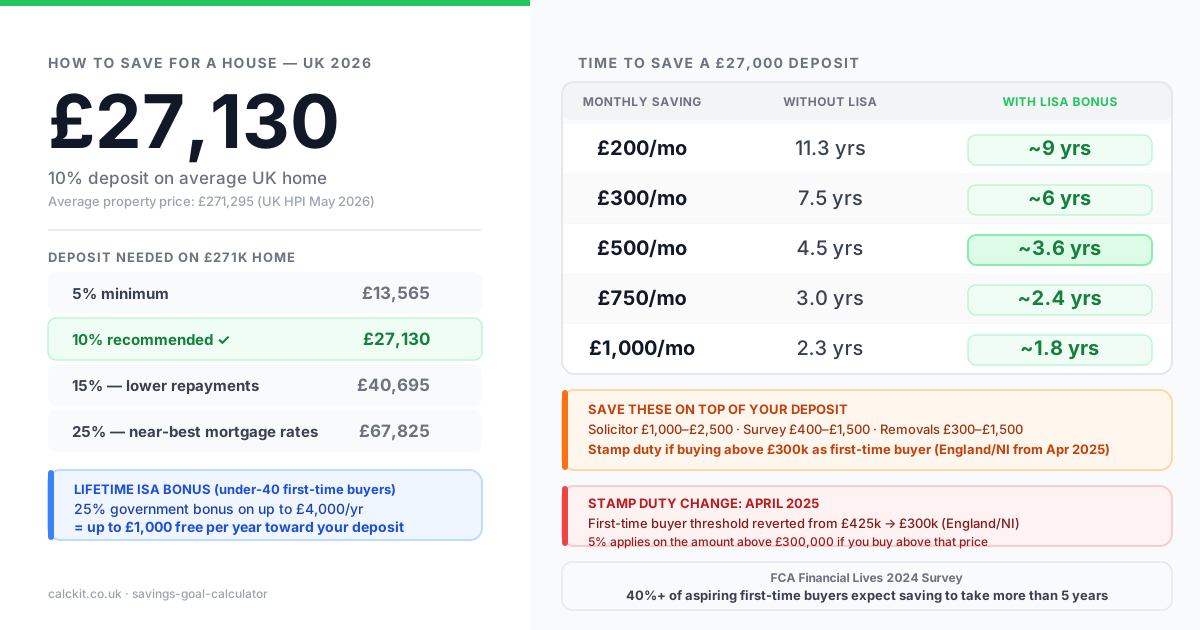
The average UK property price stood at £271,295 in May 2026. A 10% deposit — the standard first-time buyer target — means saving just over £27,000. That sounds straightforward until you factor in that over 40% of aspiring first-time buyers expect saving to take more than five years (FCA Financial Lives 2024 Survey).
This guide gives you a concrete plan: how to calculate your specific target, which account earns the most bonus money, and how to use the savings-goal calculator to work out exactly when you can buy.
🐷Step 1 — Work Out Your Deposit Target
How much deposit do you need?
| Deposit % | On £200k property | On £271k (avg) | On £400k property | What you get |
|---|---|---|---|---|
| 5% | £10,000 | £13,565 | £20,000 | Access to the market; higher mortgage rate |
| 10% | £20,000 | £27,130 | £40,000 | Better rate band; most lenders' sweet spot |
| 15% | £30,000 | £40,695 | £60,000 | Noticeably lower monthly repayments |
| 25% | £50,000 | £67,825 | £100,000 | Near-best mortgage rates available |
| 40% | £80,000 | £108,520 | £160,000 | Best mortgage rates |
For most first-time buyers, 10% is the practical target — it opens a much wider range of mortgage products and drops the rate materially compared to 5%.
Regional property prices and deposit sizes (2026)
Prices vary massively by location. A 10% deposit is very different depending on where you want to buy:
| Region | Average property price | 5% deposit | 10% deposit |
|---|---|---|---|
| London | £508,000 | £25,400 | £50,800 |
| South East | £390,000 | £19,500 | £39,000 |
| East of England | £340,000 | £17,000 | £34,000 |
| South West | £312,000 | £15,600 | £31,200 |
| East Midlands | £245,000 | £12,250 | £24,500 |
| West Midlands | £250,000 | £12,500 | £25,000 |
| Yorkshire | £210,000 | £10,500 | £21,000 |
| North West | £215,000 | £10,750 | £21,500 |
| North East | £162,000 | £8,100 | £16,200 |
| Scotland | £195,000 | £9,750 | £19,500 |
| Wales | £205,000 | £10,250 | £20,500 |
Regional averages are approximate for 2026 based on UK HPI and Rightmove data.
Don't forget stamp duty (April 2025 change)
From April 2025, the stamp duty first-time buyer threshold in England and Northern Ireland reverted from £425,000 back to £300,000. This is a significant change that many guides have not updated:
- Buying at £300,000 or below: no stamp duty as a first-time buyer
- Buying at £300,001–£500,000: 5% on the amount above £300,000
- Buying at above £500,000: no first-time buyer relief at all; standard rates apply
Example on a £350,000 purchase: stamp duty = 5% × £50,000 = £2,500 — this needs to be saved on top of the deposit.
🏠Step 2 — Calculate Your Deposit Gap
Before setting a savings target, work out how much you can borrow. UK mortgage lenders typically offer 4–4.5× your annual salary (some lenders will go to 5–5.5× for high earners with strong credit).
| Gross salary | Borrowing (4×) | Gap to buy £271k avg | Gap to buy £350k |
|---|---|---|---|
| £25,000 | £100,000 | £171,295 needed | £250,000 needed |
| £30,000 | £120,000 | £151,295 needed | £230,000 needed |
| £35,000 | £140,000 | £131,295 needed | £210,000 needed |
| £40,000 | £160,000 | £111,295 needed | £190,000 needed |
| £50,000 | £200,000 | £71,295 needed | £150,000 needed |
| £60,000 | £240,000 | £31,295 needed | £110,000 needed |
These "needed" figures are your deposit target — the difference between what you can borrow and the purchase price.
For many first-time buyers on typical UK salaries, buying alone in London or the South East requires an extremely large deposit unless you are a high earner. Buying with a partner roughly doubles the borrowing capacity and halves the deposit gap.
🏡Buying as a couple vs buying solo
| Combined vs solo | Monthly savings each | Target deposit (£30k) | Time to target |
|---|---|---|---|
| Solo, £500/month | £500 | £30,000 | ~4.8 yrs |
| Couple, £500 each | £1,000 | £30,000 | ~2.4 yrs |
| Couple, £700 each | £1,400 | £30,000 | ~1.7 yrs |
Buying with a partner also increases your mortgage offer — which can be the bigger factor in reducing the deposit needed.
Step 3 — Set Your Monthly Savings Target
Once you know your deposit target, use this table to find your timeline:
| Monthly saving | £15,000 | £20,000 | £27,000 | £35,000 | £50,000 |
|---|---|---|---|---|---|
| £200/month | 6.3 yrs | 8.3 yrs | 11.3 yrs | 14.6 yrs | 20.8 yrs |
| £300/month | 4.2 yrs | 5.6 yrs | 7.5 yrs | 9.7 yrs | 13.9 yrs |
| £400/month | 3.1 yrs | 4.2 yrs | 5.6 yrs | 7.3 yrs | 10.4 yrs |
| £500/month | 2.5 yrs | 3.3 yrs | 4.5 yrs | 5.8 yrs | 8.3 yrs |
| £750/month | 1.7 yrs | 2.2 yrs | 3.0 yrs | 3.9 yrs | 5.6 yrs |
| £1,000/month | 1.3 yrs | 1.7 yrs | 2.3 yrs | 2.9 yrs | 4.2 yrs |
Excludes interest earned. A LISA earning 5% AER plus the 25% government bonus reduces each figure by approximately 20–25%.
For a personalised calculation including interest, use the savings-goal calculator and enter your exact target and monthly amount.
Step 4 — Choose the Right Savings Account
Getting the account right can save (or earn) thousands. Here is the priority order for a first-time buyer deposit in 2026:
1. Lifetime ISA (LISA) — best return if you qualify
Who: First-time buyers aged 18–39. You must open it before 40; you can contribute until 49. Bonus: Government adds 25% on contributions, up to £4,000/year → £1,000 bonus per year. Property cap: £450,000 purchase price. Key rule: Must have been open for 12 months before you can use it to buy.
| Years saving | Your contributions | Government bonus | Total |
|---|---|---|---|
| 1 | £4,000 | £1,000 | £5,000 |
| 3 | £12,000 | £3,000 | £15,000 |
| 5 | £20,000 | £5,000 | £25,000 |
| 7 | £28,000 | £7,000 | £35,000 |
Plus interest on the growing balance. At 4% AER a 5-year LISA pot grows to roughly £27,500.
Important: withdrawing for anything other than a first home or retirement (after 60) triggers a 25% penalty on the whole pot — this claws back the bonus and effectively deducts about 6.25% of your own money too. The LISA is only worth it if you are confident you will use it for a qualifying first home.
2. Easy-access savings account — for savings above the LISA limit
Why: Deposits above £4,000/year need somewhere else to go. Easy-access accounts offer full flexibility with top rates around 5.00% AER in late 2026.
When to use: The portion of your monthly savings above the LISA limit, and your buffer for buying costs (solicitor, survey, moving).
3. Regular saver account
Why: Some banks offer high rates (up to 7.1% AER in 2026) for monthly deposits, typically capped at £100–£300/month with a 12-month term.
When to use: As a booster alongside your LISA and easy-access accounts. Note that many regular savers require you to stay with the bank for 12 months and pay a penalty for missing a payment.
4. Cash ISA — for savings above your Personal Savings Allowance
If your deposit pot is growing large enough that interest exceeds your Personal Savings Allowance (£1,000 for basic-rate taxpayers, £500 for higher-rate), move the excess into a Cash ISA to shelter the interest from tax.
Coming in 2028: First Time Buyer ISA. The government has announced a replacement for the LISA for first-time buyers, expected to launch around 2028. Key differences: no early withdrawal penalty, designed only for first-home purchase (not retirement), available in cash and stocks-and-shares forms. You do not lose out by opening a LISA now — transfers to the new account are expected to be permitted.
Should you invest your deposit?
Only if your buying horizon is 5+ years. Stock market investments can lose value in the short term; a 20% drop when you are ready to buy would delay your purchase significantly. For a 3–5 year horizon, a stocks-and-shares Lifetime ISA is lower risk than a general investment account, but still carries market risk.
Step 5 — Automate and Protect Your Savings
The biggest risk to a deposit pot is easy access — small withdrawals add up to years of delay.
- Standing order on payday — transfer to the deposit account the same day your salary lands; you never see it
- Separate account, no debit card — friction prevents impulse withdrawals
- LISA first, easy-access second — fill the LISA £4,000 limit at the start of each tax year (April) to maximise the bonus
- Review every 6 months — if property prices in your target area have moved, adjust the target; if your salary increased, increase the monthly contribution
The Extra Costs You Must Also Save
A deposit is not all you need at exchange. Budget these costs separately — do not draw on the deposit pot:
| Cost | Typical range (2026) |
|---|---|
| Solicitor / conveyancing | £1,000–£2,500 |
| Home survey (RICS level 2) | £400–£1,000 |
| Home survey (full structural) | £800–£1,500 |
| Stamp duty (if over £300k, FTB) | 5% on amount above £300k |
| Mortgage arrangement fee | £0–£2,000 |
| Removal costs | £300–£1,500 |
| Total (ex. stamp duty) | £2,000–£8,000 |
Add at least £3,000–£5,000 to your savings target to cover these, even if you avoid stamp duty.
Last updated October 2026. Property price data from UK HPI May 2026. LISA rules as of 2026/27 tax year. Stamp duty thresholds for first-time buyers in England and Northern Ireland — Scotland and Wales use different systems (LBTT and LTT). This article is for information only; for personalised mortgage advice contact a registered mortgage adviser or MoneyHelper (moneyhelper.org.uk).