
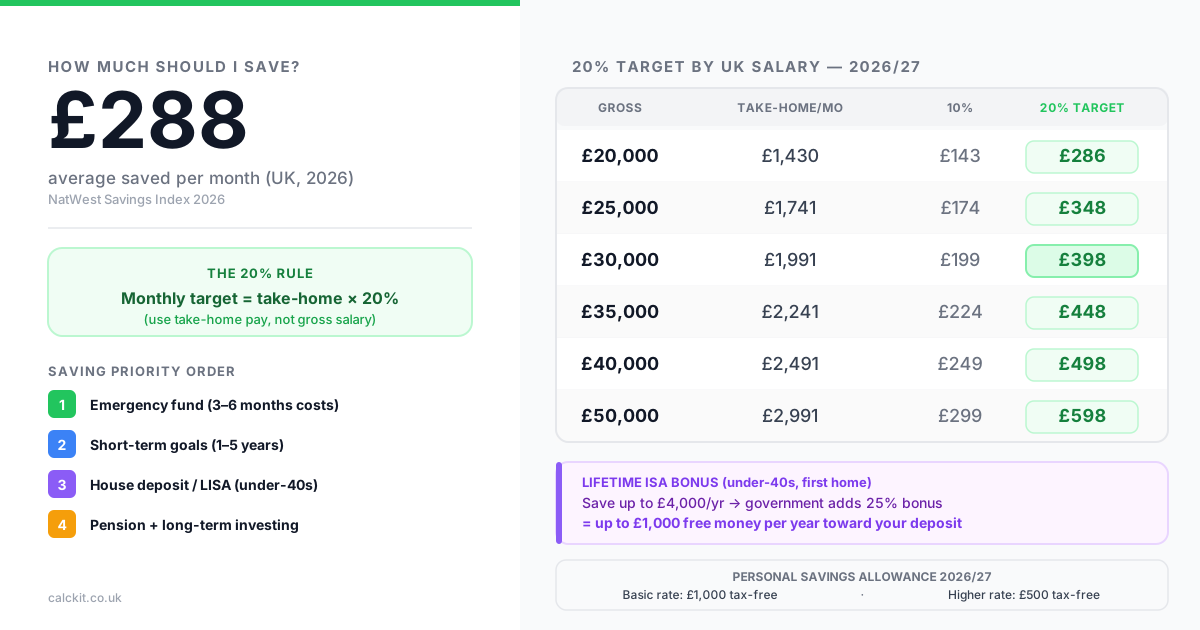
The average UK saver put aside £288 a month in 2026 — up from £226 the year before (NatWest Savings Index, 2026). But that average hides a wide split: roughly 27% of UK adults save nothing at all each month, while a smaller group saves over £1,000.
So what should your number be? The honest answer is that it depends on take-home pay, not gross salary — and on what you're saving for. Here's how to work it out.
🐷The 20% Rule — Applied to Real UK Salaries
The most widely used savings target is 20% of take-home pay (not your gross salary before tax and National Insurance). Starting from gross salary is the most common mistake — it makes your savings target look more achievable than it really is.
Monthly savings target = (Annual salary − Income tax − National Insurance) ÷ 12 × 20%
Here is what 20% looks like across a range of UK salaries in 2026/27:
| Gross salary | Monthly take-home (approx) | 10% savings | 15% savings | 20% savings |
|---|---|---|---|---|
| £18,000 | £1,321 | £132 | £198 | £264 |
| £22,000 | £1,557 | £156 | £234 | £311 |
| £25,000 | £1,741 | £174 | £261 | £348 |
| £30,000 | £1,991 | £199 | £299 | £398 |
| £35,000 | £2,241 | £224 | £336 | £448 |
| £40,000 | £2,491 | £249 | £374 | £498 |
| £50,000 | £2,991 | £299 | £449 | £598 |
| £60,000 | £3,491 | £349 | £524 | £698 |
Take-home pay figures are approximate for 2026/27 with standard 1257L tax code and employee pension at 5%. Use the calculator below for your exact figure.
💷If you are currently saving less than 20%, that is not a crisis — it is a starting point. Increase your savings rate by 1% each quarter. Reaching 20% from 5% over five years is more sustainable than jumping immediately and abandoning it.
What Counts as a Good Amount to Save?
Rather than aiming for a single "right" number, structure your savings around three purposes:
| Priority | Goal | Target amount | Account type |
|---|---|---|---|
| 1 | Emergency fund | 3–6 months' essential costs | Easy-access savings |
| 2 | Short-term goals | 1–5 year horizon (holiday, car, wedding) | Cash ISA or easy-access |
| 3 | Long-term / house deposit | 5+ year horizon | LISA (if under 40), Stocks & Shares ISA |
| 4 | Retirement | As early as possible | Workplace pension + SIPP |
Build these in order. An emergency fund comes first — without one, any unexpected cost goes onto a credit card and undercuts all other saving.
Emergency fund target
| Monthly essential costs | 3-month fund | 6-month fund |
|---|---|---|
| £1,000 | £3,000 | £6,000 |
| £1,400 | £4,200 | £8,400 |
| £1,800 | £5,400 | £10,800 |
| £2,200 | £6,600 | £13,200 |
| £2,800 | £8,400 | £16,800 |
Start with three months. Six months is ideal. Self-employed earners should target nine to twelve months because income is less predictable.
For a full guide to building your emergency fund, see our emergency fund guide.
How Long to Reach Your Savings Goal
| Monthly saving | £3,000 | £5,000 | £10,000 | £20,000 | £30,000 |
|---|---|---|---|---|---|
| £100/month | 2.5 yrs | 4.2 yrs | 8.3 yrs | 16.7 yrs | 25 yrs |
| £200/month | 15 mo | 2.1 yrs | 4.2 yrs | 8.3 yrs | 12.5 yrs |
| £300/month | 10 mo | 16.7 mo | 2.8 yrs | 5.6 yrs | 8.3 yrs |
| £500/month | 6 mo | 10 mo | 20 mo | 3.3 yrs | 5 yrs |
| £700/month | 4.3 mo | 7 mo | 14.3 mo | 2.4 yrs | 3.6 yrs |
Excludes interest. At 4.5% easy-access rate, add roughly 8–12% to your effective progress.
Savings Targets by Age
These benchmarks assume you started saving in your mid-20s. If you started later, increase the monthly contribution rather than panicking about the total.
| Age | Liquid savings target | Pension pot target (Fidelity rule) |
|---|---|---|
| 25 | 1 month's expenses | First contributions begun |
| 30 | 3–6 months' expenses | 1× annual salary |
| 35 | 6 months' expenses | 2× annual salary |
| 40 | 6–12 months' expenses | 3× annual salary |
| 50 | 12 months' expenses | 6× annual salary |
| 60 | 12–24 months' expenses | 8× annual salary |
Liquid savings (easy-access accounts) and pension pots serve different purposes. Do not count your pension as an emergency fund.
Average UK savings by age (for comparison)
| Age group | Average savings (Finder UK, 2025) |
|---|---|
| 18–24 | £2,699 |
| 25–34 | £11,023 |
| 35–44 | £13,379 |
| 45–54 | £12,452 |
| 55+ | £33,420 |
The 45–54 dip is real: this is the age group most likely to be managing both children's costs and ageing parent support simultaneously. If your savings are below these averages, focus on the monthly rate rather than the total — the total catches up.
Which Savings Account to Use
Choosing the wrong account costs real money. Here is a quick guide for 2026:
| Account type | Best for | 2026 notes |
|---|---|---|
| Easy-access savings | Emergency fund, goals under 2 years | Best rates around 4.5–5.0% (shop around) |
| Cash ISA | Medium-term savings above personal savings allowance | Tax-free interest; £20,000 annual allowance |
| Lifetime ISA (LISA) | First-home deposit (under 40s only) | 25% government bonus on up to £4,000/yr = up to £1,000 bonus |
| Premium Bonds (NS&I) | Tax-free, capital-secure long-term saving | Prize rate ~4.4% equivalent tax-free; max £50,000 |
| Stocks & Shares ISA | Long-term goals, 5+ years | Higher expected return with market risk; inside ISA wrapper |
| Workplace pension | Retirement | Auto-enrolment minimum 3% employer + 5% employee; tax relief included |
Personal Savings Allowance 2026/27: Basic-rate taxpayers can earn £1,000 in savings interest tax-free. Higher-rate taxpayers get £500. Additional-rate taxpayers (income over £125,140) get nothing — a Cash ISA becomes essential at this level.
The Lifetime ISA — the biggest savings bonus most people miss
If you are under 40 and saving for a first home, the Lifetime ISA adds a 25% government bonus on up to £4,000 you pay in each year — a maximum of £1,000 free money per year. On a £30,000 salary saving £333/month, that is an instant 25% return on your house deposit savings, guaranteed.
Rules: you must be under 40 to open one, and you must use the money for a first home (up to £450,000 purchase price) or retirement after 60. Withdrawing for any other reason triggers a 25% penalty that effectively claws back the bonus and takes a small slice of your own money too.
If You Cannot Save 20%
A third of UK adults save nothing each month. If that is your situation right now, the goal is not immediately hitting 20% — it is building the habit.
The minimum viable approach:
- Start at 1–5% — even £20–£50 a month begins the habit and removes the psychological barrier
- Automate it on payday — standing order out on the same day your salary lands; you never see it
- Increase by 1% every three months — the increase is too small to feel painful
- Target your first milestone: £500 — a buffer that stops small emergencies becoming credit card debt
- Then £1,000 — reduces financial anxiety measurably, even if the 20% target is years away
Our budgeting guide covers how to find the room in your monthly spending to make this work.
🏛If You Are Self-Employed
Self-employed savers need two separate pots before personal savings targets apply:
- Tax reserve pot — 20–25% of each invoice, into a separate account, immediately. This is not savings — it is tax you owe. Pay it first.
- Business emergency fund — 3–6 months of business operating costs
- Personal emergency fund — 6–12 months of personal essential costs (higher target because income is unpredictable)
- Personal savings target — 20% of take-home income after tax reserves
The most common self-employed savings mistake is treating January's tax bill as a surprise. Ring-fence every percentage point of income that HMRC will eventually claim before budgeting the rest.
Month-by-Month Savings Milestones
Use these as waypoints rather than hard deadlines — hitting them late still means hitting them.
| Milestone | What it does |
|---|---|
| £500 | Small emergency buffer — stops minor crises becoming debt |
| £1,000 | Covers most car repairs, boiler callouts, dental bills |
| £3,000 | One month's essential costs — beginning of the emergency fund |
| £6,000 | Three months' costs — the recommended minimum emergency fund |
| £10,000 | Six months' costs for many people; meaningful LISA progress toward a house deposit |
| £20,000 | Fills a Cash ISA allowance; viable deposit on a lower-priced property in some regions |
| £50,000 | Substantial deposit in most UK regions; fills a Premium Bonds account |
Last updated October 2026. Take-home pay figures based on 2026/27 HMRC income tax and National Insurance rates with standard 1257L code. Average savings figures from NatWest Savings Index 2026 and Finder UK. This article is for information only; for personalised financial advice consult a regulated financial adviser or contact MoneyHelper (moneyhelper.org.uk) free of charge.