
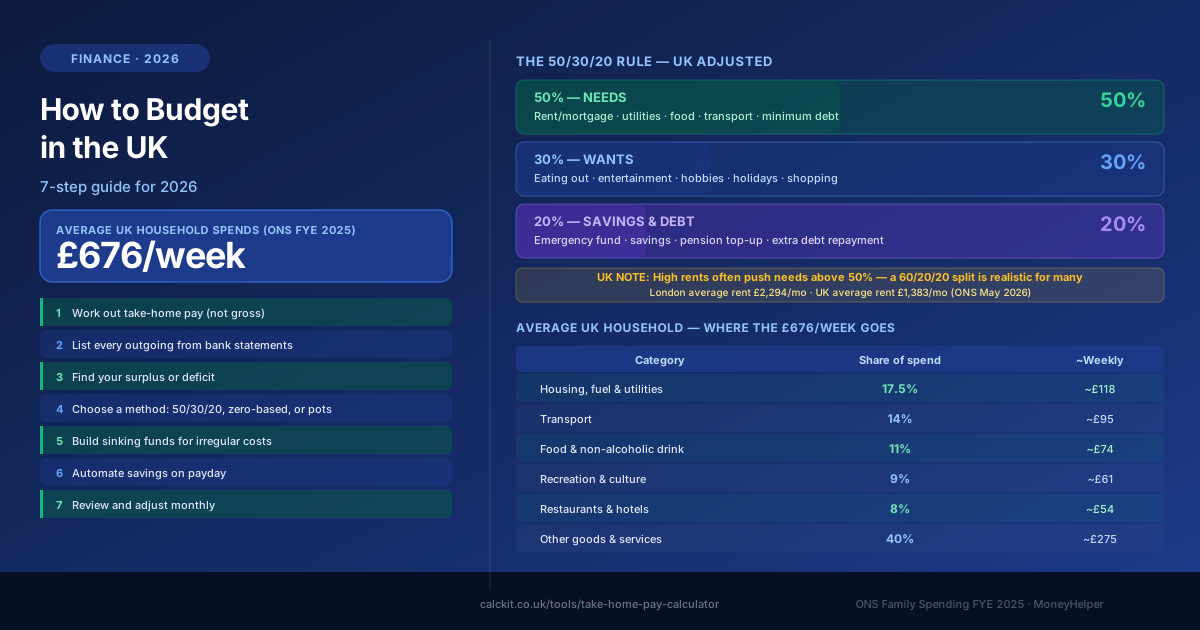
The average UK household spends £676.60 per week — roughly £2,933 a month (ONS Family Spending, financial year 2025). Most people have no idea how that breaks down, or where the extra goes when they hit the end of the month short.
A budget fixes this. Not by restricting what you spend, but by making it visible, deliberate, and something you control rather than react to.
Here's how to build one that actually works for UK costs in 2026.
💷Step 1: Work Out Your Income
Start with your take-home pay — not your gross salary. It's the money that actually arrives in your account. Using gross income is the most common budgeting mistake; it makes your budget look more comfortable than it is.
What to include:
- Net salary after tax and National Insurance
- Any regular overtime (use a 3-month average if it varies)
- Universal Credit or other benefits
- Child Benefit
- Rental income (after costs)
- Any other regular income
If your income varies — freelance, self-employed, zero-hours, or commission-based — use the lowest month from the past 6–12 months as your baseline. Budget from the floor, not the ceiling.
Your take-home pay calculator shows exactly what you keep after tax, National Insurance, and pension contributions.
Step 2: List Every Outgoing
Pull up your last 2–3 months of bank statements and card transactions. Write down everything. People consistently underestimate spending by 20–30% because they forget subscriptions, quarterly bills, and small recurring purchases.
Separate your outgoings into two types:
Fixed costs (same each month):
- Rent or mortgage payment
- Council tax
- Gas and electricity (monthly direct debit)
- Water rates
- Broadband and mobile
- Insurance (home, life, car)
- Minimum debt or loan repayments
- Pension contributions
Variable costs (change month to month):
- Groceries
- Petrol or public transport
- Eating out and takeaways
- Clothing
- Entertainment and subscriptions
- Personal care
- Household items
Typical UK Monthly Costs (2026 reference)
| Category | Typical monthly range | Notes |
|---|---|---|
| Rent (outside London) | £700–£1,200 | Average private rent £1,383/mo UK; lower outside major cities |
| Rent (London) | £1,500–£2,500+ | Average private rent £2,294/mo in London |
| Mortgage repayment | £700–£1,500+ | Depends on property value, deposit, and rate |
| Gas and electricity | £130–£180 | Based on Ofgem price cap Q4 2026 |
| Council tax | £100–£250 | Varies significantly by band and local authority |
| Groceries (one adult) | £150–£250 | ONS data: ~£71/week per household |
| Groceries (family of 4) | £350–£550 | Budget brands vs premium |
| Transport (car owner) | £200–£400 | Petrol, insurance, tax, maintenance |
| Transport (no car) | £80–£150 | Monthly rail pass or bus travel |
| Broadband + mobile | £50–£90 | Combined |
| Streaming subscriptions | £20–£50 | Netflix, Spotify, Disney+ etc |
Step 3: Find Your Starting Point
Subtract total monthly outgoings from monthly take-home pay:
Take-home pay − Total outgoings = Your surplus (or deficit)
| Result | What it means |
|---|---|
| Large surplus (20%+ of income) | Room to save more and build wealth faster |
| Small surplus (5–10%) | Workable, but vulnerable — one unexpected bill can wipe it out |
| Near zero | Spending matches income — no buffer and no savings capacity |
| Deficit | Spending exceeds income — needs immediate action |
If you're in deficit, the priority is identifying and cutting flexible spending before the budget is fully optimised. Citizens Advice and MoneyHelper offer free budget planners and debt advice.
🐷Step 4: Choose a Budgeting Method
There is no single best method. The best method is the one you'll actually use.
The 50/30/20 Rule
The simplest framework. Divide take-home pay into three buckets:
| Bucket | Target | What goes here |
|---|---|---|
| Needs | 50% | Rent/mortgage, utilities, food, transport, minimum debt repayments |
| Wants | 30% | Eating out, entertainment, hobbies, holidays, non-essential shopping |
| Savings & debt | 20% | Emergency fund, savings, pension top-up, extra debt repayment |
The UK caveat: UK housing costs — especially private rent — push the "needs" bucket above 50% for many people, particularly in London and the South East. If your rent alone is 35–40% of take-home pay, a realistic UK split is closer to 60/20/20 or even 65/15/20. The principle matters more than the exact ratio: keep wants below needs, and save something every month.
Zero-Based Budgeting
Every pound is given a specific job before the month starts. Total income minus total assigned spending equals zero.
| Category | Monthly allocation |
|---|---|
| Rent | £900 |
| Utilities | £160 |
| Groceries | £250 |
| Transport | £120 |
| Entertainment | £100 |
| Savings | £200 |
| Emergency fund | £100 |
| Total | = Take-home pay |
This takes more effort but gives the most control. It works well for people who have tried simpler methods and still overspend.
Envelope Budgeting (Digital Pots)
Allocate specific amounts to variable spending categories — in cash envelopes, or digitally using bank account pots (Monzo, Starling, and many traditional banks offer these). When a category pot is empty, you stop spending in that category until the next month.
Best for: variable spending that consistently runs over budget.
Pay Yourself First
On payday, before anything else, move a fixed amount into savings. Budget the rest. This flips the default (spend first, save what's left) and makes saving automatic.
Step 5: Budget for Irregular Costs
This is where most budgets fall apart. People plan for monthly bills but forget:
- Annual car insurance renewal
- MOT and car servicing
- Home insurance renewal
- Christmas and birthday presents
- Dental and optician appointments
- Holidays
- Clothing and footwear
- Home repairs
The solution is sinking funds — smaller monthly contributions that accumulate ready for the expense:
| Expense | Annual amount | Monthly to set aside |
|---|---|---|
| Car insurance | £600 | £50 |
| MOT + servicing | £400 | £33 |
| Christmas + gifts | £600 | £50 |
| Holiday | £1,200 | £100 |
| Dental + optician | £240 | £20 |
| Clothing | £480 | £40 |
| Home repairs (emergency) | £600 | £50 |
| Total | £4,120/yr | £343/mo |
Open a dedicated savings account (or a named pot) for these and set up a standing order from payday. Treat them as fixed monthly costs, not optional extras.
Step 6: Automate
The most effective budgets run on autopilot. On payday:
- Emergency fund / savings — standing order fires first, moves money before you can spend it
- Bill account — if you use a separate account for direct debits, top it up automatically
- Sinking funds — individual standing orders or pot transfers for each fund
- Discretionary spending — whatever remains in your main account is yours to spend
With automation, the budget runs without willpower. You only need discipline for discretionary spending, not for every financial decision.
🏛Step 7: Review and Adjust
A budget is a draft, not a contract. Review it monthly.
Monthly review (15 minutes):
- Compare planned vs actual spending in each category
- Identify which categories consistently overspent — these need adjusting, not more willpower
- Move unused budget from underspent categories to savings or the next month
Trigger a full reset when:
- Income changes significantly (pay rise, job change, benefits change)
- A major expense changes (new lease, mortgage renewal, new car)
- A new financial goal appears (saving for a house, paying off a credit card)
Common Budgeting Mistakes in the UK
| Mistake | Fix |
|---|---|
| Budgeting from gross salary, not take-home pay | Always start with what lands in your account |
| Forgetting annual and irregular costs | Build sinking funds into the monthly budget |
| Setting unrealistic spending targets | Review 3 months of real spending first; budget from truth, not aspiration |
| Not having an emergency fund | Build 3 months' essential costs before investing or paying extra debt |
| Treating the budget as punishment | The budget is permission to spend — once a category is funded, you don't need to feel guilty |
| Giving up after one bad month | Reset on the 1st; one overspend doesn't invalidate the system |
Average household spending figure: ONS Family spending in the UK, financial year ending 2025 (published June 2026). Average private rent figures from ONS Private rental market summary statistics, May 2026. This article is for information only; for personalised financial advice, consult a regulated financial adviser or contact MoneyHelper (moneyhelper.org.uk) for free guidance.