
The average UK adult gets 6.4 hours of sleep per night. The NHS recommends 7 to 9 hours. That gap — more than half an hour of missed sleep every single night — compounds into a sleep debt that no single lie-in can repay.
How much sleep you need is not a matter of willpower or habit. It is largely determined by your age, your biology, and the quality of the sleep cycles you complete each night. This guide covers the numbers, the science behind 90-minute cycles, and how to use a sleep calculator to find the exact bedtime that works for you.
😴How much sleep do you actually need?
The NHS and sleep researchers agree on the following recommendations by age:
| Age group | Recommended sleep per night |
|---|---|
| Newborns (0–3 months) | 14–17 hours |
| Infants (4–11 months) | 12–15 hours |
| Toddlers (1–2 years) | 11–14 hours |
| Preschool (3–5 years) | 10–13 hours |
| School age (6–13 years) | 9–11 hours |
| Teenagers (14–17 years) | 8–10 hours |
| Adults (18–64 years) | 7–9 hours |
| Older adults (65+) | 7–8 hours |
For most working adults, the target is 7 to 9 hours. Sleeping fewer than 6 hours consistently produces cognitive impairment equivalent to going without sleep entirely for 24 hours — even if it does not feel that way in the moment.
How much sleep are UK adults actually getting?
Not enough. A 2026 survey of 2,004 UK adults found the reality falls well short of the recommendation:
- Only 27.9% of UK adults regularly achieve 7 or more hours of sleep
- Just 14.3% wake up feeling consistently refreshed
- 45% describe themselves as tired or exhausted upon waking
- 91% use screens before bed
- 88% experience at least one night waking
The regional picture varies significantly. London residents sleep best — 37% hit the 7+ hour target. Yorkshire is the most sleep-deprived region, with 9.6% sleeping fewer than 5 hours per night. The North East reports the highest rate of night waking, with 54.5% waking twice or more.
The single biggest cause of disrupted sleep is stress, accounting for 24.4% of night wakings. Financial worry is the top stressor across all age groups — cited by 33.7% of respondents.
Why sleep cycles matter more than total hours
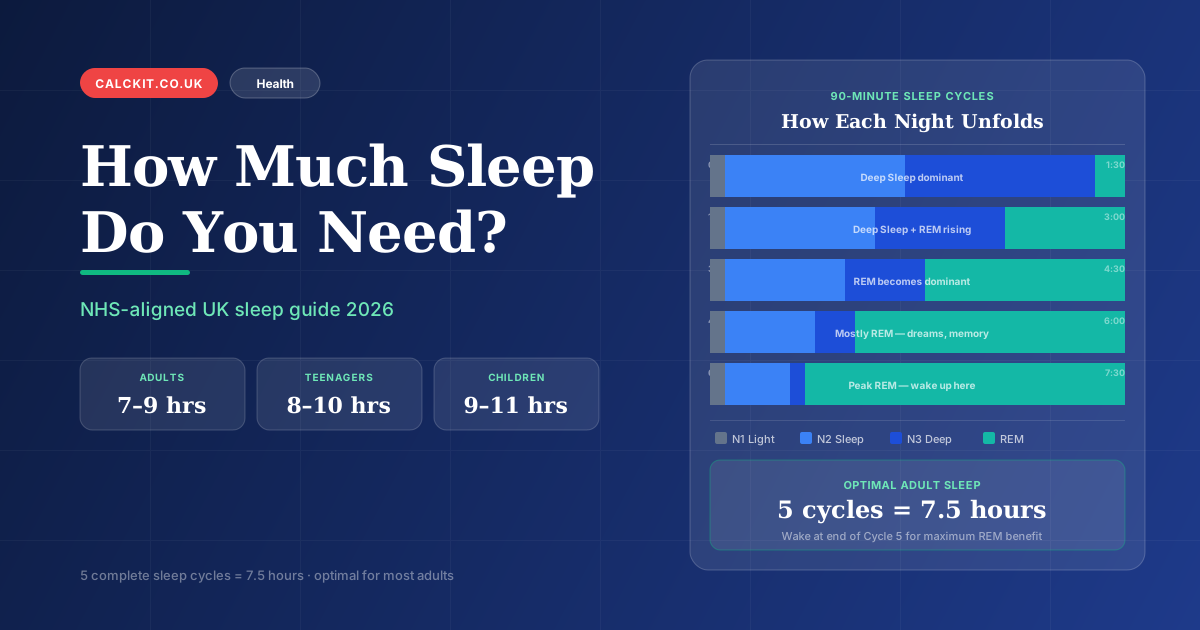
Sleep is not a uniform block of rest. It unfolds in 90-minute cycles, and each cycle moves through four distinct stages:
- N1 (light sleep) — the brief transition between wakefulness and sleep, lasting 1–7 minutes
- N2 (light sleep) — body temperature drops, heart rate slows, memory consolidation begins
- N3 (deep sleep / slow-wave sleep) — the most physically restorative stage; tissue repair, immune function, and physical recovery happen here
- REM sleep — brain activity increases, vivid dreaming occurs, and emotional memory is processed
One sleep cycle = ~90 minutes 5 complete cycles = 7.5 hours (optimal for most adults) 6 complete cycles = 9 hours
In a healthy night, deep sleep (N3) should make up roughly 20–25% of total sleep — around 1.5 to 2 hours in a 7.5-hour night. REM sleep should account for another 20–25%. If you wake feeling physically unrestored, you are likely cutting short the early deep-sleep cycles. If you wake feeling emotionally flat or mentally foggy, you are more likely cutting into REM.
The critical pattern: deep sleep (N3) dominates the first two cycles of the night. REM sleep dominates the later cycles — cycles 4 and 5 are mostly REM. This is why cutting sleep from 8 hours to 6 does not just remove 2 hours of rest. It removes most of your REM sleep, which handles emotional regulation, creativity, and memory consolidation.
Waking in the middle of a sleep cycle — rather than at the natural light-sleep end point — is also what causes that groggy, disoriented feeling (called sleep inertia). Timing your wake-up to the end of a complete cycle largely eliminates it.
How to use a sleep calculator
A sleep calculator finds your optimal bedtime by counting backwards in 90-minute sleep cycles from your target wake-up time. Here is the manual method:
- Subtract 15 minutes from your wake-up time (accounts for average time to fall asleep)
- Count back in 90-minute blocks to find optimal bedtimes
Example: wake up at 7:00am
| Bedtime | Cycles | Sleep duration |
|---|---|---|
| 9:45pm | 6 cycles | 9 hours |
| 11:15pm | 5 cycles | 7.5 hours ✓ recommended |
| 12:45am | 4 cycles | 6 hours |
| 2:15am | 3 cycles | 4.5 hours ✗ too little |
The calculator below handles this instantly — enter your alarm time and it shows every optimal bedtime for tonight.
😴What happens when you do not get enough sleep?
Sleep deprivation has measurable effects that begin within 24 hours and compound quickly.
Short-term (1–2 nights of poor sleep):
- Reaction time slows by up to 50%
- Working memory and concentration decline significantly
- Mood regulation deteriorates — emotional responses become disproportionate
- Hunger hormone (ghrelin) rises; satiety hormone (leptin) drops, making overeating more likely
Longer-term (weeks of chronic under-sleeping):
- Immune function weakens — infections are caught more easily and recovery slows
- Cortisol stays elevated, raising blood pressure and accelerating the stress response
- Insulin sensitivity decreases, raising the risk of type 2 diabetes
- Cardiovascular disease risk rises
- Mental health deteriorates — both anxiety and depression are independently linked to chronic sleep deprivation
The "I function fine on 6 hours" claim is almost always inaccurate. Research shows people who sleep 6 hours consistently rate their own performance as fine — while objective tests reveal significant impairment. The subjective feeling of adaptation is real; the actual cognitive recovery is not.
Can you catch up on lost sleep?
The short answer is: partially, but not quickly. Research shows that recovering from one hour of sleep debt takes up to four days of adequate sleep. A weekend lie-in after five short nights cannot undo the accumulated deficit — it reduces it, but does not erase it.
Weekend catch-up sleep also creates social jet lag — shifting your sleep timing later on Saturday and Sunday, which then makes it harder to fall asleep Sunday night and wakes you groggily on Monday. The circadian rhythm does not distinguish between "earned" and "bonus" sleep; it just sees an inconsistent schedule.
The most effective approach is not catching up after the fact but preventing accumulation. If you consistently fall short during the week, building in an extra 30–45 minutes on most nights beats attempting a 10-hour recovery at the weekend.
Can you sleep too much?
Oversleeping — regularly logging 9–10 or more hours as an adult — is associated with increased risk of cardiovascular disease and depression. However, it is important to distinguish cause from correlation: in most cases, excessive sleep is a symptom of an underlying condition (depression, sleep apnoea, chronic fatigue, thyroid disorders) rather than a cause of poor health in itself.
Occasional long nights after a period of deprivation are entirely normal and beneficial. If you find you consistently need 10 or more hours to function and still feel unrefreshed, it is worth discussing with a GP rather than trying to force yourself onto fewer hours.
Sleep by age: what changes over a lifetime
Children and teenagers need substantially more sleep because their brains and bodies are still developing. Sleep is when growth hormone is released and when new neural connections formed during learning are consolidated. Teenagers also experience a genuine biological shift in their circadian rhythm — melatonin is released later in the evening during adolescence, making it physiologically difficult to fall asleep before 11pm. This is not laziness; it is a hormonal change.
Adults in their 20s and 30s typically function well on consistent 7.5-hour nights (five complete sleep cycles). Individual variation exists — roughly 3% of people carry a genetic variant allowing full function on less than 6.5 hours, but they are genuinely rare.
Adults over 50 often notice sleep architecture changes: lighter sleep overall, more frequent night waking, and less time in deep sleep (N3). Total sleep need does not drop significantly, but sleep efficiency — the proportion of time in bed actually spent asleep — often does. Earlier wake times are common and do not necessarily mean insufficient sleep.
Older adults (65+) often need 7–8 hours but may take it in shorter blocks with an afternoon nap. The NHS advises maintaining consistent sleep and wake times regardless of age, as irregular sleep schedules fragment circadian rhythm.
Six evidence-based habits that improve sleep quality
The number of hours matters, but so does the quality of sleep within those hours:
1. Keep a consistent wake time — including weekends. Your circadian rhythm responds to consistency more than anything else. Sleeping in at weekends shifts your internal clock and creates social jet lag — the Monday-morning grogginess that comes from misaligning your schedule with your biology.
2. Avoid bright screens 60–90 minutes before bed. Blue light suppresses melatonin production. If screens are unavoidable, use night mode or blue-light-filtering glasses after 9pm.
3. Keep the bedroom cool — around 16–18°C. Core body temperature drops as you fall asleep. A cool room supports this process. A warm room delays sleep onset and reduces time in deep sleep.
4. Cut caffeine after 2pm. Caffeine has a half-life of 5–7 hours. A coffee at 3pm still carries half its caffeine load at 8–9pm when you are trying to wind down.
5. Avoid alcohol as a sleep aid. Alcohol may shorten the time taken to fall asleep, but it fragments sleep in the second half of the night and suppresses REM. The net result: longer time in bed, less restorative sleep, grogginess in the morning.
6. Exercise regularly, but not within 2–3 hours of bedtime. Regular physical activity deepens slow-wave sleep, but vigorous exercise too close to bedtime raises core temperature and delays sleep onset. Morning or afternoon exercise has the strongest positive effect on sleep quality.
7. Nap strategically — or not at all. A 20-minute nap before 3pm can restore alertness without entering deep sleep (which causes grogginess on waking). Naps longer than 30 minutes or taken after 3pm make it harder to fall asleep at night and can fragment your circadian rhythm. If you are struggling with nighttime sleep, cutting naps entirely is usually the first intervention worth trying.
How sleep connects to other health metrics
Sleep does not exist in isolation. Consistently poor sleep is directly linked to weight management, hydration balance, and overall health markers.
Sleep and hydration: poor sleep disrupts the production of vasopressin, the hormone that regulates water retention. This means mild dehydration overnight is more common after poor sleep — drinking enough water through the day supports both hydration and sleep recovery.
💧Sleep and BMI: chronic sleep deprivation is independently associated with higher BMI, separate from its effect on appetite and calorie intake. The relationship is bidirectional — higher BMI also disrupts sleep quality through conditions like sleep apnoea.
⚕️The bottom line
Most UK adults need 7–9 hours of sleep, and the evidence suggests a significant proportion consistently fall short. The total hours matter — but waking at the right point in a sleep cycle matters too. A 7.5-hour night timed to end on a complete cycle will almost always feel better than an 8-hour night interrupted mid-cycle.
Use the sleep calculator to find your optimal bedtime tonight. Set a consistent wake time, stick to it for two weeks, and track whether the timing change makes a noticeable difference before reaching for supplements or sleep aids.
😴Last updated June 2026. Sleep duration recommendations based on NHS and National Sleep Foundation guidelines.