
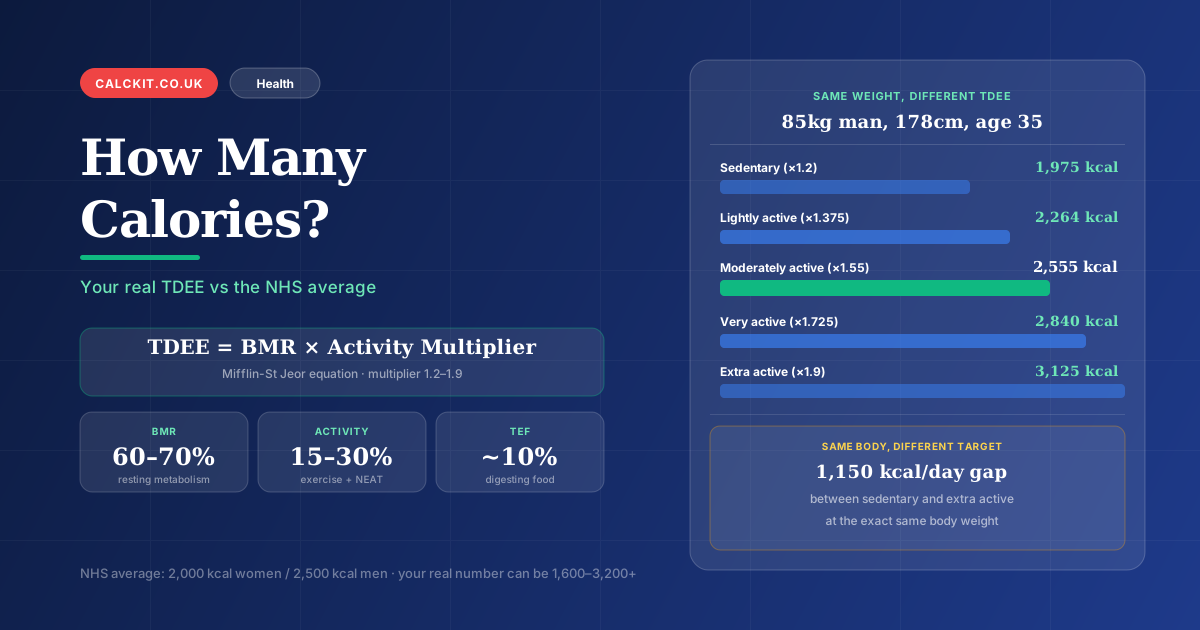
The NHS reference figure is 2,000 calories a day for women and 2,500 for men. But a 55kg, mostly sedentary office worker and an 85kg construction worker who lifts weights five times a week have wildly different real calorie needs — potentially a 1,500-calorie gap between them. The NHS number is a population average. Your TDEE is your actual number.
This guide explains exactly what TDEE is, how to calculate it properly, how UK guidance compares to your personalised figure, and how to use it to lose weight, gain muscle, or simply maintain — without guesswork.
⚡What is TDEE?
TDEE stands for Total Daily Energy Expenditure — the total number of calories your body burns across a full 24-hour period, including everything from breathing and digestion to a gym session.
TDEE is made up of three components:
| Component | What it is | Approximate share of TDEE |
|---|---|---|
| BMR (Basal Metabolic Rate) | Calories burned at complete rest to keep vital organs functioning | 60–70% |
| Physical activity | Exercise plus all daily movement (NEAT) | 15–30% |
| TEF (Thermic Effect of Food) | Energy used to digest, absorb, and process food | ~10% |
TDEE = BMR × Activity Multiplier
BMR is the foundation. Everything else is added on top of it based on how much you move.
BMR vs TDEE vs "calorie calculator" — clearing up the confusion
These three terms get used interchangeably online, which causes genuine confusion:
- BMR (Basal Metabolic Rate) — calories burned at complete rest. This is the smallest number. You would burn roughly this many calories lying in bed all day doing nothing.
- TDEE (Total Daily Energy Expenditure) — BMR plus activity and digestion. This is your actual maintenance calorie number — what keeps your weight stable.
- "Calorie calculator" — a general term that usually calculates TDEE, but sometimes refers to a simpler estimate without the activity multiplier step. CalcKit's calorie calculator and TDEE calculator use the same underlying Mifflin-St Jeor methodology — the TDEE calculator additionally breaks out the BMR and activity components separately.
The number that matters for weight management is TDEE, not BMR. If you only look at BMR and eat that amount, you will lose weight far faster than intended — because BMR ignores the calories you burn through daily movement and exercise.
🔥The Mifflin-St Jeor formula
The Mifflin-St Jeor equation is the most widely validated formula for estimating BMR, and is the one used by CalcKit's calculators.
Men: BMR = (10 × weight in kg) + (6.25 × height in cm) − (5 × age) + 5 Women: BMR = (10 × weight in kg) + (6.25 × height in cm) − (5 × age) − 161
Worked example — 30-year-old man, 80kg, 180cm:
- (10 × 80) = 800
- (6.25 × 180) = 1,125
- (5 × 30) = 150
- BMR = 800 + 1,125 − 150 + 5 = 1,780 kcal/day
This is his BMR — the calories he would burn doing nothing at all. His actual TDEE depends on the activity multiplier applied next.
Activity multipliers — and how to assess yours accurately
| Activity level | Multiplier | Description |
|---|---|---|
| Sedentary | 1.2 | Desk job, little to no exercise |
| Lightly active | 1.375 | Light exercise 1–3 days/week |
| Moderately active | 1.55 | Moderate exercise 3–5 days/week |
| Very active | 1.725 | Hard exercise 6–7 days/week |
| Extra active | 1.9 | Very hard exercise, physical job, or training twice a day |
Continuing the example: at "moderately active" (1.55), TDEE = 1,780 × 1.55 = 2,759 kcal/day.
The biggest source of error in TDEE calculations is not the formula — it's choosing the wrong activity level. Research and practitioner experience consistently show that roughly 80% of people overestimate their activity level by one full category.
A more honest self-assessment checklist:
- Do you have a desk job and drive or sit for most commutes? → Start at sedentary, even if you go to the gym 2–3 times a week. A gym session does not offset 8 hours of sitting.
- Do you walk for transport, stand for parts of your job, or do light housework regularly, on top of occasional exercise? → Lightly active
- Is your job physically active (on your feet most of the day, regular lifting/moving) OR do you train hard 4+ times a week consistently? → Moderately active
- Do you have a physically demanding job AND train hard most days? → Very active or extra active
If in doubt, choose the lower category. It is far easier to add 100–150 calories after 2 weeks of slower-than-expected progress than to keep guessing why a diet "isn't working."
TDEE reference table — by weight and activity level
These figures use an average height and a 35-year-old, illustrating how much activity level alone changes TDEE for the same body weight:
| Weight | Sedentary (1.2) | Moderately active (1.55) | Very active (1.725) |
|---|---|---|---|
| 60kg (woman, 165cm) | ~1,550 kcal | ~2,000 kcal | ~2,230 kcal |
| 70kg (woman, 165cm) | ~1,670 kcal | ~2,160 kcal | ~2,400 kcal |
| 70kg (man, 178cm) | ~1,800 kcal | ~2,325 kcal | ~2,590 kcal |
| 85kg (man, 178cm) | ~1,975 kcal | ~2,555 kcal | ~2,840 kcal |
| 100kg (man, 178cm) | ~2,150 kcal | ~2,785 kcal | ~3,095 kcal |
The gap between sedentary and very active at the same body weight is consistently 600–950 calories per day — roughly equivalent to an extra full meal. This is why two people of the same weight can have completely different "correct" calorie targets.
⚡How UK NHS guidance compares to your personal TDEE
The NHS reference values commonly cited are approximately 2,000 kcal/day for women and 2,500 kcal/day for men. These figures come from population-level dietary reference values, not individual calculations — they assume an average body size and a moderate activity level across the whole adult population.
Why your number is probably different:
- A petite, mostly sedentary woman might have a TDEE closer to 1,600 kcal — eating to the NHS "2,000" reference would cause weight gain over time
- A tall, active man working a physical job might have a TDEE above 3,000 kcal — eating to the NHS "2,500" reference would cause unintended weight loss
- The NHS figures are useful for food labelling and population health messaging (hence "Reference Intake" on UK food packaging), but were never intended as personalised targets
Use the NHS figures as a sanity check, not a target. If your calculated TDEE is wildly different from 2,000/2,500, that's expected — it reflects your actual body and activity level, which the population average cannot capture.
Using TDEE for weight loss, maintenance, or muscle gain
| Goal | Calorie target | Typical result |
|---|---|---|
| Weight loss (moderate) | TDEE − 250 to 500 kcal (15–25% deficit) | 0.25–0.5kg/week loss |
| Weight loss (aggressive) | TDEE − 500 to 750 kcal (25–35% deficit) | 0.5–0.75kg/week loss, higher muscle loss risk |
| Maintenance | TDEE (±100 kcal) | Stable weight |
| Muscle gain (lean bulk) | TDEE + 200 to 350 kcal (5–10% surplus) | Slow, mostly muscle gain |
| Muscle gain (faster bulk) | TDEE + 400 to 500 kcal | Faster gain, more fat alongside muscle |
What a 500-calorie deficit actually looks like in practice:
- Skip one 500ml regular cola (210 kcal) AND a chocolate bar (250 kcal) — covers most of it
- Swap a creamy pasta dish for a tomato-based one (~300–400 kcal saved) plus a 20-minute walk (~100 kcal)
- Reduce portion sizes by roughly 20% across all meals, rather than cutting out entire meals
A deficit doesn't require eliminating entire food groups — it is the accumulated effect of small, sustainable changes across the day rather than one dramatic restriction.
A 500 kcal/day deficit produces roughly 0.45kg of fat loss per week (3,500 kcal ≈ 0.45kg of fat). This is an approximation — water retention, glycogen stores, and measurement timing cause week-to-week fluctuation that doesn't always match the maths exactly.
Metabolic adaptation — why your TDEE drops while dieting
TDEE is not fixed. As you lose weight, your TDEE genuinely decreases — for two compounding reasons:
- A smaller body burns fewer calories at rest. Less body mass (both fat and muscle) requires less energy to maintain. This is mechanical and expected.
- Adaptive thermogenesis. Beyond the expected drop from reduced body size, the body can reduce its energy expenditure by an additional 5–15% during sustained dieting — through subtle reductions in NEAT, slightly lower body temperature, and hormonal changes (reduced thyroid hormone, leptin) that all act to conserve energy.
This is why a calorie deficit that worked perfectly for the first 6 weeks of a diet can stop producing results by week 10, even with no change in food intake or exercise — the TDEE itself has fallen below what it was when you started.
What to do about it: recalculate TDEE every 5–10kg of weight lost, and expect to need to reduce intake further (or increase activity) at intervals throughout a long diet, rather than expecting a single calculated number to hold for months.
NEAT — the most overlooked lever for daily calorie burn
NEAT (Non-Exercise Activity Thermogenesis) is energy burned through everything that isn't formal exercise — walking around, fidgeting, taking the stairs, standing instead of sitting, doing housework, carrying shopping.
NEAT is remarkably variable between individuals of similar size and can differ by up to 2,000 calories per day between a naturally fidgety, active person and a naturally still one — even without either of them doing any formal exercise. This is one of the largest unexplained sources of variation in why some people "can eat more and stay lean."
Practical ways to increase NEAT:
- Take phone calls standing up or walking
- Use stairs instead of lifts for anything under 4–5 floors
- Park further away or get off public transport one stop early
- Stand or pace during TV adverts rather than staying seated
- Take a 10-minute walk after meals (also helps blood sugar control)
- Use a standing desk for part of the working day if available
Unlike formal exercise, NEAT activities are low-fatigue and easy to sustain daily — which makes them a genuinely effective lever for increasing TDEE without the recovery demands of additional training.
How often to recalculate your TDEE
Recalculate your TDEE:
- Every 5–10kg of weight change (up or down)
- Every 4–8 weeks if actively dieting or bulking, even without a major weight change yet
- After any significant change in activity level (new job, injury, training programme change)
Using a TDEE figure calculated when you were 10kg heavier (or before you started training 5 days a week) is one of the most common reasons people report unexplained weight loss plateaus or unexpected weight gain despite "eating the same as always."
⚕️Frequently Asked Questions
Is the Mifflin-St Jeor formula the most accurate one?
Among formulas that don't require body fat percentage, Mifflin-St Jeor is generally considered the most accurate for the general population, validated against measured energy expenditure across multiple studies. The Katch-McArdle formula can be slightly more accurate for individuals who know their body fat percentage, particularly very lean or very muscular people, since it accounts for lean body mass directly rather than estimating it from height and weight.
Why do two people with the same TDEE lose weight at different rates on the same deficit?
Individual variation in NEAT, hormonal factors, sleep quality, stress levels, and even gut microbiome composition all affect real-world results beyond the basic calorie maths. TDEE calculations provide a strong starting estimate, but expect to need to adjust based on 2–4 weeks of actual tracked results rather than treating the initial number as exact.
Should I eat back calories burned during exercise?
If you selected an activity level that already accounts for your typical exercise routine, no — your TDEE already includes it. Eating back exercise calories on top of an activity-adjusted TDEE effectively cancels out your intended deficit. This mistake is common among people using fitness trackers that separately report "calories burned" for a workout already factored into their TDEE multiplier.
Does TDEE matter if I'm not trying to lose or gain weight?
Yes — knowing your TDEE helps you maintain a stable weight rather than gradually drifting up or down over months without noticing. Many people who say they "don't diet" are simply eating close to their TDEE through habit; understanding the number explicitly makes it easier to course-correct quickly if your weight starts trending in an unwanted direction.
The bottom line
TDEE is the calorie number that actually matters for managing your weight — not BMR, and not a generic NHS population average. Calculate it using the Mifflin-St Jeor formula, be honest (or slightly conservative) about your activity level, and adjust your intake based on 2–4 weeks of real results rather than the number alone. Recalculate periodically as your weight and activity change, since TDEE is a moving target, not a fixed one.
⚡Last updated June 2026. Calorie and TDEE figures based on the Mifflin-St Jeor equation and NHS dietary reference values. This guide provides general information, not medical advice — consult a GP or registered dietitian for personalised guidance.