
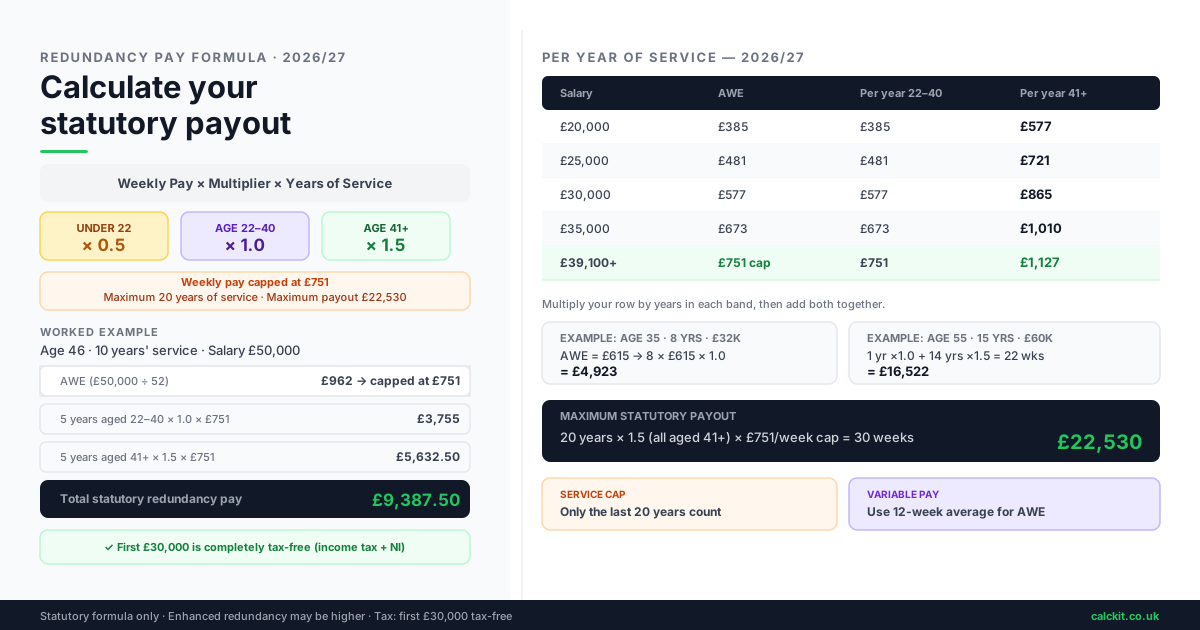
Statutory redundancy pay is calculated using three inputs: your weekly pay (capped at £751), how long you have worked for the employer (capped at 20 years), and your age when you worked each year. The formula produces a number of weeks' pay, and that figure is your statutory entitlement.
📋The formula
Redundancy pay = weekly pay × age multiplier × years of service
The age multiplier changes in three bands:
| Age band | Multiplier | Weeks earned per year |
|---|---|---|
| Under 22 | × 0.5 | Half a week's pay |
| 22 to 40 | × 1.0 | One week's pay |
| 41 and over | × 1.5 | One and a half weeks' pay |
Two caps apply regardless of your inputs:
- Weekly pay cap: £751 from 6 April 2026
- Service cap: Maximum 20 years counts — earlier years are ignored
The highest possible statutory payout is £22,530 (30 weeks × £751), which requires 20 years of service all worked aged 41 or over at a salary above the cap.
Calculating your average weekly earnings
Your average weekly earnings (AWE) is your annual salary divided by 52.
| Annual salary | AWE | Capped? |
|---|---|---|
| £20,000 | £385 | No |
| £25,000 | £481 | No |
| £30,000 | £577 | No |
| £35,000 | £673 | No |
| £39,100 | £752 → £751 | Capped at £751 |
| £50,000 | £962 → £751 | Capped at £751 |
| £80,000 | £1,538 → £751 | Capped at £751 |
Salaries of £39,100 or above (£751 × 52 = £39,052) hit the cap. Every pound above that threshold earns nothing extra.
For employees with variable pay — shift work, guaranteed overtime, or commission — the AWE uses the average of the 12 weeks before notice was given.
Splitting years across age bands
If you have worked past your 41st or 22nd birthday, your years of service split across two or three bands. Work backwards from your current age:
Worked example — age 46, 10 years, £50,000 salary:
| Step | Calculation |
|---|---|
| AWE | £50,000 ÷ 52 = £962 → capped at £751 |
| Years aged 41+ | 46 − 41 = 5 years × 1.5 = 7.5 weeks |
| Years aged 22–40 | 10 − 5 = 5 years × 1.0 = 5.0 weeks |
| Total weeks | 7.5 + 5.0 = 12.5 weeks |
| Redundancy pay | 12.5 × £751 = £9,387.50 |
Worked example — age 35, 8 years, £32,000 salary:
| Step | Calculation |
|---|---|
| AWE | £32,000 ÷ 52 = £615 |
| Years aged 22–40 | All 8 years fall in this band |
| Total weeks | 8 × 1.0 = 8 weeks |
| Redundancy pay | 8 × £615 = £4,923 |
Worked example — age 55, 20 years (capped), £60,000 salary:
| Step | Calculation |
|---|---|
| AWE | £60,000 ÷ 52 = £1,154 → capped at £751 |
| Years aged 41+ | 55 − 41 = 14 years × 1.5 = 21 weeks |
| Years aged 22–40 | 20 − 14 = 6 years × 1.0 = 6 weeks |
| Total weeks | 21 + 6 = 27 weeks |
| Redundancy pay | 27 × £751 = £20,277 |
Per-year reference table
This table shows how much each year of service earns at different salaries. Multiply by your years in each band.
| Salary | AWE | Per year age 22–40 (×1.0) | Per year age 41+ (×1.5) |
|---|---|---|---|
| £20,000 | £385 | £385 | £577 |
| £25,000 | £481 | £481 | £721 |
| £30,000 | £577 | £577 | £865 |
| £35,000 | £673 | £673 | £1,010 |
| £39,100+ | £751 (cap) | £751 | £1,127 |
To use the table: find your salary row, identify how many years you worked in each age band, multiply, and add both figures. For a salary above £39,100, every row above that threshold gives the same answer.
📋The 20-year service cap in practice
Only the most recent 20 years of continuous employment count. If you have worked for the same employer for 25 years, the five earliest years are dropped. This means long-serving employees can hit the cap while still being paid less than the £22,530 maximum — if some of those 20 years were in lower age bands.
Example: Age 60, 20 years (capped), £45,000 salary, AWE = £751.
- Years in 41+ band: 60 − 41 = 19 years × 1.5 = 28.5 weeks
- Years in 22–40 band: 20 − 19 = 1 year × 1.0 = 1.0 week
- Total: 29.5 × £751 = £22,154.50
Tax treatment
Statutory redundancy pay is treated favourably for tax:
| Element | Tax treatment |
|---|---|
| Statutory redundancy (up to £30,000) | Completely tax-free — no income tax, no NI |
| Any enhanced redundancy (combined total below £30,000) | Also tax-free, within the same £30,000 limit |
| Amounts above £30,000 combined | Taxed as earnings at your marginal rate |
| Payment in lieu of notice (PILON) | Always taxable — does not count toward £30,000 |
Since the statutory maximum is £22,530, most employees receiving only the statutory minimum stay comfortably within the tax-free limit. If you receive enhanced pay that pushes the total above £30,000, only the excess is taxed.
Common calculation mistakes
Using an old weekly pay cap. The cap was £719 for 2024/25 and rose to £751 from 6 April 2026. If your employer uses last year's figure, your payment will be short by about 4.4%.
Including all service when over 20 years. Only the last 20 years count. Some employers pay on longer service by mistake — others mistakenly cap correctly but calculate the band split from the wrong starting year.
Treating the tax-free limit as the payment cap. The £30,000 tax-free threshold is a tax rule, not a cap on how much you can receive. Enhanced redundancy and statutory redundancy are added together for tax purposes.
Calculating AWE from take-home rather than gross. The formula uses your gross weekly pay before tax and NI, not your net pay.
Frequently Asked Questions
What if I am on garden leave — does that count toward service?
Yes. Garden leave is still employment: you remain on payroll, your service continues to accrue, and the period counts toward the 2-year qualifying threshold and toward the total years used in the calculation.
Can my employer pay me less than the statutory minimum?
No. The statutory formula is a legal floor. Any payment below the statutory entitlement is unlawful, and you have six months from your employment end date to bring a tribunal claim.
Does my redundancy payment affect my benefits?
Redundancy pay counts as capital for Universal Credit purposes. Capital between £6,000 and £16,000 reduces your UC award; above £16,000 it stops it entirely until the amount drops below the threshold. It does not affect contribution-based JSA immediately, but it may delay your UC entitlement if you have savings above the threshold. See the statutory redundancy pay guide for the full rules on benefits and what to do if your employer is insolvent.
Last updated November 2026. Figures use 2026/27 rates: £751/week cap, £22,530 maximum, effective from 6 April 2026.