
When Ahmed was called into a meeting on a Tuesday afternoon in February, he was given two choices: accept a voluntary redundancy package of £4,200, or risk being selected in the formal process. He had 9 years of service, was 38 years old, and earned £38,000 a year. His statutory entitlement was £6,578. The voluntary package was offering him £1,378 less than the legal minimum.
He didn't know that. He signed.
Redundancy is one of the few areas of employment law where employees consistently receive less than they're entitled to — not because employers break the law deliberately, but because most employees don't check the numbers. This guide walks through every figure you need to know before you sign anything.
📋What is redundancy pay?
Redundancy pay is compensation for losing your job because your role is no longer needed. It is not a goodwill gesture — it is a legal right for qualifying employees.
There are two types:
| Type | What it is | Who sets it |
|---|---|---|
| Statutory redundancy pay | The legal minimum, calculated using a fixed age-and-service formula | Parliament — Employment Rights Act 1996 |
| Enhanced redundancy pay | Any amount above the statutory minimum | Your employer (contract, policy, or negotiation) |
Your contract may entitle you to enhanced pay automatically. If it doesn't, you can still negotiate — particularly if you are willing to sign a settlement agreement.
Who qualifies for statutory redundancy pay?
You qualify if all four of these apply:
- You are an employee — not a worker, contractor, or self-employed person
- You have at least 2 years' continuous service with the same employer
- Your role has been made redundant — not dismissed for misconduct, performance, or another reason
- You have not been offered and unreasonably refused suitable alternative employment
Zero-hours and agency workers usually do not qualify. Most are classified as workers rather than employees, which means they fall outside the statutory redundancy framework. The key test is whether you have "employee" status — check your contract. If it says you have an obligation to personally perform the work and your employer has obligations to give you work, you may be an employee regardless of what the contract calls you.
TUPE transfers: If your employer was sold or taken over, your service with the previous employer counts in full. The new employer inherits your redundancy liability.
How is redundancy pay calculated?
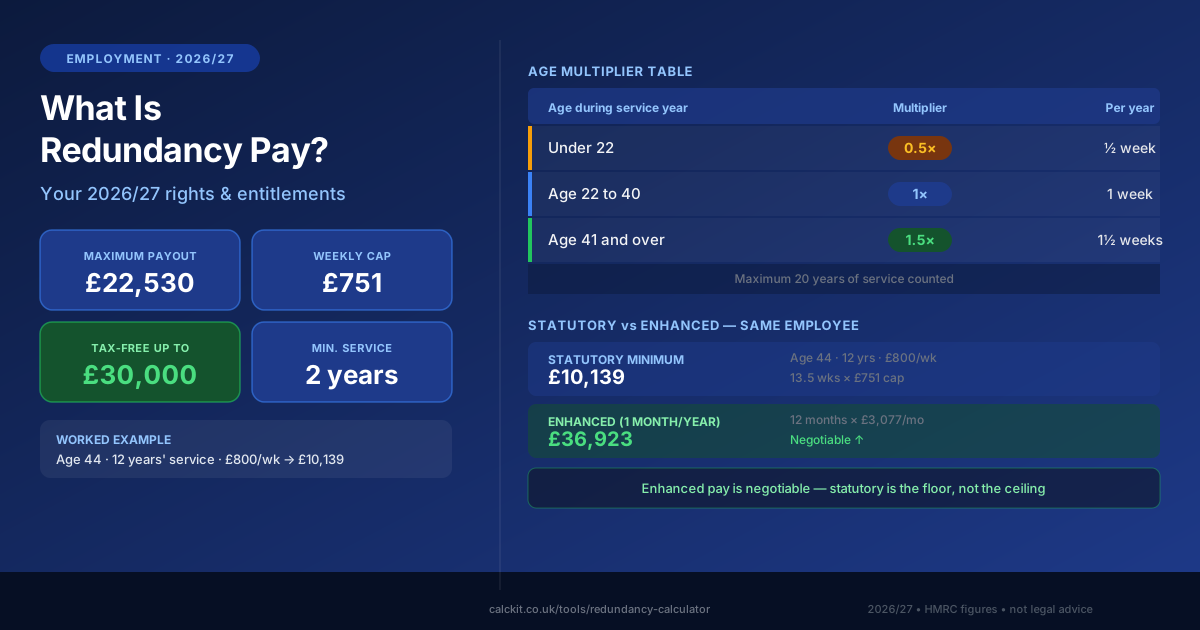
The calculation uses your age during each year of service, the number of qualifying years (capped at 20), and your weekly pay before tax (capped at £751 in 2026/27).
Age multipliers per year of service:
| Age during that year | Weeks of pay per year |
|---|---|
| Under 22 | 0.5 weeks |
| 22 to 40 | 1 week |
| 41 and over | 1.5 weeks |
The formula: total weeks (from age bands) × weekly pay (capped at £751) = statutory redundancy pay
Quick example: Sophie is 44, has 12 years' service, and earns £800/week.
- 3 years worked aged 41–44: 3 × 1.5 = 4.5 weeks
- 9 years worked aged 32–41: 9 × 1 = 9 weeks
- Total: 13.5 weeks × £751 (cap applied) = £10,138.50
For the full calculation — including how the age-band split works when your service crosses your 41st birthday — see our statutory redundancy pay guide and use the calculator below to get your precise figure.
📋Statutory vs enhanced redundancy: what's typical?
Enhanced redundancy pay is common in the public sector, large corporates, and heavily unionised workplaces. In smaller businesses it is less common — but not unheard of when an employer wants to avoid an employment tribunal or maintain goodwill.
Typical enhanced structures:
| Approach | How it works | Example |
|---|---|---|
| Multiplier on statutory | Pays 2× or 3× the statutory amount | Statutory = £8,000 → enhanced = £16,000 |
| Uncapped weekly pay | Removes the £751 cap | Uses actual weekly pay instead |
| Ex-gratia payment | Flat sum on top of statutory | Statutory + £5,000 lump sum |
| Contractual redundancy | Set formula in your contract | Often 1 month per year of service |
If your contract includes a redundancy clause, read it carefully before accepting any offer. Your employer must honour whatever your contract says — the statutory minimum is a floor, not a ceiling they can substitute.
The £30,000 tax-free threshold — and the PILON trap
The first £30,000 of a genuine redundancy payment — combining both statutory and enhanced elements — is completely free of income tax and National Insurance.
Amounts above £30,000 are taxed at your marginal income tax rate (20%, 40%, or 45% depending on your total income that year).
What counts toward the £30,000:
- Statutory redundancy pay ✅
- Enhanced redundancy pay ✅
- Ex-gratia payments that are genuinely a redundancy payment ✅
What does NOT count:
- Payment in lieu of notice (PILON) ❌ — always fully taxable as earnings
- Holiday pay owed ❌ — fully taxable
- Commission or bonuses owed ❌ — fully taxable
The PILON trap catches many employees. If your employer pays your notice period as a lump sum instead of asking you to work it out, that amount is taxable income — it does not reduce your £30,000 allowance. So if your redundancy package includes "£6,000 statutory redundancy + £4,000 PILON", only the £6,000 counts toward the tax-free threshold. The £4,000 is taxed as normal earnings.
🏛How to negotiate a better redundancy package
Negotiation is more common than most employees realise. Employers have strong incentives to agree a higher payment if you are prepared to sign a settlement agreement — it closes off employment tribunal claims and avoids costly litigation.
When you have leverage:
- Your employer wants a quick process (no formal selection, no risk of challenge)
- Your role is genuinely unique and knowledge transfer will take time
- You have evidence of unfair selection or a procedural failure in the redundancy process
- You have a potential unfair dismissal claim, discrimination claim, or whistleblowing concern that could be worth more than the enhanced offer
What to ask for:
Start from the statutory calculation, then ask for a multiplier or additional sum. A common ask is 1 month per year of service (in place of the statutory formula). Employers in strong financial positions often agree to 1–3 months' extra salary on top of statutory as part of a settlement agreement.
Settlement agreements: These are legally binding contracts where you waive the right to bring most employment claims in exchange for a payment. You must receive independent legal advice from a qualified solicitor before a settlement agreement is valid — your employer is usually required to contribute toward your legal fees (typically £300–£500).
Before signing, check whether the agreement covers:
- All potential claims (unfair dismissal, discrimination, breach of contract)
- Post-employment restrictions (non-compete clauses, garden leave)
- References — get the exact wording agreed in the settlement
- Confidentiality — standard, but understand what you can and cannot say
One thing most employees miss: PILON can increase your redundancy entitlement
If your employer terminates your contract immediately and pays you in lieu of notice instead of letting you work out your notice period, your "relevant date" — the date used to calculate your redundancy entitlement — shifts forward by your statutory notice period.
Example: David has 8 years' service. His statutory notice is 8 weeks. His employer pays him PILON instead of notice.
His relevant date moves forward by 8 weeks, adding one more qualifying year (or part-year) of service to his redundancy calculation. If he was within a year of a birthday that would move him into the 41+ bracket, this could increase his redundancy pay by 50% of a week's pay.
This is easy to miss. If your employer pays PILON, ask them to recalculate your redundancy using the shifted relevant date.
What happens to your pension?
You can pay some or all of your redundancy payment into your pension — and this is one of the most tax-efficient things you can do if your payment is large.
Why it works: pension contributions reduce your taxable income. If your redundancy package exceeds £30,000, the excess is taxable. Contributing the excess directly into your pension can eliminate that tax bill entirely.
2026/27 annual allowance: £60,000 (you can also carry forward unused allowance from the previous 3 years).
Example: Mark receives £45,000 in enhanced redundancy pay. The first £30,000 is tax-free. The remaining £15,000 would normally be taxed at 40% = £6,000 tax bill. If Mark contributes £15,000 to his pension, the tax liability disappears.
Note: once employment ends, employer contributions under salary sacrifice arrangements stop. You can make personal contributions but not employer ones.
Universal Credit after redundancy
If your redundancy payment gives you capital above £6,000, it affects your Universal Credit claim.
| Capital | UC impact |
|---|---|
| Under £6,000 | No impact |
| £6,001–£16,000 | Each £250 above £6,000 reduces UC by £4.35/month (tariff income rule) |
| Over £16,000 | No UC entitlement at all |
Unlike leaving a job voluntarily, there is no waiting period before you can claim UC after redundancy. You can apply on the day your employment ends.
If your redundancy payment exceeds £16,000 but you need UC, consider:
- Paying off debts (credit cards, loans)
- Contributing to your pension (reduces assessable capital)
- Pre-paying rent or other household costs
Once your capital falls below £16,000 through legitimate spending, UC entitlement resumes.
🐷Step-by-step: what to do when facing redundancy
- Get the calculation in writing — your employer must provide a written breakdown of how your redundancy pay was calculated
- Verify it — use CalcKit's redundancy calculator to check their figures against the statutory formula
- Check your contract — look for any enhanced redundancy clause, notice provisions, or bonus entitlements
- Do not sign anything immediately — you have time; a settlement agreement requires independent legal advice before it's valid
- Seek legal advice — ACAS helpline (0300 123 1100) is free; a solicitor review of a settlement agreement costs £300–£500, usually funded by your employer
- Consider negotiating — especially if your employer wants speed or you have a potential claim
- Claim Universal Credit — apply on the day employment ends, before your capital changes
- Think about your pension — if your payment exceeds £30,000, a pension contribution can save substantial tax
- Request indexing — ask for a reference in writing, agreed as part of the settlement if possible
- Tribunal deadline — if anything goes wrong, you have 6 months minus 1 day from your end date to file a claim; do not let this lapse
Key 2026/27 figures at a glance
| Figure | Amount |
|---|---|
| Weekly pay cap | £751 |
| Maximum statutory redundancy pay | £22,530 |
| Years of service counted | Up to 20 |
| Tax-free threshold | £30,000 |
| Pension annual allowance | £60,000 |
| UC capital lower threshold | £6,000 |
| UC capital upper threshold (no UC) | £16,000 |
| Tribunal claim deadline | 6 months minus 1 day |
Last updated October 2026. Statutory redundancy pay rates from HMRC 2026/27 (effective 6 April 2026). Universal Credit capital rules from DWP 2026/27. This article covers England, Wales, and Scotland — Northern Ireland redundancy legislation differs in some respects. For personal employment law or tax advice, consult ACAS, a qualified employment solicitor, or a chartered accountant.