
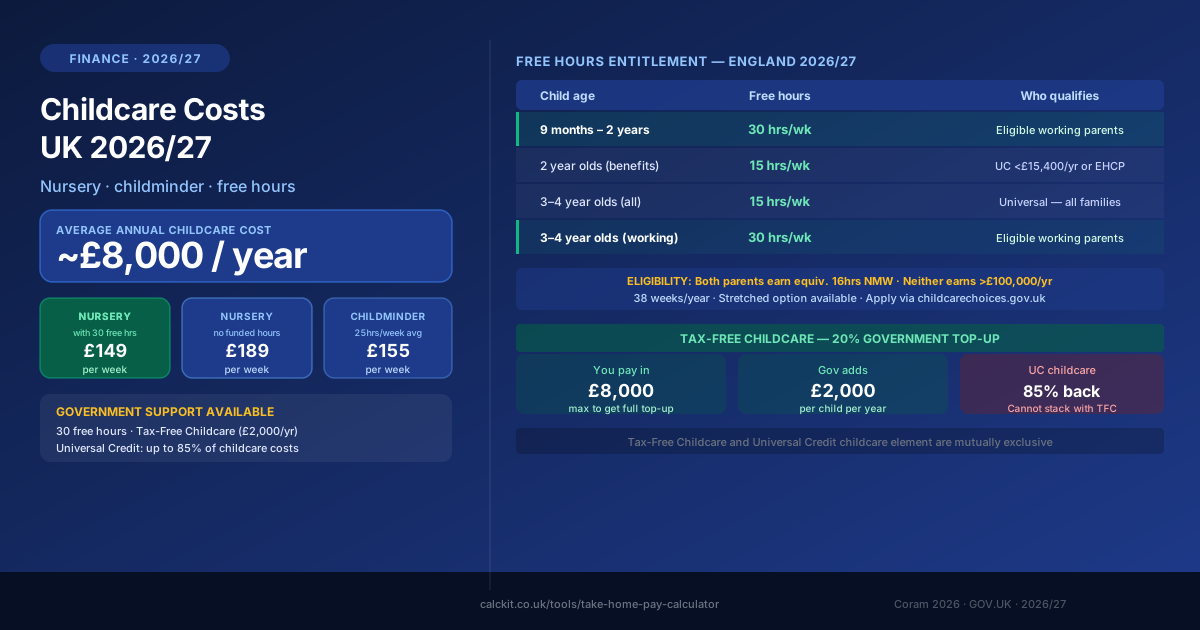
A full-time nursery place for a child under two costs close to £8,000 a year in the UK — before any government support. That figure hasn't changed dramatically since 2020, but what has changed is how much of it the government now covers for working parents.
Since September 2025, eligible working parents in England can claim 30 free hours per week from when their child turns 9 months old — right through to school age. For a family that qualifies, this transforms the bill. For a family that doesn't, the full rack rate still applies.
This guide sets out exactly what childcare costs in 2026/27, what support is available, and — critically — what you'll actually pay after applying everything you're entitled to.
💷Average Childcare Costs UK 2026
Nursery fees
| Child age | England (with funded hours) | England (without funded hours) | Scotland | Wales |
|---|---|---|---|---|
| Under 2 (full-time, 50hr/wk) | ~£149/week | ~£176–£189/week | Higher than England | Higher than England |
| 3–4 year olds | Significant reduction with 30hr entitlement | ~£176/week | Covered by 30hr scheme | 10hrs universal; rest charged |
Source: Coram Family and Childcare Survey 2026. "With funded hours" assumes eligible working parents applying 30-hour entitlement.
The annual spend on childcare across the UK averages close to £8,000 per year per child for families using full-time care — though this varies enormously based on age, location, and entitlement status.
Childminder rates
A childminder caring for a child under two for 25 hours per week costs around £7,764 per year (50 weeks) on average in England — roughly £155 per week or £6.20 per hour.
Hourly rates by region as a guide:
| Region | Childminder hourly rate |
|---|---|
| London | £7.00–£9.00/hr |
| South East / East of England | £6.00–£8.00/hr |
| Rest of England | £5.50–£7.00/hr |
| Scotland | £5.50–£7.50/hr |
| Wales | £5.00–£7.00/hr |
Rates are indicative; agree the exact rate with your childminder before starting.
After school clubs and holiday clubs
| Type | Typical cost |
|---|---|
| After school club (school-run) | £10–£20 per session |
| Breakfast club | £3–£8 per session |
| Holiday club / playscheme | £25–£50 per day |
| Wraparound care (before + after school) | £30–£50 per day |
After school and holiday club costs are not usually covered by the 30 free hours entitlement (which applies to early years only), but they can be paid for using Tax-Free Childcare.
Regional Costs in England
Childcare costs vary significantly across England. Based on 2024–2026 Coram data:
| Region | Average nursery cost (under 2, part-time) |
|---|---|
| London | Highest (~£158/week) |
| South East | Above average |
| East of England | Above average |
| East Midlands / West Midlands | Around average |
| North West | Around average |
| Yorkshire & Humberside | Lowest (~£97/week) |
If you're in London, childcare can cost 60% more than in Yorkshire for the same provision.
💰Government Support: What You Can Claim
1. The 30 Free Hours (England)
The biggest change in recent years. Since September 2025, eligible working parents in England can claim:
30 hours per week, 38 weeks per year — from the term after their child turns 9 months old until they start school.
Who qualifies:
- Both parents (or the sole parent) must each earn the equivalent of at least 16 hours per week at the National Minimum or Living Wage
- Neither parent can have an adjusted net income above £100,000 per year
- Your child must be living in England
How to apply: Through the government's Childcare Service at childcarechoices.gov.uk. You'll receive a code to give to your provider. Codes must be renewed every 3 months.
Important: The 30 hours covers 38 term-time weeks. It does not automatically cover 52 weeks. Ask your provider whether they offer a stretched option (same total hours spread over more weeks at fewer hours per week).
If you don't qualify for 30 hours:
All 3 and 4 year olds in England are entitled to 15 universal hours per week regardless of parental income or employment status.
Two-year-olds may also qualify for 15 hours if you receive Universal Credit with earnings below £15,400/year, or if your child has an Education, Health and Care (EHC) Plan.
2. Tax-Free Childcare
Available to working parents who are not on Universal Credit.
How it works:
- Open a childcare account at childcarechoices.gov.uk
- For every 80p you pay in, the government tops up 20p
- Maximum government top-up: £500 per quarter (£2,000 per year) per child
- Disabled children: £1,000 per quarter (£4,000 per year)
Example: You pay £8,000/year in nursery fees → you put in £6,400, government adds £1,600 → provider receives £8,000.
Who qualifies:
- Same working test as the 30 hours (16hr equivalent at NMW/NLW, under £100k income)
- Can be used for nurseries, childminders, after school clubs, holiday clubs — any Ofsted-registered provider
3. Universal Credit Childcare Element
If you're on Universal Credit, this is likely worth more than Tax-Free Childcare.
What you get:
- Up to 85% of registered childcare costs reimbursed
- Maximum per month: £1,014.63 for one child, £1,739.37 for two or more children
Key rules:
- You must be working (or starting work within a month)
- You pay the provider first, then claim it back — UC pays in arrears
- Report costs within 3 months of paying or you lose the entitlement
- Cannot be combined with Tax-Free Childcare — choose one
4. Scotland: 30 Hours for 3–4 Year Olds
Scotland provides 30 hours per week of free early learning and childcare for all 3 and 4 year olds — not just working parents. Some eligible 2 year olds also qualify, including looked-after children and those whose families receive certain benefits.
The scheme runs for 38 weeks (or equivalent stretched hours). Apply through your local council.
5. Wales: 10 Hours Universal + Flying Start
All 3 and 4 year olds in Wales receive 10 hours per week of free childcare. Working parents may access additional funded hours through local Flying Start and Childcare Offer schemes — up to 30 hours per week in some areas. Check with your local council for availability.
What Will You Actually Pay? Worked Examples
Example 1: Working parents, child aged 18 months (England)
- Full-time nursery (50hr/week): £189/week rack rate
- Apply 30 funded hours (38 weeks/year): saves ~£2,180/year
- Apply Tax-Free Childcare on remaining costs: government adds up to £2,000/year
- Estimated net annual cost: ~£4,000–£5,000/year (down from ~£9,800 unfunded)
Example 2: Non-working parent or income above £100k, child aged 2 (England)
- No 30 hours entitlement
- Part-time nursery (25hr/week): ~£94/week → ~£4,900/year
- Tax-Free Childcare not available (income test fails)
- Estimated net annual cost: ~£4,900/year at full rate
Example 3: Universal Credit family, child aged 3 (England)
- Child qualifies for 15 universal free hours (or 30 if parent is working)
- Remaining costs after free hours: ~£60/week
- UC childcare element covers 85%: family pays ~£9/week
- Estimated net annual cost: under £500
See your take-home pay to understand how childcare costs fit into your household budget.
🐷Can You Stack Multiple Types of Support?
| Combination | Allowed? |
|---|---|
| 30 free hours + Tax-Free Childcare | ✅ Yes — use TFC for hours beyond the funded entitlement |
| 30 free hours + Universal Credit childcare | ✅ Yes — UC covers costs beyond the free hours |
| Tax-Free Childcare + Universal Credit childcare | ❌ No — mutually exclusive, choose one |
| Child Benefit + any childcare support | ✅ Yes — Child Benefit is separate and can be claimed alongside |
| Salary sacrifice childcare vouchers (legacy) | ⚠️ Closed to new entrants since Oct 2018 — existing users can continue |
Planning Checklist
Before your child starts childcare:
- Check your entitlement at childcarechoices.gov.uk — enter your details to see what you qualify for
- Apply for your 30 hours code at least a month before the term starts — codes take time to process
- Open a Tax-Free Childcare account if you're not on UC — start saving early
- Ask providers whether they accept the funded hours and whether they offer stretched hours
- Budget for the gap — providers can charge "top-up" fees for meals, consumables, and hours beyond the funded entitlement
- Check your Universal Credit entitlement if your income is low — the childcare element can cover up to 85% of costs
Last updated October 2026. Childcare cost data from Coram Family and Childcare Survey 2026. Entitlement rules from GOV.UK / Childcare Choices. Figures correct for 2026/27 academic year. For personalised advice, contact your local Family Information Service.