
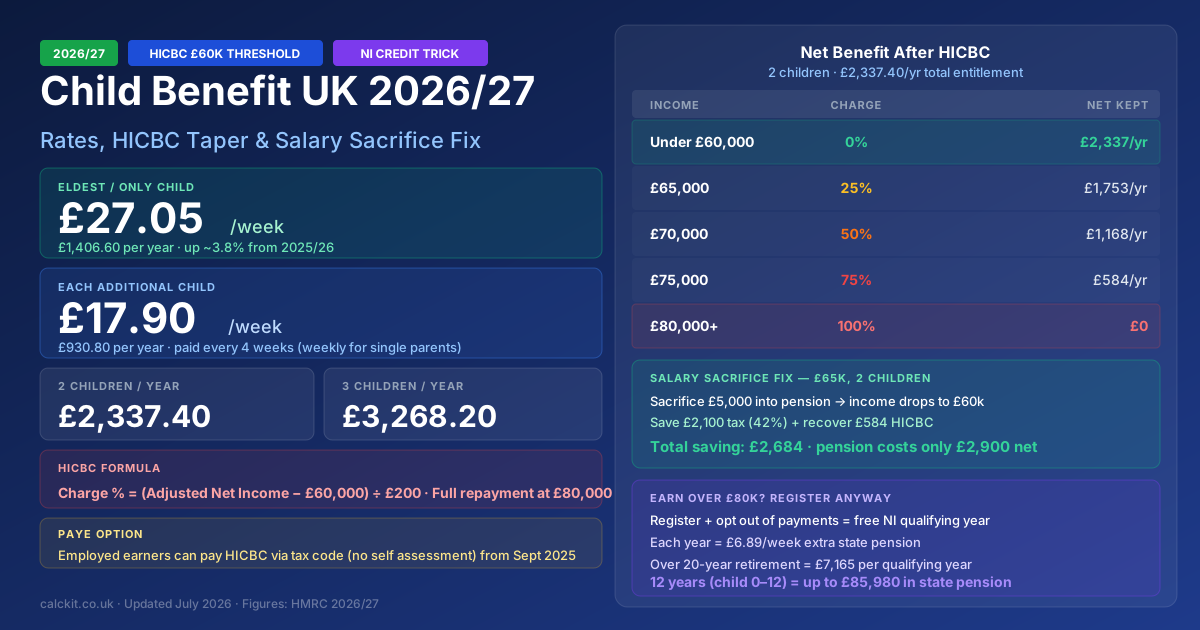
Child benefit is one of the few universal UK benefits that's paid regardless of whether you work — but the High Income Child Benefit Charge has quietly turned it into a means-tested payment for anyone with a higher earner above £60,000 in the household. The charge is steep, the maths is counterintuitive, and the fix is almost always worth running.
This guide covers the 2026/27 rates, exactly how the charge works, what you actually keep at every income level, and the salary sacrifice move that most affected families are missing.
🏛Child benefit rates 2026/27
| Child | Weekly | Annual |
|---|---|---|
| Eldest or only child | £27.05 | £1,406.60 |
| Each additional child | £17.90 | £930.80 |
Rates increased by approximately 3.8% from April 2026 under the benefits uprating, which followed CPI inflation measured in September 2025.
Total annual child benefit by number of children:
| Children | Weekly total | Annual total |
|---|---|---|
| 1 | £27.05 | £1,406.60 |
| 2 | £44.95 | £2,337.40 |
| 3 | £62.85 | £3,268.20 |
| 4 | £80.75 | £4,199.00 |
Payments are made every four weeks directly to the claimant's bank account (weekly if you are a single parent).
Child benefit is paid to one person only — usually the person most responsible for the child. For couples where both partners could claim, you choose who receives it. This matters for the High Income Child Benefit Charge, which is always paid by the higher earner, even if they're not the one claiming.
Who qualifies for child benefit?
You can claim child benefit if:
- You are responsible for a child under 16 (or under 20 if in approved education or training)
- You live in the UK
- Your child lives with you, or you are contributing at least the same amount as child benefit towards their upkeep
There is no income limit on the eligibility to claim — the High Income Child Benefit Charge is a separate mechanism that claws back payments through the tax system.
Age rules:
Child benefit normally stops on 31 August after your child's 16th birthday. It continues until age 20 if your child remains in approved full-time education (A-levels, Scottish Highers, NVQs up to Level 3) or approved training such as Foundation Apprenticeships. You must notify the Child Benefit Office when they leave education or training.
Twins and multiple births:
If you have twins first, one is treated as the eldest child (£27.05/week) and the other as an additional child (£17.90/week). If you already have older children, twins both receive the additional child rate.
The High Income Child Benefit Charge — how it actually works
The HICBC applies when the highest earner in a household (you or your partner) has an adjusted net income above £60,000. It is not based on combined income — one partner earning £70,000 while the other earns nothing triggers the charge; two partners each earning £59,000 do not.
The formula:
Charge (%) = (Adjusted Net Income − £60,000) ÷ £200
Charge (£) = Charge % × Total Annual Child Benefit
What is adjusted net income?
It is your total taxable income (salary, bonuses, rental income, investment income) minus:
- Pension contributions (employer contributions made via salary sacrifice reduce your salary, so they lower the figure automatically)
- Personal pension contributions (the gross amount, including basic rate tax relief)
- Gift Aid donations (the gross amount)
- Trading losses
Adjusted net income is not your take-home pay — it is the figure on which income tax is calculated, after deducting the items above.
What you actually keep: net child benefit by income
The table below shows what a family with two children (£2,337.40/year) keeps after the HICBC at different income levels.
| Adjusted net income | Charge % | Charge (£) | Net child benefit kept |
|---|---|---|---|
| Under £60,000 | 0% | £0 | £2,337/yr |
| £62,000 | 10% | £234 | £2,104/yr |
| £65,000 | 25% | £584 | £1,753/yr |
| £68,000 | 40% | £935 | £1,402/yr |
| £70,000 | 50% | £1,169 | £1,168/yr |
| £72,000 | 60% | £1,402 | £935/yr |
| £75,000 | 75% | £1,753 | £584/yr |
| £78,000 | 90% | £2,104 | £234/yr |
| £80,000+ | 100% | £2,337 | £0 |
The cliff between £60,000 and £80,000 is steep — a £1,000 pay rise in this range costs you £1,000 × 42% income tax + the HICBC effect. For families with multiple children, the effective marginal rate in this zone can exceed 70%.
For one child (£1,406.60/year):
| Adjusted net income | Net child benefit kept |
|---|---|
| Under £60,000 | £1,407/yr |
| £65,000 | £1,055/yr |
| £70,000 | £703/yr |
| £75,000 | £352/yr |
| £80,000+ | £0 |
For three children (£3,268.20/year):
| Adjusted net income | Net child benefit kept |
|---|---|
| Under £60,000 | £3,268/yr |
| £65,000 | £2,451/yr |
| £70,000 | £1,634/yr |
| £75,000 | £817/yr |
| £80,000+ | £0 |
The salary sacrifice fix — and why it's worth the maths
If your adjusted net income is between £60,000 and £80,000, salary sacrifice is the most efficient financial lever available to you. Every pound you redirect into a pension or electric car scheme reduces your adjusted net income — which reduces both your income tax bill and the HICBC.
How the saving compounds between £60,000 and £80,000:
| Sacrifice £ | Income tax saved (42%) | HICBC recovered (2 children) | Total saving |
|---|---|---|---|
| £1,000 | £420 | £117 | £537 |
| £3,000 | £1,260 | £351 | £1,611 |
| £5,000 | £2,100 | £584 | £2,684 |
| £10,000 | £4,200 | £1,169 | £5,369 |
These figures are for a higher-rate (40%+2% NI) taxpayer with two children. The total saving of £537 for every £1,000 sacrificed means the effective cost of putting £1,000 into your pension — in this income zone — is only £463.
Worked example: earning £65,000 with 2 children
Without sacrifice:
- Income tax + NI on full salary: standard rates
- HICBC: 25% × £2,337.40 = £584.35/year clawed back
- Net child benefit: £1,753/year
Sacrifice £5,000 into pension → adjusted net income drops to £60,000:
- HICBC: 0% — no charge, full £2,337.40/year retained
- Tax saved on sacrifice: £2,100 (42%)
- Total annual gain from the £5,000 sacrifice: £2,100 (tax) + £584 (HICBC) = £2,684
- Effective net cost of £5,000 in pension contributions: £5,000 - £2,100 = £2,900
Electric car salary sacrifice works the same way — the lease cost reduces your adjusted net income, and the BiK tax on an EV is only 3% of its P11D value in 2025/26 (rising to 4% from April 2026).
Not all salary sacrifice reduces adjusted net income in the same way. Standard employer pension contributions and salary sacrifice schemes do reduce it. Personal pension contributions via relief at source also reduce it (claim via self assessment). Salary sacrifice for non-pension benefits (cycle to work, EV car) works differently — check with HMRC or an accountant if your situation is complex.
Always register — even if you earn over £80,000
This is the point most higher earners miss.
If your income is above £80,000, claiming child benefit means you'll pay 100% of it back through the HICBC. Many families simply never claim. That is almost always the wrong decision.
You should always register for child benefit and then opt out of payments.
Here's why:
1. NI qualifying years for the claimant
For every year you have a child under 12 and are registered for child benefit, you receive a free NI qualifying year — even if you opted out of payments. Each qualifying year is worth up to £6.89 per week in additional state pension. Over a 20-year retirement that's approximately £7,165 per qualifying year.
A parent who doesn't register for child benefit for 12 years (child from birth to 12) forfeits up to 12 qualifying years — a potential loss of over £85,000 in state pension income over retirement. This is the single most expensive administrative mistake higher-earning families make.
2. Your child's National Insurance number
When you register for child benefit, HMRC automatically issues your child a National Insurance number just before their 16th birthday. Without child benefit registration, your child has to apply for an NI number manually — a slow process that can delay their first payslip.
How to opt out of payments without giving up the NI credit:
- Register for child benefit as normal
- Log into your personal tax account at gov.uk
- Select "opt out of child benefit payments"
- The NI qualifying year credit continues automatically
How to pay the HICBC — and avoiding penalties
If child benefit is being paid to you or your partner and the higher earner's income is above £60,000, the charge must be paid to HMRC.
From September 2025 — the PAYE option:
Employed higher earners can now elect to have the HICBC collected directly through their PAYE tax code, without needing to file a self assessment return. Look for the High Income Child Benefit Charge option in your personal tax account online.
Self assessment (for everyone else):
If you are self-employed, have rental income, or have other reasons to file self assessment, you declare the HICBC on your return in the "Additional information" section. The tax year runs 6 April to 5 April; the payment deadline is 31 January following the end of the tax year.
Penalties for non-payment:
If you fail to notify HMRC that you need to pay the HICBC, you face:
- A £100 initial penalty for not registering for self assessment on time
- A 30-day penalty (10% of tax owed)
- A 6-month penalty (further 10% of tax owed)
- Interest on the unpaid amount
HMRC regularly cross-references payroll data to identify families where the charge applies and enforcement has become more active in recent years.
Child benefit quick-reference 2026/27
| Figure | 2026/27 |
|---|---|
| First/only child weekly | £27.05 |
| Each additional child weekly | £17.90 |
| 2-child household annual | £2,337.40 |
| HICBC lower threshold | £60,000 |
| HICBC upper threshold | £80,000 |
| Charge rate | 1% per £200 above £60,000 |
| Higher-rate tax saving per £1 sacrificed | 42p (40% IT + 2% NI) |
| NI qualifying year value (20-yr retirement) | ~£7,165 |
| Child benefit continues to age | 16 (or 20 in approved education) |