
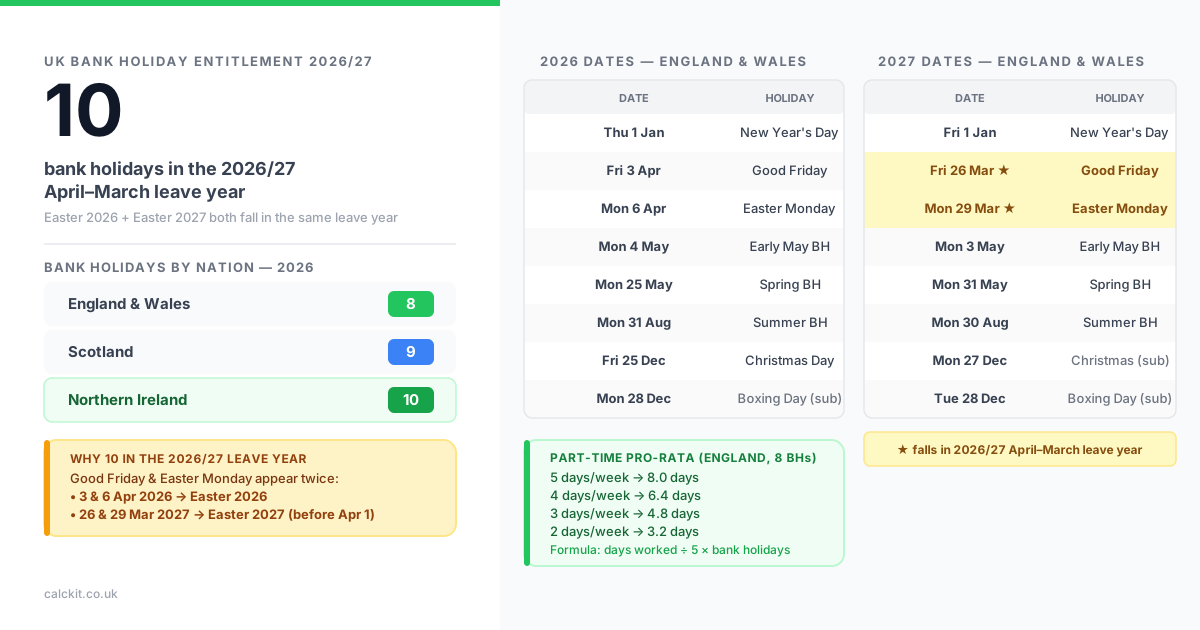
The 2026/27 leave year contains 10 bank holidays for employers running an April-to-March annual leave cycle — two more than the standard eight. It is a calendar quirk caused by Easter 2027 landing just before the leave year closes, not a change in the law.
Whether your employees (or you) actually receive those extra days as paid leave depends entirely on what the contract says. Here is everything you need to know, including all the dates for 2026 and 2027 across all four UK nations.
⏱️UK Bank Holidays 2026 — All Nations
England and Wales (8 bank holidays)
| Date | Day | Holiday |
|---|---|---|
| 1 January | Thursday | New Year's Day |
| 3 April | Friday | Good Friday |
| 6 April | Monday | Easter Monday |
| 4 May | Monday | Early May Bank Holiday |
| 25 May | Monday | Spring Bank Holiday |
| 31 August | Monday | Summer Bank Holiday |
| 25 December | Friday | Christmas Day |
| 28 December | Monday | Boxing Day (substitute) |
Boxing Day falls on Saturday 26 December 2026, so Monday 28 December is the substitute.
Scotland (9 bank holidays)
| Date | Day | Holiday |
|---|---|---|
| 1 January | Thursday | New Year's Day |
| 2 January | Friday | 2nd January |
| 3 April | Friday | Good Friday |
| 4 May | Monday | Early May Bank Holiday |
| 25 May | Monday | Spring Bank Holiday |
| 3 August | Monday | Summer Bank Holiday |
| 30 November | Monday | St Andrew's Day |
| 25 December | Friday | Christmas Day |
| 28 December | Monday | Boxing Day (substitute) |
Scotland has no Easter Monday. Its Summer Bank Holiday is the first Monday of August, not the last Monday.
Northern Ireland (10 bank holidays)
| Date | Day | Holiday |
|---|---|---|
| 1 January | Thursday | New Year's Day |
| 17 March | Tuesday | St Patrick's Day |
| 3 April | Friday | Good Friday |
| 6 April | Monday | Easter Monday |
| 4 May | Monday | Early May Bank Holiday |
| 25 May | Monday | Spring Bank Holiday |
| 13 July | Monday | Battle of the Boyne (substitute) |
| 31 August | Monday | Summer Bank Holiday |
| 25 December | Friday | Christmas Day |
| 28 December | Monday | Boxing Day (substitute) |
UK Bank Holidays 2027 — All Nations
England and Wales (8 bank holidays)
| Date | Day | Holiday |
|---|---|---|
| 1 January | Friday | New Year's Day |
| 26 March | Friday | Good Friday |
| 29 March | Monday | Easter Monday |
| 3 May | Monday | Early May Bank Holiday |
| 31 May | Monday | Spring Bank Holiday |
| 30 August | Monday | Summer Bank Holiday |
| 27 December | Monday | Christmas Day (substitute) |
| 28 December | Tuesday | Boxing Day (substitute) |
Christmas Day falls on Saturday 25 December 2027 and Boxing Day on Sunday, so both shift to the following weekdays.
Scotland (9 bank holidays in 2027)
All England and Wales dates, plus:
- 4 January (Monday) — 2nd January substitute (2 January 2027 falls on a Saturday)
- 30 November (Tuesday) — St Andrew's Day
(Scotland has no Easter Monday, so its count stays at 9.)
Northern Ireland (10 bank holidays in 2027)
All England and Wales dates, plus:
- 17 March (Wednesday) — St Patrick's Day
- 12 July (Monday) — Battle of the Boyne
The 10 Bank Holiday Issue — 2026/27 Leave Year
If your organisation runs a 1 April 2026 to 31 March 2027 leave year, the following 10 bank holidays fall within it for England and Wales:
| # | Date | Holiday |
|---|---|---|
| 1 | 3 April 2026 | Good Friday |
| 2 | 6 April 2026 | Easter Monday |
| 3 | 4 May 2026 | Early May Bank Holiday |
| 4 | 25 May 2026 | Spring Bank Holiday |
| 5 | 31 August 2026 | Summer Bank Holiday |
| 6 | 25 December 2026 | Christmas Day |
| 7 | 28 December 2026 | Boxing Day substitute |
| 8 | 1 January 2027 | New Year's Day |
| 9 | 26 March 2027 | Good Friday |
| 10 | 29 March 2027 | Easter Monday |
Both the 2026 Easter and the 2027 Easter land inside the same April-to-March leave year.
Does this mean employees get extra paid days?
It depends entirely on the contract wording. Three common scenarios:
| Contract wording | What happens in 2026/27 |
|---|---|
| "20 days' annual leave plus bank holidays" (no number stated) | 2 extra paid days — employees get all 10 bank holidays |
| "20 days' annual leave plus 8 bank holidays" (number specified) | No extra days — cap is fixed at 8 |
| "28 days' annual leave including bank holidays" | No extra days — bank holidays already counted within the total |
The third wording is the most common for minimum-entitlement contracts. The second is common in many standard employment contracts. The first is the one that creates an obligation to grant the extra days.
Employer action if your contract says "plus bank holidays" with no cap: You must allocate 10 paid bank holidays in the 2026/27 leave year. If the business needs to remain open on those extra Easter days, you can require employees to take the days as leave, but must give notice of at least twice as many days in advance as the leave you are requiring (Working Time Regulations 1998, Reg. 15).
Bank Holiday Entitlement for Part-Time Workers
Under the Part-Time Workers (Prevention of Less Favourable Treatment) Regulations 2000, part-time employees must receive the same bank holiday entitlement as full-time workers, calculated on a pro-rata basis.
Formula: bank holiday entitlement = bank holidays × (days worked per week ÷ 5)
| Working pattern | England/Wales (8 BHs) | Scotland (9 BHs) | N. Ireland (10 BHs) |
|---|---|---|---|
| 5 days/week (full-time) | 8.0 days | 9.0 days | 10.0 days |
| 4 days/week | 6.4 days | 7.2 days | 8.0 days |
| 3 days/week | 4.8 days | 5.4 days | 6.0 days |
| 2 days/week | 3.2 days | 3.6 days | 4.0 days |
| 1 day/week | 1.6 days | 1.8 days | 2.0 days |
Fractional entitlements (e.g. 4.8 days) should be rounded up, never down — rounding down shortchanges the employee.
What if a bank holiday falls on a day the part-timer doesn't work?
This is the most common source of disputes. If a part-time employee works Tuesday to Thursday and a bank holiday falls on Monday, their employer cannot count that Monday against their bank holiday entitlement. The employee must receive:
- A substitute day off, or
- The equivalent added to their annual leave balance
Failing to do this is unlawful less favourable treatment. It applies regardless of how many years the employee has worked.
💷Working on Bank Holidays
Is extra pay required by law?
No. UK law does not require enhanced rates (time and a half, double time, or any premium) for working a bank holiday. Whether you receive extra pay depends on:
- Your employment contract (check the bank holiday or public holiday clause)
- Your employer's policy or staff handbook
- Any collective agreement with a trade union
The only legal floor is that total annual pay across all hours worked, including bank holidays, must not fall below the applicable National Minimum Wage or National Living Wage rate.
Time off in lieu
If your contract entitles you to bank holidays as paid leave but you are required to work one, your employer must either:
- Pay you for the bank holiday at your normal rate and give you a replacement day off, or
- Pay a premium rate that compensates for both (as agreed in the contract)
The replacement day off cannot be unreasonably refused if you have requested it before the end of the leave year.
Your Bank Holiday Entitlement — Quick Summary
| Question | Answer |
|---|---|
| Is there a legal right to bank holidays off? | No — it depends on your contract |
| Statutory minimum annual leave (England) | 5.6 weeks = 28 days for a 5-day week |
| Can bank holidays count toward the 28 days? | Yes — and for many employees they do |
| Are part-timers entitled to bank holidays? | Yes, pro-rata |
| Is premium pay required for working a bank holiday? | No — law does not require it |
| What if a bank holiday falls on a non-working day? | Employee gets a replacement day or equivalent credit |
| Bank holidays in the 2026/27 leave year (Eng/Wales) | 10 (calendar quirk — see above) |
Last updated November 2026. Bank holiday dates for England, Wales, Scotland and Northern Ireland sourced from GOV.UK. Employment law references based on the Working Time Regulations 1998 and the Part-Time Workers (Prevention of Less Favourable Treatment) Regulations 2000. This article is for information only and does not constitute legal advice. For specific employment queries, contact ACAS (acas.org.uk) or a qualified employment solicitor.